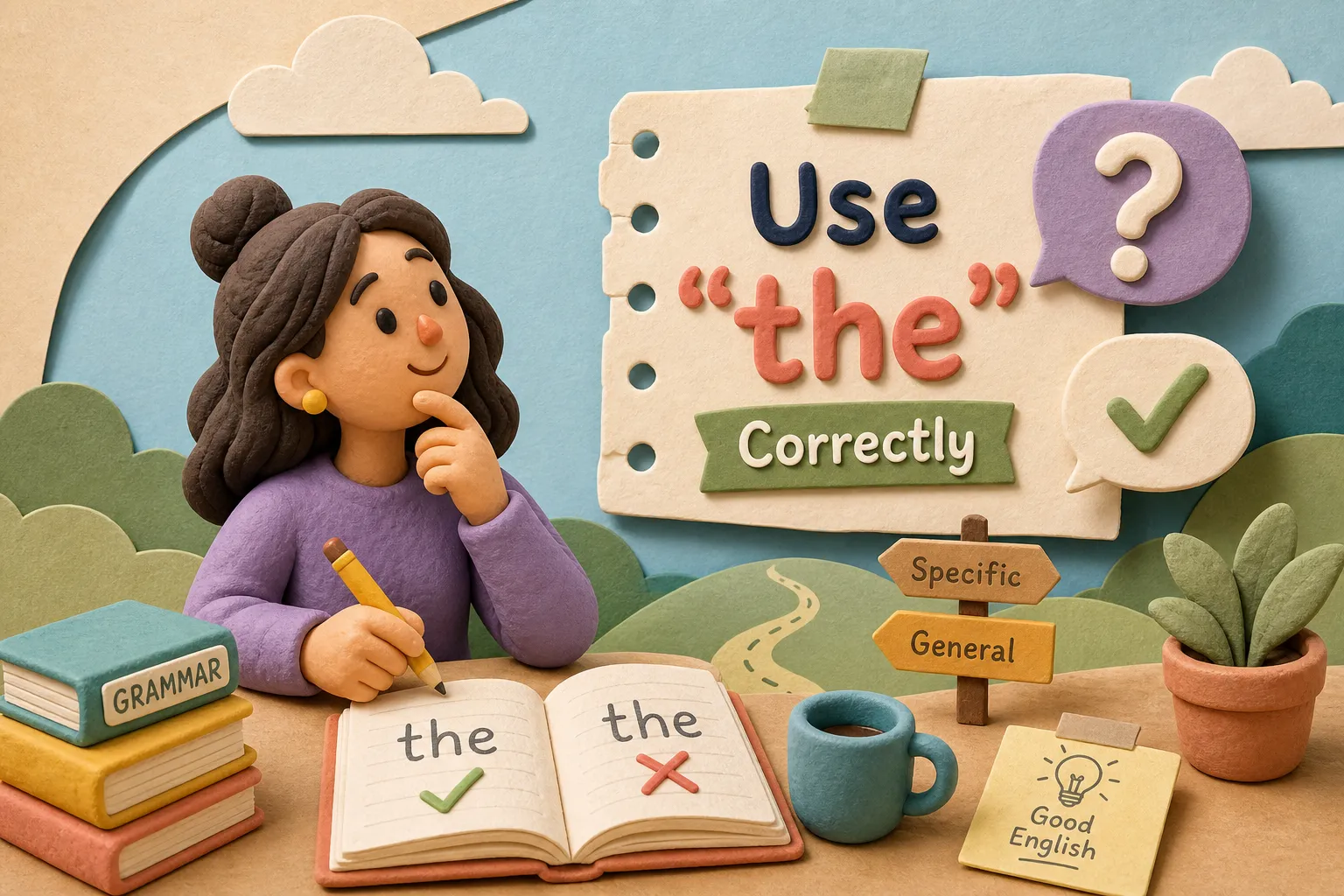
By the time you finish reading this, you’ll know exactly when to use “the,” when to drop it entirely, and how to say it the way native American English speakers do, without thinking twice. That might sound like a small shift, but for most learners it changes the way American English actually feels to speak.
Here’s the quiet irony: according to major English language corpora like COCA (the Corpus of Contemporary American English), “the” is the single most frequent word in the English language, and yet it’s one of the most confusing parts of grammar for learners. Many learners who can hold full conversations at work, write professional emails, and follow fast American speech still hesitate over article choice. The reason isn’t a vocabulary gap. It’s that “the” follows a logic that many languages simply don’t share, and most explanations rush past the parts that actually cause trouble.
At Your Daily American, the approach is always usage-first: not rules for their own sake, but the real-world logic behind how the language actually works. That’s exactly what this lesson delivers. You’ll cover the core rules for using the definite article, the zero-article situations, the tricky exceptions with geography and institutions, and the two-pronunciation system every native speaker runs automatically.
Why Using the Definite Article Is Harder Than It Looks
The logic hiding inside one small word
The foundational principle is this: “the” signals that both you and the listener already know which specific thing you’re talking about. It marks something as identified, unique, or already established in the conversation. That’s the single insight that makes every other rule make sense. Once you see “the” as a signal for shared knowledge rather than just a grammar marker, the whole system becomes clearer.
What your native language might be working against you
This is genuinely hard for many learners, and the reason is concrete. If your native language is Mandarin, Japanese, or Korean, there is no grammatical article system comparable to English, the concept simply doesn’t exist in those grammars. If you speak Spanish or Portuguese, articles exist but they’re tied to noun gender: “el,” “la,” “o,” “a” don’t map cleanly onto “the.” Arabic has a definite article (al-) but it behaves differently in key ways. This isn’t about intelligence. It’s about rewiring a deeply ingrained language habit, and knowing that going in makes the learning process less frustrating and more strategic.
The Core Rules for Using the Definite Article (With Real American English Examples)
The second-mention and specific-context rule
Two of the most common situations call for “the”: when a noun has already been introduced, and when context makes it clear which specific thing you mean, even without a prior mention. Consider these natural American examples: “I ordered a sandwich. The sandwich came out cold.” “Can you pass the salt?” (Both people are at the table; only one shaker exists in that context.) “Who’s calling? It’s the guy from the office.” Notice that “the” doesn’t require the noun to be famous or unique in the world. It just needs to be specific and identifiable in this moment, between these two people.
Unique things, superlatives, and ordinal numbers
Certain nouns almost always take “the” because there is only one of them in any given context: the sun, the moon, the president, the internet. The logic is the same as above, if there’s only one, both speakers already know which one. This extends naturally to superlatives (“the best burger I’ve had,” “the fastest route”) and ordinal numbers (“the first time,” “the third floor”). Once you see the underlying pattern, one and only, these feel automatic.
Talking about a whole category or class
“The” can also refer to an entire group: “the rich,” “the elderly,” “the unemployed.” You can also use it with a singular noun to represent a whole class: “The guitar is one of the most popular instruments in the world.” “The bald eagle is a symbol of American identity.” This usage surprises many learners because the noun isn’t specific in the usual sense. But it’s definite because it stands for an entire, identifiable category.
When to Leave the Definite Article Out Entirely
General nouns: plural and uncountable
When you’re talking about something in general, not a specific one, “the” disappears. Contrasting pairs make this click fast. “I love dogs” vs. “I love the dogs next door.” “Water is essential” vs. “The water in this restaurant tastes strange.” The first sentence in each pair is a general statement; the second is about something specific and already identified. Developing a feel for this distinction is one of the most practical things you can do for your English fluency. For more on using articles, Purdue OWL’s guide is a clear reference.
Proper nouns: countries, languages, meals, and more
The most common proper-noun categories drop “the” entirely. That includes most country names (France, Brazil, Japan), cities (Chicago, São Paulo, Tokyo), languages (Spanish, Mandarin, Arabic), academic subjects (math, history, biology), meals (breakfast, lunch, dinner), and sports (basketball, tennis). These come up every day in American conversation, so they need to be automatic. The practical shortcut: if it’s a name, a person, country, language, or subject, “the” is usually out.
Fixed phrases where “the” simply doesn’t belong
Everyday fixed expressions in American English work as chunks: at home, in bed, at school, by car, at work. Learn these as units rather than analyzing the grammar each time. “She’s still at home.” “He takes the subway to work.” “The kids are in bed.” Treating them as memorized phrases is faster and more effective than applying rules mid-sentence.
Geographical Names and Other Tricky Exceptions
Rivers, mountain ranges, and oceans vs. countries and cities
This is where many learners hit a wall, and the pattern is actually consistent once you see it. Countries, cities, states, continents, and individual lakes don’t take “the”: France, Chicago, Lake Michigan, Asia. But rivers, oceans, seas, mountain ranges, deserts, and island groups do: the Mississippi, the Pacific Ocean, the Rockies, the Sahara, the Philippines. Then there are the well-known exceptions: the Netherlands, the United States, the United Kingdom. These are country names that are either plural or built around a common noun, and that’s exactly why they take “the.” One country name? No “the.” A river or mountain range? Use “the.” A plural or descriptive country name? Use “the.” For a focused discussion on the geographical use of “the”, Grammarly’s guidance is helpful.
Buildings, newspapers, and institutions
Institutional names that include “of” typically take “the”: the University of Michigan, the Museum of Modern Art, the Bank of America. Many landmark buildings and newspapers also carry “the” by convention: the Empire State Building, the New York Times, the Smithsonian. But a proper name without “of” or a descriptive element often drops it: Harvard University, not “the Harvard University.” The contrast between “the University of Michigan” and “Michigan State University” shows the pattern cleanly.
Musical instruments vs. sports and games
This one comes up constantly in everyday conversation and is worth locking in: “She plays the violin” but “He plays basketball.” In standard American English, playing an instrument takes “the” while playing a sport or game doesn’t. Note that in casual speech some speakers do drop “the” with instruments, “she plays piano”, but the version with “the” is the standard, widely accepted form across American registers. The instrument-vs.-sport contrast is consistent enough to serve as a reliable default rule.
How to Pronounce “The” Correctly in American English
Thuh vs. thee: the vowel-sound rule
In natural American speech, “the” has two pronunciations. Before a consonant sound, it’s “thuh” (IPA: /ðə/), rhyming with “duh.” Before a vowel sound, it shifts to “thee” (IPA: /ði/), rhyming with “me.” Quick examples: “thuh table,” “thuh car,” “thee apple,” “thee idea.” The rule is about the sound that follows, not the spelling, and that’s the part that catches learners off guard.
When spelling and sound don’t match
This is the point that surprises many people, including some native speakers. “The university” becomes “thuh university” because “university” starts with a /j/ (y) sound, not a vowel sound. “The hour” becomes “thee hour” because the H is silent and the word opens with a vowel sound. “The one” becomes “thuh one” because “one” opens with a /w/ sound. “The European Union” becomes “thuh European Union” because “European” starts with a /j/ sound. Always ask: what sound does this word actually start with? Then choose “thuh” or “thee” from there.
Emphatic “thee”: when native speakers stress it on purpose
There’s a third use that learners rarely see explained but hear constantly. When a native speaker stresses “thee” for emphasis, it signals “the best” or “the most important” version of something. “This is thee place for deep-dish pizza in Chicago.” “She’s thee person you want to call.” This pattern shows up in casual conversation, recommendation contexts, and even advertising. Understanding it helps with listening comprehension and makes your own speech sound more natural and confident.
A Quick Decision Framework to Get the Definite Article Right Every Time
Three questions to ask yourself
When you’re mid-sentence and you feel that small hesitation before a noun, run through these three questions:
- Is this a proper noun, like a person’s name, country, language, sport, or meal? Skip “the.”
- Do both of us know exactly which one you mean, because it’s unique, already mentioned, or identifiable by context? Use “the.”
- Are you talking about something in general, not a specific one? Skip “the.”
Most native speakers run this check automatically without realizing it. The goal is to build the same unconscious fluency through practice, not to pass a grammar test.
Try it yourself: practice prompts
Fill in each blank with “the” or nothing at all, then say the sentence out loud and notice whether you say “thuh” or “thee”:
- “I had ___ breakfast at ___ best café in ___ city.”
- “She plays ___ piano and also loves ___ tennis.”
- “___ Rockies are beautiful, but ___ Colorado winters are tough.”
- “He works at ___ University of Texas, not at ___ Harvard.”
- “Can you close ___ window? ___ air conditioning is on.”
For the open-ended version: write two sentences about your morning using “the” at least once in each. Then test both sentences against the three questions above. If “the” survives all three checks, it belongs there.
Frequently Asked Questions About the Definite Article in American English
When do we leave out the definite article entirely?
Drop “the” when you’re speaking in general terms (not about a specific thing), with most proper nouns like countries and languages, and in fixed phrases like “at work” or “in bed.” The zero-article rule comes down to one question: are you referring to something specific and shared, or something general?
Why do some country names use “the” while others don’t?
Country names that are plural (the Philippines, the United States) or built around a common descriptive noun (the United Kingdom, the Netherlands) take “the.” Single, standalone country names like France, Brazil, or Japan do not. For more on how geography affects article choice, see the guidance linked above.
Does “the” pronunciation ever change?
Yes, and it’s based on sound, not spelling. Use “thuh” (/ðə/) before consonant sounds and “thee” (/ði/) before vowel sounds. The tricky cases involve words where the first letter and the first sound don’t match, like “university” (starts with a /j/ sound) or “hour” (the H is silent).
The definite article rule that actually sticks
“The” isn’t random. It follows one clear logic: is this specific and identifiable to both of us, or is it general? That single question handles the majority of cases you’ll face in daily American conversation, emails, and meetings. The exceptions, geography, institutions, instruments, zero article, are learnable patterns, not arbitrary rules.
The next time you reach for “the” mid-sentence and feel that small hesitation, you now have a clear framework to work through it in real time. Use it in your next conversation. Use it in your next email. That’s exactly how a rule stops being a rule and becomes habit.
This is the kind of usage-first grammar insight Your Daily American is built around, the real logic behind how American English actually works, so you can use it the next time you open your mouth. More lessons like this, pronunciation, grammar, everyday phrasing, live at Your Daily American.