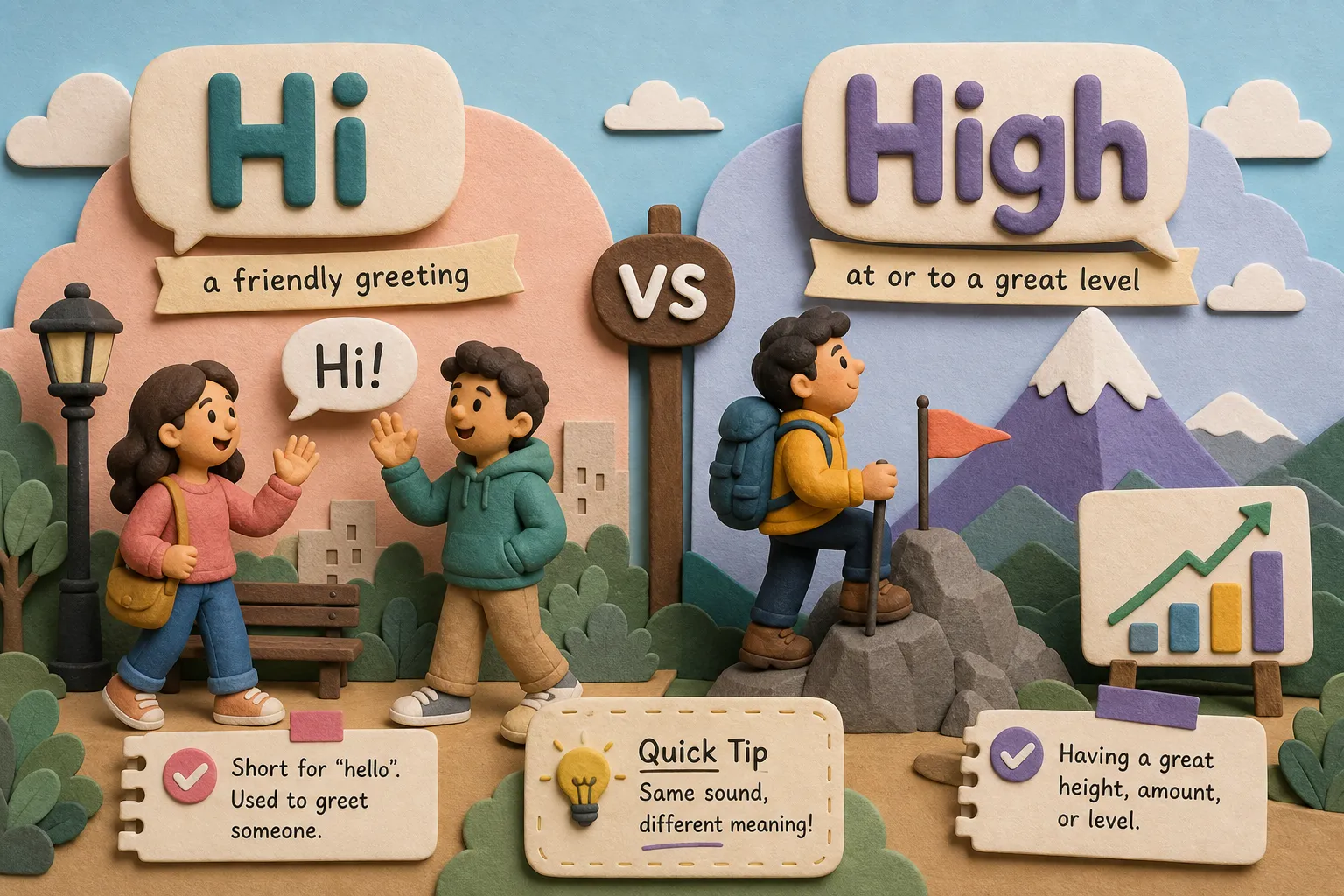
Hi vs. high: two words that sound identical but serve completely different purposes. You heard the sound /haɪ/ a hundred times. You know what it means. But somewhere between your ear and your keyboard, the wrong spelling showed up. This is one of the most common small mistakes English learners make, and it happens for a completely logical reason.
The core fact: “hi” and “high” are pronounced exactly the same in American English. Both are transcribed as /haɪ/, and in standard American speech, no phonemic difference separates them, though intonation or emphasis can create subtle audible variation in connected speech. That shared sound is what makes this tricky, and that’s exactly what this lesson from Your Daily American will fix.
By the end of this lesson, you’ll be able to identify the meaning and grammatical role of each word, use a reliable strategy for choosing the right spelling every time, and recognize a few other homophone pairs that follow the same pattern. Start with the basics: what each word actually means.
Hi vs. High: Meaning and Usage
The meaning and role of “hi”
“Hi” is an interjection and informal noun. Its only job is to greet someone. It works exactly like “hello” in casual situations, though “hi” feels slightly more informal and is extremely common in spoken American English, text messages, and emails. You’ll encounter it constantly in any American workplace, school, or coffee shop.
What makes “hi” unique grammatically is that it has no other function. It can’t describe anything, it can’t modify a noun, and it doesn’t appear in the middle of a sentence doing a descriptive job. It typically opens a sentence or follows a reporting verb like “said,” “waved,” or “shouted.”
- “Hi, Maya, good to see you.”
- “She waved and said hi.”
- “Hi everyone, thanks for being here.”
In every case, “hi” is either the opener of the sentence or it follows a verb like “said,” “waved,” or “shouted.” That’s the position it occupies.
The many meanings of “high”
“High” does a lot more work than “hi.” As an adjective, it means elevated, above a normal level, or at a great degree. It describes physical height, intensity, price, emotion, volume, and more. It also functions as an adverb (“she jumped high”) and as a noun (“the market hit a new high”). It takes comparatives: higher, highest.
The key thing to understand is that “high” always connects to something. It is measuring, describing, or labeling something else in the sentence. That connection is your biggest clue.
- “The mountain is extremely high.”
- “She scored high on the exam.”
- “His voice went high when he was excited.”
- “The price hit an all-time high.”
One quick note: “high” and “tall” overlap in everyday use but aren’t interchangeable. “Tall” typically describes the physical height of people or freestanding objects (“a tall building,” “a tall person”), while “high” refers more to position, level, or intensity (“a high shelf,” “high prices,” “high altitude”). When something is physically distant from the ground or measures a great degree of something, “high” is usually the right choice.
Hi vs. High Pronunciation: /haɪ/ for Both Words
The phonetics explained
Both “hi” and “high” are transcribed as /haɪ/ in American English. This is the same vowel sound you hear in “my,” “by,” “sky,” and “fly.” The simple phonetic respelling is HAI, and it rhymes with “my.” In standard American pronunciation, native speakers typically produce the same phonemic sequence /haɪ/ for both words, making them reliable homophones across most dialects, though intonation or speaking rate can occasionally create audible differences in natural conversation. See the Oxford Learner’s Dictionary entry for “hi” for a succinct dictionary transcription and usage note.
The mouth movement: start with your jaw open and your tongue low and slightly forward. Then glide your tongue upward toward the front, letting the sound move from an open “ah” position to a higher, more closed position. Your lips stay spread or neutral throughout. That full movement is the diphthong /haɪ/, and it’s the same for both words. If you want a visual reference for common American IPA symbols, check the American English IPA chart.
Why listening to the word won’t help you in writing
In conversation, context rescues you. Compare “She said hi to him” vs. “She jumped high”, the surrounding words do all the heavy lifting. You understand the meaning instantly. But in writing, those surrounding words aren’t always so clear, and that’s where the error lives.
This is the central challenge with homophones: you cannot listen to a word and figure out the correct spelling from sound alone. You have to know the meaning first, then choose the spelling that matches it. English spelling is frequently disconnected from pronunciation, and this is a known feature of the language, not a learner failure. Studies of writing errors show that homophone mix-ups affect native speakers too, not just learners building their vocabulary. For a focused look at common learner errors and which words tend to trip people up, see our piece on English Words Non-Native Speakers Mispronounce Most Often, Your Daily American.
The mistakes learners make, and why they happen
The most common mix-up
The classic error is writing “High, how are you?” instead of “Hi, how are you?” Learners who recently encountered the word “high” in a lesson or reading naturally default to that spelling when they hear /haɪ/, because it feels more substantial or familiar. The reverse also happens: someone describes a tall building in an informal note and writes “That mountain is very hi.”
Both versions side by side:
- Wrong: “High, how are you? Haven’t seen you in a while!” (using the adjective spelling as a greeting)
- Correct: “Hi, how are you? Haven’t seen you in a while!”
- Wrong: “The temperature is really hi today.” (using the greeting spelling as a descriptor)
- Correct: “The temperature is really high today.”
Why this confusion is completely understandable
English spelling does not reliably follow pronunciation. That’s not an ESL problem; it’s an English problem. Learners who are still building their vocabulary recognize the sound /haɪ/ before they’ve fully locked in which spelling belongs to which meaning. That’s a normal stage of language acquisition.
There’s also a first-language transfer factor. If your native language doesn’t have a situation where a greeting word and a descriptive word sound exactly the same, your brain doesn’t have an existing filing system for it. The fix isn’t drilling pronunciation, you already pronounce both words correctly. The fix is building strong meaning recognition, so the right spelling becomes automatic. For a concise guide on why learners make these kinds of mistakes and practical tips to avoid them, Grammarly’s hi vs. high guide offers a clear comparison.
How context tells you which word it is every time
The one-question test for “hi”
Ask yourself: “Is this word greeting someone?” If yes, it’s “hi.” Full stop. “Hi” only appears at the start of a sentence or message, or directly after a verb like “say,” “wave,” or “shout.” It never sits in the middle of a sentence describing something.
There’s also a quick substitution test: swap the word with “hello.” If the sentence still sounds natural, you have “hi.” If swapping in “hello” breaks the sentence or sounds absurd, you have “high.” Try it: “Hello, how are you?” works perfectly. “The temperature is really hello today?” That’s clearly wrong, which confirms the word should be “high.”
Reading “high” by what comes after it
“High” almost always connects to a noun, verb, or comparison structure. Look for patterns like “high score,” “high up,” “higher than expected,” or “an all-time high.” If the word is doing a descriptive job, measuring something, comparing something, or labeling a level, it’s “high.” The word is never standing alone at the opening of a message unless it’s part of a phrase like “High five!” (which is its own fixed expression).
A few contrast sentences to make this concrete:
- “Hi, I wanted to follow up on our meeting.” (greeting, opener)
- “The follow-up rate was surprisingly high.” (adjective, describes a rate)
- “She said hi when she passed my desk.” (noun after “said”)
- “She aimed high when setting her career goals.” (adverb, describes how she aimed)
A short dialogue using both words correctly
Read this short exchange between two coworkers and notice how the surrounding words make each spelling choice obvious:
Alex: “Hi, Sarah! You look energized today.” Sarah: “Ha, thanks. I’ve been in back-to-back meetings all morning. Stress is high, but the coffee is helping.” Alex: “I know the feeling. Anyway, say hi to your team from me.” Sarah: “Will do! The project pressure has been really high this week, but we’re managing.”
“Hi” appears as a greeting opener and after the verb “say.” “High” appears as an adjective describing the level of stress and pressure. Greetings open sentences; “high” sits next to nouns and measures something.
Other homophones that follow the same pattern
Hear vs. here, and bye vs. buy
“Hear” (to perceive sound) and “here” (in this place) share the pronunciation /hɪr/. Same sound, completely different meanings and grammatical roles. “Did you hear that?” uses the verb, while “Come over here” uses the adverb of place. A useful memory hook: hear contains the word ear, because hearing involves your ear.
“Bye” (a farewell) and “buy” (to purchase) share the sound /baɪ/. “Bye, see you tomorrow!” is the interjection. “I need to buy groceries” is the verb. These pairs all follow exactly the same logic as hi vs. high: sound gives you nothing useful, but meaning and grammatical role give you everything. Once you know what job the word is doing in the sentence, the correct spelling becomes clear. For more common pairs to practice, check out Duolingo’s list of common English homophones.
Building your homophone awareness over time
The more you read American English in context-rich environments, news articles, podcasts with transcripts, natural conversations, the faster these distinctions become automatic. Your brain starts to recognize the patterns without consciously running through a checklist. That automatic recognition is what fluency feels like.
Your Daily American publishes focused guides on American pronunciation patterns, including the way sound-spelling mismatches work across everyday vocabulary. Rather than stumbling across each confusing pair by accident, you can build this awareness systematically and track your progress as you go. Homophone recognition is one of those skills that compounds quickly once you start paying attention to it.
Practice: try it yourself before you go
Homophones are one of the genuine quirks of American English, and noticing them is a real sign that your reading and writing awareness is growing. Quick recap on hi vs. high: both are pronounced /haɪ/, but “hi” is a greeting and “high” is a descriptor measuring elevation, level, or intensity. Context, not pronunciation, is always your guide. Use the substitution test (“Can I swap this with hello?”) and the descriptive test (“Is this word modifying something?”) whenever you’re unsure. Remember: hi vs. high, same sound, different jobs; use context to pick the right spelling.
Now give these a try on your own:
- Write three sentences using “hi” correctly and three using “high” correctly. Mix up the contexts: casual greetings, workplace situations, descriptions of sound, price, or temperature.
- Fill in the blank with the right word: “The temperature was very ___ this afternoon.” / “___, I haven’t seen you in ages!”
- Look at this sentence and decide what’s wrong: “High there! Ready for the meeting?” Then rewrite it correctly.
Getting these small distinctions right is exactly the kind of precision that makes your English feel more natural and confident to the people reading and listening to you. Keep that momentum going. If you’d like to learn more about who writes these guides and why we focus on practical pronunciation and usage tips, visit our About, Your Daily American page.