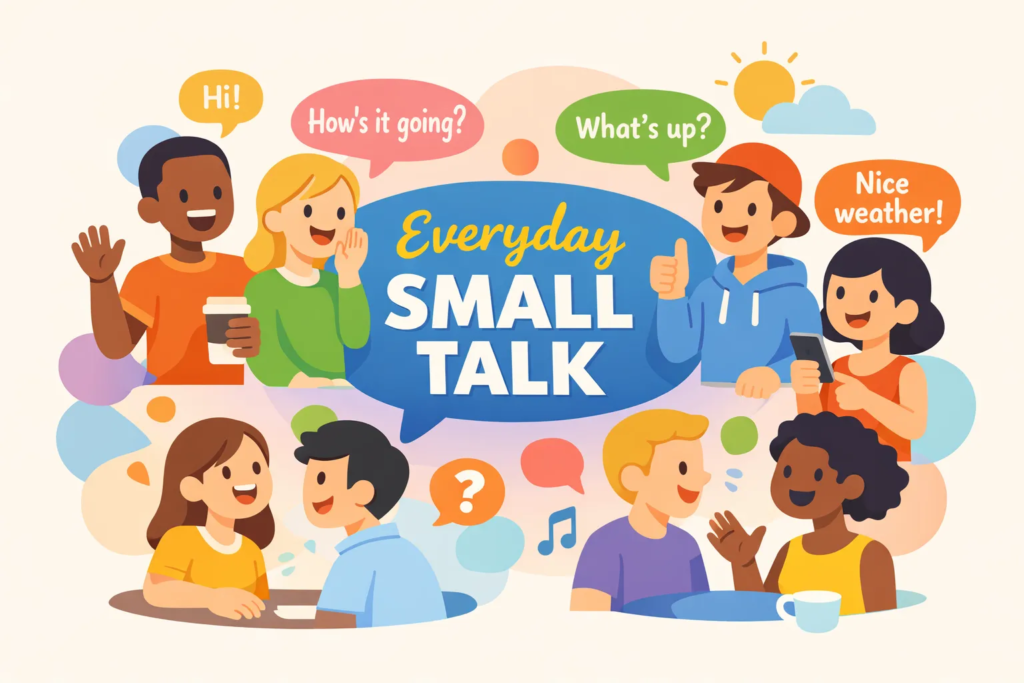
Someone says “How’s it going?” and your brain freezes. You know hundreds of English words. You’ve studied grammar for years. But in that split second, nothing comes out except a stiff “I am fine, thank you.” That moment is one of the biggest confidence killers for English learners, and it has nothing to do with grammar or vocabulary. For beginners, common American small talk phrases are exactly what fills that gap, the ready-made expressions that let you respond naturally before your brain has time to overthink it.
Most learners have never been handed a shortlist of what Americans actually say in real situations. Some textbooks focus on more formal examples that can feel less natural in casual conversation. This guide fixes that. The everyday American English expressions below are organized by situation so you know exactly which ones to reach for at work, at a party, with a neighbor, or in a shop. If you already spend time daily on Your Daily American, you’ll recognize the approach: real phrases, real context, zero textbook stiffness. If this is your first time here, welcome to your practical foundation.
What makes American small talk different from what you studied in class
The phrase “How do you do?” appears in almost every English textbook, but it’s rarely used in casual American speech. Real small talk in the U.S. is shorter, faster, and much more casual than anything you were taught in a formal course. It runs on a small set of go-to phrases that people rotate through dozens of times a day, and the goal of those phrases is never to exchange deep information. The goal is to signal friendliness and acknowledge the other person. Think of it as a social handshake, not a conversation.
The safe topics are a short list, and knowing them puts you ahead of most beginners immediately. Weather is the most common small-talk topic you’ll encounter. After that come weekend plans, food and restaurants, local events, and work talked about in very broad strokes. Entertainment like movies and TV shows also works well because almost everyone has an opinion. These topics stay comfortable because they’re neutral, shared, and low-stakes for both sides.
A few topics are worth avoiding for now: politics, religion, money, and personal questions about relationship status or family. Americans generally value personal privacy even in friendly conversations. As a practical guideline, personal topics become comfortable once the other person brings them up first. Until then, keep it light.
Common American small talk phrases for beginners, first meetings
Opening lines that feel natural, not rehearsed
Below are the icebreakers for beginners that Americans actually use day to day. Each one comes with a short note on tone so you know when it fits.
- “What’s up?” Very casual. Use with peers or friends, not in a job interview.
- “How’s it going?” Casual but works in most settings, including with coworkers you don’t know well.
- “How are you doing?” Slightly more deliberate. Works everywhere from a coffee shop to a first meeting.
- “Hey, how are things?” Warm and relaxed. Great for someone you’ve met once before.
- “Good to meet you.” Clean and professional. Use it right after an introduction.
- “Nice to meet you too.” Your natural reply when someone says “Good to meet you.”
- “What brings you here?” Useful at events or parties where context isn’t obvious.
- “How do you know [name]?” Perfect when you meet someone through a mutual friend.
- “Have you been here before?” Works at any venue, restaurant, or event.
- “I don’t think we’ve met. I’m [your name].” Direct and confident. Americans appreciate this one. For interview-specific introductions, see How to Introduce Yourself in an American Job Interview, Your Daily American.
Simple greetings and follow-ups to keep the conversation alive
The follow-up is where most beginners stall. Someone asks “How’s it going?” and you say “Fine.” Silence. Americans expect a short response and a return question. That rhythm is the whole structure of small talk. Here are the natural replies to use:
- “I’m good, thanks. You?”
- “Not bad, yourself?”
- “Pretty good!”
- “I’ve been busy but good.”
- “Same old, same old.”
- “Can’t complain.”
- “Doing well, thanks for asking.”
- “Hanging in there!”
Notice that every one of these is short. You don’t need to explain your entire week. A two-word answer plus “You?” is completely normal and socially fluent.
Pronunciation tips for common openers
“How’s it going?” in natural American speech sounds like “Howzit goin’?” The words blend together and the “g” at the end of “going” is often reduced or dropped in casual speech. “What’s up?” moves so fast it becomes almost one syllable: “‘Sup?” or “Wassup?” If you hear something that sounds like “Notatall” as one quick word, that’s just “not at all” said at native speed. Knowing this helps you understand Americans when they speak naturally and stops you from panicking when the phrase doesn’t match what you practiced.
Workplace small talk phrases for beginners
Before meetings and at the coffee machine
Workplace small talk has its own micro-rhythm. These phrases fit those five minutes before a meeting starts or while the coffee brews:
- “Busy morning?”
- “Coffee’s definitely needed today.”
- “How was your weekend?”
- “This week is flying by.”
- “Did you catch the game last night?”
- “Have you tried that new place nearby?”
- “How’s your project going?”
- “Almost Friday!”
- “I’ve been in back-to-back meetings all morning.”
- “What are you up to this weekend?”
The key here is to keep it brief and positive. You’re not opening a deep conversation. You’re building a small moment of connection that makes the whole office feel warmer.
Elevator and hallway chat
Elevator small talk follows one unspoken rule: keep it short and positive. The conversation ends naturally when the doors open, and that’s perfectly acceptable. No one expects a continuation. These phrases work well in that context: “Nice weather today,” “This week is going fast, isn’t it?”, “Heading out for lunch?”, “Have a good one!”, and “Almost the weekend.” Say one, get a reply, smile, and you’re done.
Phrases that wrap up without being awkward
Knowing how to exit a conversation is just as important as knowing how to start one. These closers are natural and commonly used in workplace settings: “Well, I should get back to it,” “Good catching up!”, “Let’s talk more later,” and “I’ll let you get back to work.” Each signals a friendly end without making things feel cut off, clean, warm, and easy for both sides.
Keeping it light at parties, shops, and with neighbors
Party and networking openers
Social events are where Americans are most open to a longer exchange. The stakes are lower than at work, so follow-up questions matter more here. Start with one of these conversation starters and let the exchange develop naturally:
- “How do you know [host’s name]?”
- “Have you been to events like this before?”
- “Are you from around here?”
- “What do you think of the food?”
- “I love your [jacket/bag/shoes].” (Keep compliments non-personal.)
- “These networking events are always a little awkward, aren’t they?” (Light humor works well here.)
- “What do you do?” (Acceptable at a party or professional event; less so in purely casual settings, where it may come across as probing about someone’s job or finances.)
- “Have you checked out [something at the venue] yet?”
Small-talk phrases for neighbors, shops, and casual run-ins
These interactions are brief by design. A friendly one-liner and a smile are all that’s expected. You don’t need to fill the silence. These phrases handle most everyday encounters:
- “Nice out today, right?”
- “Looks like you’ve been busy!”
- “You need a hand with that?”
- “Have you tried the new place on [street]?”
- “Just let me know if you need anything.”
- “Hey, how’s it going?” (Yes, it works here too, every time.)
With neighbors especially, these brief exchanges build genuine goodwill over time. The goal isn’t a long conversation. It’s a friendly signal that says “I see you and I’m approachable.”
Cultural rules beginners often get wrong
Questions that feel friendly but land awkwardly
Some questions feel natural to ask when you’re getting to know someone but come across as intrusive in American culture. Asking “What do you do?” right away in a purely casual setting may be perceived as probing about someone’s job or finances. Asking about relationship status or whether someone has kids touches on highly personal territory. And asking “Where are you really from?” when someone looks or sounds different from you carries an unspoken “you don’t belong here” subtext that most people find uncomfortable, even if that’s not your intention at all.
The cultural logic behind all of these is consistent: Americans generally value personal privacy even in friendly contexts. Personal topics become comfortable once the other person introduces them. If they mention their kids, ask about them. If they bring up where they’re from, share where you’re from. Let them open those doors first.
Safe territory that always works
When in doubt, weather, weekend plans, food recommendations, and shared environment never go wrong. Something like “This place is really nice, have you been here before?” works at a restaurant, a coworking space, or a company event. It’s neutral, curious, and easy to answer. Americans will often drop what linguists call a “conversation hook” in their reply. If someone says “I’ve been so tired lately,” they’re inviting you to ask why. Picking up on those hooks and following them naturally is one of the highest-level small talk skills you can build. For a longer list of topic ideas, see this guide to English small talk topics for casual conversations.
How to make these phrases stick with daily practice
Reading phrases once is not enough. The brain needs repetition in context to recall them under pressure, which is exactly why a moment of stress like someone saying “What’s up?” can make everything go blank. Spaced repetition, where you review phrases across multiple days in realistic contexts, builds the recall you need when someone catches you off guard. Research on language learning consistently supports this kind of distributed practice for building automatic responses. You can also download a large set of ready-to-use expressions like the 500 Real English Phrases PDF to practice patterns and chunks of speech.
That’s the approach behind Your Daily American: real American phrases organized by situation, with cultural context and examples baked into every post, so you can review a handful each day and actually internalize them before you need them in a real conversation. It turns a one-time reading into a genuine daily habit. For additional practice routines and prompts, check out the article on Common American Expressions Every English Learner Should Know, Your Daily American.
Three short dialogues to practice right now
Dialogue 1: Meeting a coworker before a meeting
You (opener): “Hey, busy morning so far?”
Them (follow-up): “Yeah, back-to-back calls. Coffee’s saving my life right now.”
You (transition): “I hear that. This week is flying by.”
You (closer): “Well, looks like we’re about to get started.”
Notice how the opener leads to a follow-up, the follow-up gets a transition, and the closer feels natural because the meeting is starting. You didn’t need to say anything brilliant. You just showed up as friendly and present.
Dialogue 2: Chatting with a neighbor outside
You (opener): “Hey, how’s it going? Nice out today, right?”
Them (follow-up): “Yeah, finally! I’ve been waiting for weather like this.”
You (transition): “Same. You doing anything fun this weekend?”
Them: “Probably just yard work. You?”
You (closer): “Nice, enjoy it. See you around!”
This one extends slightly because the neighbor engaged. You followed their lead. When they mentioned yard work, you didn’t need to dig deeper. A closer landed perfectly and left things warm.
Dialogue 3: Light talk at a workplace coffee station
Them (opener): “Can’t believe it’s only Tuesday.”
You (follow-up): “Right? Feels like it should be Thursday by now.”
You (transition): “You have a lot going on this week?”
Them: “Yeah, big presentation Friday. Anyway, I should get back to it.”
You (closer): “Good luck with the presentation. You’ve got this.”
Three key moves happened here: you matched their energy, asked one follow-up, and closed warm. That’s the full small talk formula working in under a minute.
Start using these phrases today
American small talk is not complicated once you know the phrases that actually get used. Beginners who focus on the right openers, natural follow-ups, and clean closers for each situation are already ahead of most learners. You don’t need to memorize everything at once. You need the right phrases for the moments you face most often.
The next step is not to study more. It’s to practice in context. Pick one situation from this guide, the coffee machine, a neighbor run-in, or a party opener, and commit to using at least two of these phrases today. Many learners report that the first attempt feels awkward, but after a few repetitions the response starts to feel natural. Keep going and it stops feeling like a performance at all. For quick question prompts you can use today, see this list of small talk questions to try out in real conversations.
Everything here is your starting point, not your finish line. Keep building on these small talk phrases for beginners daily at Your Daily American, where every post adds new expressions organized by situation, with pronunciation guidance and real-context examples designed to help you sound natural and genuinely fluent in American English. If you’d like a short practice plan or more exercises, check this extra small-talk guide for practice ideas and prompts, and pair this post with our curated list 25 Small Talk Phrases Americans Use Every Day, Your Daily American to expand your starter set.