Open any American workplace email and you’ll find a supervisor. Open a physics textbook and you’ll find a superconductor. Send a text to a friend and you might write, “That’s super easy!” Same prefix, three completely different situations. That one small piece, the super- prefix, is one of the most active word-building tools in American English. Understanding how it works will help you recognize and use dozens of new words right away.
By the end of this lesson, you’ll be able to spot the super- prefix in unfamiliar words, understand its three core meanings, use it correctly in both formal writing and casual conversation, and write super- words without spelling mistakes. This is exactly the kind of vocabulary knowledge that bridges the gap between grammatically correct English and natural American English, the gap that drives every lesson at Your Daily American.
What the Super- Prefix Actually Means
Where super- comes from
The super- prefix comes from Latin, where the word super meant “above” or “over.” You can see this meaning clearly in the word supervise. When you supervise someone, you literally look “over” their work. The Latin root carries that spatial sense into modern English: if something is super-, it sits above or beyond the baseline. For a short explanation of the root meaning, see this note on super- meaning “over”.
The three meanings you need to know
Super- works three different ways in English, and each one is useful to know.
- Position: above or on top of something. Examples: superimpose (to place one image over another), superstructure (the part of a building above its base).
- Degree: more than normal, beyond the standard. Examples: supernatural (beyond what is natural), supersonic (faster than the speed of sound), superhuman (beyond normal human ability).
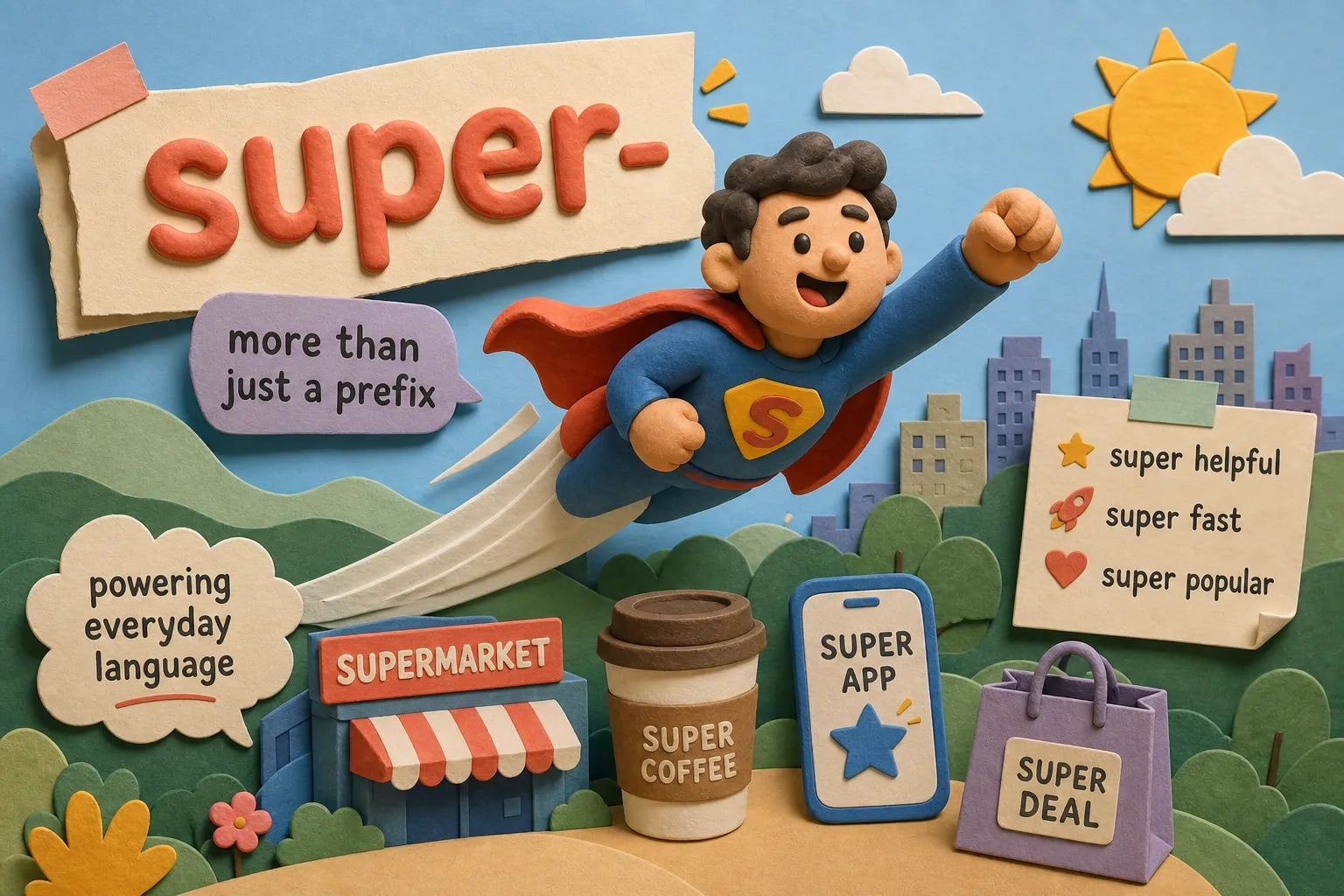
- Informal intensifier: very or extremely. Examples: “super easy,” “super tired,” “super excited”, common in casual American conversation.
The prefix does not change its spelling when you attach it to a base word. Unlike some suffixes that modify the root, super- stays the same regardless of what follows it. That makes it easy to spot and easy to use.
Super- in Formal and Professional American English
Common words you hear in the workplace
Many professional English words use the super- prefix, and you probably already know some of them. Supervisor is a job title for someone who manages a team. Superintendent refers to the head of a school district or a building manager. Superior describes someone at a higher level in the company. These words appear in job postings, performance reviews, and everyday workplace conversations.
A few more professional words worth knowing: supersede means to replace something with a newer version (“The new policy supersedes the old one.”), and superfluous means more than is needed (“Please remove any superfluous details from the report.”). Superlative describes the highest level of something, and it also has a grammar meaning: the superlative form of “good” is “best.”
How recognizing super- helps you read new words
Once you know the prefix, you can often guess the meaning of a new word without a dictionary. Take superficial: “super” (over) plus a root related to “face” or “surface” gives you the idea of something that stays on the surface and does not go deep. Or take superimpose: to place something “over” something else. Breaking words into parts this way is a real skill, and it gets faster with practice.
Super- as an Intensifier in Everyday American Conversation
How Americans use “super” to mean “very”
In informal American English, “super” works as an adverb that describes an adjective. You place it directly before the adjective, and it means “very” or “extremely.” This use has grown sharply over the past two decades. Corpus data from the Corpus of Contemporary American English shows that “super” as an intensifier became nearly five times more common between the 1990s and the early 2010s, and it continues to grow in 2026. For a reader-friendly discussion of intensifiers and how they function in English, see this article on intensifiers in American English.
These examples reflect real everyday American situations:
- “That presentation was super helpful, thank you.” (after a team meeting)
- “I’m super tired, the flight was delayed.” (talking to a coworker)
- “She’s super excited about the new project.” (in a text message)
- “The new coffee shop downtown is super good.” (casual conversation)
Notice that in all these examples, “super” is a separate word. It does not attach to the adjective. Writing “supertired” or “superexcited” as one word is a common mistake that ESL learners make. In informal use, always keep them apart: super tired, super excited, super good.
When it’s okay to use super- this way (and when it’s not)
Register matters a lot here. Register means the level of formality in your language. “Super” as an intensifier is perfectly natural in text messages, team chats, and friendly conversations. In formal emails, presentations, or professional documents, it sounds too casual. Use “very,” “extremely,” or “highly” in those situations instead.
Compare these two examples: “That’s super helpful, thanks!” works well in a team Slack channel. “Your feedback was extremely helpful” works better in a formal follow-up email to a client. Same idea, different register. Knowing when to switch is one of the most important skills in professional American English.
How Super- Compares to Similar Prefixes
Super- and its opposite: sub-
Sub- is the direct opposite of super-. Where super- means above or beyond, sub- means below or under. If superior means above average, substandard means below average. If superhuman describes something above normal human limits, subhuman points in the opposite direction. In a workplace context, a subcommittee sits below the main committee in authority, just as a supervisor sits above the team. Knowing both prefixes together doubles your vocabulary recognition immediately.
Super-, hyper-, over-, and sur-: what’s the difference?
These four prefixes are related in meaning but not identical in use. Here’s how to think about each one clearly.
Hyper- comes from Greek and also means “over” or “beyond,” but it appears most often in medical or technical contexts. Hypertension means high blood pressure. Hyperactive describes someone who is overly active. You’ll see hyper- in science, medicine, and psychology more than in everyday conversation.
Over- is the everyday English word that often means the same thing as super- or hyper-. Overload means too much load. Overwhelmed means too much to handle. Over- is very common in spoken English and feels natural in both formal and informal situations.
Sur- is not a variant of super-. It is a separate prefix that came into English from French, which borrowed it from Latin. Both sur- and super- share the same Latin root, so their meanings are related, but they function independently. Surface is the face that lies over something. Surpass means to go beyond a limit. You cannot swap sur- and super- freely; each belongs to specific words, and you learn them word by word.
Spelling and Hyphenation Rules for Super- Words
When you don’t need a hyphen (most of the time)
The standard rule in American English is simple: write most super- words as one closed word with no hyphen. This is the style recommended by AP, Chicago, and Merriam-Webster. Superhuman, supernatural, supermarket, supervisor, superstar, supersonic, all one word, no hyphen. When you are not sure, check Merriam-Webster online or consult a practical hyphenation guide. The first spelling listed is always the standard form.
The three cases when a hyphen is needed
There are a small number of situations where a hyphen is correct:
- When “super-” is followed by a capital letter. Example: super-American. Because “American” is a proper noun, the hyphen separates the prefix from the capitalized word.
- When the next word starts with a vowel that could cause confusion. Example: super-essential. Without the hyphen, the word could look strange or be hard to read quickly.
- When the compound is a one-time creation and the meaning is unclear without a hyphen. This is rare. Most established super- words are already in the dictionary as closed forms.
For everyday writing, the safest and most common choice is no hyphen. The exceptions above cover unusual or constructed words. You won’t need to think about this for standard words like superpower or superintendent.
Super- Prefix: Practice Using It Today
Three quick exercises to test yourself
The fastest way to make this knowledge stick is to use it right away. Try these three short exercises on your own.
- Replace “very” with “super” in three casual sentences. For example: “I’m very tired” becomes “I’m super tired.” Then ask yourself: does it sound natural? Would you say this to a friend? Now try: “That was very interesting,” “She is very organized,” “The test was very hard.”
- Look at five unfamiliar super- words and guess the meaning before checking. Try these: superlative, superfluous, superimpose, superconductor, superintendent. Use what you know about the super- prefix to make your best guess first.
- Write one formal sentence using a workplace super- word. Use supervisor, superintendent, or supersede. Keep the sentence short and situational, as if you were writing it in a work email.
Where to go next
Knowing Prefixes and Suffixes: Unlock Thousands of English Words like super- is one of the fastest ways to build vocabulary in American English. One super- prefix connects to dozens of words across formal writing, professional communication, and casual conversation, letting you multiply your vocabulary without memorizing each word separately.
Start next with our Un- prefix: The Simplest Way to Expand Your Vocabulary lesson to practice working with the opposite side of meaning and common negative forms.
At Your Daily American, every lesson is built around this kind of real-world vocabulary knowledge. You’ll find lessons on the most common American phrasal verbs, pronunciation guides that show you exactly how native speakers connect words, and workplace English lessons that prepare you for emails, meetings, and job interviews. The goal is always the same: not just to learn words, but to use them with confidence in real situations. Visit Your Daily American and explore lessons that show you how American English actually sounds and works in everyday life.