The meeting room was quiet. Then the project manager said one sentence and it changed everything: “This feedback will brighten the whole project.” What did that word just do? It took a quality, brightness, and turned it into an action. That’s the power of the -en suffix at work.
“Brighten” follows one of the most useful word-building patterns in American English. You add -en to an adjective (a describing word) and you get a verb that means “to make something more [that quality]” or “to become [that quality].” Once you recognize this pattern, you’ll start seeing it everywhere: in conversations, in emails, and in everyday speech.
By the end of this lesson, you’ll know what the -en suffix is, which words it works with, how to use these verbs naturally at home and at work, and when not to use it. At Your Daily American, grammar lessons like this one focus on real patterns you can use right away, not abstract rules from a textbook. Here’s how it works.
What the -en suffix does in American English
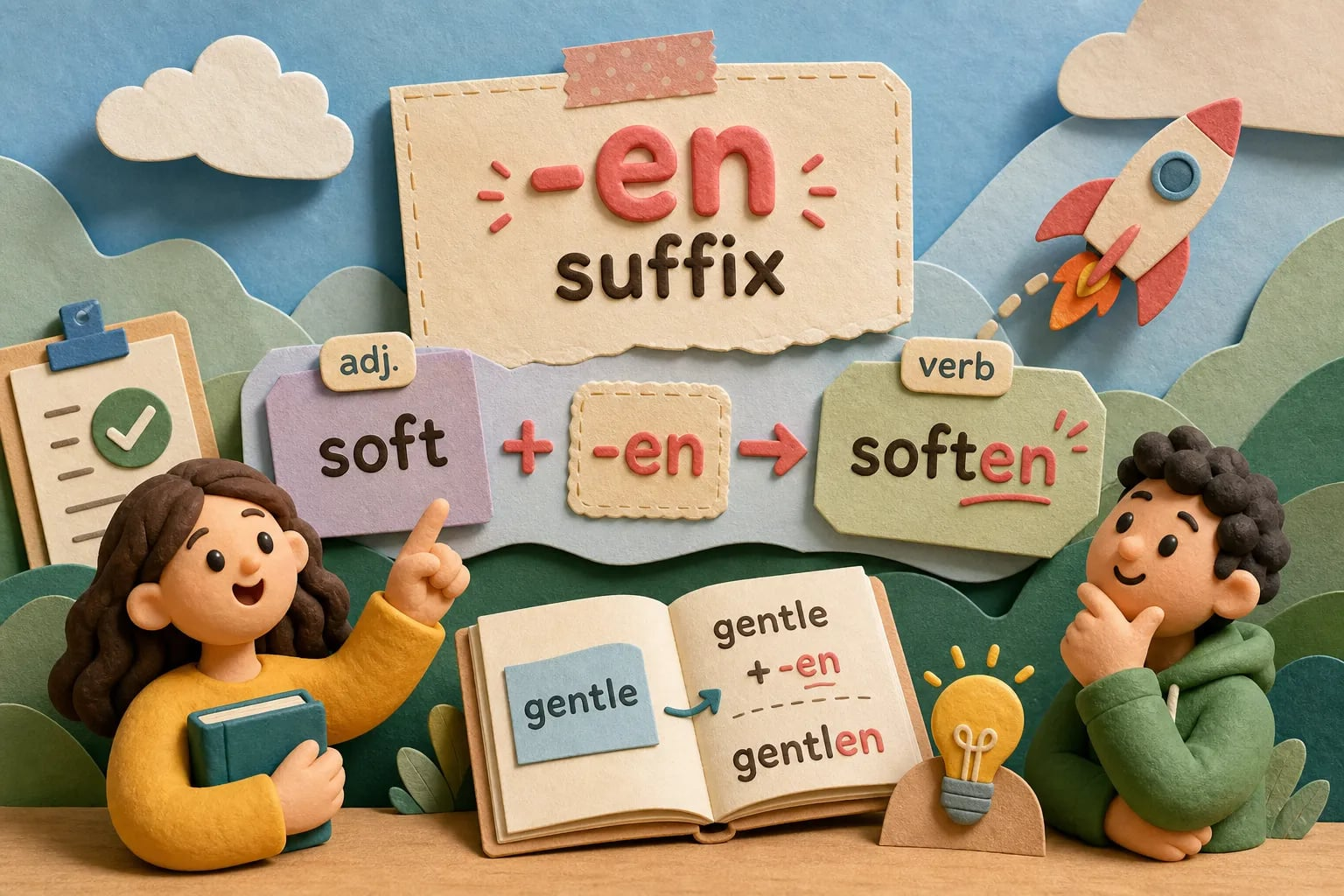
A suffix is a group of letters you add to the end of a word. It changes the word’s meaning or its role in a sentence. The -en suffix is an adjective-to-verb suffix , which means it turns adjectives, and sometimes nouns, into verbs. Linguists classify it as a derivational suffix, because it creates a new word with a new grammatical function. It’s worth noting that -en appears in other roles in English too: as an adjective-forming suffix (as in wooden or golden) and as a past-participle marker (as in broken or taken). This lesson focuses specifically on its verb-forming function.
The core meaning is straightforward: -en verbs mean “to make something [that quality]” or “to become [that quality].” Take the adjective wide. Add -en, and you get widen: to make something wider. Example: The city plans to widen the highway next spring. Most -en verbs share this basic “make or become” meaning, though individual verbs can carry their own nuances built up through use over time.
Most -en verbs start from short, everyday adjectives, a pattern rooted in Old English and Germanic -en morphology that has persisted into modern American English. You see this in words like bright → brighten, soft → soften, sharp → sharpen, loose → loosen, and tight → tighten. Some -en verbs come from nouns instead: strength → strengthen, height → heighten, length → lengthen. In every case, the meaning is similar: to make or become more of that quality.
How the -en suffix compares to -ize and -ify
English has several verb-forming suffixes, with -en , -ize , and -ify among the most common and relevant for everyday learners (others, like -ate, also exist). They all carry a general sense of “to make,” but they feel different. The -en suffix tends to be casual and direct, soften , deepen, and is most at home with short, Germanic-rooted adjectives. The suffix -ize skews more formal and technical, modernize, prioritize, and typically pairs with Latinate bases. The suffix -ify often signals a stronger or more complete change, simplify, intensify, and is also common with Latinate roots. In practice, which form sounds most natural depends on the specific base word and the register you’re working in: -en is the go-to choice for many short, familiar adjectives, while -ize and -ify handle more formal or technical vocabulary.
This split in -en etymology, Germanic roots taking -en, Latinate roots taking -ize or -ify, is one of the most reliable patterns in English word formation. For a concise overview of prefixes and suffixes and how they behave, see this prefixes and suffixes guide.
The most common -en verbs to learn first
Here is a core set of commonly used -en verbs. Each one is made from a simple adjective or noun. Study the base word, the verb, and the example sentence. These are among the -en forms you’ll encounter most frequently in Everyday American English, Your Daily American.
- bright → brighten: Opening the curtains will brighten the room.
- dark → darken: The sky started to darken around 5 p.m.
- wide → widen: They plan to widen the road near the school.
- short → shorten: Can you shorten the introduction by two sentences?
- soft → soften: Let the butter soften before you mix it in.
- hard → harden: The glue will harden in about ten minutes.
- sharp → sharpen: She stopped to sharpen her pencil before the test.
- loose → loosen: He had to loosen his tie after the long meeting.
- tight → tighten: Tighten the screws so the shelf stays in place.
- deep → deepen: The conversation started to deepen as the evening went on.
- strength → strengthen: Daily practice will strengthen your vocabulary fast.
- flat → flatten: Flatten the box before you throw it away.
A quick note on spelling
For most words, you simply add -en directly, no letters change. Wide → widen, deep → deepen, soft → soften. The verb flatten is a well-known exception: the double t is part of how that word has been spelled historically, rather than the result of a general doubling rule. The standard consonant-doubling rule (as in run → running or stop → stopped) applies to vowel-initial inflectional suffixes like -ed and -ing; it does not reliably apply to the derivational -en suffix. When in doubt, check a dictionary, most -en forms are built by straightforward addition, and flatten is one of the few you simply have to memorize. For a clear guide to common suffix spelling rules, see this suffix spelling rules overview, and you can review basic suffix definitions and examples in this suffixes lesson.
How -en verbs show up in everyday conversation
These verbs are natural in casual, everyday American English. They make your speech more direct. Instead of saying “make the color more bright,” you simply say “brighten the color.” That’s shorter, cleaner, and more native-sounding.
Picture a few everyday moments. You’re in the kitchen and ask: “Can you loosen that jar lid? I can’t get it open.” You’re talking about the backyard: “We need to widen the path so two people can walk side by side.” You’re describing the morning: “Opening the blinds will brighten the kitchen.” In each case, the -en verb does the job in one word instead of four or five.
Here are two short dialogues that show verbs ending in -en in real spoken American English:
Dialogue 1 (at home, with a friend or family member):
A: “The bedroom looks kind of dark, don’t you think?” B: “Yeah. We could brighten it up with some white paint or a new lamp.”
Dialogue 2 (a phone call about a work project):
A: “The report is too long. Can we shorten it before the meeting tomorrow?” B: “Sure. I’ll also soften the tone in the last section. It sounds a bit harsh.”
In both exchanges, the -en verbs, brighten , shorten, soften , slot naturally into everyday speech. Each one replaces a longer phrase and keeps the conversation moving.
-en verbs in American workplace communication
-en verbs are well-suited to professional settings because they are direct and active. They help you sound confident in emails, meetings, and presentations. A number of these verbs, particularly strengthen , tighten, shorten, and deepen, turn up regularly in workplace writing and conversation.
Using the -en suffix in professional emails
In professional emails, these verbs do a lot of work. Compare two versions of the same sentence: “We need to make the onboarding process stronger” sounds wordy, while “We need to strengthen the onboarding process” sounds clear and professional. In many contexts, the -en form is the more concise choice, though tone and emphasis will always play a role. Here are three more workplace email examples:
- This plan will shorten the delivery timeline by one week.
- We want to deepen our partnership with this client.
- Please tighten the budget estimates before Thursday’s review.
In spoken meetings, -en verbs help you speak with clarity and confidence. A team lead might say: “Let’s tighten up the schedule before Q3.” A project manager might say: “I want to deepen our relationship with this client.” These sentences are short and easy to follow, they work in formal meetings and in casual team check-ins, which makes them especially useful to learn.
When the -en suffix doesn’t work: knowing the limits
The -en suffix works best with adjectives that describe a quality that can increase or decrease in degree, something can become more wide, more bright, or more deep. Adjectives that describe something absolute are trickier. You can’t say “perfecten” to mean “make perfect.” Words like perfect and unique don’t typically take -en because the quality can’t logically be increased. That said, English has lexicalized exceptions worth knowing: dead → deaden is a real, established verb (medication can deaden the pain; acoustic panels deaden the sound). The broader rule holds, non-gradable adjectives rarely take -en, but individual verbs sometimes break that mold through long usage.
Long, formal adjectives from Latin or French also don’t take -en. You wouldn’t say “intelligenten” or “beautifyen.” These words use -ize or -ify instead: beautiful → beautify, intense → intensify. A practical guideline: if the adjective is short, common, and Germanic in feel, there may well be an -en verb for it. If it’s long and formal, look for an -ify or -ize form instead. This split in -en etymology, Germanic roots taking -en, Latinate roots taking -ize or -ify, is one of the most reliable patterns in English word formation.
ESL learners sometimes add -en to adjectives that don’t accept it. Forms like “expensiven,” “popularen,” or “happyen” do not exist in English. When you’re not sure, use the phrase “make it more [adjective].” That construction always works: make it more expensive, make it more popular. It’s clear and correct every time.
Building real fluency with -en verbs
Understanding a grammar pattern is step one. Using it naturally in real conversation is the goal. The fastest way to get there is to practice in real situations, not just in exercises.
Try this simple method: pick three -en verbs each week. Write two sentences for each one. Then use the verbs in your next English conversation or email. When you focus on a small number of words at a time, the pattern becomes automatic faster. You build real confidence, not just knowledge.
Reading and listening also help. When you read American news articles or watch workplace-style videos in English, keep an eye out for verbs ending in -en . Each time you spot one in context, you reinforce the pattern in memory. The more you see these verbs in real situations, the more natural they feel when you try to use them yourself. For a practical explanation of how adjectives are formed and how they relate to verb formation, this guide on forming adjectives may be useful.
Grammar patterns like this one are part of a larger system: how English builds words, shifts word classes, and signals meaning through structure. At Your Daily American, the grammar and vocabulary content is built specifically to help learners see these patterns clearly and use them in real American English situations. Whether you’re working on word formation, phrasal verbs, or professional vocabulary, you’ll find lessons organized by level so you can learn and apply something new the same day. For more focused practice and weekly grammar material, check out our Daily Grammar, Your Daily American section.
What to take from this lesson
The -en suffix turns adjectives and nouns into verbs that mean “to make or become [that quality].” Words like widen, strengthen , brighten , and soften follow this pattern and appear regularly in both everyday and professional American English. Understanding this adjective-to-verb suffix gives you a reliable tool for building new vocabulary from words you already know.
Remember the two main limits: not all adjectives accept -en, and long Latinate words usually take -ize or -ify instead. There are a handful of lexicalized exceptions, like deaden, that simply need to be learned as individual words. When you’re not sure, a simple “make it more [adjective]” phrase always works as a safe alternative.
Now it’s your turn. Pick one -en verb from this lesson, write a sentence with it, and use it in real English today. That one small action moves you from reading about the pattern to actually using it. For a basic, student-friendly lesson on suffixes that reinforces what you’ve learned here, you can also review this student lesson on suffixes. For more grammar and vocabulary lessons built for real American English fluency, visit Your Daily American, Your Daily American and explore the full content library.