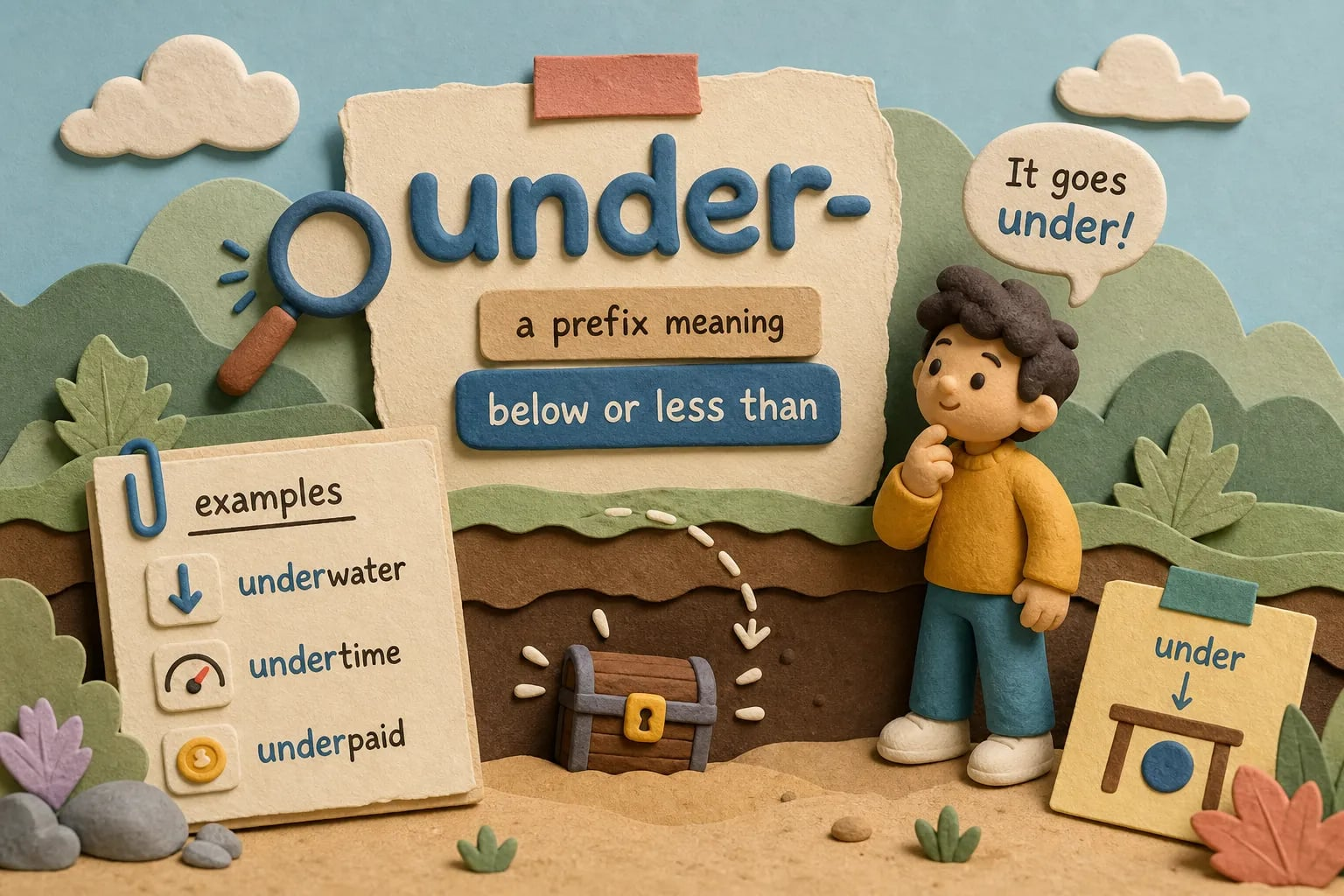
You’re watching an American TV show and a character says, “You’re underestimating this project.” You understand the word. But have you ever stopped to think about why it means what it means? Or maybe you heard a coworker say someone “really underperformed this quarter” and you nodded along, but you weren’t completely sure why that word works the way it does. The under- prefix is the reason, and once you understand it, dozens of English words suddenly make sense.
A prefix is a word part added to the beginning of a word that changes its meaning. When you understand what the under- prefix means and how it works, you stop guessing at vocabulary and start seeing a pattern. One pattern unlocks dozens of words at once. That’s the kind of word-building skill that Your Daily American focuses on throughout its vocabulary and study resources, because it builds real, lasting fluency.
By the end of this lesson, you’ll be able to recognize the three meanings of the under- prefix, use the most common under- words in real conversations, and start noticing this prefix on your own.
What the under- prefix means
The under- prefix has three main meanings. Each one appears in a different type of situation, so it helps to see them grouped clearly.
The first meaning is below or beneath something physical. Think of words like underground (below the ground), underwater (below the surface of the water), and underarm (the area beneath your arm). These words describe a physical location that is lower than something else.
The second meaning is lower in rank or status. Words like undergraduate (a student who hasn’t finished their degree yet), undersecretary (a government official below a secretary), and underdog (a person or team expected to lose) all carry this idea. Here, the under- prefix tells you that something or someone is at a lower level in a group or system.
The third meaning is not enough, or less than needed. In modern usage, this sense is very common in everyday American English. Words like undercooked, underpaid, and underfunded all suggest that something didn’t reach the right level. The food needed more time, the worker needed more money, and the project needed more resources to succeed.
The prefix comes from Old English, which makes it a Germanic word part. This is different from the Latin prefix “sub-,” which you may also know. Both mean “under,” but they are used in different ways; see the Oxford Learner’s Dictionary definition of “under” for a concise sense of the base word.
How under- works with verbs, adjectives, and nouns
The prefix behaves a little differently depending on the type of word it joins. Understanding this gives you a real feel for how the under- prefix works in practice.
Under- with verbs: the action isn’t enough
When under- attaches to a verb (an action word), it means the action happened less than it should have. The verb describes something that didn’t reach the right level.
- underperform: to perform worse than expected
- underestimate: to think something is smaller or less important than it really is
- undercook: to cook something for less time than needed
- undercharge: to charge too little money for a product or service
These show up in everyday speech more often than you might expect. “She undercharged me for the repair” is something you’d say after leaving a shop surprised by a low bill. “We underestimated how long it would take” is standard in any workplace debrief.
Under- with adjectives: the quality falls short
When under- modifies an adjective (a describing word), it signals that something is below the normal or expected level. The word describes a state, not an action.
Examples include undercooked (not cooked enough), underripe (not ripe enough), underpaid (not paid enough), and underprivileged (having fewer advantages than most people). In each case, the word tells you that something didn’t reach where it should be.
Under- with nouns: position or status
With nouns (people, places, and things), under- often describes a physical position below something, or a lower level of rank or age. Underground is below the surface. An undercurrent is a flow of water below the surface. Undergraduate is a student at a lower academic level. Underdog is a person or team at a lower position in a competition.
One important exception: the word understand. It does not mean “to stand below something.” It comes from Old English and simply means “to know the meaning of something.” This word does not follow the pattern, so it’s worth remembering separately.
Under- prefix examples from everyday American life
Here’s where these words show up in everyday American conversations.
Talking about food
Food is one of the easiest places to hear under- words. Americans use them naturally when cooking, eating at restaurants, or describing a meal. If your steak arrives pink when you asked for medium, you’d say, “This steak is undercooked.” Standing over a fruit bowl, you might tell a friend, “The peaches are still underripe, let’s wait a few more days.” You don’t need to explain these words in conversation. People understand them immediately because the meaning is clear from the prefix.
Talking about people and situations
In casual conversation and on social media, Americans use under- words to talk about value and recognition. “He’s definitely the underdog in this race, but I’m rooting for him.” / “That movie is so underrated, everyone should watch it.” The word underrated means something didn’t get the praise or attention it deserved. It’s very common in American pop culture, on TikTok, and in everyday discussions about music, sports, and food.
Talking about everyday observations
You’ll also hear the “physical position” meaning of under- in simple, everyday sentences. “The subway runs underground through the city.” / “She works undercover for the FBI.” These uses are straightforward: something is literally or figuratively below the surface or hidden from view.
Under- words that come up at work
In professional American settings, under- words appear often in meetings, performance reviews, and workplace discussions. Knowing these words helps you follow conversations and speak more clearly at work.
When performance is the topic
Two of the most common workplace under- words are underperform and underestimate. “She underperformed in last quarter’s review” means she did not meet the expected results. “The team underestimated how long the project would take” means they thought it would be shorter, but it wasn’t. Both words are used by managers and coworkers to talk about gaps between expected results and real results.
When pay and resources come up
These words come up in salary discussions, budget conversations, and job interviews. “A lot of people feel underpaid in this industry” is a common statement in workplace conversations. “The department is understaffed and underfunded” means there are not enough people and not enough money to do the work properly. These words are direct and clear, so people use them without hesitation.
A short workplace dialogue
Here’s how these words sound in a real conversation between two coworkers:
Marcus: Did you see the review from last quarter?
Priya: Yeah. The team underperformed, but honestly, I think we underestimated the timeline from the start.
Marcus: Agreed. And we were underfunded. You can’t hit targets without the right resources.
Priya: Exactly. We need to bring that up in the next planning meeting.
Notice how naturally these words fit. They’re not formal or unusual. They’re just standard workplace English.
Under- vs. sub-: knowing which one to use
Both under- and sub- can mean “below” or “beneath,” so it’s easy to wonder if they’re the same. They’re not, and the difference is practical.
The key difference in everyday use
Under- is the more natural choice in everyday American English, the prefix you reach for when speaking or writing informally: underperform, undercooked, underground. Sub- tends to appear in more formal, scientific, or technical words: submarine, substandard, subcommittee. In conversational English, under- is generally the more common option, while sub- fits better in formal or technical contexts. When in doubt, a dictionary or quick corpus search can confirm which form a specific word takes.
Same idea, different register
Register means the level of formality in language. Consider these two sentences: “The work was substandard” and “The report felt undercooked.” Both suggest the work didn’t reach the right level, but they land differently. The first sounds formal and written, the kind of phrase you’d see in an official evaluation. The second sounds natural in speech, the kind of thing a colleague might say after a presentation. Sub- often signals technical or official language. Under- signals everyday, spoken American English. Knowing this helps you choose the right word for the right situation. For another simple prefix study, see our Un- prefix: The Simplest Way to Expand Your Vocabulary.
How to build your under- vocabulary from here
You don’t need to memorize a long list of under- words to benefit from this lesson. A different approach works much better.
Start with the words you actually need
Begin with a small set of high-frequency under- words that connect directly to your real life. If you work in an office, start with underperform, underestimate, underfunded, and understaffed. If you spend time talking about food, entertainment, or sports, start with undercooked, underrated, and underdog. Learning words you’ll actually use right away helps your brain hold on to them. Here’s a quick reference list of high-frequency under- words worth knowing:
- underground, below the surface
- underwater, beneath the water
- underdog, the less-favored competitor
- underrated, not given enough credit
- undercooked, not cooked long enough
- underpaid, not compensated enough
- underfunded, not given enough money
- understaffed, not enough people to do the work
- underestimate, to misjudge something as smaller or easier than it is
- underperform, to do worse than expected
For a longer compilation you can explore a searchable list of words starting with “under”.
Use a word-building approach, not a word list
When you learn one prefix deeply, the pattern behind it, not just the words, you can figure out new vocabulary on your own. If you see the word underexposed for the first time, you already know it means “not exposed enough.” You don’t need a dictionary. That’s the real power of prefix study: it gives you a tool, not just a list. For a practical overview of prefix use and study strategies, Grammarly’s guide to prefixes is a helpful, user-friendly resource.
Where to go next
Your Daily American’s vocabulary and study tips section is built around exactly this kind of word-building approach. Every lesson is grounded in real American English, with context and examples from situations you’ll actually encounter. If you want to work through English word patterns in a structured, practical way, that’s the right place to continue, and you can also look into resources that focus on explicitly teaching prefixes for classroom or self-study use, like this guide to explicitly teaching prefixes.
Put it together
The under- prefix has three core meanings: below or beneath something physical, lower in rank or status, and not enough or less than needed. One prefix, three meanings, and dozens of useful words, that’s a strong return on a single lesson.
Now try this: pick three under- words from this article. Write one original sentence for each. Then ask yourself: does this word mean “physical position,” “lower rank,” or “not enough”? That simple check will help you use these words correctly and remember them longer. Mastering the under- prefix is one of the fastest ways to expand your American English vocabulary through pattern recognition rather than rote memorization.
Once you start seeing word-building patterns like this, English vocabulary stops feeling like a long list you have to memorize. It starts to feel like a system you can read and use on your own. That shift makes a real difference, and Your Daily American is here to help you make it. If you’d like a related deep dive into word roots, see our Root Words Explained: Build English Vocabulary Fast, and for more on prefixes in general check our Prefixes and Suffixes: Unlock Thousands of English Words.