You’re standing in a clothing store. You pick up a pair of jeans from the rack right next to you. You want to ask the store employee a question. Do you say, ” these on sale?” or “Are those on sale?” That right there is the these vs those question, and once you learn the one rule behind it, you’ll never mix them up again.
Many English learners confuse “these” and “those”, a common error that becomes much easier to fix with a clear rule. At Your Daily American, every grammar lesson starts with a real situation, because that’s where language actually sticks. At Your Daily American, we believe grammar rules connected to real life stay with you far longer than anything you’d find in a dry textbook.
By the end of this lesson, you’ll know the one rule that explains everything about these vs those. You’ll also learn how to use these words before a noun as demonstrative determiners and alone as demonstrative pronouns (words that replace a noun). You’ll see both words in real American English dialogues. And there’s a short practice at the end so you can test yourself right away.
These vs Those: The One Rule That Explains Everything
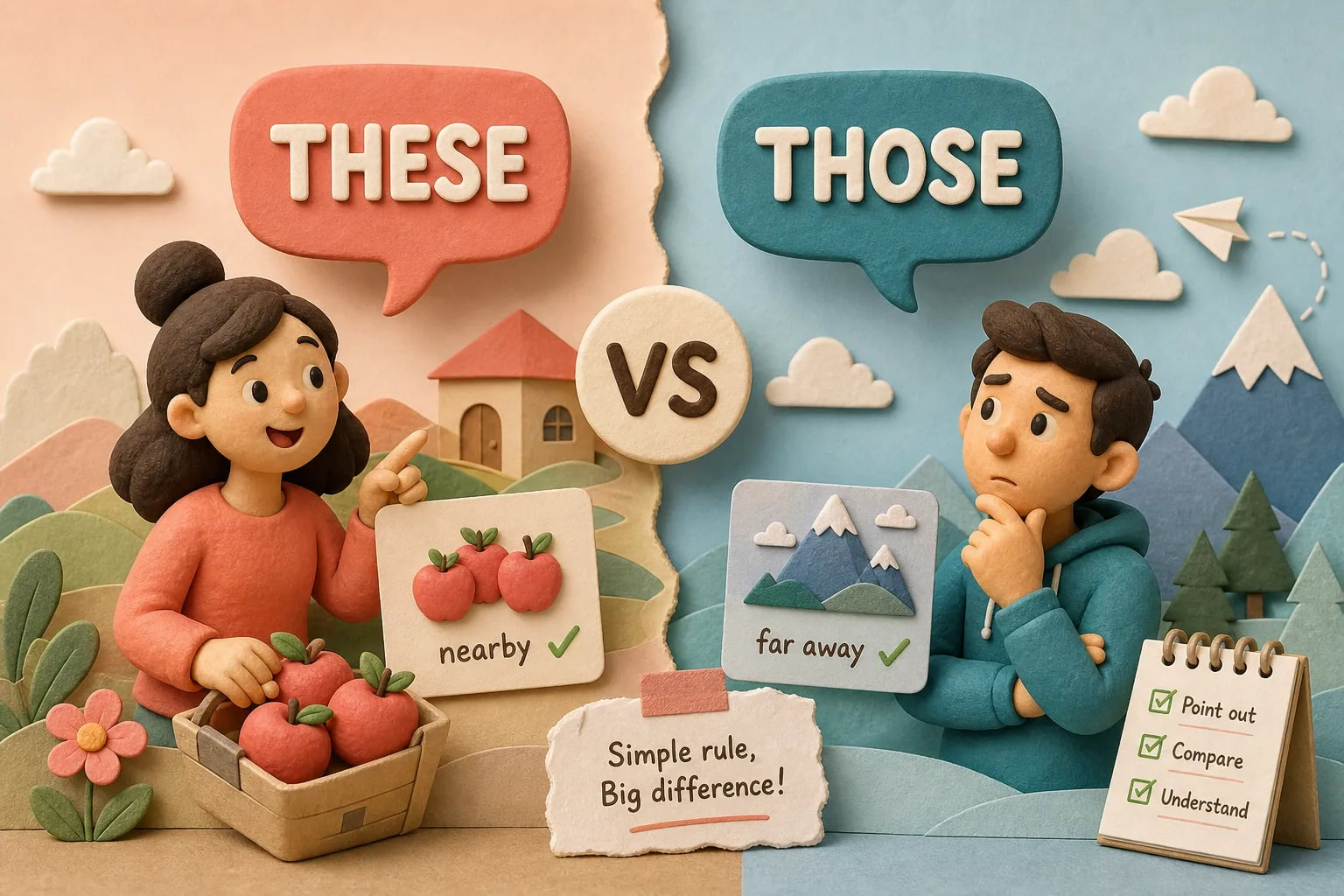
“These” and “those” are both plural demonstratives. A demonstrative is a word that points to specific things. The primary difference between “these” and “those” is proximity, how near or far something is from the speaker. That’s the heart of it.
Here’s how all four demonstrative words connect:
| Near | Far | |
|---|---|---|
| Singular (1 thing) | this | that |
| Plural (2+ things) | these | those |
Near = these, far = those
If the object is close to you, use “these.” If it’s far from you, use “those.” Proximity, the distance between you and the object, is the primary thing that matters when choosing between these vs those.
- “These apples in my hand are sweet.” (The apples are right here, in the speaker’s hand.)
- “Those apples on the top shelf look good too.” (The apples are farther away, across the store.)
“These” and “those” also work for time
Proximity isn’t only physical. It can also be about time. “These” points to something close in time, like right now or recently. “Those” points to something far in time, like a distant past. This temporal use follows the same near-vs-far logic as physical distance.
- “These days, I study English for 20 minutes every morning.” (now, current)
- “Those days in school were tough, but I learned a lot.” (a long time ago, far in the past)
Using These and Those Before a Noun
When “these” or “those” comes directly before a noun, it works as a demonstrative determiner. A determiner is a word that tells you which specific things you’re talking about. It narrows down the noun so the listener knows exactly what you mean.
At the store
Picture yourself shopping. The word you choose depends on where the items are relative to you.
- “These boots are exactly my size.” (The boots are right in front of the speaker, close enough to touch.)
- “Those boots on the display wall look amazing.” (The boots are across the store, farther away.)
- “Can I get a bag for these items?” (The items are in the speaker’s hands, nearby.)
For extra practice and examples, see how to use this, that, these, and those in English.
At work
The same rule works in the office. If the files or reports are right in front of you, use “these.” If they’re in another room, on a different server, or from a past time period, use “those.”
- “These files need to be sent today.” (The files are on the desk, right now.)
- “Those reports from last quarter are in the archive.” (The reports are in another location, from a past time.)
Using These and Those Without a Noun
“These” and “those” can also work as demonstrative pronouns. A pronoun is a word that replaces a noun. You use the pronoun form when the object is already clear from the situation, so you don’t need to repeat the noun.
When the noun is already understood
When everyone in the conversation knows what you’re pointing to, you can drop the noun entirely. Here’s how that sounds in a natural exchange:
Person A: “Which bags are yours?” Person B: “These are mine.” (The bags are close to Person B.) Person A: “And those?” Person B: “Those are Sarah’s.” (The bags are farther away, closer to Sarah.)
The proximity rule still applies, “these” for what’s near you, “those” for what’s farther away. The only thing that changes is that no noun follows the word.
For a short grammar note, check Cambridge Dictionary’s guide to this/that/these/those.
Introducing people nearby
One very common use in American English is introducing people. When the people are standing right next to you, use “these.” When they’re across the room, use “those.”
- “These are my friends, Sarah and Mike.” (Sarah and Mike are standing nearby, right next to the speaker.)
- “Those are my coworkers over there by the window.” (The coworkers are on the other side of the room.)
These vs Those in Real American Conversations
Reading a rule is one thing. Hearing it in a real conversation is another. Here are three short dialogues that show how native American English speakers use these words naturally.
Shopping dialogue
Customer: “Excuse me, are these jackets on sale?” Employee: “Yes, all of these are 30% off today.” Customer: “Great. What about those on the rack over there?” Employee: “Those are full price, but they’re a newer style.” Customer: “I’ll try a couple of these on first, then.”
Notice: The customer uses “these” for the jackets right in front of her and “those” for the jackets on a rack across the store. Same rule, applied twice in one short conversation.
Workplace dialogue
Coworker A: “Did you finish these slides for the presentation?” Coworker B: “Yes, these are ready. Do you need me to update those charts from yesterday’s meeting?” Coworker A: “Yes. Those numbers changed. I’ll send you the new data.” Coworker B: “Perfect. I’ll update those and send everything over by noon.”
Notice: “These slides” are on the desk right now. “Those charts” and “those numbers” come from a previous meeting, so they feel more distant, which is why “those” fits.
Casual conversation
Friend A: “I love these new coffee shops opening up in the neighborhood.” Friend B: “Me too. These places are so much better than those big chains.” Friend A: “Remember those little diners we used to go to back in school?” Friend B: “Yes! Those were great. Nothing fancy, but the food was amazing.”
Notice: “These coffee shops” and “these places” are current and nearby in time. “Those big chains” feel more distant in a psychological sense, and “those diners” refer to a distant past. The time-distance rule shows up naturally here.
Common Mistakes and How to Fix Them
Even intermediate learners make these errors regularly. Here are the most common ones, along with the fix for each.
Singular vs. plural mix-ups
One of the most frequent mistakes is using “this” or “that” (singular) when you need the plural form. If you’re talking about more than one thing, you need “these” or “those.”
- Incorrect: “This shoes are too small.” / Correct: “These shoes are too small.“
- Incorrect: “That pants look great on you.” / Correct: “Those pants look great on you.“
A quick check: count the objects. If there are two or more, “this” and “that” are wrong. Use “these” or “those” instead.
When to Use These vs Those: Getting the Distance Right
Some learners use “those” for things that are right in front of them, or “these” for things far away. This often happens because of direct translation from another language, where the near/far distinction works differently.
- Situation: You’re holding a menu at a restaurant. / Incorrect: “I want to order those items.” / Correct: “I want to order these items.“
- Situation: You’re pointing to a building across the street. / Incorrect: “These apartments look new.” / Correct: “Those apartments look new.“
One more note: in some Southern American regions, you may hear people say “them” instead of “those,” as in “them shoes” or “them people.” This is a non-standard dialect feature rooted in certain regional and informal speech patterns. It’s non-standard in formal writing and standard American English, so if your goal is to speak and write standard American English, avoid it in those contexts.
Try It Yourself: Quick Practice
Use this short exercise to check your understanding of these vs those. Choose “these” or “those” for each sentence.
Fill in the blank
- “Can you pass me ________ folders? They’re right here on my desk.” (these / those)
- “Do you remember ________ summer trips we took as kids? I miss them.” (these / those)
- “________ are my parents. Mom, Dad, meet my coworker James.” (These / Those)
- “Look at ________ mountains in the distance. Aren’t they beautiful?” (these / those)
- “I’ll take ________ two, please.” (The items are in the speaker’s hand.) (these / those)
Answers and explanations
- These. The folders are right on the desk, close to the speaker.
- Those. The summer trips are in the distant past, far in time.
- These. The parents are standing right next to the speaker, so “these” is the right choice for an introduction.
- Those. The mountains are far away in the distance, not close to the speaker.
- These. The items are in the speaker’s hand, which makes them near.
Now write your own: Look at your surroundings right now. Write one sentence using “these” and one using “those.” For example: “These headphones on my desk are new. Those books on the shelf are from my old English class.”
You can also browse our Everyday American English section, or read our article on Filler Phrases Every American English Learner Should Know.
The Short Version to Remember
When it comes to these vs those, there’s one core principle: proximity. “These” is the plural of “this” and points to things that are near. “Those” is the plural of “that” and points to things that are far. Near and far can mean physical distance or distance in time, and in some cases, even emotional or psychological distance.
Both words can act as demonstrative determiners (before a noun: “these shoes,” “those reports”) or as demonstrative pronouns (alone: “these are mine,” “those are yours”). The proximity rule stays the same either way. The only thing that changes is whether a noun follows the word.
Start noticing these words in real American English. Watch a TV show and listen for when characters say “these” vs. “those.” Pay attention in stores, at work, or in conversations around you. The more you notice examples of these and those in real situations, the more natural they’ll feel when you use them. If you want to keep building your American English grammar through real situations and practical examples, explore more lessons at Your Daily American. Every lesson is designed to help you use English in the real world, not just understand it on paper.
See LinguaPress’s overview of demonstratives for extra detail.