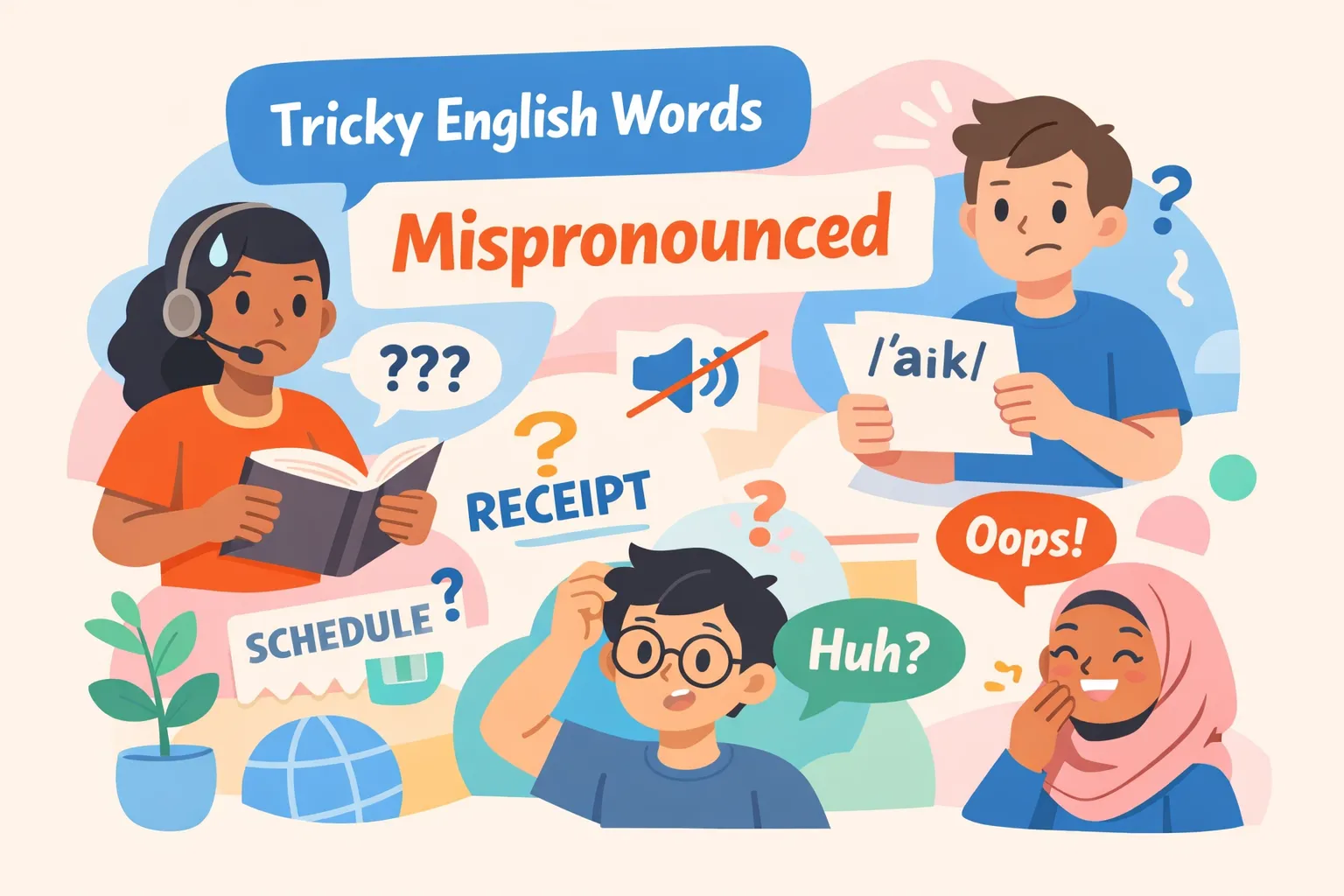
If you’ve ever wondered what English words non-native speakers mispronounce most often, you already know the feeling behind the question. You’ve studied “epitome” for months. You know exactly what it means, you’ve used it confidently in writing, and then the moment arrives in a meeting when you say it out loud: “epi-TOHM.” The room goes quiet for half a second. Someone tilts their head. The conversation continues, but something shifted. That gap between knowing a word and saying it the way Americans actually say it is one of the most frustrating experiences in language learning, and it has nothing to do with intelligence or effort.
At Your Daily American, pronunciation questions are among the most frequent topics our readers bring to us. The same words keep appearing again and again from learners across many different language backgrounds and proficiency levels. That pattern is actually good news: mispronunciation isn’t random. It follows predictable rules, which means it has predictable fixes.
This article covers the commonly mispronounced English words that give non-native speakers the most trouble, explains the specific reasons each one goes wrong, and gives you targeted drills to correct them. You’ll also see how your first language shapes which words give you the most trouble, so you can stop practicing everything equally and focus where it actually counts.
Why English Spelling Makes Pronunciation So Unpredictable
The Spelling-to-Sound Gap That Catches Every Learner Off Guard
English borrows from Latin, French, Germanic, and Norse roots, which means the same letter combination can produce completely different sounds depending on the word’s origin. Take “ough”: it sounds different in “though,” “through,” “thought,” and “tough.” Learners who encounter words in reading first build a mental sound model from the spelling, and that model is wrong before they ever open their mouth.
Silent letters create another layer of confusion. “Choir” looks like it should start with a “ch” sound, but it doesn’t. “Drawer” looks like it has two clear syllables, but native speakers collapse it. “Niche” carries its French spelling into English but not its French pronunciation, at least not in American English. Each of these words needs to be treated as a memorized sound unit, not decoded letter by letter.
Stress Patterns With No Clear Rule
Unlike Spanish or Italian, English has no predictable stress placement rule. “REcord” and “reCORD” are spelled identically but function differently as a noun and a verb. Stress shifts meaning, and it also shifts how recognizable a word is to a listener. When stress lands on the wrong syllable, even a perfectly-sounded word can fail to land.
“Mischievous” is a classic example of stress going wrong. The word has three syllables: “MIS-chiv-us.” But because the spelling looks like it should have four syllables, learners say “mis-CHEE-vee-us,” which sounds like a different word entirely. The spelling invited the error. English stress is shaped by word origin, among other factors, rather than letter count, and recognizing that connection is often the first shift that makes a noticeable difference.
What English Words Do Non-Native Speakers Mispronounce Most Often?
Silent Letter Traps: Choir, Drawer, and Niche
“Choir” is not “choy-er.” The correct American pronunciation is “kwire,” with the “ch” working like the “qu” in “quick.” “Drawer” collapses into roughly “dror” rather than the two-syllable “draw-er.” And “niche,” which many learners carry over from French as “nee-shay,” is simply “neech” in standard American speech. These words have no phonetic logic you can apply on the fly.
What helps most with silent-letter words is treating each one as a single stored sound unit rather than a string of letters to decode. When you encounter a new word in this category, look it up in a pronunciation dictionary, listen to the audio, and repeat it as a whole chunk. Trying to reason through the spelling will steer you wrong almost every time.
Stress and Vowel Surprises: Epitome, Mischievous, February
“epitome” ends not in a hard “tome” but in “uh-mee”: the full pronunciation is “ih-PIT-uh-mee.” “February” loses its first “r” for most learners, turning into “FEB-yoo-air-ee” rather than “FEB-roo-air-ee,” though even many native speakers drop that “r.” “Squirrel” is notoriously difficult because it piles up the /skw/ cluster at the start and /rl/ at the end with no vowel to separate them, so learners often insert one: “es-kwir-el.”
Other tricky English pronunciation cases include “gauge” (often said as “gowj” instead of “gayj”), “genre” (often “jen-re” instead of “zhahn-ruh”), “hierarchy” (missing the full four syllables: “hahy-uh-rahr-kee”), and “colleague” (said as “KOH-luhj” instead of “KOH-leeg”). Each of these carries a French or Latin origin that breaks the rules learners have internalized for everyday English spelling.
The Error Patterns Behind Most Pronunciation Mistakes
Vowel Length and Vowel Quality Confusion
English has 12 to 14 distinct vowel sounds. Most languages have five or fewer. Learners constantly map English vowels onto a smaller mental inventory, which creates real confusion in conversation. The short /ɪ/ in “ship” and the long /iː/ in “sheep” aren’t just different in vowel length; they require entirely different tongue positions. Getting the length right while the quality is wrong still sounds wrong.
This vowel mismatch produces some of the most common errors: “since” pronounced as “seens,” “live” rhyming with “leave,” “fill” sounding like “feel.” These aren’t random slips. They’re the result of a five-vowel system trying to fit into a fourteen-vowel language. The fix isn’t just practicing more; it’s learning the physical mouth position for each new sound.
Consonant Clusters and Word Stress Errors
English allows consonant sequences that simply don’t exist in many languages. Spanish avoids complex clusters, so learners add a vowel to make the sequence feel natural: “stress” becomes “e-stress,” “school” becomes “es-cool.” The same pattern appears with “squirrel” and “explained.” The inserted vowel feels necessary because the learner’s mouth has never been trained to produce the cluster directly.
Stress errors compound the problem. Saying “proNUNciation” instead of the correct /prəˌnʌnsiˈeɪʃən/ can make even correctly-articulated individual sounds difficult to recognize in context. Listeners process speech in rhythmic chunks, and when the stress pattern doesn’t match expectations, comprehension slows. Stress isn’t decoration; it’s part of the word.
How Your First Language Shapes Which Words Give You Trouble
What Spanish Speakers Consistently Struggle With in English
Spanish has five vowels and no phonemic distinction between /b/ and /v/, which creates two immediate and predictable problems. “Very” comes out as “berry,” and “vowels” can sound like “bowels.” The /dʒ/ sound in “job” or “just” gets replaced by a /y/ sound, so “job” becomes “yob” and “just” becomes “yust.” These aren’t careless errors; they’re direct transfers from sounds that exist in Spanish onto the closest English equivalent.
Vowel contrasts cause additional trouble. The “ship” and “sheep” distinction collapses because Spanish has no /ɪ/ separate from /iː/. Consonant clusters trigger epenthesis. These patterns are entirely predictable, which is good news: a predictable error has a predictable fix. Targeted drilling on the specific phonemes Spanish doesn’t use will get you further than general pronunciation practice ever will.
Pronunciation Tips for Non-Native Speakers From Other Language Backgrounds
Chinese speakers often struggle with final consonants, producing “lam” instead of “lamp” or simplifying consonant blends. The /l/ and /n/ contrast frequently collapses, making “nice” sound like “lice” and “light” sound like “night.” The short /ɪ/ vowel becomes the long /iː/, turning “fill” into “feel” and “him” into “heem.” The /θ/ sound in “three” or “think” has no equivalent in Mandarin, so it often gets replaced by /f/ or /t/.
Arabic speakers typically replace /p/ with /b/ (turning “park” into “bark”) and /θ/ with /t/ or /s/ (so “think” becomes “tink” or “sink”). Russian speakers replace /w/ with /v/ (making “wine” sound like “vine”), drop the /h/ sound, and fully pronounce unstressed vowels instead of reducing them to a schwa. Each of these patterns comes directly from a phoneme gap in the first language, not a gap in dedication from the learner.
Short Drills That Actually Fix These Errors
Minimal Pairs: A Fast Tool for Vowel and Consonant Corrections
A minimal pair is two words that differ by exactly one sound: “ship” and “sheep,” “bat” and “bad,” “very” and “berry.” Drilling minimal pairs trains your ear to hear the distinction before your mouth can produce it reliably. Start slowly with deliberate articulation, then increase speed until the distinction becomes automatic. Short, targeted drills focused on your specific L1 gaps tend to produce faster gains than unfocused general listening practice.
Target your drills to your specific background. For Spanish speakers: “very/berry,” “van/ban,” “job/yob,” “ship/sheep.” For Chinese speakers: “right/light,” “three/free,” “fill/feel,” “lamp/lam.” For Arabic speakers: “park/bark,” “think/tink,” “pin/bin.” For Russian speakers: “wine/vine,” “hat/at,” “ship/sheep.” The specificity matters because you’re not building general pronunciation awareness; you’re building new muscle memory for phonemes your first language never required.
Articulatory Tips for Hard Words
For “squirrel,” practice the /skw/ cluster in isolation first: “skw-skw-skw.” Get comfortable with that sequence before you attach the rest of the word. For “epitome,” say “ih-PIT-uh” three times, then add “mee” at the end. For “choir,” treat the “ch” exactly as you would the “qu” in “quick,” because phonetically it works the same way. Exaggerating the correct mouth position in slow, deliberate repetition is more effective than simply streaming audio repeatedly without active focus on articulation.
Record yourself saying the target word, then compare it to a native speaker saying the same word at normal speed. The gap you hear is your target. Don’t move on from a word until you can produce it at normal conversational speed without thinking about it. That automaticity is the goal, not careful slow-motion accuracy.
Where Isolated Word Practice Falls Short, and What Works Instead
Why Drilling Words in a List Only Gets You So Far
Fixing a pronunciation in isolation doesn’t automatically transfer to real conversation. You can nail “February” in a quiet room and then revert to the wrong version the moment you’re mid-sentence with a colleague, because fluency under conversational pressure uses a different mental pathway than careful practice. The word needs to live inside a sentence, a scenario, and a realistic social context before it sticks in production.
This is the part most pronunciation resources miss. A list of 50 words with IPA transcriptions gives you a map, but it doesn’t put you on the road. You need to hear “epitome” used in a real work conversation, practice it in that setting, and retrieve it in the same setting again. Context builds the neural path that makes the correct version automatic.
How Your Daily American’s Pronunciation Lessons Tackle This
Your Daily American‘s pronunciation-focused lessons are built around exactly this challenge. Instead of isolated word drills, each lesson embeds target words and sounds into real conversational contexts: work meetings, casual small talk, ordering at a counter, introducing yourself in a new setting. You practice the word the same way you’ll eventually need to use it, which is what makes the correct version stick under real-world pressure.
Many of the words covered in this article appear directly in Your Daily American lessons, with pronunciation guidance tied to actual American scenarios rather than textbook sentences. The platform is designed specifically for adult learners who already have vocabulary but need to close the gap between knowing a word and saying it naturally. That’s exactly the gap this article is about.
Putting It Into Practice
Now you know what English words non-native speakers mispronounce most often, and more importantly, why each one goes wrong. They cluster around silent letters, irregular stress, vowel gaps between your first language and English, and consonant clusters that require new muscle memory. Knowing which category your mistakes fall into lets you target your practice instead of spreading effort across everything equally.
Pick two or three words from this article that you already know you say wrong. Run them through the minimal pair drills in the section above, then find a real sentence where those words come up naturally and practice them in that context. Isolation first, then context: that’s the path from knowing a word to saying it correctly under real-world pressure.
For a ready reference of commonly mispronounced items to practice with, see this list of commonly mispronounced words, which pairs well with targeted drills.
For learners who want to go further, Your Daily American’s pronunciation lessons give you exactly that kind of contextual practice, built around the American English you actually hear in daily life. Start with the words that are already costing you in conversations. Fix those first, then keep moving. For a systematic way to schedule and review new pronunciations, see our guide to learning with Anki.
Learn more About, Your Daily American if you’d like to see how our lessons are structured and which modules might match your needs.