Picture this: you are in a work meeting and your manager looks at you and says, “I don’t need exact numbers yet. Just give me a ballpark figure.” Everyone around the table nods. But you freeze. What does that phrase actually mean? And what are you supposed to say next?
Many learners report this kind of hesitation, not because they lack the knowledge, but because no one taught them the phrase. At Your Daily American, we believe the best way to learn an American expression is to understand the story behind it, know when to use it, and practice it with real examples. That is exactly what this article covers.
By the end, you will be able to define “ballpark figure,” explain where it comes from, use it correctly in meetings and emails, and give a rough estimate with confidence.
What “ballpark figure” actually means
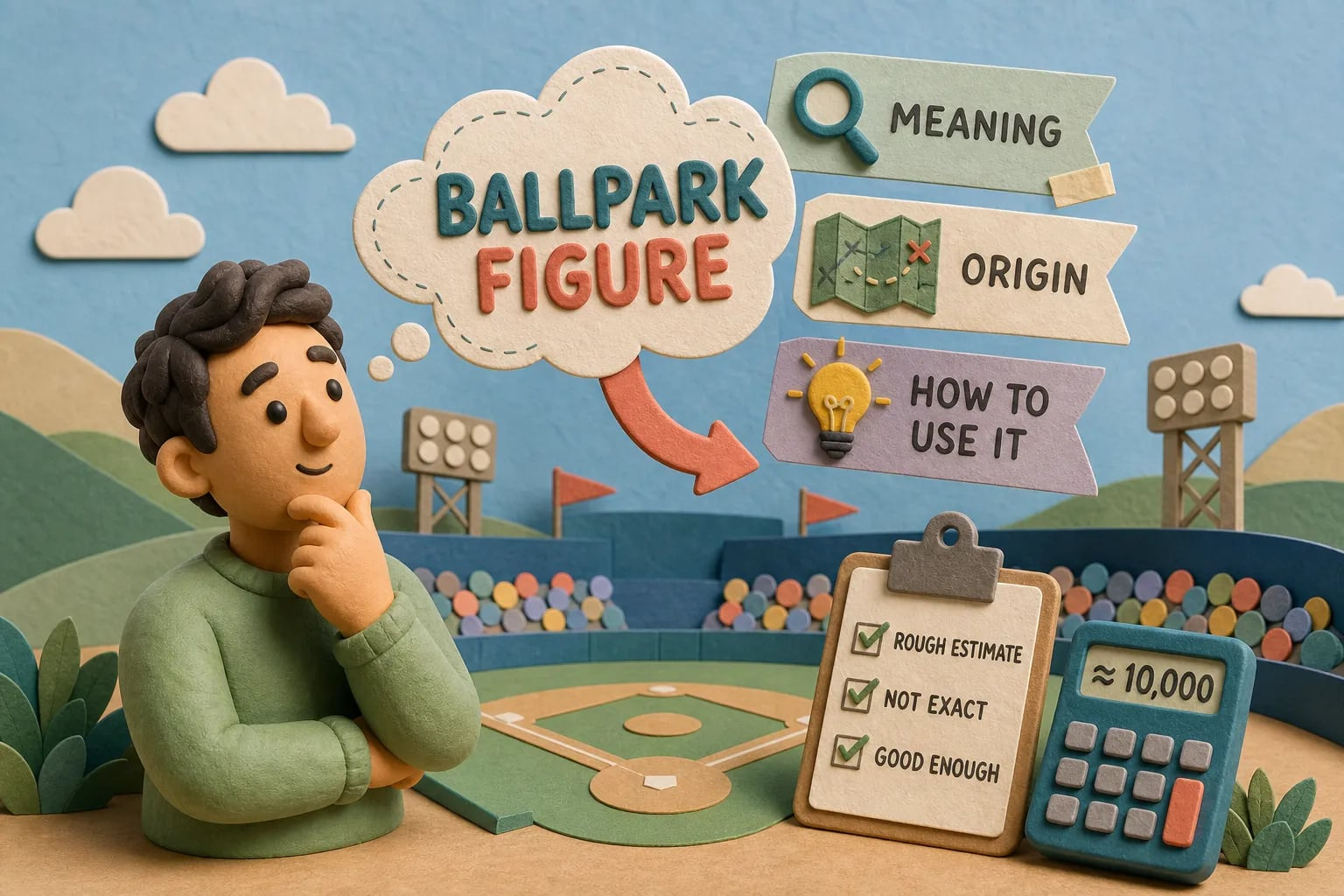
A ballpark figure is a rough estimate, not an exact number, but a general idea of a cost, a quantity, or a timeline when you do not yet have precise information. Think of it this way: “The project will cost somewhere between $5,000 and $8,000.” That is a ballpark figure. It is not a final price or a commitment. It is a starting point that gives everyone enough to keep the conversation moving.
The typical accuracy range for a ballpark figure is roughly ±30% to 50%, and sometimes wider. That wide range is intentional. The goal is not precision. The goal is to answer a much simpler question: “Are we talking about $5,000 or $500,000?” A quick estimate like this lets people decide whether to keep planning or stop before committing time and resources to a detailed analysis, sometimes called a rough order of magnitude (ROM) in project management and engineering contexts.
You will hear several similar phrases in American English. Here is a quick guide to the most common ones:
- Ballpark number: an informal synonym for ballpark figure, used interchangeably in conversation
- Rough estimate: a general number that is not exact
- Guesstimate: an estimate based partly on a guess, not hard data
- Approximate figure: a number that is close but not precise
- Back-of-the-envelope estimate: a quick calculation using simple math
All of these phrases describe a similar idea. In spoken American business English, “ballpark figure” and “ballpark estimate” are among the most common choices you will hear in meetings and on calls. If you are going to learn one, make it this one.
The baseball story behind the phrase
“Ballpark” literally means a baseball stadium. According to Merriam-Webster and the Online Etymology Dictionary, the word was first recorded in 1893. A typical baseball stadium is large, roughly 330 feet (about 100 meters) across an outfield. In the 1950s, scientists and engineers began using the size of a ballpark as a practical comparison: if a missile “lands in the ballpark,” it is close enough to the target. The earliest recorded figurative use dates to 1954, in the context of atomic weapons testing.
By the late 1950s, the phrase had moved out of science labs. Newspaper columnists described it as Pentagon language for “a very rough estimate.” By the 1960s, it had entered everyday business conversation. The specific adjective form, “a ballpark figure”, was first recorded around 1967.
Knowing this history is genuinely useful. When you picture a large baseball stadium, the meaning clicks immediately. You are not asking for a number that hits the exact center of the field. You just need a number that lands somewhere inside the stadium. That mental image works far better than memorizing a definition from a list.
When to use a ballpark figure at work
A ballpark figure belongs in early conversations, not final decisions. It is the right tool when someone needs a rough number to move forward but the details are not ready yet. These are the moments when it fits naturally:
- A client asks about project costs before work has started
- Your manager needs a rough budget number to get approval for a project
- A colleague wants to know roughly how long a task will take
- You are comparing two options and need approximate numbers to decide which one to explore further
In all of these situations, a rough number moves the conversation forward and helps people make a quick decision without waiting for perfect information. Think of it as the difference between “We have no idea what this costs” and “We know we’re somewhere in the $10,000, $20,000 range”, that second statement is enough to keep a project alive while the details get worked out.
There are also times when you should not use a ballpark figure. Avoid it in contracts, legal documents, or final proposals. Once you have enough information to calculate a more precise number, use that instead. Also, be careful when the other person needs a number they can act on directly. A ballpark figure is a starting point, not a commitment. If the listener hears it as a final price, that creates a problem later.
How to give a reliable ballpark figure
Many people freeze when asked for a rough estimate because they are afraid of being wrong. Here is the good news: a ballpark figure is supposed to be imprecise. You just need a method. Here are three that work in most professional situations.
1. Order of magnitude
Round your numbers to the nearest 10, 100, or 1,000. For example, 987 becomes 1,000. This makes mental math much faster and keeps your estimate in the right general range. If a project has four tasks and each one takes about three days, you round to roughly 12 to 15 days total. No spreadsheet required.
2. Rule of thumb
Apply a standard percentage from your field. In project management, a common heuristic is to add roughly 20% to a base number as a contingency for surprises and extra costs, though the right buffer varies by industry. If materials cost about $10,000, your ballpark for the total project might be around $12,000. It is a simple and widely used method in business planning.
3. Sizing by analogy
Compare the new project to a similar one you already know. If a past project of the same size cost $15,000 and took three months, those numbers are your starting point. This method is especially useful when you do not have time to calculate anything from scratch.
One more best practice worth following: give a range, not a single number. Instead of saying “about $10,000,” say “somewhere between $10,000 and $15,000.” A range signals that you are being honest about the uncertainty and sets the right expectation for everyone in the room. It also protects you if the final number turns out differently.
Natural phrases for asking and giving ballpark estimates
Knowing what “ballpark figure” means is useful. Knowing how to use it in a real conversation is even better. Here are the phrases American professionals actually use.
To ask for a ballpark figure:
- “Can you give me a ballpark on that?”
- “I don’t need an exact number. Just a rough idea.”
- “What’s the ballpark for this project?”
- “Roughly speaking, what are we looking at?”
Each of these phrases signals that you are not asking for precision, they invite a quick, informal answer and give the other person permission to estimate without pressure. Notice how none of them put the listener on the spot for a final commitment.
To give a ballpark figure in a meeting:
- “Ballpark, I’d say around $20,000.”
- “My rough estimate would be somewhere between two and four weeks.”
- “Off the top of my head, probably in the $5,000 range, but I’d need to check the details.”
Notice that each of these phrases labels the number as approximate. That label matters. It tells the listener: “This is my best guess right now, not a final answer.” That small addition sets the right expectation and keeps you from being held to a number you gave without full information.
To frame a ballpark figure in a business email:
Here is a short example you can use or adapt:
“As a quick ballpark, the total cost for this phase would be in the range of $8,000 to $12,000. I’ll send a more detailed estimate once we finalize the scope.”
That two-sentence structure is clean and professional. It gives a number, signals that it is approximate, and tells the reader when a more precise figure is coming. Use this pattern whenever you need to reply quickly but cannot yet commit to a final number.
Try it yourself: three quick practice scenarios
Reading about a phrase is one step. Using it is the next one. Try writing a response to each of these situations. Keep your answers short, two or three sentences each.
Practice 1: The meeting question. Your manager asks: “We’re thinking about redesigning the website. What’s the ballpark?” Write a two-sentence response using one of the phrases from the previous section. Focus on giving a range, not a single number.
Practice 2: The email reply. A client emails you asking roughly how long a project will take. You do not have full details yet. Write two or three sentences replying with a ballpark timeline. Remember to label your number as an estimate and mention when you will have better information.
Practice 3: Asking for one yourself. You need to know if a new software tool fits your team’s budget, but you are not ready to ask for a formal quote. Write the question you would ask the salesperson to get a rough idea of the price.
If you want to keep learning American expressions like this one, with the cultural context and real examples that make them easy to remember and use, Your Daily American is built exactly for that. Every lesson connects language to real life, so you are always learning something you can put to work right away.
Now you know your ballpark
Here is a quick summary. A ballpark figure is a rough estimate used when exact data is not yet available. The phrase comes from baseball and entered everyday American business language by the 1960s. It is best used in early planning conversations, not in contracts or final proposals.
Three simple methods can help you produce one quickly: rounding to the order of magnitude, applying a rule of thumb from your field, and comparing a new situation to a similar one you already know. Natural phrases like “Ballpark, I’d say…” and “Can you give me a rough idea?” make asking and giving estimates feel comfortable in any professional setting.
The best way to make any expression feel natural is to use it in a real situation. Try one of the practice scenarios above, then use the phrase in your next meeting or email. One real use does more for your fluency than rereading this article twice. And when you are ready for more American expressions with the cultural stories that make them stick, Your Daily American has everything you need to keep building your fluency, one real phrase at a time.