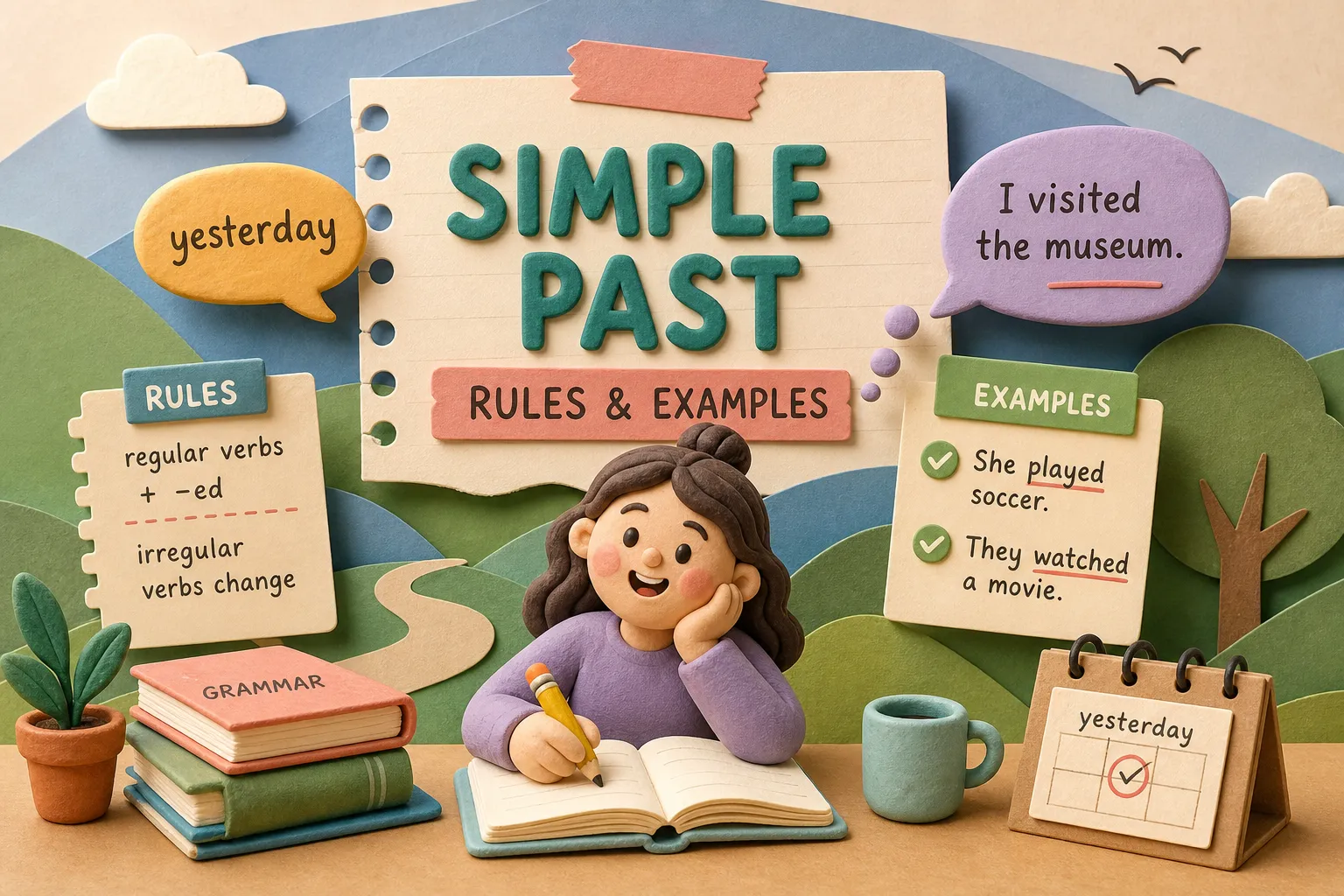
It’s Monday morning. Your coworker smiles and asks, “How was your weekend?” You want to tell her where you went, what you ate, and who you saw. Every single answer needs the simple past tense. This is one of the most common tenses in spoken American English, and knowing how to use it well makes your speech sound natural, whether you are chatting with a neighbor or updating your team at work. Linguists sometimes call it the preterite, but in everyday American English instruction, “simple past” is the term you will see most often.
By the end of this lesson, you will be able to form regular and irregular past tense verbs correctly, use the right time expressions, build negatives and questions with did and didn’t, and avoid the mistakes most learners make. This is exactly the kind of practical grammar lesson you will find across Your Daily American: real language for real situations, not abstract rules from a textbook.
1. How to form the simple past tense
English verbs fall into two groups in the past tense: regular and irregular. The group a verb belongs to tells you exactly how to change it. Start with regular verbs, then look at the ones you will use every single day.
Regular verbs: add -ed (with spelling rules)
Most regular verbs simply take -ed at the end. But spelling changes slightly depending on how the verb ends. Here are the five patterns you need to know:
- Standard: talk → talked, watch → watched (“I talked to my manager this morning.”)
- Silent -e: live → lived, create → created (“She lived in Boston for two years.”)
- Consonant + y: study → studied, carry → carried (“He studied for the test last night.”)
- Vowel + y: play → played, stay → stayed (“We stayed at a hotel last weekend.”)
- CVC doubling: stop → stopped, plan → planned (“The train stopped suddenly.”)
One important American English note: verbs ending in -l do not double the final letter. In American English, travel becomes traveled, not travelled. This is different from British English, so keep that in mind if you have studied from British materials. For extra guided practice on past simple with regular verbs, see the British Council’s past simple (regular verbs) page.
Irregular verbs you use every day
Irregular verbs do not follow the -ed pattern. Each one has its own past form, and you need to learn them one by one. The good news is that a small group of these verbs covers most of what you say and hear in daily American conversation.
| Base form | Past form | Example sentence |
|---|---|---|
| go | went | I went to the gym yesterday. |
| say | said | She said she would call me back. |
| get | got | He got a promotion last month. |
| make | made | We made dinner at home last night. |
| come | came | My friend came to visit last weekend. |
| see | saw | I saw a great movie on Friday. |
| know | knew | She knew the answer right away. |
| take | took | He took the early train this morning. |
| tell | told | My manager told me about the change. |
| find | found | We found a great restaurant downtown. |
| think | thought | I thought the meeting was at 3 PM. |
| give | gave | She gave me great feedback on my report. |
These verbs appear constantly in American daily speech and workplace communication. The more you practice them in full sentences, the faster they will become automatic. For a clear overview of common irregular verbs and how they behave, this short guide is a helpful reference.
2. Signal words that go with the simple past
Certain time expressions almost always appear with the simple past tense because they point to a finished moment in time. When you see or hear one of these words, the verb that follows almost certainly belongs in the past tense.
Time expressions for finished actions
Here are the main groups, each with a short example:
- Yesterday / yesterday morning / yesterday afternoon: “I sent the report yesterday afternoon.”
- Last + time word: “We had a team meeting last Friday.” / “She called last week.”
- [Number] + ago: “He started the job two months ago.” / “I moved here three years ago.”
- Specific dates and times: “The conference began on July 1st.” / “I submitted the form in 2024.”
One word that trips many learners up is ago. It always comes after the time reference, not before. You say “two days ago,” never “ago two days.” Practice this word order until it feels natural.
Using signal words in real sentences
Here is how these time expressions sound in natural conversation. Notice that each sentence points to a specific, finished time.
- “I went to New York last weekend and visited a few museums.”
- “Our team finished the project two weeks ago.”
- “She started her new position on Monday.”
Each sentence has a clear past time reference and uses the simple past tense. If your sentence includes one of these markers, check that your verb is in past form.
Simple past examples: practice sentences and exercises
The best way to lock in the simple past is to see it in action across different contexts, then try producing it yourself. Read through the examples below, then answer the quick-check questions that follow. If you’d like a compact explanation of past simple rules and usage before you practice, the past simple tense guide offers a clear summary.
More simple past examples by context
- Work: “My manager approved the budget last Tuesday.” / “We presented our findings at the meeting yesterday.”
- Daily life: “I made coffee, checked my phone, and left the house at 7.” / “They moved to a new apartment three months ago.”
- Social: “We went out for dinner on Saturday and ran into some old friends.” / “She texted me, but I didn’t see it until this morning.”
Quick-check quiz
Choose the correct verb form for each sentence. Answers appear below.
- She ______ (go/went) to the doctor last Thursday.
- They ______ (didn’t finish / didn’t finished) the report on time.
- Where ______ (did you go / did you went) after the meeting?
- He ______ (taked / took) the bus to work yesterday.
- I ______ (have went / went) to that restaurant two weeks ago.
Answers: 1. went 2. didn’t finish 3. did you go 4. took 5. went
3. Negatives and questions with did/didn’t
You do not just talk about what you did. You also need to say what you didn’t do and ask what others did. This is where many learners make errors, so read this section carefully.
Making negatives with didn’t
The structure is simple: subject + didn’t + base verb. The key word here is base. Because didn’t already carries the past meaning, the main verb goes back to its base form.
Here are three examples across different contexts:
- “I didn’t finish the report on time.”
- “She didn’t call me back yesterday.”
- “We didn’t go to the party last weekend.”
Notice that none of the main verbs are in past form. You never say “I didn’t finished” or “She didn’t called.” The word didn’t does all the past tense work.
Asking questions with did
For yes/no questions, the structure is: Did + subject + base verb? For wh- questions, add the question word at the front: Wh- word + did + subject + base verb?
Here are some natural examples you might hear at work or in daily conversation:
- “Did you see the game last night?” / “Yes, I did. / No, I didn’t.”
- “Did she send the invoice?” / “Yes, she did.”
- “Where did you go after work?”
- “What did your manager say in the meeting?”
One important exception: never use did with the verb be. You ask “Were you at the office?” not “Did you be at the office?” The verb be forms its own past tense with was and were, so it does not need did.
4. Simple past vs. present perfect: the key difference
These two tenses confuse many intermediate learners, especially those whose first language handles tense differently. The good news is that there is one clear test you can use every time.
Finished time = simple past
If the time is finished and specific, use the simple past. If the time is unfinished or you are describing an experience without saying exactly when, use the present perfect. Look at these contrast pairs:
- “I ate lunch at noon.” (finished, specific time) vs. “I’ve already eaten.” (no specific time; the result matters now)
- “I sent the email an hour ago.” vs. “I’ve sent the email.” (done and relevant now, no specific time given)
- “She lived in Chicago in 2019.” vs. “She has lived in Chicago for three years.” (she still lives there now)
Notice that the first sentence in each pair has a specific time marker. The second sentence has no specific time. That single detail tells you which tense to use. For a thorough explanation of the difference, see the Cambridge Dictionary’s guide to the past simple or present perfect.
Quick rule to remember
Here is a practical test: can you naturally add “yesterday,” “last week,” or “in [year]” to the sentence? If yes, use the simple past. If those time words feel wrong or strange, the present perfect is probably the better choice. This one test covers most situations you will face in daily American English.
5. Common mistakes ESL learners make
These are the error patterns that appear most often. Each one is easy to fix once you see it clearly.
Using the past form after did/didn’t
This is the most common error. Learners write “Did you went?” or “She didn’t went.” Both are wrong. The correct forms are “Did you go?” and “She didn’t go.” Remember: did and didn’t already show the past tense, so the main verb returns to its base form. No exceptions.
Mixing up irregular verb forms
A common habit is to apply -ed to irregular verbs or use the wrong form entirely. Here are the most common errors with corrections:
- “She goed to the store.” → “She went to the store.”
- “He taked the bus.” → “He took the bus.”
- “We buyed new chairs.” → “We bought new chairs.”
- “I have went.” → “I went.” (no auxiliary needed in the simple past)
Many learners are also surprised by the verb read: it looks identical in both present and past tense, but the pronunciation changes. Present tense: /riːd/ (sounds like “reed”). Past tense: /rɛd/ (sounds like “red”). In a sentence like “I read the report last night,” the word read is pronounced “red,” not “reed.” This matters for clear spoken American English.
Confusing simple past with past progressive
“I worked” describes a completed action. “I was working” describes an action that was in progress at a specific moment in the past. For example: “I worked on the report all morning” (completed) vs. “I was working on the report when my phone rang” (in progress when something else happened). They are not the same, and choosing the wrong one changes your meaning.
6. Try it yourself: quick practice
Reading about grammar is only the first step. You need to produce the language yourself to make it stick. Try these three prompts out loud or in writing. Use at least one time expression and one irregular verb in each answer.
Three conversation prompts to practice right now
- What did you do last weekend?
- Where did you go for your last vacation?
- What did you eat for breakfast this morning?
If you can answer all three with natural, complete sentences, you are already using the simple past the way a native speaker would in daily conversation.
A quick self-check
Before you finalize any sentence you write in the past tense, ask yourself these questions:
- Is the time finished? If yes, the simple past is most likely correct.
- Did you use the base form after did or didn’t?
- If the verb is irregular, did you use the correct past form instead of just adding -ed?
These three questions catch the majority of past tense errors. Make them a habit every time you write or speak in the past.
You now have the tools. Start using them today.
You can now form regular and irregular past tense verbs, use signal words to place actions in time, build negatives and questions with did and didn’t, and spot the most common errors before they happen. The simple past comes up constantly in American English, from Monday morning small talk to work updates to telling a story at dinner. This is grammar that earns its place in every real conversation.
At Your Daily American, every grammar lesson is built around real American situations just like the ones in this article. If you want to keep building your fluency in the same practical, step-by-step way, explore our Daily Grammar section. There is a free proficiency test there too, so you can see exactly where you stand and what to focus on next. For a focused review of tense forms, check our 12 English Verb Tenses: A Pocket Guide for Non-Native Speakers, and for more everyday phrases that sound natural in conversation, read Common American Expressions Every English Learner Should Know.
You have everything you need. Go use it.