You’re reading an email from your American manager. The subject line says: “Non-Disclosure Agreement, Please Review.” You pause. You know that “non” means something like “not,” but you’re not sure exactly what this agreement is or how to talk about it in your reply. A few minutes later, your colleague tells you the deadline is “non-negotiable.” What does that mean for you in the meeting tomorrow?
These moments happen every day in professional American English. This lesson explains the non prefix as it’s used in American English workplace language, where it appears, what it means, and how to spell it correctly. Once you understand how it works, you’ll recognize dozens of words immediately. By the end of this lesson, you’ll know what “non-” means, how to spell non- words correctly, and how to use the most important ones at work.
At Your Daily American, we build lessons around real situations like these, so you can use language right away, not just understand it on paper. This article is part of our professional vocabulary series.
Non prefix meaning and origin
The non prefix comes directly from Latin. The Latin word nōn means “not,” and it entered English through Latin-based vocabulary. You can see it in hundreds of common words: nonstop, nonfiction, nonprofit, nonsense. The pronunciation is always /nŏn/ (sounds like “nawn”), and adding “non-” to a word does not change how the base word sounds. For the formal dictionary entry on the prefix, see the Merriam-Webster definition of “non-“.
The most important idea to understand is this: “non-” signals absence or lack, not the opposite of something. This is what makes it different from other negative prefixes, which we’ll look at below. Nonfiction doesn’t mean bad fiction, it means writing that is simply not fiction. Nonflammable doesn’t mean fireproof, it means the material lacks the quality of being flammable. This neutral, factual meaning is exactly why the non prefix is so common in legal, formal, and professional writing. It states a fact without adding emotion or judgment.
Non prefix: hyphenation rules and spelling
Many ESL learners add a hyphen to every non- word because it looks safer. But the standard rule in American English is to write non- words without a hyphen. Three major style guides govern American professional writing: Merriam-Webster, the Chicago Manual of Style, and the AP Stylebook. All three agree on this point. Words like nonviolent, nonprofit, nonfiction, and nonrefundable are all written as one word with no hyphen. For authoritative guidance on prefix hyphenation, see the Chicago Manual of Style guidance on hyphenation.
There are three situations where you do use a hyphen. First, before a proper noun: non-American, non-European. Second, as a stylistic option when the word would create a double letter that looks visually awkward, for example, “non-native” instead of “nonnative.” Note that both forms are correct; this is a matter of preference, not a firm rule. Third, when “non-” attaches to a word that is already hyphenated: non-English-speaking. Outside of these three cases, close the word up and skip the hyphen.
Non- vs. un-, in-, and dis-: which one do you use?
This is where many ESL learners make mistakes. “Un-” is the most common negative prefix in English, so learners often reach for it out of habit. But “non-,” “un-,” “in-,” and “dis-” are not interchangeable. The right prefix depends on the specific word, and using the wrong one either sounds unnatural or creates a word that doesn’t exist.
Here is a clear comparison to help you choose:
- Non-: neutral absence or lack. Used with nouns and formal adjectives, especially in professional and legal writing. “Non-compliance” = the state of not complying. “Nonfiction” = not fiction.
- Un-: means “not” or can reverse an action. “Unlock” reverses locking. “Unhappy” = not happy, but it implies an opposite feeling. Common with adjectives and verbs.
- Dis-: means the opposite of something or an active reversal. “Disagree,” “disappear,” “disconnect.” Stronger than “non-.”
- In-: formal, Latin-based, attached to specific adjectives. “Inactive,” “incomplete,” “invisible.” Use “im-” before m, p, or b: “impossible,” “immature.”
A simple guideline: if you are writing a professional email or a contract, and the base word is a noun or a formal adjective, “non-” is usually the right choice. You cannot say “unfiction” or “unconprofit”, these do not exist. The correct words are “nonfiction” and “nonprofit” because convention has settled on the non prefix for these meanings. (See How to Write a Professional Email in American English, Your Daily American.)
Must-know non prefix words for the workplace
Non-disclosure and non-compete: the language of contracts
A non-disclosure agreement, often written as “NDA,” is a legal document that prevents someone from sharing private or confidential company information. “Non-disclosure” = not revealing information. You will see this term during job offers, business partnerships, and client meetings. Here is how it looks in a professional email:
“Before we share any proprietary details, our legal team will need you to sign a non-disclosure agreement. We can send it over later today.”
A non-compete clause is a part of an employment contract that prevents an employee from working for a competitor for a set period after the employee leaves their employer. When you see this in a contract, it means there are restrictions on where you can work next. Here is a typical example:
“The offer includes a non-compete clause covering a 12-month period.”
Non-negotiable and non-refundable: words you’ll hear every day
Non-negotiable is one of the most useful words in business English. It means a condition, price, or requirement that will not be changed. When someone says something is non-negotiable, they are closing the discussion on that point. Recognize this word as a signal to stop pushing back. Here is how it sounds in a real workplace conversation:
Colleague A: “Can we move the delivery date?”
Colleague B: “The client said the deadline is non-negotiable.”
Non-refundable means money that will not be returned to you. You will see this word in travel bookings, event registrations, and service contracts. Example: “Please note that the deposit is non-refundable once the contract is signed.” Both words carry a firm, final tone in professional writing. For practical workplace guidance on non-negotiable policies and flexibility, see this Forbes article on non-negotiable work policies.
Nonprofit and non-partisan: organizational vocabulary
A nonprofit (also written “non-profit”) is an organization that does not distribute its earnings to shareholders. Instead, it puts the money back into its mission, whether that is education, healthcare, or community services. You will see this word in job descriptions, grant applications, and news articles. Example: “We’ve been working with a local nonprofit to expand the program.”
Non-partisan means not supporting one political party or side. This word signals that a person, organization, or report is neutral and objective. It appears often in research reports, news sources, and government documents. Example: “The study was conducted by a non-partisan research group.” Both words signal credibility in American professional writing, so understanding them helps you read and write with more confidence.
Common non- words: a quick reference list
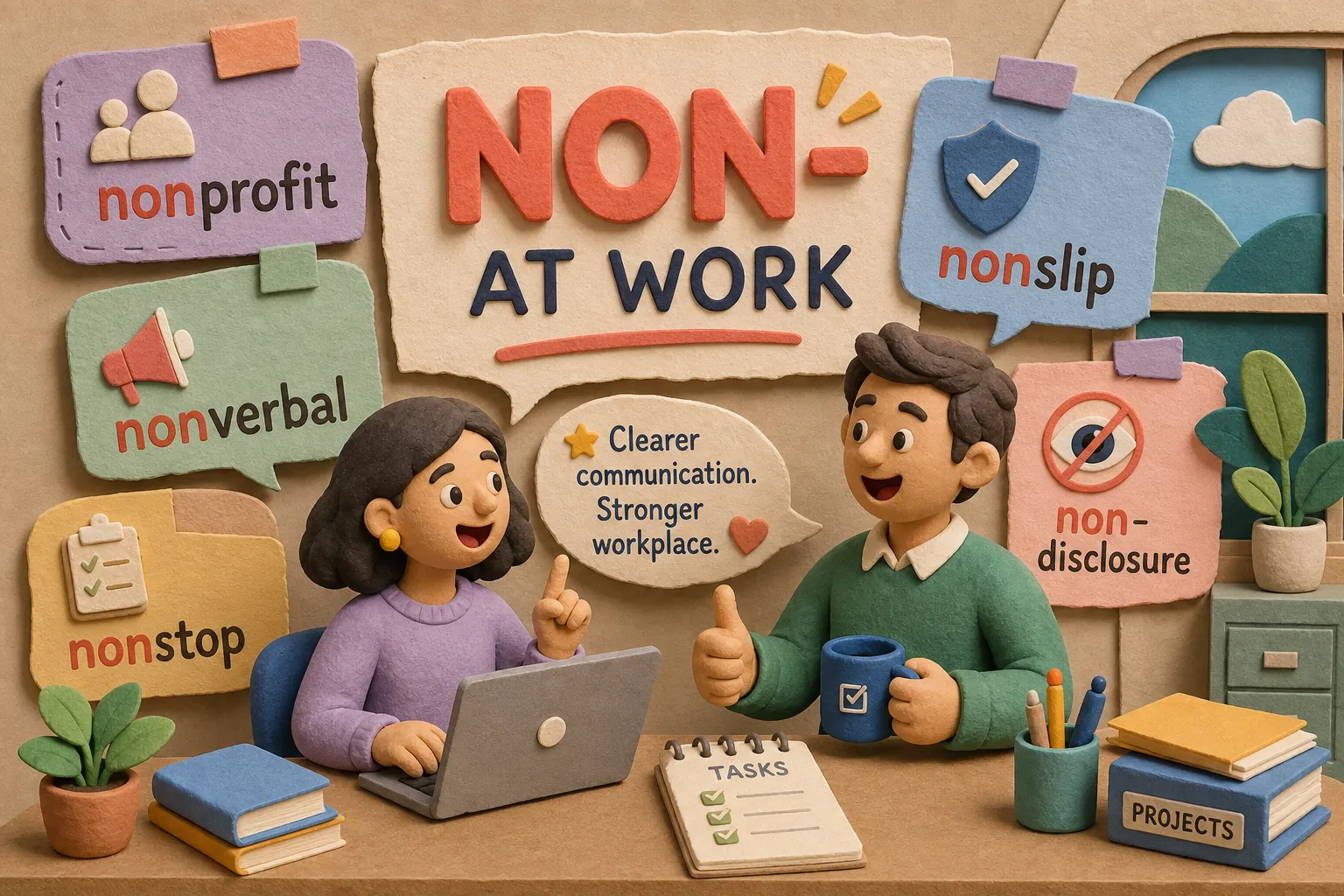
Below are some of the most frequently used non- words in American workplace settings. Scan through them and notice how each one signals absence or lack rather than active opposition.
- Noncompliance, failure to follow a rule or requirement
- Non-disclosure, the act of keeping information confidential
- Non-compete, a restriction on working for rivals after leaving a job
- Non-negotiable, a condition that cannot be changed
- Nonrefundable, a payment that will not be returned
- Nonprofit, an organization that reinvests earnings into its mission
- Non-partisan, free from political bias
- Nonfiction, writing based on real events and facts
- Nonflammable, not capable of catching fire easily
- Nonviolent, not involving physical force or harm
Bookmark this list and return to it as you encounter new non- words in emails, contracts, and reports.
A few non- words that confuse learners
Nonchalant describes someone who appears calm, relaxed, and unconcerned, and it is a great example of non prefix usage that goes beyond simple negation. It comes from French, not direct English negation, so the base word (“chale,” related to warmth) is not in modern English. Pronunciation: nawn-shuh-LAHNT. Example: “She was completely nonchalant about the presentation, even though it was her first time presenting to executives.” The word is not negative in tone. It simply describes a relaxed, unbothered manner.
Nonplussed is a word you should recognize in context before you use it yourself, because it has two meanings in American English today. The traditional meaning is: surprised and confused, unsure what to do. Example: “He was nonplussed by the sudden change in plans.” However, many Americans now use it to mean “unfazed” or “not impressed,” which is the opposite meaning. Because of this split in usage, it is safer to avoid it in formal writing. When you hear it, use the surrounding context to understand what the speaker means. For the standard dictionary entry and usage notes, see the Dictionary.com entry for “nonplussed”.
Nonentity does not simply mean “not an entity.” It describes a person or thing with no importance or significance. Example: “He was a nonentity in the industry before that project launched.” You will hear this word in more formal or news-style writing. It carries a slightly critical tone, so use it carefully.
Build your professional English vocabulary at Your Daily American
Understanding the non prefix is a real skill. Once you know how it works, words like non-disclosure, non-compete, non-negotiable, and nonprofit stop looking like difficult vocabulary and start looking like patterns you can read and use. That shift from confusion to recognition is exactly how fluency grows.
At Professional English, Your Daily American, the Professional English section has lessons on email phrases, meeting vocabulary, and formal versus informal register in American workplace communication. If you want to build a complete business word bank, those lessons connect directly to what you practiced here. Not sure where to start? Our free CEFR-aligned proficiency test shows you exactly where your vocabulary stands and what to build next. For extra practice on pronunciation pitfalls commonly made by learners, see English Words Non-Native Speakers Mispronounce Most Often, Your Daily American.
Try it yourself: a short practice exercise
Before you close this page, try these three short exercises. Writing something down helps you remember it much longer than just reading it.
- Write one sentence using “non-disclosure” as if you are asking a colleague about an agreement.
- Use “non-negotiable” in a sentence that describes a work situation you have been in or can imagine.
- Which is correct: “non-profitable” or “nonprofit”? Why?
The non prefix appears constantly in professional American English. Every time you see it, you now know it signals one clear idea: this thing lacks that quality. That is a simple, powerful rule. Apply it to new words as you read, and your professional vocabulary will grow faster than you expect.