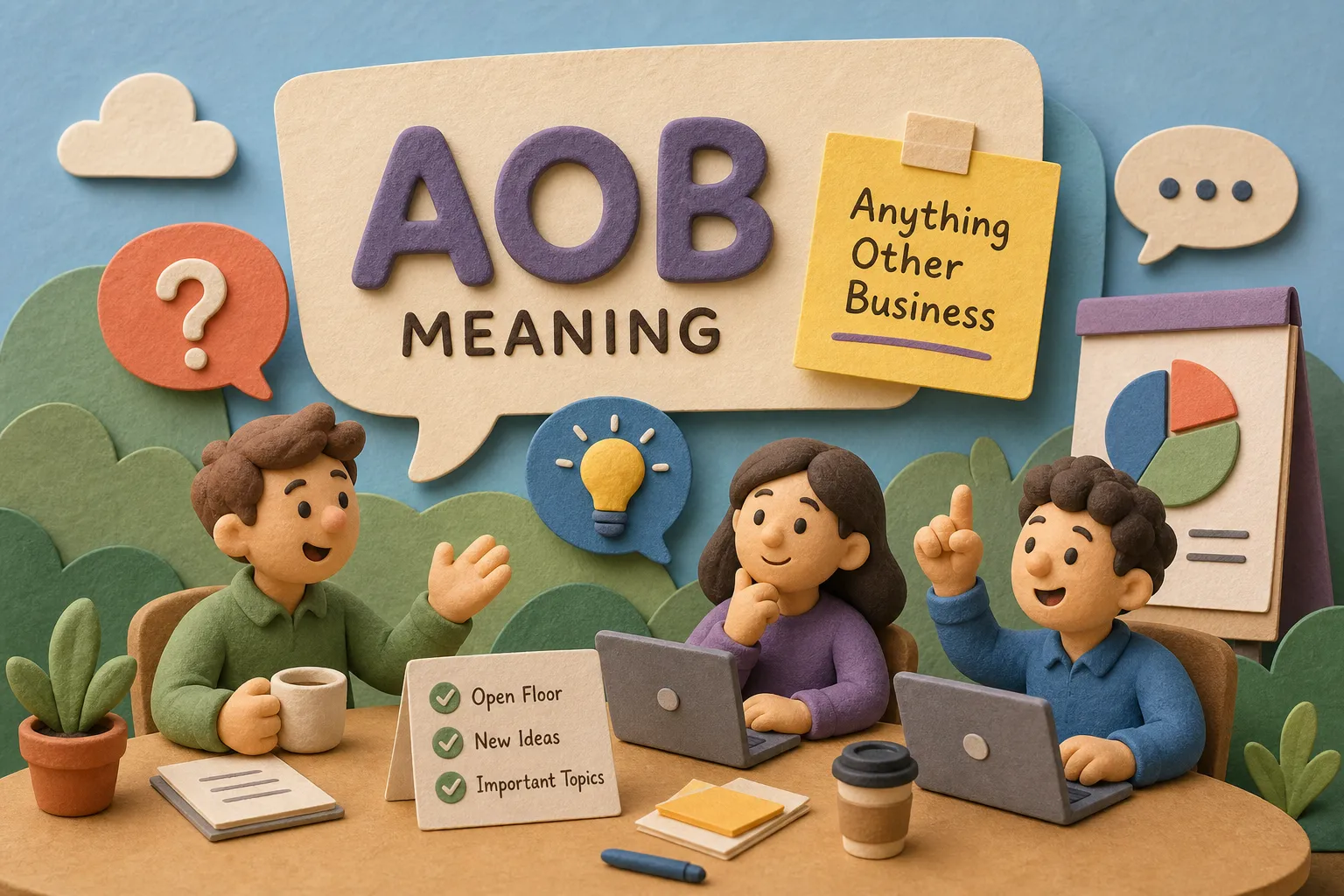
If you’ve ever sat in an English-language meeting and spotted “AOB” at the bottom of the agenda without knowing what it meant, you’re not alone. Understanding the AOB meaning is one of those small but genuinely useful gaps to close for any ESL professional working in American or international business settings.
Meeting agendas in English are full of abbreviations that native speakers use automatically but rarely explain. AOB is one of the most common, and not knowing what it means can leave you confused or silent at exactly the moment you could be contributing.
By the end of this article, you’ll know what AOB stands for, when and how to use it, how it appears in meeting minutes, and what a few other essential meeting agenda terms mean. You’ll also know what to say when the chair asks the room if there’s “any other business.”
What AOB Stands For and Where It Appears on an Agenda
AOB is short for “any other business.” It is a standard item placed at the very end of a meeting agenda. Its purpose is simple: it gives participants a chance to raise topics that were not included in the planned agenda.
Think of it as a short, open window at the end of a meeting. It’s for anything urgent or unexpected that came up after the agenda was finalized. It is not a place for long discussions or major decisions, just a brief catch-all for small but timely points.
Meeting agendas across corporate and professional settings consistently place AOB last. When you see it listed, it signals that the meeting is almost over and that the floor will be opened briefly for new points. It commonly appears in board meetings, team meetings, and committee meetings. The chair controls this section and decides what qualifies.
Here are two ways you’ll see it in practice:
- On the agenda: “5. AOB”
- Spoken by the chair: “Does anyone have any other business before we close?”
AOB Meaning in Meeting Agendas: Key Terms Every English Learner Should Know
Meeting agendas also carry several other abbreviations and fixed phrases alongside AOB. Knowing these terms helps you follow the meeting and respond at the right moment.
TBA stands for “to be announced.” It means the information exists but has not been shared yet. TBD stands for “to be determined.” It means a decision has not been made yet. Both appear as placeholders on agendas. For example, “Budget review, presenter TBA” means the presenter is confirmed internally but not yet announced to the group.
An action item is a specific task that someone agrees to complete after the meeting. It always has three parts: what needs to be done, who will do it, and by when. “Follow-up” means checking back on a previous task or decision. For a concise external definition and examples of common action items, see this resource on action-item best practices.
A motion is a formal proposal put forward for a vote, a term rooted in parliamentary procedure. A quorum (pronounced “KWOR-um”) is the minimum number of people required to hold a valid, official meeting, as defined by an organization’s governing rules.
If you want a complete vocabulary guide for business meetings in English, Your Daily American covers every stage of a formal meeting in clear, practical detail, with content built for international professionals working in American English environments.
How AOB Actually Works During a Meeting
When the meeting reaches the AOB point, the chair will typically say something like: “We’ve reached the end of the agenda. Does anyone have any other business?” or simply, “Any other business?” That’s your signal. If you have a point to raise, this is the moment.
AOB is for urgent, brief, or newly emerging topics only. Good AOB items include a quick update that affects the group, a time-sensitive announcement, or a minor administrative note. Avoid using this slot for something that requires a long discussion, a formal vote, or pre-reading by the group. If your topic is significant, it belongs on the main agenda for the next meeting.
Natural Phrases to Raise a Point During AOB
Here are some natural phrases you can use when it’s time to speak up:
- “I have a quick item, if I may.”
- “Before we close, I’d like to mention something.”
- “Can I raise a point here? It just came up this morning.”
Notice that these phrases are polite and brief. They signal to the chair that your item is short and genuinely new, the right tone for AOB. You are not opening a new meeting; you are adding a small note before the current one ends.
How AOB Is Recorded in Meeting Minutes
Meeting minutes are the official written record of what happened in a meeting. When something is raised under AOB, it must be recorded just like any formal agenda item. Being unplanned is not a reason to skip it. For guidance on how AOB entries commonly appear in formal minutes, see this explanation of AOB in meeting minutes.
Good AOB minutes include five things: who raised the point, a brief summary of what was discussed, any decision made, the person responsible for the follow-up, and the deadline. Focus on outcomes, not on the full conversation.
Here is a simple format you can follow or adapt:
Any Other Business (AOB):
- Item raised by: [Name]
- Topic: Brief description of the issue
- Decision / Action: What was agreed
- Owner: [Name]
- Deadline: [Date]
Do not write a word-for-word record of the conversation. Focus only on outcomes. The goal is for someone who missed the meeting to read the minutes and understand clearly what was decided and what happens next. Short and specific is always better than long and detailed.
One common mistake: some minute-takers skip the owner and deadline for AOB items because the discussion felt informal. Resist that habit. Without a named owner and a date, action items disappear, nothing gets done, and no one is accountable.
AOB Meaning in Other Contexts: A Quick Reference
Outside of meetings, AOB appears in a few other fields. Recognizing these meanings prevents confusion when you see the abbreviation in a different setting.
In healthcare, AOB has two separate meanings. In clinical notes, it stands for “alcohol on breath,” used by medical staff to record a physical observation about a patient. In medical billing, AOB stands for “assignment of benefits,” which is a legal agreement in which a patient allows their healthcare provider to bill the insurance company directly. Neither meaning is likely to come up in a business meeting, but both are worth knowing.
In computing and data fields, you may occasionally see AoB used as a technical term specific to those industries. In almost every case, if you see AOB on a printed agenda or a shared document, the meeting meaning applies.
Quick Practice: Are You Ready for AOB?
Before your next English-language meeting, try these short preparation steps.
Look at the agenda in advance and check whether AOB is listed. If it is, think about whether you have any brief, timely points to raise. For tips on preparing a clear, useful agenda that leaves room for items like AOB, this agenda checklist and template is practical and easy to apply. Then practice saying the phrases from the section above out loud, say “I have a quick item, if I may” until it sounds easy and natural. Finally, after the meeting, try writing a short AOB entry in the minutes format above, even if no AOB items came up. Building the habit before you need it is what makes the difference.
When the chair says “any other business?” you’ll be ready to respond clearly instead of wondering what the question means.
Now You Know the AOB Meaning
AOB stands for “any other business.” It appears at the end of a meeting agenda and signals an open window for brief, urgent, or unplanned topics. Raise a point with a short, polite phrase. Record it in minutes with an owner and a deadline. And keep in mind that in healthcare and a few technical fields, the same abbreviation carries a completely different meaning.
These terms are small, but knowing them changes how you show up in a room. You stop guessing and start participating, and that shift is what professional English fluency actually looks like in practice.
To go deeper into professional English for meetings, from how to open a discussion to how to disagree without causing tension, take a deep dive into business English. Every lesson is practical and grounded in real American workplace language.