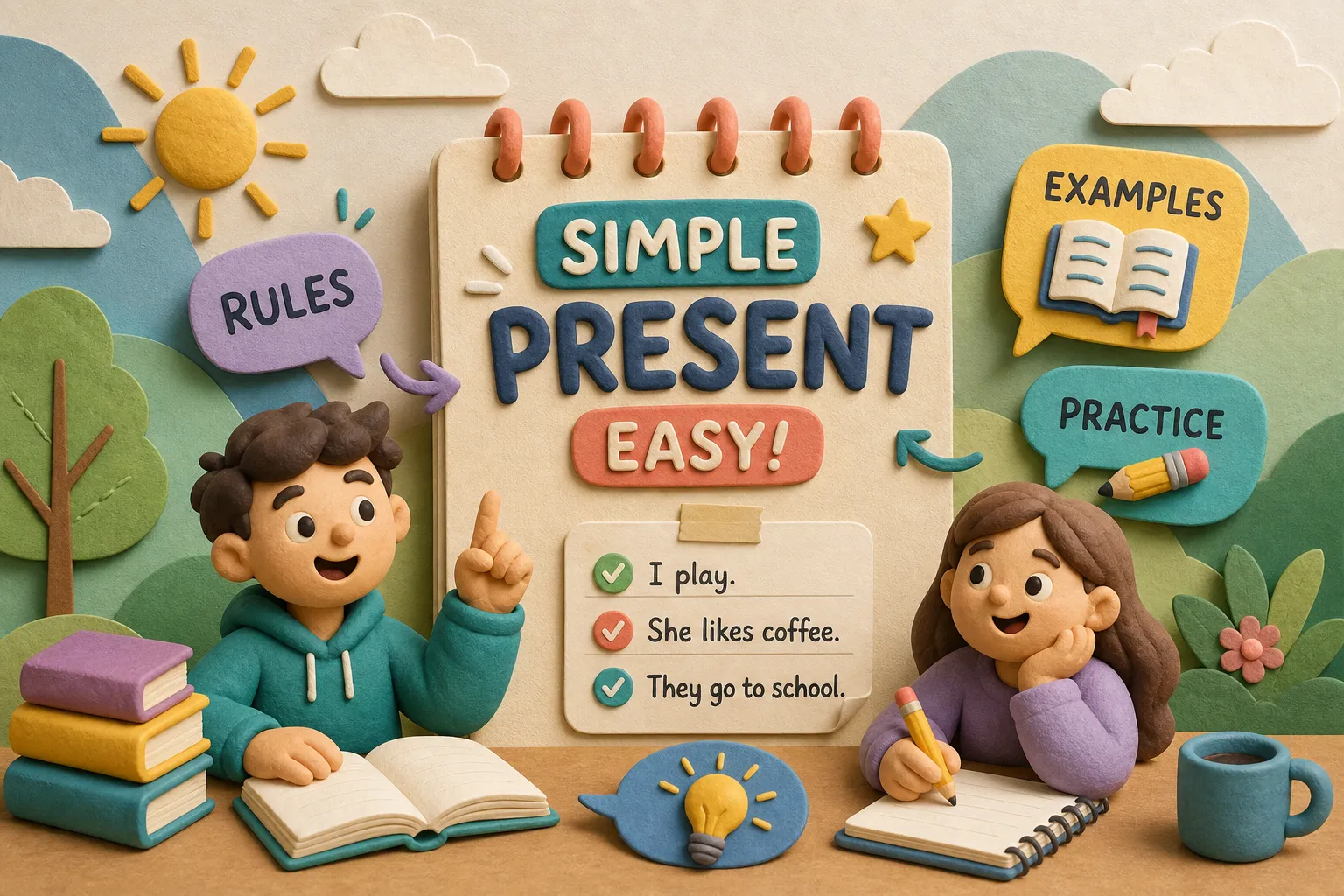
The simple present tense is at work before you even leave the house. You wake up at 7. Your coffee takes five minutes. You take the train to work. All three sentences use the same verb form, and that form is one of the most common tenses in everyday American English.
By the end of this article, you will know exactly when to use the simple present, how to form it correctly, how to make negatives and questions, and which mistakes to avoid. You will also practice with a short exercise so you can use this grammar right away.
At Your Daily American, our grammar lessons emphasize real-life usage, the way Americans actually speak day to day. The simple present is one of the first tenses to get right, because you need it every single day.
When to use the simple present tense
Habits and routines
A habit is something you do regularly, every day, every week, or on a set schedule. When someone asks “What do you usually do in the morning?” or “What does your typical workday look like?”, you answer with the simple present tense.
“She runs three miles every morning.” “He checks his phone before bed.” “They order pizza on Fridays.” These sentences describe patterns, not something happening right now. That distinction is key.
General truths and permanent facts
Some things are always true. The sun rises in the east. Water boils at 212 degrees Fahrenheit. New York has five boroughs. These facts do not change, so you do not use a continuous form for them.
This also covers stable personal facts: “I live in Chicago.” “She works in finance.” “He has two brothers.” If the situation is long-term and permanent, the simple present is the correct choice.
Schedules and timetables
The simple present also describes fixed schedules, and this surprises many learners who expect a future form. Because the time is already set and the event is treated as a certainty, English uses the simple present rather than “will” or “going to.” “My shift starts at 9 a.m.” “The bus leaves at 6:45.” “The game ends at 10.” You will hear this pattern constantly in American workplaces, schools, and travel announcements.
For a clear reference on general uses and examples of the simple present tense, see the EF guide to the simple present tense.
How to form positive sentences
Base form for most subjects
For I, you, we, and they, use the base form of the verb. No changes needed. “I work from home.” “You speak clearly.” “They live in Chicago.” If the subject is not he, she, or it, just use the verb as it is.
Third-person singular: adding -s, -es, or -ies
Third-person singular means he, she, or it, one person or thing you are talking about, not talking to. For these subjects, you must add an ending to the verb. The ending depends on how the verb is spelled.
| Verb ending | Rule | Example |
|---|---|---|
| Most verbs | Add -s | work → she works |
| -ch, -sh, -ss, -x, -o | Add -es | watch → he watches, go → she goes |
| Consonant + y | Drop y, add -ies | study → she studies |
| Vowel + y | Add -s only | play → she plays |
| -z (or short vowel + z) | Add -zes | quiz → he quizzes |
A quick note on irregular verbs
A few common verbs do not follow the regular -s rule and need to be memorized on their own. “Have” becomes “has”: “She has two cats.” “Do” becomes “does”: “He does the laundry.” “Be” becomes “is”: “It is cold today.” Worth noting: “go” follows the regular -es pattern (he goes), but it comes up so often that it is worth practicing separately. These verbs appear constantly in conversation, so treat them as a short priority list.
For a concise explanation of the present simple form and third-person rules, the Cambridge Dictionary’s present simple guide is a helpful reference.
Negatives and questions with do and does
Making negative sentences
The pattern is: subject + do/does + not + base verb. Use “don’t” with I, you, we, and they. Use “doesn’t” with he, she, and it.
“I don’t eat meat.” “She doesn’t drive.” “They don’t work on weekends.” Notice that the main verb stays in its base form. Never say “She doesn’t works.” When you use “doesn’t,” the verb drops its -s, “doesn’t” is already doing that job.
For extra rules and practice exercises on negatives and question forms in the simple present, check this Grammarly guide to the simple present.
Yes/no questions
To ask a yes/no question, move do or does to the front. The pattern is: do/does + subject + base verb. “Do you like spicy food?” “Does he take the subway?” “Do they speak Spanish at home?” The main verb never gets an -s in a question. This is one of the most common errors in the simple present, so pay close attention here.
Wh- questions for real conversation
For questions with a question word, the pattern is: question word + do/does + subject + base verb. “Where do you work?” “What does she study?” “When does the show start?” These are exactly the kinds of questions Americans use in small talk and at work. Master these patterns and conversations will feel much more natural.
Frequency adverbs and time expressions
Common frequency adverbs
Frequency adverbs tell your listener how often something happens. The scale runs from most to least frequent: always, usually, often, sometimes, rarely, never.
“I always have coffee in the morning.” “She usually works from home.” “He sometimes skips lunch.” “They never watch the news.” These words add a lot of meaning to a sentence without any extra explanation.
Where to place them in a sentence
Frequency adverbs go before the main verb. “She always takes notes.” “He never eats breakfast.” If the main verb is “be,” the adverb comes after it: “I am usually tired on Mondays.” “She is never late.”
In negative sentences, the adverb goes after “don’t” or “doesn’t”: “He doesn’t usually check email after 6.” One common placement error sounds like this: “I every day go to the gym.” That word order does not work in English. The correct version is: “I go to the gym every day.”
Time expressions that signal routine
Phrases like “every morning,” “on weekends,” “twice a week,” and “in the evening” go at the end of the sentence. “She calls her mom every Sunday.” “He works out three times a week.” These phrases pair naturally with the simple present to make your meaning clear and specific.
Simple present examples: common mistakes and how to fix them
Forgetting the -s with he, she, and it
Research on ESL learner errors consistently shows that omitting the third-person -s is the single most frequent mistake with the simple present, accounting for roughly half of all verb-form errors in learner writing. It is especially common for speakers whose first language is Spanish or Portuguese, where every subject has its own unique verb form. In English, only he, she, and it require a change.
Before you finish a sentence, ask yourself: is the subject he, she, or it? If yes, check the verb ending.
| Wrong | Right |
|---|---|
| “She walk to work.” | “She walks to work.” |
| “He go to the gym.” | “He goes to the gym.” |
Confusing simple present with present continuous
The simple present describes habits, facts, and permanent situations. The present continuous describes something happening right now or temporarily.
| Wrong | Right | Why |
|---|---|---|
| “I am living in Dallas.” (permanent home) | “I live in Dallas.” | Permanent situation → simple present |
| “The economy grows fast this month.” | “The economy is growing fast this month.” | Temporary/ongoing change → present continuous |
Some verbs describe states rather than actions, these are called stative verbs, describing a state rather than an action. Verbs like know, want, need, hear, like, and love do not use the continuous form. “I know the answer.” Not “I am knowing the answer.” “She wants coffee.” Not “She is wanting coffee.” For a clear list and explanation of common stative verbs, see this practical guide.
The double -s error in questions
Wrong: “Does she lives here?” Right: “Does she live here?” When you use “does,” the main verb returns to its base form. “Does” already shows the third person, so adding -s to the main verb as well is redundant.
Quick practice: try it yourself
Fill in the correct form
Write or say each answer out loud before you check. Use the verb or instruction in parentheses.
- She _____ (study) every night.
- _____ you _____ (like) American food?
- He _____ (not watch) sports.
- The meeting _____ (start) at 10.
- I _____ (always / check) my email in the morning. Put “always” in the right position.
Check your answers
- She studies every night. (Consonant + y: drop y, add -ies.)
- Do you like American food? (Yes/no question: do + subject + base verb.)
- He doesn’t watch sports. (Doesn’t + base verb. No -s on the main verb.)
- The meeting starts at 10. (Third-person singular subject: add -s.)
- I always check my email in the morning. (Frequency adverb goes before the main verb.)
Keep practicing
Now write three sentences about your own daily routine using the simple present. For example: “I drink tea in the morning. I work from home. I call my family on Sundays.” Writing about your real life helps you remember the grammar faster.
For a quick review of how the simple present fits with the other tenses, read our internal guide 12 English Verb Tenses: A Pocket Guide for Non-Native Speakers, Your Daily American.
For more lessons built around real American speech, visit Daily Grammar, Your Daily American. Every lesson connects directly to the conversations you will actually have, moving you steadily toward natural, confident English.
Put these tools to work
Here is what to take away. Use the simple present for habits, facts, and fixed schedules. Add -s, -es, or -ies when the subject is he, she, or it. Use do and does for negatives and questions, and remember that the main verb always returns to its base form. Place frequency adverbs before the main verb, or after the verb “be.”
These are not just rules to memorize for a test. They are the building blocks of real American conversation. Every time someone tells you about their routine or asks what you do for work, the simple present is right there, carrying the meaning. To improve everyday speech and idiomatic phrasing, also see Common American Expressions Every English Learner Should Know, Your Daily American.
You understand it now. Start using it today in real conversations and watch it become second nature.