Picture this: you write “If I would have more time, I will help you” in an email to your American coworker. They understand what you mean, but something sounds off to them. A native reader may notice something isn’t quite right and pause to reread the sentence.
That’s the will vs would problem in a nutshell. Both will and would deal with actions that may or may not happen. They look similar. They even sound similar. But native speakers switch between them automatically, and getting it wrong can change your meaning or your tone in ways you might not notice.
This is one of the most common grammar questions at Your Daily American, and the good news is that the answer is practical, not complicated. You don’t need to memorize abstract grammar charts. You need to understand one clear pattern, then see it in real situations: requests, conversations, if-sentences, reported speech, and professional emails. By the end of this lesson, you’ll know exactly which word to choose, and you’ll have a one-line checklist to use whenever you’re not sure.
The core difference between will and would
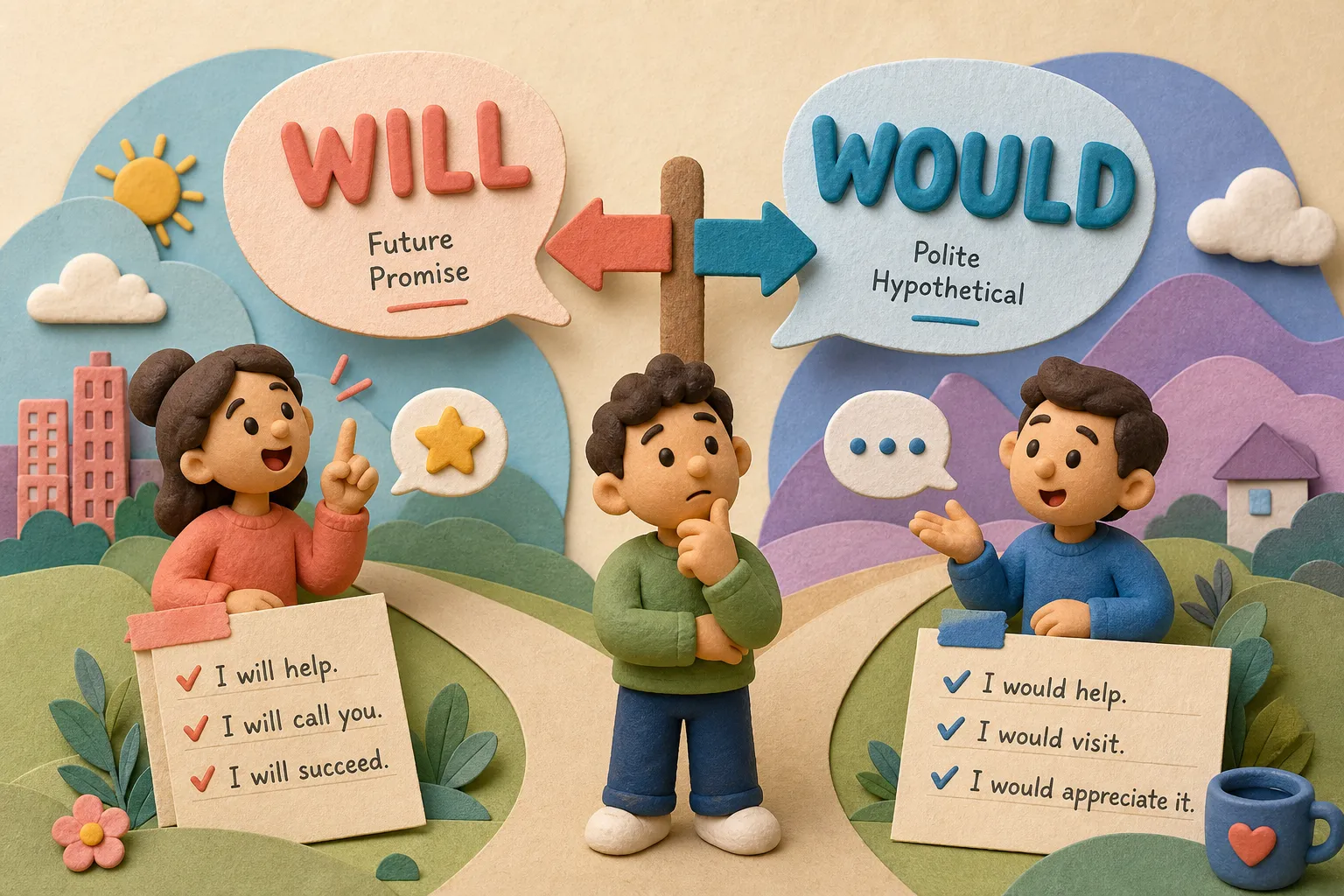
Both will and would are modal verbs, helping verbs that express possibility, intention, or conditions. The will vs would difference comes down to one question: is the situation real or imaginary?
Will belongs to the real world
Will is used when you talk about something real: a future fact, a promise, or a decision you just made. The situation is real and expected.
- “I’ll call you back in five minutes.” (a promise)
- “The meeting will start at 9 a.m.” (a future fact)
- Someone knocks on the door. You say: “I’ll get it!” (a decision made right now)
Notice that last example. You decided at that exact moment to answer the door. That spontaneous decision is a perfect use of will.
Would belongs to the imaginary or the past
Would is used when the situation is not real, when you are imagining something, when you are talking about a past habit, or when you want to soften your tone. Think of it as a step away from reality.
- “If I had more time, I would help.” (imaginary: I don’t actually have more time)
- “She would visit her family every summer.” (a past habit that no longer happens)
- “Would you help me with this?” (softer and more polite than “Will you help me?”)
A simple test: if it’s real and certain, use will. If it’s imaginary, past, or polite, use would. Keep that in mind as you read the rest of this lesson.
Will vs Would: Everyday Requests, Offers, and Polite Phrasing
One of the most practical places to see the will vs would difference is in daily conversation, especially when making requests or offers. This is where would does a lot of work in American English.
How will sounds in a request
“Will you send me the file?” is grammatically correct. But it can sound direct, even a little impatient. Between close friends, it usually sounds fine. In most other situations, it can feel too sharp. Compare these two lines:
Person A: “Will you send me the file?”
Person B: “Would you send me the file?”
Person B sounds more respectful and natural in many American contexts. The meaning is the same, but the tone is completely different.
Why would is the default for polite requests
In American English, would is widely preferred when you ask someone to do something. It gives the other person more space to say no, which is why it sounds respectful. Here are some common patterns you can use right away:
- “Would you mind closing the door?”
- “Would it be possible to reschedule?”
- “I would appreciate it if you could review this.”
- “Would you like some coffee?” (making an offer, not “Will you like coffee?”)
For offers, the pattern is straightforward: use will for spontaneous, casual offers (“I’ll carry that for you.”) and would for formal or considered ones (“I would be happy to help with that.”).
Will vs Would in If-Sentences
A conditional sentence (an if-sentence) shows that one thing depends on another. This is where many learners make mistakes. Here’s how each type works.
First conditional: use will for real possibilities
When the situation could actually happen, use will in the result part of the sentence. The formula is: if + present tense, will + verb.
- “If it rains, I’ll take an umbrella.” (It might actually rain.)
- “If you finish early, I’ll meet you outside.” (This could really happen.)
One important note for standard conditionals: avoid putting will inside the if-clause. “If it will rain” is incorrect in this pattern, the if-clause uses the present tense: “If it rains.” (Note: will can appear in an if-clause in special cases, such as expressing willingness, “If you will wait here, I’ll get the manager”, but that’s a separate structure.) For a clear breakdown of when will can and cannot appear in if-clauses, see Grammarly’s guide to using will and would in if-clauses.
Second and third conditionals: use would for hypothetical situations
The second conditional uses would for situations that are imaginary or unlikely right now. The formula is if + past tense, would + verb, as in: “If I had more time, I would learn Spanish.” That sentence means I don’t have more time right now, it’s imaginary.
The third conditional uses would have + past participle for situations that are impossible because they already happened differently. The formula is if + past perfect, would have + past participle: “If she had studied, she would have passed”, she didn’t study and she didn’t pass, so we’re looking back at something that can’t be changed.
One of the most common errors in English: “If I would have known, I would have helped.” This is incorrect. The right version is: “If I had known, I would have helped.” Never use would inside the if-clause of a third conditional.
Will vs Would in Reported Speech
Reported speech is when you tell someone what another person said. For example, your friend says something to you on Monday, and you tell a coworker about it on Tuesday. This is where will often changes to would.
The backshift rule: will becomes would
When you report what someone said in the past, will moves one step back in time and becomes would. This is called backshifting, the tense moves one step into the past.
Direct speech: “She said, ‘I’ll call you tomorrow.'”
Reported speech: “She said she would call me the next day.”
Why does this happen? The reporting verb “said” is in the past, so the future verb will shifts back one step to match: will becomes would. For more examples and exercises on backshifting in reported speech, see EnglishClub’s guide to backshifting.
When you don’t need to backshift
If the future event hasn’t happened yet and is still true right now, you can keep will. “She said she will call me tomorrow.” If tomorrow hasn’t come yet, both versions are acceptable, backshifting is optional when the future is still relevant.
As a general rule: if you’re telling a story about the past and the future is already gone, use would. If the future is still coming, you can use either one.
Will and would in professional emails and workplace English
The same patterns you’ve learned appear constantly in work emails and meetings. In professional writing, getting the tone right matters even more because there’s no facial expression or voice to carry your intent. The wrong word can sound rude without you meaning it that way.
Polite workplace requests use would almost every time
In professional emails, would is commonly preferred for requests. It sounds respectful and gives the reader space to respond on their terms. For a discussion of how language choices affect politeness, see the Cambridge Dictionary notes on politeness.
- “Would you be able to review this by Friday?”
- “I would appreciate your feedback on the attached draft.”
- “Would it be possible to schedule a call this week?”
Compare that to: “Will you send me the report?” In writing, this can feel like a demand. The same request with would sounds professional and considerate.
Confirming plans and commitments: this is where will fits
When you want to confirm that something will happen, will is the right choice. It sounds confident and clear. “I will send the revised document by end of day.” That’s exactly the tone you want when making a commitment in a professional context.
Will and would also appear in meeting invitations, follow-up emails, and presentation language. If you want to practice these patterns in real workplace situations, including emails, meetings, and business conversations, the Professional English section at Your Daily American has structured lessons built around exactly these scenarios.
Common mistakes and how to fix them
Here are the three errors that come up most often. Check if you’ve made any of them before.
Mistake 1: putting will or would inside the if-clause
Wrong: “If you will come, I’ll make dinner.” / “If I would have known, I would have helped.”
Right: “If you come, I’ll make dinner.” / “If I had known, I would have helped.”
In a standard if-sentence, the if-clause uses the present or past tense, not will or would. This is the most common conditional error for ESL learners at every level.
Mistake 2: forgetting to backshift in reported speech
Wrong: “He said he will call me.” (when reporting something clearly in the past)
Right: “He said he would call me.”
When the reporting verb “said” is in the past and the future moment has already passed, will should shift back to would. If the future event is still upcoming, keeping will is also acceptable, backshifting is optional in that case.
Mistake 3: using will in polite requests
Too direct: “Will you help me with this?”
More natural: “Would you help me with this?”
This isn’t grammatically wrong, but it can sound too sharp in many situations. In American English, would is the default for requests because it gives the other person more room to respond comfortably.
Your one-line checklist and practice
Here is the checklist promised at the start: Is the situation real and certain? Use will. Is it imaginary, past, or polite? Use would. That single question covers most situations you’ll face in daily life, at work, and in writing. (For edge cases, like will in if-clauses expressing willingness or optional backshifting in reported speech, revisit the relevant sections above.)
Remembering the will vs would difference gets easier with exposure. Once you start noticing these patterns in real conversations and emails, you’ll hear the distinction naturally. The key is practice: reading professional emails, listening to native speakers, and using both words in context. To work on rhythm and comprehension while you practice, check our Word Stress in American English: A Complete Guide which helps with listening and natural phrasing.
Try these practice sentences on your own. Choose the correct word for each blank, then check your answer against what you’ve learned in this lesson:
- “If I ___ (have) more money, I ___ (travel) more.” (Second conditional)
- “She told me she ___ (call) later.” (Reported speech)
- “___ you mind sending me the agenda?” (Polite request)
Answers: 1. had / would travel 2. would call 3. Would
When you’re ready to keep building, the Your Daily American professional English section gives you more practice with will, would, and other modal verbs in real workplace situations, from emails to presentations. If you want quick, natural responses you can use immediately, see our Short answers in English to Sound Like a Native Speaker page for fast, practical examples.
Practicing in context is how these patterns stop feeling like rules and start feeling like your own natural English. When in doubt, come back to the will vs would checklist above: real and certain, or imaginary and polite?