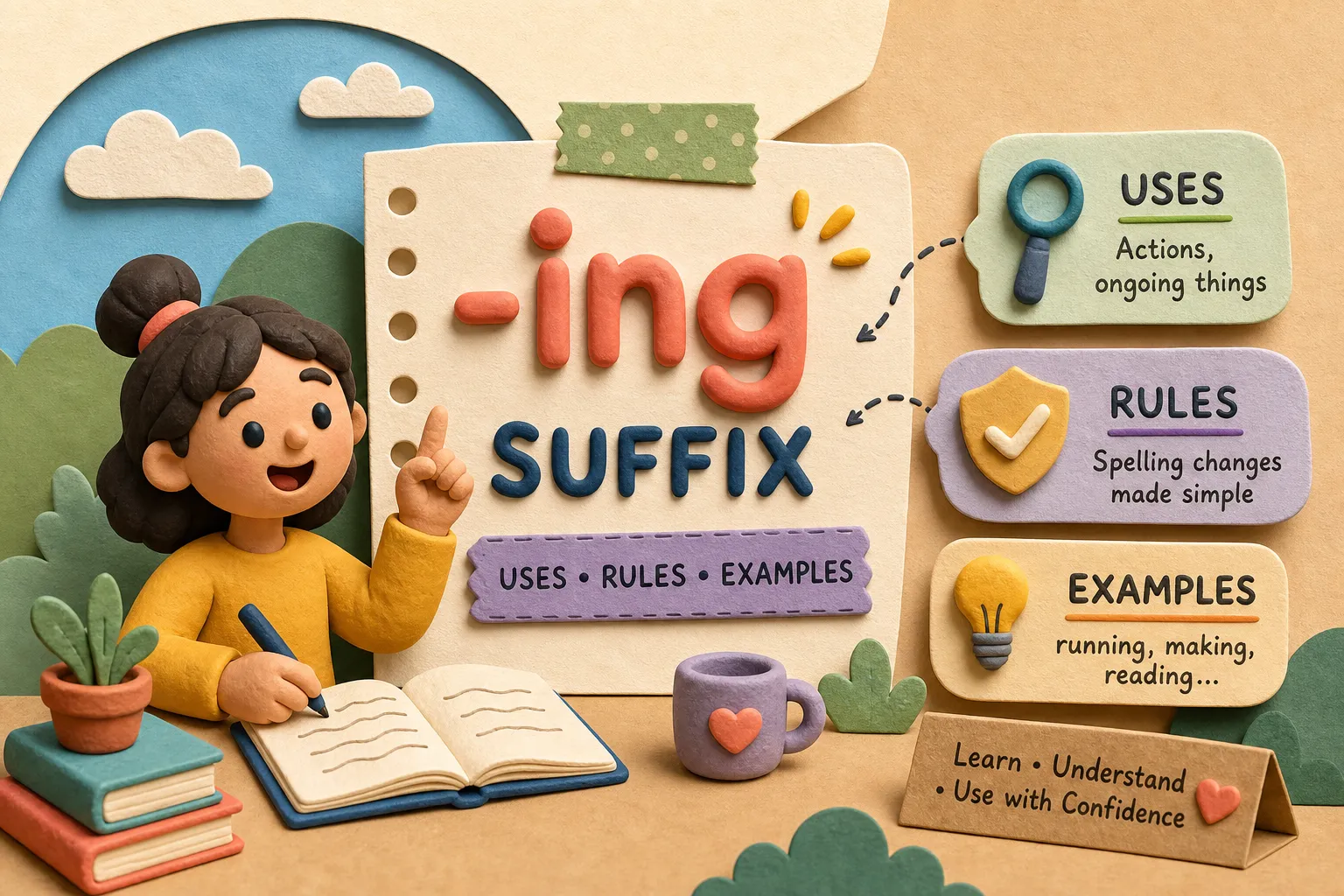
One of the most useful things you can learn about English grammar is how the -ing suffix works. This word ending is everywhere in American English, in text messages, work emails, casual conversation, and on signage all around you. At Your Daily American, the -ing suffix is also one of the most common points of confusion for intermediate learners, which is exactly why it deserves a close look.
Here is what surprises many people: two sentences can use the same -ing word in completely different ways. “I love swimming” and “She is swimming” both use “swimming,” but one treats it like a noun and the other like a verb. That difference matters a lot. By the end of this article, you will know exactly what job any -ing word is doing in a sentence, how to spell -ing forms correctly, and how to use them naturally in real American English.
Three things the -ing suffix does to a verb
A suffix is a word ending that changes how a word works in a sentence. The -ing suffix has three specific jobs, and each one gives the -ing word a completely different role.
As a noun (gerund)
A gerund is a verb form that works like a noun. “Swimming is great exercise.” “I enjoy cooking.” In both sentences, the -ing word fills the same position a noun would take: it is either the subject or the direct object. This structure is common in American English when people talk about hobbies, habits, and daily activities.
As a verb (present participle)
A present participle is the -ing form used together with a helper verb like “is,” “was,” or “are.” “She is running late.” “They were discussing the project.” The -ing word and the helper verb work together to show that an action is ongoing or was in progress at a specific time.
As an adjective
Some -ing words describe nouns, but they fall into two slightly different categories. Words like “interesting” or “boring” have become pure adjectives that describe a state or quality rather than an action happening right now (“A boring meeting,” “An interesting idea”). Other -ing adjectives, like “running” in “the running water” or “sleeping” in “a sleeping child,” still carry a sense of ongoing action tied to the noun. In both cases, the -ing word modifies a noun, the key distinction is whether it describes an active process or a more fixed quality.
Gerunds and present participles: how to tell them apart
This is where many learners get confused. A gerund and a present participle look exactly the same. The only difference is the job they do inside the sentence, and that job is what you need to learn to spot.
The noun-swap test
Here is a simple way to check. Try replacing the -ing word with a regular noun like “exercise,” “work,” or “it.” If the sentence still makes sense, the -ing word is a gerund. If the sentence breaks, it is a present participle. This is a helpful quick test for most cases, but keep in mind that complex structures, like clauses with possessives or small-clause objects, may need a second look. When in doubt, identify the word’s function directly: is it acting as a subject, an object, or part of a verb phrase?
- “Running is healthy.” → “Exercise is healthy.” ✓ (gerund)
- “She is running.” → “She is exercise.” ✗ (present participle)
Try it with another word: “Cooking is her hobby.” → “Work is her hobby.” ✓ That is a gerund. “She is cooking dinner.” → “She is dinner.” ✗ That is a present participle. Once you practice this test a few times, it becomes second nature.
Sentence pairs from daily American life
Here are four sentence pairs using the same -ing word in two different roles. Notice how the structure changes each time.
| Sentence | -ing role |
|---|---|
| “Talking helps me feel better.” | Gerund (subject) |
| “She is talking on the phone.” | Present participle (verb) |
| “Waiting is the hardest part.” | Gerund (subject) |
| “They were waiting at the café.” | Present participle (verb) |
| “I appreciate you helping.” | Gerund (object) |
| “He is helping a customer.” | Present participle (verb) |
| “Ordering coffee takes practice.” | Gerund (subject) |
| “I’m ordering a latte right now.” | Present participle (verb) |
One common mistake: many learners assume every -ing verb shows continuous action. But gerunds don’t show time at all. “Smoking is banned here” is a rule, not something happening right now. The word “smoking” works like a noun, it names an activity that is not allowed in that place.
Spelling rules for the -ing suffix
Most -ing words follow one of three spelling patterns. Once you know them, you can spell almost any -ing form correctly without second-guessing yourself. There are a handful of rare or regional exceptions (for instance, both “aging” and “ageing” appear in different style guides), but the three core rules below cover the vast majority of everyday verbs.
Drop the silent e
When a verb ends in a silent e, remove it before adding -ing: make → making, write → writing, dance → dancing, give → giving. The most common learner error here is writing “makeing” or “takeing.” The rule is straightforward: if the verb ends in a silent e, drop it.
One important group keeps the e, verbs ending in -ee, -oe, or -ye: see → seeing, agree → agreeing, dye → dyeing. Why? Dropping the e in “see” would give you “seing,” which looks wrong and changes how the word sounds.
Double the final consonant
When a verb ends in a single vowel followed by a single consonant, and the stress falls on the last syllable, double the consonant before adding -ing: run → running, stop → stopping, swim → swimming, sit → sitting. Don’t double when the stress is on the first syllable: “happen” becomes “happening,” not “happenning.”
| Verb | Pattern | -ing form |
|---|---|---|
| run | Short vowel + 1 consonant (stress on last syllable) | running |
| stop | Short vowel + 1 consonant (stress on last syllable) | stopping |
| happen | Stress on first syllable | happening |
| rain | Two vowels before consonant | raining |
Words ending in y: keep the y
This rule surprises many learners. Unlike the past tense, where y often changes to i, the -ing suffix never changes y to i in standard English spelling. Just add -ing directly: try → trying, worry → worrying, carry → carrying, study → studying. Never write “triing” or “worring.” In standard English, the y is retained when adding -ing, it’s one of the few truly consistent rules in the language.
-ing words in real American English: from daily talk to the office
Grammar rules become real when you hear them in natural speech. Here is where all three -ing functions appear in everyday American life.
Phrases you’ll hear every day
Gerunds are all over casual American conversation. “I’ve been thinking about moving.” “She’s really good at multitasking.” “Would you mind turning that down?” These phrases come up at home, on the phone, at a café, and in a wide range of everyday social situations.
-ing adjectives are just as common. “That’s pretty amazing.” “This is so frustrating.” “She gave an interesting answer.” These -ing words describe a quality. They are not showing an action happening right now, they describe how something feels or seems to the speaker.
A quick note on pronunciation: the standard American English form of the -ing suffix is /ɪŋ/ (rhymes with “ring,” like “swim-ING”). In informal spoken American English, many people reduce it to /ɪn/ or even /ən/ in rapid speech, often written as -in’. “I’m working” can sound like “I’m workin'” in casual conversation. Both are natural. In formal situations, use the full /ɪŋ/ sound.
-ing in professional American settings
The workplace uses -ing forms constantly, especially in emails and meetings. Gerunds show up in professional language like this: “Managing your time well is essential.” “I appreciate you taking the time to meet.” “We’re considering hiring two new people.” These phrases are polite, direct, and standard in American business communication.
Present participles appear in project updates and status reports: “She is leading the new initiative.” “We are looking at two options right now.” And -ing adjectives turn up regularly in feedback and presentations: “That was a compelling presentation.” “The updated numbers are encouraging.” “This is a challenging situation, but we have a plan.”
Quick practice: test yourself on the -ing suffix
Read these sentences. For each one, decide: is the -ing word a gerund, a present participle, or an adjective?
- “Reading every day improves your vocabulary.”
- “He was reading the report when I called.”
- “That was a very confusing explanation.”
Answers: 1. Gerund (subject of the sentence). 2. Present participle (verb with helper “was”). 3. Adjective (describes the explanation). If you got all three right, you have a solid understanding of how the -ing ending works.
Now try completing these sentences on your own. Write them down and say them out loud:
- “I enjoy ___ing.”
- “Right now, I am ___ing.”
- “The most ___ing part of my day is ___. “
Build this skill with structured daily practice
Noticing -ing words is a great first step. The next step is using them correctly without pausing to analyze each sentence. At Your Daily American, the study tips section shows you how to build vocabulary habits that actually stick, including how to practice word forms like these until they feel automatic. The grammar section also has focused lessons on verb forms and sentence structure, organized so you can build on what you already know and fill in the gaps at your own pace.
What you now know about the -ing suffix
You covered the three main functions of the -ing suffix. Gerunds act like nouns: they can be the subject or object of a sentence. Present participles work with helper verbs to show ongoing action. And -ing adjectives describe qualities and states, some capturing a fixed property, others implying an active process tied to the noun they modify.
The three spelling rules are straightforward: drop the silent e (make → making), double the consonant when the stress pattern calls for it (run → running), and always keep the y (try → trying). These patterns appear across emails, meetings, casual conversation, and everything in between, which means every piece of English you read or hear is a chance to practice.
The goal is not to memorize grammar charts. It is to notice these words when you see them and use them without hesitation. Start right now: pick an activity you did this morning and write one sentence using the -ing suffix. “___ing is ___.” That one sentence is a real step toward more confident, natural American English.