You’re in a work meeting and need to ask your manager something. You type: “Can I send you the report after lunch?” Then you stop. Should it be “Could I send you the report after lunch?” Both feel possible. Which one is right? This guide to can vs. could breaks down exactly when to use each one, with real examples you can put to work immediately.
A common question learners bring to Your Daily American is precisely this one, and the good news is that the core rules are straightforward once you understand what each word is actually doing. By the end of this article, you will know exactly when to use can and when to use could. You’ll be able to make polite requests at work, ask for permission naturally, and talk about present and past ability with confidence. We’ll cover four main areas: ability, permission, requests, and possibility.
Can vs. Could: Ability Now vs. Ability in the Past
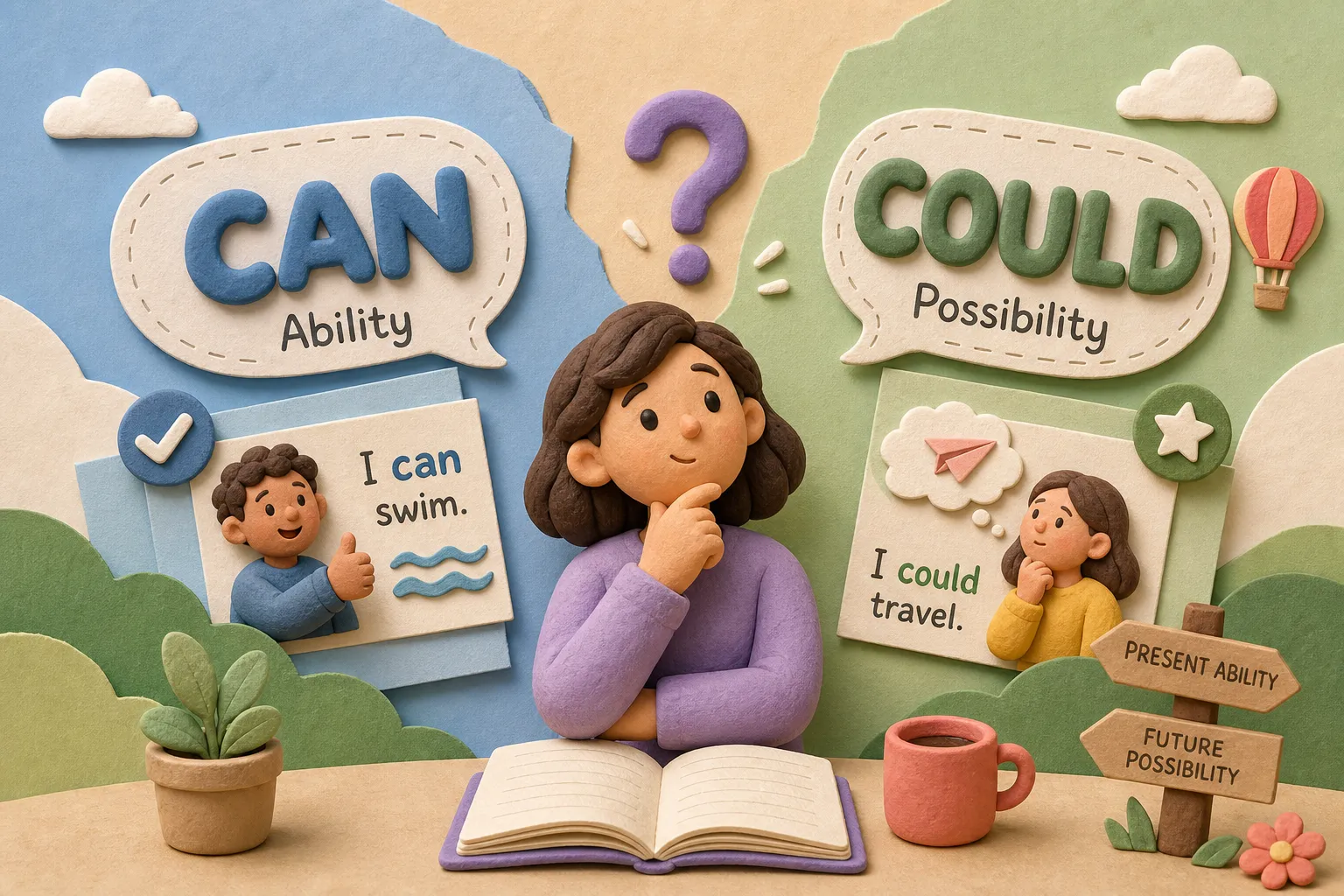
The most basic rule is about time. Can describes what you are able to do right now. Could describes what you were able to do in the past, over a period of time. That single distinction, present vs. past, clears up more confusion than any other rule in this guide.
“Can” for What You’re Able to Do Right Now
Can is your present-tense modal (a modal is a helping verb like can, could, will, or should). It tells the listener that someone has a skill or ability today. When your ability is current and you are certain about it, can is the natural choice. Here are some clear examples:
- “I can speak Spanish.”
- “She can code in Python.”
- “He can drive a manual car.”
“Could” for Skills You Had in the Past
Could is the past form of can for general abilities over a period of time. It works well when you are describing something you were able to do regularly before, not just once. For example:
- “When I was a child, I could swim across the whole pool.”
- “He could play guitar really well in college.”
- “She could speak three languages when she was twelve.”
One Important Exception: A Single Completed Action
Here is where many learners stumble. If you are talking about one specific thing you finished in the past, could is not correct. Use “was able to” or “managed to” instead.
Avoid: “I could finish the project on time yesterday.”
Better: “I was able to finish the project on time yesterday.”
There is one exception worth knowing: sense verbs like hear, see, smell, and taste. With these verbs, could is correct even for a specific moment, “I could hear the music from outside.” This is a standard grammar exception that applies across English varieties. For a clear explanation of past ability distinctions such as “could,” “was able to,” and “managed to,” see the VOA Learning English article on past ability.
Can vs. Could for Permission: The Rule Most Learners Get Backwards
Permission is where things get interesting, because there is an important difference between asking for permission and giving it. For a practical reference on how native varieties present modal meanings like ability and permission, check the British Council can vs. could reference.
“Can I…?” in Casual Conversation
In everyday American English, people use “Can I…?” all the time. It is completely natural in casual settings, you will hear it constantly among friends, family, and coworkers who know each other well. Many learners over-correct here, reaching for could in situations where can sounds perfectly normal and friendly.
- “Can I borrow your phone?”
- “Can I leave early today?”
- “Can I sit here?”
None of these sound rude. In casual American English, using can for permission is normal and accepted.
“Could I…?” When You Want to Sound More Respectful
“Could I…?” is the more polite choice. Use it with your boss, a new client, a professor, or anyone you do not know very well. The tone is softer and more professional.
- “Could I reschedule our meeting?”
- “Could I ask you a question about the report?”
- “Could I take Friday off?”
Both “Can I…?” and “Could I…?” are grammatically correct. The difference comes down to social register, meaning how formal the situation is. Native speakers process this automatically based on context and relationship.
Who Gives Permission Always Uses “Can,” Not “Could”
Here is the rule that surprises most learners: you ask with could, but you give or deny permission with can. Look at this short dialogue:
Employee: “Could I take Friday off?”
Manager: “Yes, you can.” / “No, you can’t this week.”
The manager does not say “Yes, you could.” That would sound odd to a native speaker. In straightforward cases of granting or refusing permission, native speakers use can or can’t. Note that could may occasionally appear in conditional responses, for example, “You could, if you finish the report by noon”, but for simple, direct permission, can is the go-to word.
Making Requests: How “Could” Adds Politeness Automatically
Requests are different from permission questions. A permission question asks if you are allowed to do something. A request asks someone else to do something for you. For additional tips on making polite requests in American English, see this practical guide on polite requests.
The Difference in Tone Between “Can You…?” and “Could You…?”
“Can you help me?” focuses on the other person’s ability. “Could you help me?” is softer, it signals that you know they have a choice and that you respect it. Neither is rude, but the tone is noticeably different in professional settings. For more examples and usage notes that compare these forms, the LanguageTool can vs. could explanation is a clear, user-friendly resource.
“Can you send me that file?” is direct and casual. It works well with a close coworker.
“Could you send me that file when you get a chance?” is warmer and more professional. It works well in most workplace situations.
When to Use Each Form Based on Your Relationship
Native speakers switch between can and could based on how well they know the other person, not just the setting. With close friends or family, “Can you grab me a coffee?” is completely natural. With a new coworker, a manager, or a client, “Could you review this for me?” is the better choice. The relationship matters as much as the formality of the situation.
Suggestions with “Could”: A Softer Way to Offer Ideas
Could also works well for gentle suggestions in team conversations. It presents something as possible without putting pressure on anyone, a useful quality in collaborative settings.
- “We could try a different approach.”
- “You could email them instead of calling.”
- “We could move the meeting to Thursday if that works better.”
This use of could is common in meetings and group discussions in American workplaces, where collaborative language helps ideas land more smoothly.
Can and Could in Workplace American English
Grammar rules are useful, but the real goal is to use these words naturally in real situations. Here is how can and could appear in two very important professional contexts.
Job Interview Phrases That Use Can and Could
In a job interview, your word choices send a message about your confidence and professionalism. Here are some phrases with explanations:
- “I can manage multiple projects at the same time.” (can = current ability; sounds confident and direct)
- “In my last role, I could handle up to ten client accounts.” (could = past ability; gives useful context about your experience)
- “Could I ask about the team structure?” (could = polite request; shows professionalism when you ask questions)
In interviews, use can to talk about your current strengths. Use could to describe your past experience and to ask polite questions.
Email Phrases: Choosing the Right Modal for the Right Tone
The difference between can and could shows up clearly in professional emails. Compare these two:
Casual internal email to a close coworker: “Can you send me the updated numbers?”
Professional external email to a client: “Could you please send me the updated report at your convenience?”
“Could you please” is a widely used polite phrase in American business writing. It fits naturally in almost any professional email, which is why native speakers reach for it so often in formal correspondence. For a focused walkthrough on professional email phrasing and tone, see How to Write a Professional Email in American English, Your Daily American.
Mastering these small choices is what separates intermediate learners from truly fluent speakers. It is not just about grammar, it is about reading the situation and choosing the right level of formality.
Quick Reference and the Mistakes to Avoid
Save this table for any time you are unsure which word to use.
| Use | Can | Could |
|---|---|---|
| Ability | Present: “I can code.” | Past: “I could run fast.” |
| Permission | Asking (casual) + giving: “Can I go?” / “Yes, you can.” | Asking (polite): “Could I leave early?” |
| Requests | Direct/casual: “Can you help?” | Polite/formal: “Could you help?” |
| Possibility | Strong/certain: “It can happen.” | Weak/uncertain: “It could rain.” |
A quick note on possibility: when something is very likely or always true under the right conditions, can is the natural choice (“Stress can cause headaches”). When the outcome is uncertain or hypothetical, could softens the claim (“It could rain later”). This distinction mirrors the same pattern you see with requests and permission, could signals less certainty, more tentativeness. For an easy comparison that highlights common confusions between these two modals, check Grammarly’s can vs. could guide.
Can vs. Could, The Three Mistakes ESL Learners Make Most Often
Mistake 1: Using “could” to give permission. Many learners say “Yes, you could leave early” when they intend to give someone permission. This sounds incorrect to native speakers. The natural response is always: “Yes, you can.”
Mistake 2: Using “could” for one specific completed action in the past. “I could finish it yesterday” is not correct for a single completed event. Say: “I was able to finish it yesterday.” Save could for general abilities over time.
Mistake 3: Always using “could” to sound polite, even with close friends or family. Native speakers use can freely with people they know well. If you use could in every situation without exception, it can sound stiff or distant with people you are close to.
Try It Yourself: A Short Practice
Fill in the blank with can or could. The answers are in parentheses.
- When I was in high school, I _____ run a mile in under seven minutes. (could)
- _____ you send me the agenda before the meeting? (Could, professional context)
- Yes, you _____ take the rest of the day off. (can, giving permission)
- _____ I ask a quick question? (Could, polite)
After you check your answers, try writing one original sentence for each use in the table above. Writing your own examples is one of the most effective ways to move new grammar from something you understand to something you actually use. If you want fast corrective patterns for short responses and practice, see Short answers in English to Sound Like a Native Speaker.
Putting It All Together
To summarize the can vs. could rules: use can for present ability, casual permission, and direct requests. Use could for past ability, polite permission requests, formal requests, and uncertain possibility. Always use can when giving or denying permission. Use “was able to” for one specific completed past event.
The grammar itself is manageable. The real skill is reading the social context, who you are talking to and how formal the situation is. That is what makes English sound natural rather than just correct. Choices like can vs. could are small, but they shape the impression you make on native speakers every single day. For additional tips on polite phrasing in American English (especially when making requests), the LanguageTool and related guides linked above are useful practical references.
If you want to build this kind of instinct across all areas of American English, explore the grammar and professional English lessons at Your Daily American. For a focused category of workplace and formal communication lessons, see Professional English, Your Daily American.