Look at these two sentences, both use the past tense, but they mean very different things:
“When I arrived, she left.”
“When I arrived, she had left.”
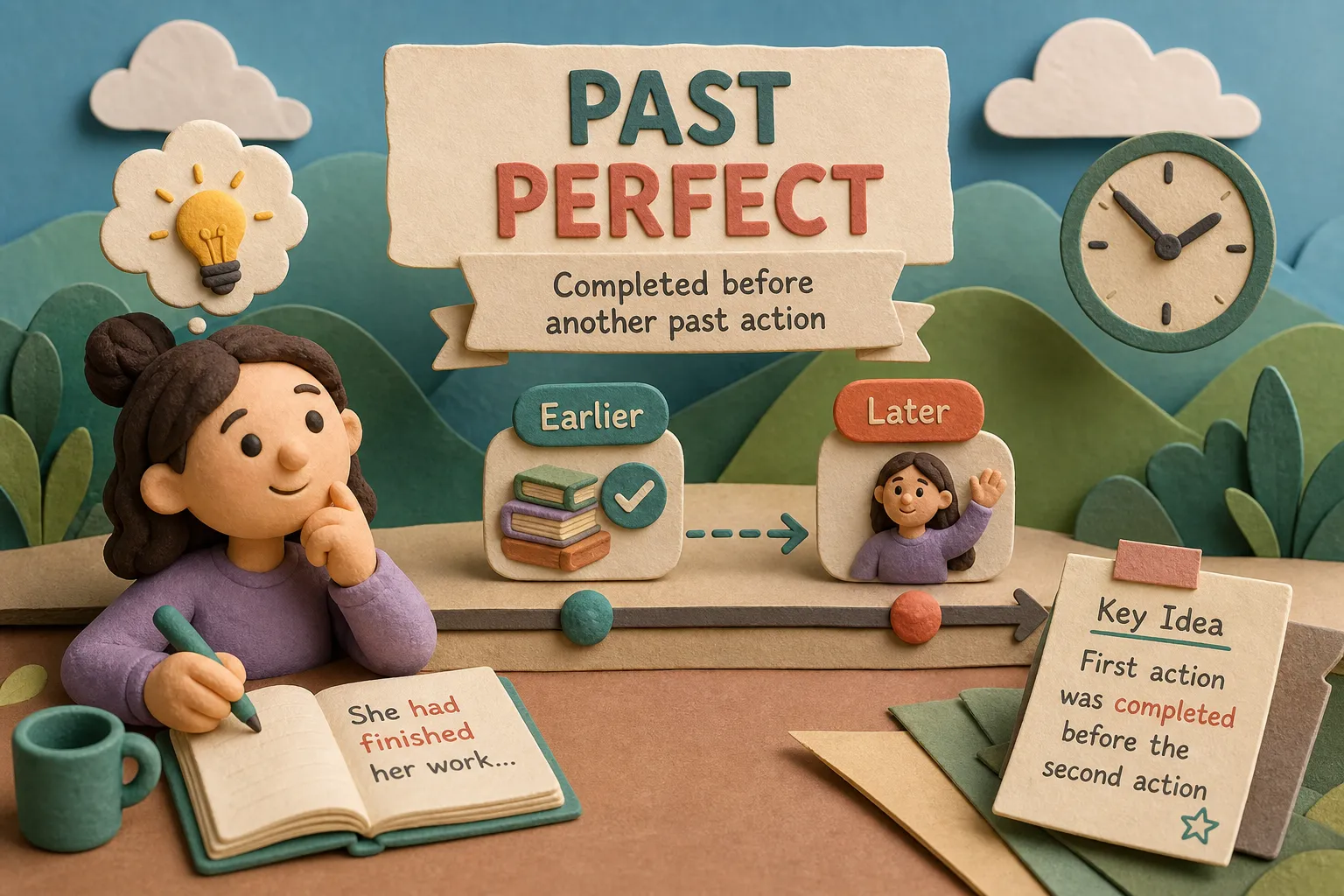
One word changes the entire meaning. These examples show the past perfect in contrast with the past simple. In the first sentence, she left at the same moment I arrived, or immediately after. In the second, she left before I arrived. She was already gone when I got there.
This is the past perfect tense (also called the pluperfect in some grammars). It does one clear job: it shows that one past action happened before another past action. By the end of this lesson, you’ll form correct past perfect sentences, choose the right tense instead of the past simple, and fix the errors that trip up even advanced learners. At Your Daily American, we teach grammar through real examples like these, because rules only make sense when you can see them working in actual sentences.
1. How to form the past perfect tense
The formula: had + past participle
The structure is simple: subject + had + past participle. The past participle is the third form of a verb. For example, the verb “go” has three forms: go (base) / went (past simple) / gone (past participle). “Gone” is the form you use after “had.”
The word “had” never changes. It stays the same for every subject: I had, you had, she had, he had, we had, they had. This makes the past perfect easier than many other tenses.
Regular vs. irregular verbs
Regular verbs form their past participle by adding -ed to the base verb. Finish becomes finished, study becomes studied, and call becomes called, all straightforward patterns.
Irregular verbs are different. You need to memorize their past participle forms because they don’t follow a pattern. Here are some common ones ESL learners often get wrong:
- go → gone (“She had gone home before the meeting started.”)
- see → seen (“I had never seen that movie before.”)
- leave → left (“They had left by 8 a.m.”)
- eat → eaten (“Had you eaten before the presentation?”)
- drive → driven (“He had driven six hours when he finally stopped.”)
- take → taken (“She had taken that route many times before.”)
- write → written (“He had written three drafts before his editor saw it.”)
Negatives and questions
To make a negative sentence, add “not” between “had” and the past participle. In conversation, American English speakers commonly use the contraction “hadn’t.” For example: “She hadn’t finished the report” (spoken) versus “She had not finished the report” (formal writing).
For questions, move “had” to the front of the sentence: “Had you met him before the interview?” or “Had they arrived when you called?” The subject comes right after “had,” followed by the past participle.
2. When to use the past perfect (and when not to)
The core rule: “the past before the past”
Think about two events that both happened in the past. One happened first. One happened second. English uses the past simple for completed past events. But when you need to show that one past event came before another past event, you use the past perfect for the earlier one.
Think of a simple timeline. Event A happened first (further back). Event B happened after. Event A gets the past perfect: “The game had already started when we arrived.” The game starting (Event A) happened before we arrived (Event B).
For a clear reference on the difference between the past perfect simple and continuous forms, see Cambridge Dictionary’s guide to past perfect simple and continuous.
Time expressions that signal past perfect
Certain words are strong signals that a past perfect is nearby. These words tell you that two past events are being compared:
- before: “She had already called before I texted her.”
- after: “After he had eaten, he felt much better.”
- already: “They had already sold the last ticket when I got there.”
- by the time: “By the time we found parking, the show had started.”
- when: “When I arrived, she had left.”
- until: “He hadn’t known the truth until she told him.”
One quick note about “already”: it most naturally sits between “had” and the past participle, “She had already left” is the most common pattern in American English. End-of-clause placement also works and sounds natural: “She had left already.” Both are correct; the mid-position is simply more frequent in everyday speech.
3. Past perfect vs. past simple: side-by-side
Paired sentences that show the meaning shift
The best way to understand the difference is to see the same situation written two ways. Read each pair carefully and notice how the meaning changes.
Pair 1:
“The train left when I got to the station.” (The train left at the same time I arrived, or after. I might have caught it.)
“The train had left when I got to the station.” (The train was already gone. I missed it.)
Pair 2:
“The house was full of smoke because I left the oven on.” (The two events are connected, but the timing is general.)
“The house was full of smoke because I had left the oven on.” (Leaving the oven on happened first and caused the smoke. The cause-and-effect relationship is clear.)
For a concise side-by-side comparison that shows when to choose past simple or past perfect, check this past simple vs. past perfect comparison at Langeek.
When you don’t need the past perfect
Many learners overuse the past perfect. If you tell events in the order they happened, the past simple is enough. “I got up, made coffee, and left for work” is perfectly clear. You don’t need “had made” or “had gotten up.”
Use the past perfect only when the order could be unclear, or when the earlier event explains the later one. Knowing when NOT to use a tense is just as important as knowing when to use it. Using “had” in every sentence sounds unnatural and actually makes your English harder to follow.
4. Real American English dialogue using past perfect
A short dialogue with past perfect in context
Here is a Monday morning conversation between two coworkers. Read it once for meaning, then read it again to notice the past perfect uses.
Sara: “Hey, did you make it to Tom’s party on Saturday?”
Mike: “I tried to. But by the time I got there, most people had already left.”
Sara: “Oh no. Was it over?”
Mike: “Pretty much. They’d moved everything inside because it had started raining.”
Sara: “That’s too bad. I heard it was great earlier.”
Mike: “Yeah. I wish I’d gotten there sooner.”
Each past perfect use has a clear reason. “Most people had already left”, meaning they left before Mike arrived. “They’d moved everything inside”, the move happened before Mike got there. “It had started raining”, the rain came before the move inside. “I wish I’d gotten there sooner”, a regret about a past event that didn’t happen.
Why native speakers use it this way
American English speakers frequently shorten “had” to “‘d” in spoken English, so frequently that it becomes nearly automatic in casual conversation. “I had already eaten” becomes “I’d already eaten.” “She had never seen it” becomes “She’d never seen it.” Worth noting: “‘d” can also represent “would,” so context tells you which meaning applies. This contraction is quiet and fast, so learners who study mainly written grammar often miss it completely.
When you watch American TV shows or listen to podcasts, train yourself to listen for “‘d.” Once you start hearing it, you’ll notice it constantly. Our lessons at Your Daily American are designed to help you hear exactly these features in natural American speech, so grammar rules connect directly to how the language actually sounds. Learn more on our About, Your Daily American page.
5. Past perfect continuous: had been + -ing
The structure: had been + verb + -ing
The past perfect continuous follows this formula: had been + present participle (the -ing form of the verb). Like the simple form, “had been” never changes with the subject.
Here are some clear examples: “She had been working on that project for three months before she got promoted.” “They had been waiting for an hour when the bus finally came.” “I had been studying English for two years before I moved to the U.S.”
For additional explanation and examples, see Grammarly’s guide to the past perfect continuous tense.
Duration vs. completion: what each form shows
The past perfect simple focuses on a completed result. The past perfect continuous focuses on how long something was happening before a past moment. Compare: “He had written the report” (it’s done; the result matters) versus “He had been writing the report for two hours” (the time spent is the focus).
Most stative verbs, verbs that describe conditions rather than actions, are not normally used in continuous forms. Verbs like know, like, understand, believe, and want fall into this category. The correct form is “I had known her for years” (not “I had been knowing her for years”). That said, some verbs have both stative and dynamic senses. “Think,” “have,” and “see,” for example, can appear in continuous forms when they describe a temporary action rather than a permanent state. When in doubt, use the simple past perfect with classic stative verbs.
6. Common mistakes and a quick practice
Top mistakes to avoid
Mistake 1: Using the past simple form instead of the past participle after “had”
After “had,” you always need the third form of the verb. “Rode” is the past simple; “ridden” is the past participle.
Incorrect: “She had rode a horse before.”
Correct: “She had ridden a horse before.”
Mistake 2: Using “didn’t” instead of “hadn’t” for negation
“Didn’t” is for the past simple. The past perfect uses “hadn’t.”
Incorrect: “She didn’t been to Paris before.”
Correct: “She hadn’t been to Paris before.”
Mistake 3: Overusing the past perfect in simple sequences
When you list events in the order they happened, the past simple is enough.
Unnecessary: “Yesterday I had eaten lunch and then I had walked to the park.”
Natural: “Yesterday I ate lunch and then walked to the park.”
Try it yourself: quick practice
Choose the correct verb form for each sentence. This is a low-pressure self-check, not a test. After you finish, review the answers below and think about why each one is correct, that reflection is where the real learning happens.
- When the firefighters arrived, the fire _____ (spread / had spread) to the second floor.
- She _____ (studied / had studied) for three hours before she took the test.
- I got up, _____ (had eaten / ate) breakfast, and went to work.
- He _____ (had never tried / never tried) sushi before he moved to California.
Answers:
- had spread, The fire spread before the firefighters arrived. The earlier event gets “had.”
- had studied, The studying happened before the test. Past perfect for the earlier action.
- ate, This is a simple sequence told in order. Past simple is correct and natural here.
- had never tried, Moving to California is the past reference point. His experience before that moment needs the past perfect.
If you got 3 or 4 right, you have a solid grasp of this tense. You’re ready to use it in your own speaking and writing.
If you’d like a concise online explanation with more examples, Grammarly’s past perfect explanation is a helpful quick reference.
What to do next
You now know the three key things about the past perfect: how to form it (had + past participle), when to use it instead of the past simple (for actions that happened before another past action), and how to avoid the most common errors.
This tense is used whenever you need to clarify the sequence of past events, and once you start listening for it, you’ll find it in almost every episode of your favorite American show. Native English speakers in America reach for it naturally, almost always in the contracted “‘d” form. The more you listen for it in American movies, podcasts, and everyday conversations, the more natural it will feel in your own speech and writing.
Your next step is simple: start noticing the past perfect in the American media you already enjoy. When you hear it, ask yourself which two past events are being compared. Then try writing two or three sentences about something that happened to you recently, using the past perfect to show which event came first. For more grammar lessons grounded in real American English, explore our Daily Grammar category, and start with our 12 English Verb Tenses: A Pocket Guide for Non-Native Speakers, where every topic connects directly to how the language is actually used.