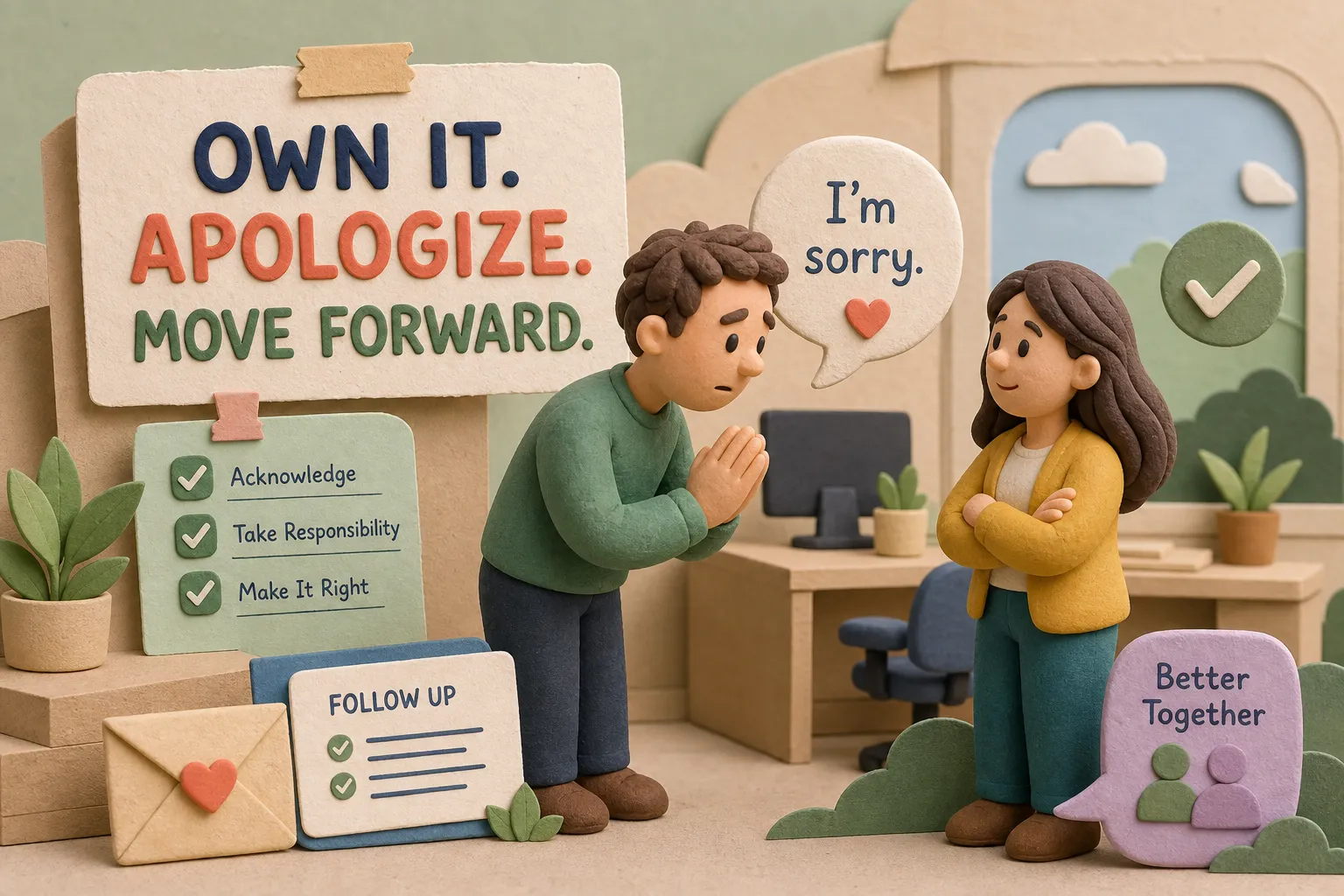
Picture this: you miss a deadline at work. You write to your American manager: “I’m sooo sorry, I feel terrible about this. I really hope you can forgive me and don’t think less of me.” Your manager reads it and, instead of feeling reassured, she feels uncomfortable. What went wrong? The problem wasn’t the apology itself. It was the cultural mismatch.
If you want to learn how to apologize professionally at work, the most important thing to understand is this: how you apologize matters just as much as whether you apologize at all. Studies on workplace communication show that the words you choose, the length of your message, and even the channel you use all send signals in the American workplace. Understanding those signals is the real skill, and it comes down to responsibility, a clear repair offer, and knowing which channel fits the situation.
At Your Daily American, this kind of professional and cultural gap is exactly what the workplace English content is built to close: not just what to say, but when, why, and how native speakers say it in real work situations. By the end of this article, you will be able to choose the right channel, use a tested 5-step framework, and customize a ready script for your specific situation.
Why apologizing at work in American English is harder than it looks
In many cultures, showing strong emotion or repeating “I’m sorry” many times signals deep sincerity. In the American workplace, the same behavior often reads as unprofessional, anxious, or even manipulative. American workplace culture values clear accountability paired with action, not expressed emotion alone.
The over-apologizing trap
Compare these two responses to a missed deadline. Version A: “I’m so sorry. I feel awful about this. I really hope you don’t think less of me as a professional.” Version B: “I’m sorry for missing the deadline. Here’s what I’m doing to fix it.”
Version A shifts the emotional weight onto the other person. Your manager now has to reassure you instead of solving the problem. Version B is direct, accountable, and forward-focused. That combination is exactly what American workplace culture respects. The goal is not to minimize your feelings; it’s to keep the focus on the other person’s experience and on the solution.
The under-apologizing mistake
The opposite problem is just as common. Phrases like “Sorry if that was unclear” or “Mistakes were made” sound evasive in American professional culture. People expect clear ownership. Instead of saying “There was a miscommunication,” say “I didn’t communicate clearly.” That small change makes a real difference in how professional you sound.
How to apologize professionally: a 5-step framework
Communication researchers have found that responsibility and a clear repair offer are the two most important components of an effective apology. Not the length. Not the emotional intensity. Responsibility and repair. Here is the framework behind every script in this article, and the foundation of how to apologize professionally at work.
Steps 1, 3: Name it, own it, and acknowledge the impact
- Name the issue. Be specific. “I missed the 3 p.m. deadline on the Johnson report” is stronger than a vague statement. Specificity shows you understand exactly what happened.
- Own it. Use “I” language. Say “I take responsibility for this delay,” not “there was a miscommunication” or “the system had issues.”
- Acknowledge the impact. State what effect your mistake had on the other person. “I know this delayed your presentation” is far more meaningful than “I know this was inconvenient.”
Steps 4, 5: Explain briefly and offer a concrete fix
- Explain without excusing. Give context in one sentence. Context helps the other person understand. A long explanation sounds defensive.
- Offer repair and prevention. State what you are doing to fix the problem now and what you will do differently going forward. This is the step that actually rebuilds trust.
Use this quick formula as your starting point: “I’m sorry for [specific issue]. I take responsibility for [what you did]. I understand this caused [impact]. I’m [repair action]. Going forward, I will [prevention step].”
One note on the framework: expressing genuine regret is built into the opening step, not treated as a separate item. A direct “I’m sorry for [specific issue]” carries that sincerity. What makes a professional apology land is pairing that regret with clear ownership and a concrete fix, the elements that actually move trust forward.
How to choose the right channel and when to send your apology
The right words in the wrong channel can still feel off. A quick instant message for a serious mistake sends the wrong signal. So does a long formal email for a minor tone issue. The channel you choose should match the weight of the situation.
When a live conversation works better
For serious mistakes, damaged trust, or emotionally sensitive situations, an in-person conversation or video call is often stronger. Your tone and facial expressions carry part of the message. A live apology also lets the other person respond right away, which often resolves tension faster than a written exchange.
If you cannot meet in person, a video call is the right choice when the matter is too important for text alone. Use a phone call when speed matters and you need more warmth than email provides, but a video call isn’t practical.
When email is the right choice
Use email when the issue is lower-stakes, when you need a written record, or when the other person may need time to process before responding. Email also works well as a follow-up after a verbal apology: it confirms your commitment in writing. Keep it short, direct, and focused on the fix.
It’s also worth knowing that the type of mistake can influence which channel works best. For situations involving a breach of trust or integrity, a written apology gives the other person time to absorb your message carefully. For competence-based errors, a missed deadline, a wrong file, a verbal apology followed by a written confirmation often lands best.
Timing rule: Apologize as soon as you understand what happened well enough to be specific. A fast but vague apology is weaker than a slightly delayed but clear one. Do not wait so long that the delay itself becomes a second problem.
How to apologize professionally by email: scripts and templates
Each template below follows the 5-step framework. Customize the bracketed fields for your situation. Notice that each one is short, direct, and ends with a clear next step. These professional apology examples cover the situations ESL learners ask about most.
Missed deadline
Subject: Apology for Missing the Deadline on [Project/Task]
Hi [Name],
I’m sorry that I missed the deadline for [project/task] on [date]. I take full responsibility for the delay.
The work is now [completed / nearly complete], and I will send it to you by [new date/time]. To prevent this from happening again, I’m [brief corrective action: for example, adding milestone check-ins or building in more time for review].
Best, [Your Name]
One important note: “I’ll try to do better” is not a repair plan. A specific corrective action, even a small one, is far more credible than a general promise.
Wrong deliverable or error in work
Subject: Apology for Sending the Wrong File
Hi [Name],
I apologize for sending the wrong [file/report/deck] earlier. I understand this caused confusion, and I take responsibility for the mistake.
The correct version is attached. If it would help, I can also [brief fix: walk you through the changes or update the rest of the team].
I’ll be more careful with version checks going forward.
Best, [Your Name]
Acknowledging the confusion caused, not just the error itself, makes the apology feel complete. Attach the corrected version in the same email so the fix is immediate.
Missed meeting or late response
Subject: Apology for Missing Our Meeting
Hi [Name],
I’m sorry I missed our meeting on [date/time]. I understand this disrupted your schedule, and I take responsibility.
I’d welcome the chance to reschedule. I’m available [option 1], [option 2], or [option 3]. If another time works better for you, please let me know.
I look forward to connecting soon.
Best, [Your Name]
Offering two or three specific times in the same message shows respect for the other person’s time. It also makes it easy to move forward instead of adding more back-and-forth messages.
Poor tone in an email or meeting
This situation is tricky for many ESL learners because you are apologizing for how something was said, not just what was done. The key is to take ownership of your tone directly.
Subject: Apology for My Tone in My Last Email
Hi [Name],
I want to apologize for the tone of my last email. It came across more sharply than I intended, and I regret that.
I respect your perspective and want to make sure we handle this well together. Going forward, I’ll be more careful to communicate in a clearer, more professional way.
Thank you for your understanding.
Best, [Your Name]
The key difference: “I’m sorry you felt offended” puts the problem on the other person’s reaction. “I’m sorry for the tone of my message” takes clear ownership. Always own the action, not the reaction.
Phrases that quietly damage your apology
Some apology phrases feel polite on the surface but send the wrong message. Others can create problems in serious or formal situations. Knowing what to avoid is just as important as knowing what to say.
“If,” “but,” and other deflection patterns
Here are the most common mistakes, with better alternatives:
- “I’m sorry if this caused confusion” → “I’m sorry this caused confusion”
- “I’m sorry, but you didn’t give me enough time” → Remove the “but” entirely
- “Mistakes were made” → “I made a mistake”
- “I’m sorry you feel that way” → “I’m sorry I said that. I understand why it landed badly.”
The pattern here is clear: any language that moves responsibility away from the speaker weakens the apology. American workplace culture reads these phrases as evasive, not humble. They often make the situation worse, not better. For practical guidance on saying sorry well in workplace settings, resources on apologizing at work offer helpful tips and examples.
A quick note on legal and professional risk
Most workplace apologies, a missed deadline, a wrong file, a sharp email, call for direct responsibility-taking, and the templates above reflect that. However, for serious situations involving clients, HR, or formal complaints, the calculus changes. In those cases, avoid detailed admissions of fault before speaking with your manager or your company’s legal team, since written statements can have consequences in formal proceedings.
A safe professional formula for higher-stakes situations is: “I’m sorry this happened and I want to make it right. Let me look into this right away.” This expresses genuine regret and a repair intent without a detailed statement of fault before you have all the facts.
Put it into practice
Knowing how to apologize professionally at work comes down to one core principle: a strong apology is not about how much you feel sorry. It is about how clearly you take responsibility and how concretely you commit to fixing the problem. That combination is what actually repairs trust and moves the situation forward.
Keep the 5-step framework as your mental checklist: name the issue, own it, acknowledge the impact, explain briefly, and offer a concrete fix. Those five steps apply whether you are speaking in person, on a video call, or writing a professional apology email. For guidance on matching tone and channel, especially when your team is remote, see practical advice on how to apologize for mistakes professionally while working remotely.
Try this now: Your report had errors that caused your manager to redo part of their presentation. Write a two-to-three sentence apology using the framework, then compare it to the templates above. Even one practice round makes the next real apology much easier to write.
Professional communication in American English is a skill. It takes practice, cultural context, and the right models to build. That is exactly what Your Daily American is here for, covering everything from workplace emails to high-stakes conversations, one practical lesson at a time.