By the end of this lesson, you’ll be able to conjugate the verb “to be” in the present and past, form negatives and questions, identify its four main uses in sentences, and correct the most common mistakes learners make. Many teachers consider this a fundamental grammar lesson in American English, and it’s worth getting right.
The verb “to be” comes up constantly in conversation. You use it to say who you are, where you are, how you feel, and what’s happening around you. Many learners know the basic forms but still make small errors when speaking fast or writing quickly. This lesson, built around the way American English is actually spoken, will help you close that gap.
Verb to Be: Full Forms (Present & Past Tense)
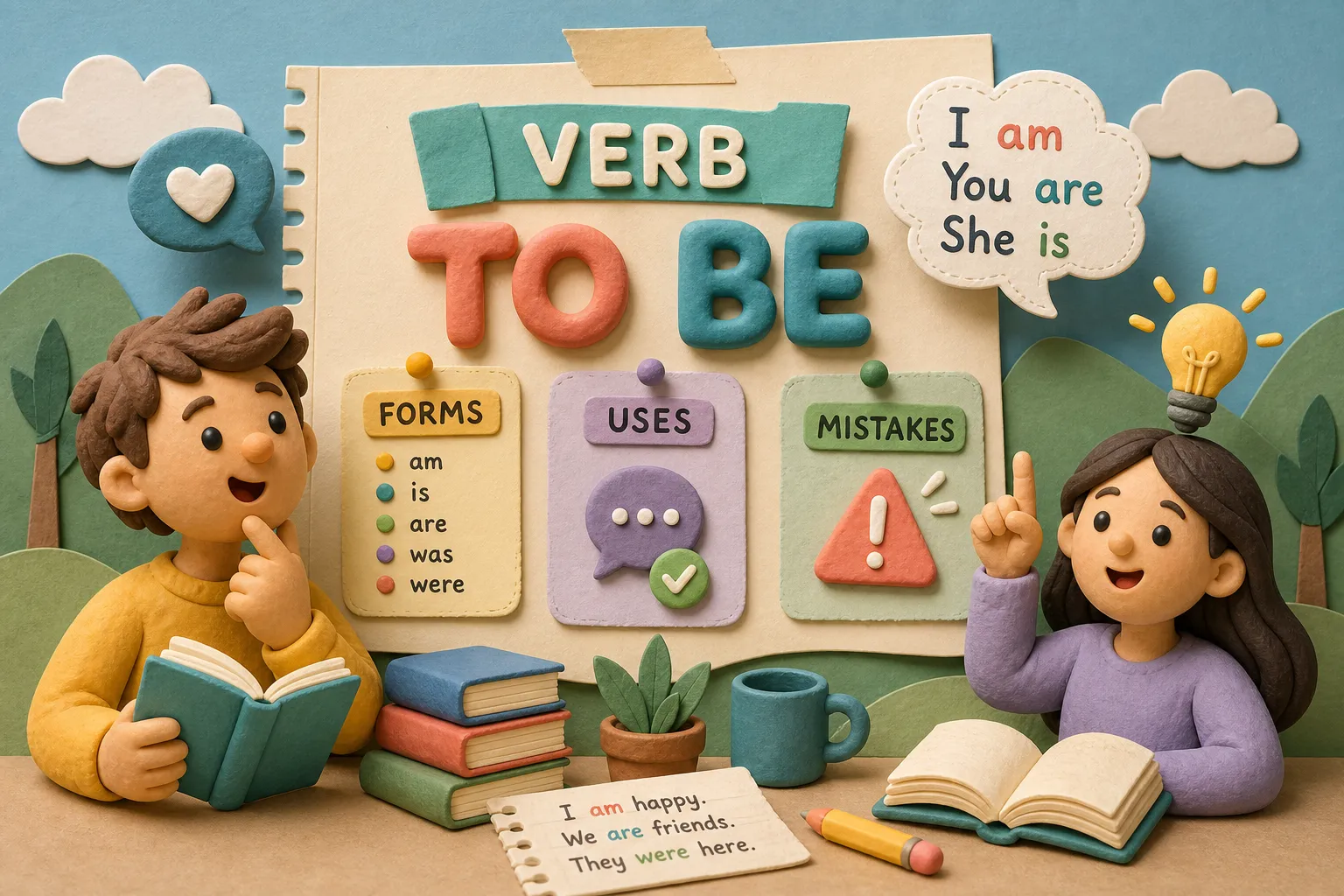
The verb “to be” is irregular, meaning it doesn’t follow the normal rules for verbs. You can’t just add “-s” or “-ed” to make new forms. You need to memorize these forms. Save this section as a reference you can come back to.
Present tense: am, is, and are
Each subject has its own form. “Is” goes with singular third-person subjects: he, she, it, and any name or single thing.
| Subject | Verb | Example |
|---|---|---|
| I | am | I am a student. |
| You | are | You are my friend. |
| He / She / It | is | She is a nurse. / It is hot. |
| We | are | We are ready. |
| They | are | They are at the office. |
For extra practice and a clear explanation of how the verb works in sentences, see Grammarly’s guide to the verb “to be”.
Past tense: was and were
The past tense has only two forms. “Was” goes with I, he, she, and it. “Were” goes with you, we, and they. That split is the key rule to remember.
| Subject | Verb | Example |
|---|---|---|
| I | was | I was tired yesterday. |
| You | were | You were great in the meeting. |
| He / She / It | was | He was at home. / It was cold. |
| We | were | We were late. |
| They | were | They were ready. |
How Native Speakers Say the Verb to Be
Knowing the written forms is only half the job. In casual American speech, native speakers reach for contractions rather than full forms. Instead of “I am,” you’ll hear “I’m.” This is called a contraction: a short form that joins two words into one. In everyday speech and informal writing, contractions are the natural, comfortable choice; full forms are more common in formal or written contexts.
| Full form | Contraction | Example |
|---|---|---|
| I am | I’m | I’m from Brazil. |
| You are | You’re | You’re right. |
| He is | He’s | He’s my manager. |
| She is | She’s | She’s at the airport. |
| It is | It’s | It’s 3 o’clock. |
| We are | We’re | We’re ready. |
| They are | They’re | They’re very friendly. |
In formal writing, the full forms are standard. In everyday speech and informal writing, contractions sound far more natural. If you say “I am not ready” in a casual conversation, it sounds a little stiff. “I’m not ready” is what native speakers say.
How these forms sound in fast speech
In fast, connected American speech, the be verb forms reduce even further. “You’re” sounds like /jʊr/ (say it like the word “your”). “He’s” sounds like /hiːz/. “They’re” sounds like /ðɛr/ (exactly like “there”). You’ll also hear “is” blend with the word before it: “What’s that?” and “He’s here” are good examples.
Training your ear to catch these reduced forms is a real step toward understanding fast native speech. The pronunciation and grammar lessons at Your Daily American go deeper into this, with audio examples built around how Americans actually talk. You can also practice common expressions with our 75 American English Phrases for ESL Beginners.
The Four Main Jobs of the Verb to Be in a Sentence
Many learners only know one or two uses of “to be.” Understanding all four helps you recognize it and use it correctly in any situation.
1. Identity and description
“To be” connects a subject to what it is or what it’s like, this is its linking verb function (a verb that connects a subject to a description or identification). This use is the foundation of almost every introduction you’ll ever give in English, from saying your name to describing your job or personality.
- “She is a doctor.”
- “I’m from Colombia.”
- “The coffee is too hot.”
- “They’re very friendly.”
2. Location, time, and age
“To be” shows where something is, what time it is, or how old someone is. One thing surprises many learners: English uses “to be” for age. In Spanish and Portuguese, you use the verb “to have” for age (“tengo 30 años,” “tenho 30 anos”), but in English, you say “I’m 30,” not “I have 30.”
- “The keys are on the table.”
- “We’re at the airport.”
- “It’s Monday.”
- “He’s 27.”
3. Continuous tenses
As an auxiliary verb (a verb that helps the main verb build a tense), “to be” combines with a main verb ending in “-ing” to show an action in progress. The structure is: to be + verb-ing. This is one of the most common patterns learners encounter in everyday conversation, so getting it right pays off quickly. For more examples of how the present continuous works in context, check out present continuous tense examples.
- “I’m working from home today.” (present continuous)
- “She was sleeping when I called.” (past continuous)
If you want a quick comparison of all the verb forms, our 12 English Verb Tenses: A Pocket Guide for Non-Native Speakers, Your Daily American is a handy follow-up.
4. Passive voice
In passive voice, “to be” combines with a past participle (the “-ed” or irregular form of a verb, like “sent,” “written,” or “built”) to show that the subject receives the action. The structure is: to be + past participle. You’ll see this pattern frequently in business communication and news writing, where the focus is on what happened rather than who did it.
- “The door is locked.”
- “The email was sent this morning.”
How to Form Negatives and Questions
The rules here are simple and consistent. Once you learn the pattern, you can apply it to any sentence.
Making a sentence negative
Add “not” directly after am/is/are or was/were. Then, for most forms, you can use a contraction.
| Affirmative | Negative | Contracted negative |
|---|---|---|
| She is tired. | She is not tired. | She isn’t tired. |
| They are ready. | They are not ready. | They aren’t ready. |
| We were late. | We were not late. | We weren’t late. |
| He was there. | He was not there. | He wasn’t there. |
One important note: “amn’t” does not exist in American English. For “I am” in the negative, always say “I’m not.” There is no contracted form like “I amn’t.”
Turning a statement into a question
Move am/is/are or was/were to the front of the sentence, before the subject. For yes/no questions in American English, your intonation (the rise and fall of your voice) typically rises at the end.
| Statement | Question |
|---|---|
| He is ready. | Is he ready? |
| You are busy. | Are you busy? |
| They were at home. | Were they at home? |
| She was your manager. | Was she your manager? |
Common Mistakes and How to Fix Them
These are the errors real learners make. Seeing the wrong form and the correct form side by side is the fastest way to fix them.
Mistake 1: “was” vs. “were”
Wrong: “They was late.” / “We was there.”
Correct: “They were late.” / “We were there.”
Remember: “was” is only for I, he, she, and it. For you, we, and they, always use “were.” One special case: “If I were you” is standard American English in hypothetical sentences. Don’t use “was” in this pattern. For a short, clear guide to when to use was vs. were, see Grammarly’s comparison.
Mistake 2: Leaving out “to be” completely
Wrong: “She very tired.” / “He a good teacher.” / “They ready.”
Correct: “She is very tired.” / “He’s a good teacher.” / “They’re ready.”
In some languages, including Mandarin, Spanish, and Portuguese, you can sometimes drop the equivalent of “to be” in a sentence. In standard English predicative sentences, you cannot. The verb always needs to be there.
Mistake 3: “I am agree” and similar errors
Wrong: “I am agree.” / “She is agree with you.”
Correct: “I agree.” / “She agrees with you.”
“Agree” is already a verb. It doesn’t need “to be” in front of it. This mistake happens when learners translate directly from their first language. In English, use the verb directly: “I agree,” “I understand,” “I think.”
Be Verb Exercises: Try It Yourself
Say your answers out loud. Producing language out loud, not just thinking it silently, builds faster recall.
Fill in the blank: am, is, are, was, or were
- My name ___ Carlos.
- Yesterday, I ___ very tired.
- ___ you at the party last night?
- The keys ___ on the table right now.
- She ___ a student in 2022.
- We ___ not hungry.
- ___ they from Mexico?
- It ___ cold this morning.
Answers: 1. is, 2. was, 3. Were, 4. are, 5. was, 6. are, 7. Are, 8. was
Negative and question practice
- Change to negative: “He is a doctor.”
- Change to negative: “They were at home.”
- Change to a question: “She is your manager.”
- Change to a question: “We were late.”
Answers: 1. He isn’t a doctor. 2. They weren’t at home. 3. Is she your manager? 4. Were we late?
Write three true sentences about yourself
Try these prompts. Write one sentence for each:
- Who are you? (your name, job, or nationality)
- Where are you right now?
- How do you feel today?
For example: “I’m a software engineer.” / “I’m at my desk.” / “I’m a little tired, but I’m focused.” These small, personal sentences are the best way to make new grammar feel real and useful.
Putting It All Together
You now have the full picture of the verb to be: am, is, and are for the present; was and were for the past. The contracted forms (I’m, you’re, he’s, we’re, they’re) are what you’ll hear and use most in real American speech. The two most important rules are simple: never drop “to be” from a standard sentence, and always match the verb form to the subject.
Getting this verb right makes a real difference in how natural and confident you sound. It shows up in introductions, in professional emails, and in the passive voice you’ll encounter in business writing. Once these forms become automatic, your English feels smoother across every situation you walk into.
If you want to keep building on this foundation, explore more grammar lessons at Your Daily American. Learn more about the team and our approach on the About, Your Daily American page.