Picture this: you sit down to write a professional email in English. You start with “I wanted to follow up on our meeting.” Then you write “You should review the attached file.” Then “He mentioned the deadline is Friday.” By the end of the email, three different people seem to be writing it. Something feels off, but you are not sure why.
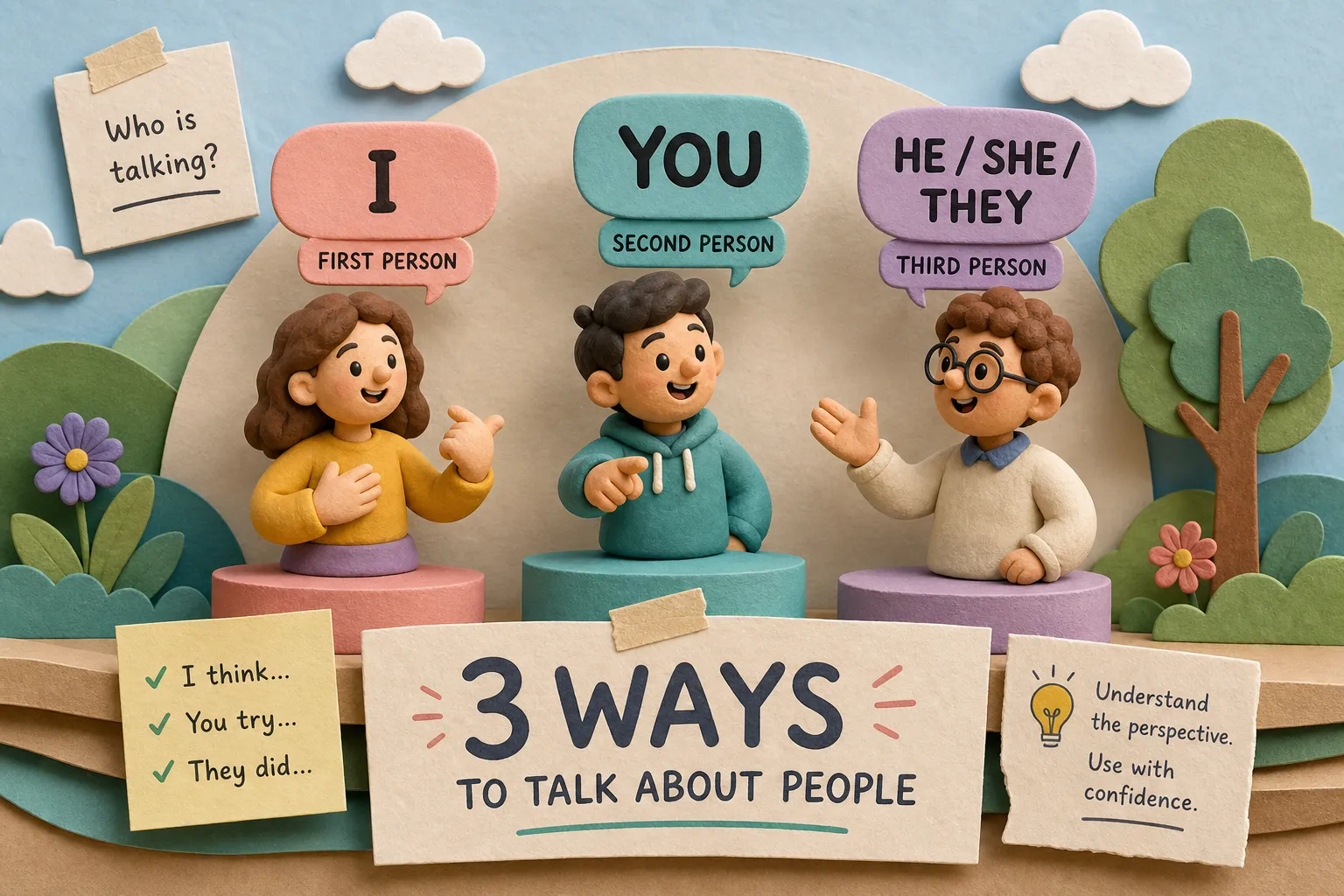
That feeling points to one of the most practical grammar skills in English: first, second, and third person. Grammatical person tells you whose perspective a sentence comes from, the speaker, the listener, or someone outside the conversation entirely. By the end of this guide, you will be able to identify all three, use the right pronouns and verb forms for each, spot accidental perspective shifts, and choose the right point of view (POV) for workplace emails, casual conversation, and storytelling.
What grammatical person means in English
Every sentence is spoken or written from a perspective. English organizes these perspectives into three groups, and each group has its own set of pronouns. Once you understand the system, you will start seeing it everywhere, in the emails you receive, the articles you read, and the stories you enjoy.
The three persons and their pronouns
First person refers to the speaker or the group the speaker belongs to. Subject pronouns: I, we. Object pronouns: me, us. Possessive pronouns: my, mine, our, ours.
Second person refers to the listener or the person being addressed. Subject, object, and possessive pronouns are the same set: you, your, yours. English uses “you” for both singular and plural, which removes a distinction present in many other languages.
Third person refers to everyone and everything else. Subject pronouns: he, she, it, they. Object pronouns: him, her, it, them. Possessive pronouns: his, her, hers, its, their, theirs. This is the largest group, covering all people, places, objects, and ideas outside the direct conversation.
How verbs change with each person
When it comes to person marking specifically, most English verbs change only for the third-person singular in the present tense. That means you add -s or -es to the verb when the subject is he, she, or it. Compare: “I walk to work.” “You walk to work.” “She walks to work.” The first two stay the same. Only the third changes. For a clear, practical explanation of this topic, see this guide to subject-verb agreement.
The verb be is the exception. It changes more than any other verb in English. In the present tense: I am, you are, he/she/it is, we are, they are. These forms are worth memorizing directly, because be appears in nearly every conversation.
First person: the “I” and “we” perspective
First person is the most personal perspective. It puts the speaker at the center of the sentence. In American English, using “I” directly and confidently is common and generally accepted, it is not considered rude or self-centered. Speakers use it to share opinions, describe experiences, and take ownership of their actions.
First person in everyday American speech
Here are some natural first-person sentences from daily life: “I had a great weekend.” “I think the blue one looks better.” “I love this coffee shop.” Phrases like “I think” and “I feel” are commonly used in American English to signal a personal view, and they are entirely expected in casual conversation.
The plural form “we” is also first person, and choosing it over “I” signals that you are speaking as part of a group rather than as an individual. “We moved to a new apartment.” “We finished the project ahead of schedule.” “We are so excited for the game tonight.” When you belong to a team, a couple, or any shared group, “we” is the natural choice.
First person in professional emails
First person is very common in American workplace writing. “I wanted to follow up on our meeting last Thursday.” “I reviewed the document and have a few questions.” These sentences feel direct and personal, which is generally a good thing in American business culture. They make it clear who is acting and who is responsible. For more tips on writing clear workplace messages, see our guide on How to Write a Professional Email in American English, Your Daily American.
“We” in emails often sounds more formal or team-oriented. “We are pleased to share the results of the Q2 report.” “We have reviewed your application and would like to schedule an interview.” Use “we” when writing on behalf of your company or team. Use “I” when speaking for yourself personally.
First-person storytelling
First-person narration puts the reader directly inside the narrator’s experience. Consider this short example: “I walked into the room and stopped. Something felt wrong. The chair where my manager always sat was empty.” First-person stories feel close and immediate. The reader sees the world through one character’s eyes only, which creates a strong sense of intimacy, but also limits what the narrator can know.
Second person: talking directly to “you”
Second person speaks directly to the reader or listener. It is the most common person in instructions, guides, and direct professional communication. In everyday English, “you” is everywhere.
Second person in instructions and professional writing
Workplace writing uses second person to address the reader clearly. “Please send your report by Friday.” “You will receive a confirmation email within 24 hours.” “Review the attached file and let me know if you have questions.” Second person works especially well when you want the reader to take action, it removes any ambiguity about who is being asked to do something.
How-to guides and instructional content also rely on second person. Think about the sentences you read in a manual or a step-by-step guide: “Open the app on your phone.” “Enter your email address and click ‘Continue’.” This is second person doing exactly what it does best: giving clear, direct instructions.
Second person as a narrative voice
Some writers use “you” to tell a story, turning the reader into the main character. Here is a short example: “You walk into the office. You don’t know it yet, but today is going to change everything.” This technique creates strong immediacy, the reader feels like they are living the story rather than observing it. The tradeoff is that some readers find the sustained “you” disorienting over a long text, which is part of why the style remains rare.
Well-known published examples include Bright Lights, Big City by Jay McInerney and choose-your-own-adventure books, where second person is part of the structure. You do not need to use this narrative style often, but recognizing it when you encounter it is a useful skill.
Third person: he, she, they, and everyone else
Third person is the most flexible perspective in English. It covers all people, objects, and ideas outside the direct conversation. It is also the most common choice in formal writing, academic papers, news articles, and most fiction.
Third person in everyday speech and professional writing
In casual conversation, third person shows up constantly. “She said she’d be about ten minutes late.” “They moved to Austin last spring.” “He’s the one who set up the meeting.” These sentences feel completely natural because the speaker is describing someone else.
In professional and academic writing, third person creates distance and a more objective tone, which is why formal reports, news articles, and official documents tend to prefer it. “The team has completed the initial phase of the project.” “The manager reviewed all applications and selected three candidates.” Shifting away from “I” or “you” signals formality and helps keep the focus on facts rather than the writer’s personal perspective.
Third-person limited vs. third-person omniscient in stories
When a story uses third person, it can do so in two main ways. Third-person limited means the narrator follows one character’s thoughts and feelings closely, using “he,” “she,” or “they.” The reader only knows what that one character knows. Here is an example: “She walked into the meeting room. Her heart was beating fast, but she kept her face calm. She had no idea what her manager was planning to say.”
Third-person omniscient means the narrator knows what all characters think and feel and can move between different minds in the same story. Here is an example: “She walked in, nervous. Across the room, her manager was already rehearsing the bad news, feeling guilty for what he was about to say.” Third-person limited is the most common choice in modern American fiction because it creates a close, personal reading experience. Omniscient narration works well for stories with many characters and a wide scope. For several concrete examples and further comparison, see this article on 3rd-person omniscient vs limited POV.
How to stay consistent: avoiding accidental person shifts
One of the most common writing problems, for both ESL learners and native speakers, is accidentally shifting from one grammatical person to another within the same piece. When that happens, the reader loses track of who is speaking.
What an accidental person shift looks like
Here is an example of an accidental shift: “I walked into the meeting room. You could feel the tension right away. He sat down and opened his laptop.” This passage starts in first person, moves to second, then jumps to third. The reader cannot tell whose experience this is. Here is the corrected version: “I walked into the meeting room. The tension was obvious. My manager sat down and opened his laptop.” The perspective stays with “I” throughout.
This also happens in professional emails. A learner might write: “I have reviewed the document. You will find some errors on page three. He should correct them before the deadline.” It is not clear who “he” is or why the perspective changed. A cleaner version: “I have reviewed the document. I found some errors on page three. These should be corrected before the deadline.”
Rules for staying consistent across a piece of writing
Four practical rules will help you maintain a consistent point of view throughout any piece of writing.
- Choose one person before you start. Decide: am I writing as “I”? Am I addressing “you”? Am I describing “he/she/they”? Make that decision first.
- Use that person’s pronouns throughout the whole piece. Do not switch unless you have a clear reason.
- Mark any intentional shift clearly. If you change perspective, start a new paragraph or section so the reader knows it is deliberate.
- Read your draft out loud. Your ear will often catch pronoun switches that your eye misses, this is a widely recommended editing technique among writing coaches and style guides. For practical tips on finding point-of-view errors, see this experienced editor’s advice.
One specific ESL challenge involves mixing “you” and “one” when giving general advice. Both are grammatically possible in English, but you need to pick one and stay with it. “You should review new vocabulary every day” and “One should review new vocabulary every day” mean the same thing. But mixing them, “You should review new vocabulary every day. One tends to forget quickly without practice”, sounds awkward and inconsistent. In most American English writing, “you” is the better choice; “one” carries a very formal register and is uncommon in everyday speech. If you’re unsure about common word pairings like “every day” vs. “everyday,” our short guide on Every Day or Everyday? A Simple Grammar Guide may help.
The pronoun agreement rule
One modern grammar point worth knowing: singular “they” is fully accepted in American English. When you refer to a person whose gender is unknown, or when someone uses “they” as their pronoun, “they” is the correct choice. “A good manager listens to their team.” “My colleague said they will send the file later.” This is standard American English in both professional and casual contexts.
Choosing the right person for your writing
The decision between first, second, and third person comes down to one core question: who is speaking, and who needs to hear this? Each writing situation tends to pull toward a particular perspective.
First, second, and third person by writing context
For personal stories, journals, and reflective emails, first person is the natural fit. Sentences like “I learned a lot from that experience” or “We are really excited to announce this news” put the writer at the center, which is exactly right for personal communication. Instructions, how-to guides, and direct professional communication call for second person, “Please review the attached file” or “You will receive your results within 48 hours” make clear who is being asked to act. Formal reports, news writing, academic papers, and most fiction default to third person: “The company reported strong growth in Q2” or “She opened the letter and read it twice.” For a helpful overview of first, second, and third person, this basic reference is useful to review.
If you are sharing your own experience, use first person. If you are directing the reader, use second person. If you are describing a situation or someone else, use third person. Keeping that framework in mind before you start writing will prevent most accidental shifts before they happen.
Try it yourself: practice prompts
Here are three first-person sentences. Try rewriting each one in third person, then check the possible answers below.
- “I go to the gym every Monday morning.”
- “I sent the report to my manager yesterday.”
- “We finished the project two days early.”
Possible answers: 1. “She goes to the gym every Monday morning.” 2. “He sent the report to his manager yesterday.” (Note: you could also use a gender-neutral option, “They sent the report to their manager yesterday.”) 3. “They finished the project two days early.” Notice that sentence 3 uses “they” for the plural “we.” Now try this one in the other direction. Rewrite this third-person sentence in second person: “Employees should submit their timesheets by noon on Friday.” One possible answer: “Please submit your timesheet by noon on Friday.”
Putting it all together
The next time you write an email, a message, or a short story in English, make a deliberate choice about first, second, or third person before you start. That one decision will shape how natural and clear your writing sounds to American readers, and it is a small shift in thinking that produces a real difference in results.
Start noticing grammatical person in the American English content you already consume every day: emails from colleagues, news articles, app notifications, YouTube descriptions. Ask yourself which person each one uses and why the writer made that choice. Spotting intentional POV decisions in real writing, especially when an article switches from third person to second person to make a direct appeal to you, the reader, is one of the most effective ways to absorb this skill naturally. When you are ready to practice applying it in real American English situations, Daily Grammar, Your Daily American is here to help.