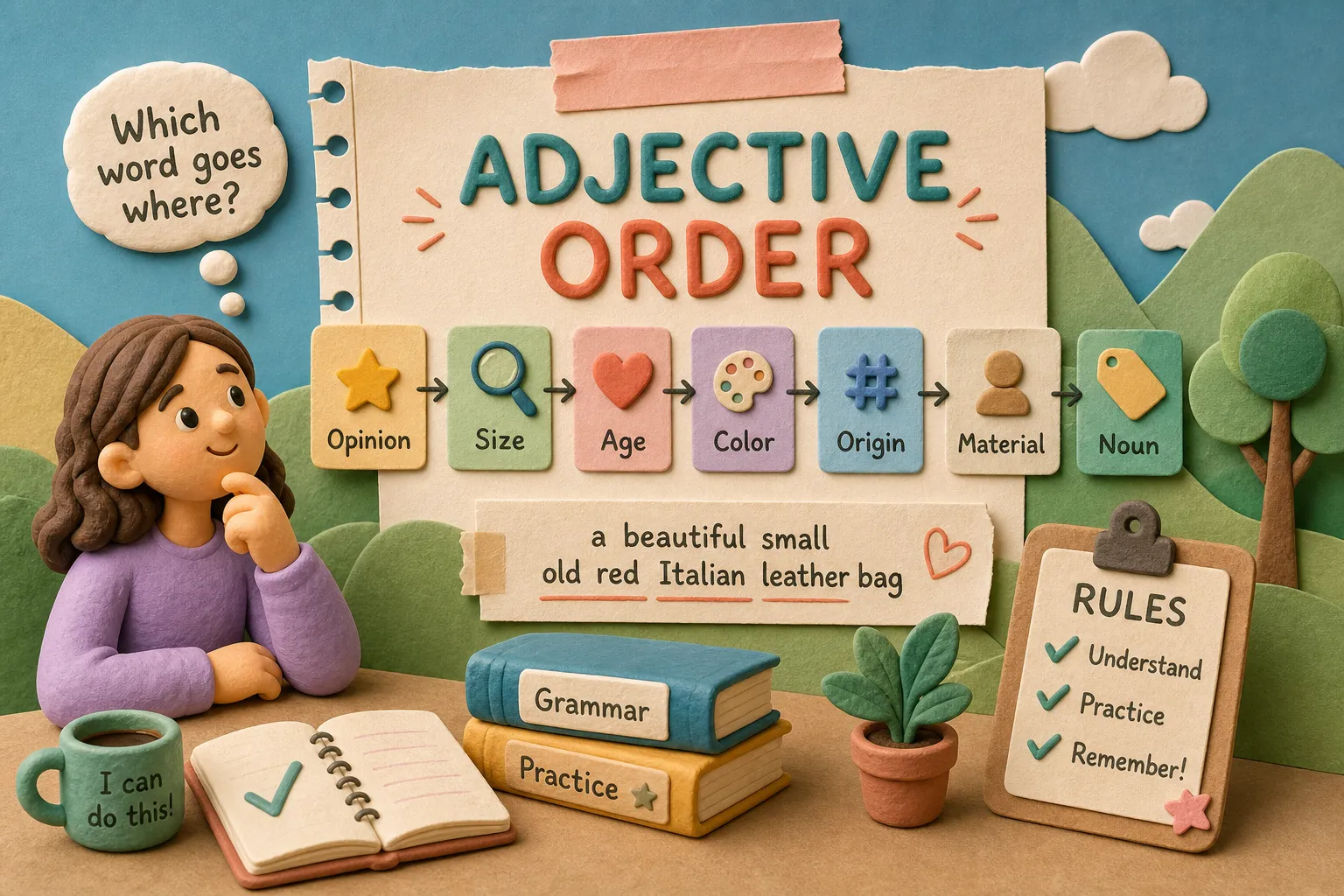
Read these two phrases carefully:
- a beautiful small old round red Italian leather writing desk
- a red old Italian small round beautiful leather writing desk
Both phrases use the exact same adjectives. But one sounds natural, and the other sounds completely wrong. Most native English speakers notice the difference right away, yet they can’t explain why.
The reason is a hidden rule: the order of adjectives in English follows a specific sequence based on category. Native speakers absorb this rule over years of listening and reading. They never study it. They just develop a feel for it. As an ESL learner, you don’t have that same background, so you need to see the structure clearly before it starts to feel natural.
That’s exactly the kind of invisible pattern that Your Daily American is built to teach: the rules that native speakers follow automatically but that most courses never explain. By the end of this article, you’ll know the 8 adjective categories, a memory trick to sequence them, when to use commas, and how numbers and hyphens fit in.
Why Adjective Order Sounds Right or Wrong to Native Ears
English adjective order is not random. There is a fixed system of categories, and adjectives from each category normally appear in a set sequence before a noun. When you break that sequence, the phrase feels wrong to native speakers right away, even if every single word is correct. (Note: idioms, fixed compounds, and deliberate emphasis can occasionally override the standard order, but those are exceptions rather than the rule.)
How Native Speakers Absorb This Rule Automatically
Native English speakers learn adjective order the same way they learn everything else: through exposure. They hear and read millions of phrases from childhood. Over time, the brain builds a strong pattern for what sounds right. Adult ESL learners don’t have that same exposure history, so the most effective approach is to learn the structure consciously first. With practice, it becomes automatic.
What Wrong Order Actually Sounds Like
Compare these pairs. The first version in each pair is natural. The second is not.
- Natural: a long red scarf / Unnatural: a red long scarf
- Natural: a lovely old house / Unnatural: an old lovely house
- Natural: a small wooden box / Unnatural: a wooden small box
The problem in each unnatural version is not the vocabulary. Every word is correct. The problem is the sequence. The next section explains exactly why the natural versions work.
The Order of Adjectives: 8 Categories and Where Each One Goes
English uses 8 standard adjective categories that normally appear in the same sequence before a noun. This system is sometimes called the adjective sequence or adjective order. Once you know the 8 categories, placing multiple adjectives correctly becomes much easier.
The First Four Slots: Opinion, Size, Age, Shape
These four categories come first, in this order:
- Opinion (what you think of it): beautiful, strange, comfortable, ugly
- Size (how big or small): tiny, large, short, wide
- Age (how old or new): old, modern, ancient, new
- Shape (its physical form): round, square, flat, oval
Put them together and you get a phrase like: a strange large old rectangular box. Each adjective sits in its correct slot, and the phrase sounds completely natural.
The Last Four Slots: Color, Origin, Material, Purpose
After shape, four more categories follow:
- Color: red, dark, golden, black
- Origin (where it’s from): Italian, American, Japanese
- Material (what it’s made of): leather, wooden, cotton, glass
- Purpose (what it’s used for): writing, running, cooking, reading
Using all four of these, you get: a black Italian leather writing journal. Each adjective sits in its designated position, color before origin, origin before material, material before purpose, and the result sounds natural and correct.
The Full Example Phrase, Labeled
Here is the complete 8-category example, with each adjective labeled by its slot:
a lovely (opinion) small (size) old (age) square (shape) red (color) Italian (origin) leather (material) writing (purpose) desk
Using all 8 categories in a single phrase is uncommon in everyday speech, you’d more likely hear it in careful, descriptive writing or a teaching example like this one. In practice, when you use 2 or 3 adjectives, this order tells you which one comes first.
OSASCOMP: A Memory Trick to Lock In the Order of Adjectives
OSASCOMP (pronounced “oh-SAS-comp”) is a mnemonic, a memory device built from the first letter of each category. It stands for: Opinion, Size, Age, Shape, Color, Origin, Material, Purpose. Grammar teachers and ESL educators have used this device widely to help learners internalize adjective sequencing.
Some teachers use a slightly fuller version called DOSA-SCOMP, which adds D for Determiner at the front. A determiner is a word like a, the, my, or this. It always comes before all adjectives. Both mnemonics teach the same underlying order. OSASCOMP is simply more compact and easier to recall.
For another clear overview of how native and learner intuitions interact with adjective order, see QuillBot’s guide to adjective order.
What Each Letter Stands For
Here is the full breakdown with one quick example for each letter:
O = Opinion (beautiful) / S = Size (small) / A = Age (old) / S = Shape (round) / C = Color (red) / O = Origin (Italian) / M = Material (leather) / P = Purpose (writing)
The two O’s are easy to mix up at first. Remember: Opinion comes first because it’s your personal view of the noun. Origin comes later because it’s a fact about where the thing is from.
How to Order Adjectives Using OSASCOMP
Here is a simple three-step process:
- Identify each adjective’s category using OSASCOMP.
- Sort the adjectives from left to right using the sequence.
- Place them before the noun.
Here’s how it works with a real example. You want to describe a sweater. Your adjectives are: wool, cozy, blue. Using OSASCOMP: cozy is Opinion, blue is Color, wool is Material. The correct phrase: a cozy blue wool sweater.
Commas Between Adjectives: When to Use Them and When to Skip Them
Not all adjectives work the same way before a noun. Some are coordinate adjectives: each one independently describes the noun and carries equal weight. Others are cumulative adjectives: they build on each other, and the order matters. Coordinate adjectives need a comma. Cumulative adjectives do not.
For a concise style reference on using commas with coordinate adjectives, see the MLA advice on coordinate adjectives and commas. For related guidance on comma rules in clauses and modifiers, you can also consult our article Adverbial Clauses: Types, Examples, and Comma Rules.
The Two Tests That Make This Easy
You don’t need to memorize grammar labels to use this rule correctly. Just apply two quick tests, both recommended by standard grammar guides:
- The “and” test: If you can insert and between the adjectives and it still sounds natural, use a comma. Example: a kind, generous teacher works because a kind and generous teacher also sounds natural.
- The swap test: If you can reverse the order of the adjectives and it still sounds natural, use a comma. Example: a generous, kind teacher works just as well.
This practical, test-based approach mirrors advice from usage references such as Merriam‑Webster’s trick for adjective order, which emphasizes listening for naturalness rather than rote lists.
Cumulative adjectives behave differently. Take a small red bag. Does a small and red bag sound natural? Not really. Does a red small bag sound natural? No. So no comma: a small red bag.
Why Adjectives in OSASCOMP Order Usually Don’t Need Commas
When adjectives come from different OSASCOMP categories, they are almost always cumulative. Small (Size) and red (Color) come from different categories, so they don’t carry the same kind of independent weight. They work together as a unit, and no comma is needed.
Opinion adjectives are the most likely group to be coordinate. Two opinion adjectives side by side, like a kind, generous person, often need a comma because both words express the same type of personal judgment about the noun.
Numbers, Hyphens, and Tricky Cases to Watch Out For
The standard OSASCOMP order handles most situations well. But a few common cases don’t fit neatly into the 8-category system. Knowing about them now will save you confusion later.
Where Numbers and Determiners Go
Determiners like a, the, my, and this always come first, before any adjective. Numbers come right after the determiner, before the OSASCOMP adjectives. The full sequence looks like this:
Determiner → Number → OSASCOMP adjectives → Noun
For example: my two beautiful old Italian leather bags. The determiner my comes first. The number two comes next. Then the adjectives follow in OSASCOMP order: beautiful (Opinion), old (Age), Italian (Origin), leather (Material).
Hyphenated Compound Adjectives: When to Connect Words with a Hyphen
A compound adjective is two or more words that work together as one modifier before a noun. When a compound adjective comes before the noun, connect the words with a hyphen. Here are three common examples:
- a ten-year-old child (but: the child is ten years old, no hyphen after the noun)
- a well-known author (but: the author is well known, no hyphen)
- a five-minute walk (but: the walk takes five minutes, no hyphen)
The pattern is simple: if the compound modifier comes directly before the noun, use a hyphen. If it comes after a linking verb like is or seems, leave the hyphen out. One important note: modifiers ending in -ly don’t take a hyphen, even before the noun. So: a poorly written report (no hyphen after poorly).
For a practical reference to hyphenation rules with compound adjectives, see this guide to compound adjectives and hyphenation.
Putting It All Together
You now have a complete picture of how the order of adjectives works in American English. Here are the three core things to take with you:
- The 8 categories follow the OSASCOMP sequence: Opinion, Size, Age, Shape, Color, Origin, Material, Purpose. Determiners come first, numbers come second.
- Use a comma between adjectives only when each one independently modifies the noun. Apply the “and” test and the swap test to check.
- Hyphenate compound adjectives before a noun. Drop the hyphen when the compound comes after a linking verb.
Try It Yourself
Practice is the fastest way to make adjective order feel automatic. Put these adjectives in the correct sequence before each noun. Write out your full answer, then say it out loud.
- Adjectives: red, large, wool, old, Noun: scarf
- Adjectives: French, small, antique, wooden, Noun: clock
- Adjectives: comfortable, new, cotton, white, Noun: shirt
The answers follow OSASCOMP order strictly:
- Scarf: a large old red wool scarf (Size → Age → Color → Material)
- Clock: a small antique French wooden clock (Size → Age → Origin → Material, note that “antique” functions as Age here, even though it can feel evaluative; OSASCOMP places it before Origin)
- Shirt: a comfortable new white cotton shirt (Opinion → Age → Color → Material)
The order of adjectives is one of many natural patterns in American English that become clear once someone explains them directly. At Your Daily American, you’ll find the same kind of practical, real-world grammar explained with plenty of examples, covering everything from pronunciation and connected speech to workplace English. If you want to review sentence-level structure while you practice these adjective patterns, check out Compound Sentences Made Simple: Rules and 25+ Examples. For tips on common adjective/adverb confusions that often come up alongside adjective order practice, see Are You Using “Good” and “Well” Wrong? Here’s the Fix.