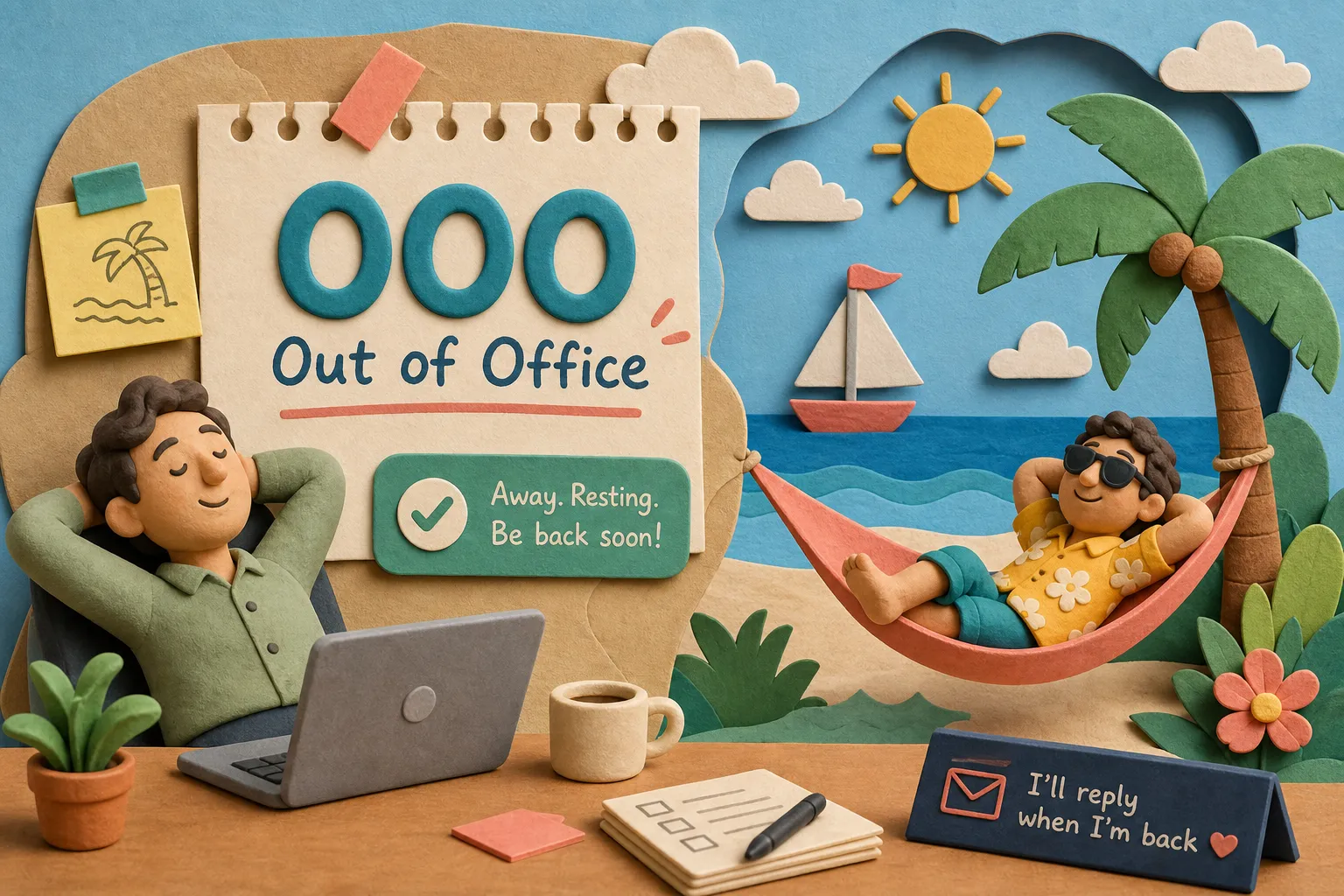
You send an email to an American colleague and, within seconds, you get an automatic reply back. The subject line says something like “Re: Project Update, OOO until July 2.” You understand the basic idea: they’re not available. But if you’ve ever wondered about the OOO meaning, what the abbreviation actually stands for, when Americans set one, and how you would write one yourself in professional American English, this guide covers all of it.
Professional email vocabulary is one of the most practical skills in American workplace communication. It shows up every day: in your inbox, on team calendars, and in Slack or Teams statuses. At Your Daily American, this kind of real-world workplace English is exactly what we teach, because knowing what to say and how to say it at work makes a real difference. This guide is part of that work.
By the end of this article, you will know what OOO means, when to set one, what to include, and how to write a polished out-of-office reply. You’ll also get five copy-ready templates you can adapt and use right away.
OOO meaning in American English
OOO stands for out of office. In American workplaces, it signals that someone is away and not available to respond to emails or messages for a set period of time. It is a widely used abbreviation in professional communication.
The abbreviation and what it signals
You’ll see OOO in several places at work. It appears in email subject lines (like “OOO: June 23, 27”), in automatic reply messages, and on calendar blocks marked “OOO, vacation.” In some workplaces, it also shows up in chat status fields on platforms like Slack or Microsoft Teams. The message is simple: “I’m not at my desk right now, and I won’t reply until a specific date.”
When someone receives an OOO reply, they know two things immediately. First, the person is unavailable. Second, there is usually an alternate contact or a return date included. That combination of information is exactly what makes OOO messages useful in a professional setting.
OOF: the other version you might see
You may also see OOF used instead of OOO. The two mean the same thing in practice. OOF is Microsoft’s historical shorthand for the same concept. One common explanation traces it to an older internal system phrase, and the abbreviation carried over even as the language changed. If you use Outlook or work in a Microsoft-heavy environment, you’ll likely see OOF more often.
One small note worth knowing: in casual texting or online chat, lowercase “ooo” can sometimes be a reaction sound, similar to writing “ohhh” to show surprise or interest. That use has nothing to do with the workplace abbreviation. Context makes the difference. In professional email and workplace contexts, uppercase OOO or OOF is almost always used to mean “out of office.”
When Americans use an out-of-office reply
Not setting an OOO message when you’re absent is often seen as unprofessional, because it leaves the other person unsure whether to wait, follow up, or find someone else to help. In American professional culture, it’s expected practice to set one any time you won’t be able to respond to emails within your usual timeframe. For additional guidance on why and when to use an out-of-office message, see Indeed’s guide to out-of-office messages.
Common situations that call for an OOO
Here are the most typical reasons to set an out-of-office reply:
- Vacation or paid time off (PTO)
- Sick days or medical leave
- Parental leave
- Company holidays or office closures
- All-day business travel or conferences
- Extended leave of absence
Notice that OOO is not only for long trips. Even a one-day absence is a common reason to set one, especially in customer-facing roles or fast-moving teams. The point is to give the other person a clear answer instead of silence.
How far in advance to set it up
For planned absences like vacation or parental leave, set your OOO message before you leave. Most email tools let you schedule it with a start and end date, so it turns on and off automatically; if you use Outlook, Microsoft explains how to set up out-of-office automatic replies in Outlook. For unexpected absences like illness, it’s fine to set it the same day, as soon as you know you won’t be responding. The goal is to give senders useful information as quickly as possible.
For anything that affects clients or external contacts, earlier is better. If your absence will affect a deadline or an ongoing project, let people know as soon as your dates are confirmed. That way, they can plan around your schedule and contact the right person for anything urgent.
What your OOO message needs to include
A good OOO message is brief and specific, typically just a few sentences that give the reader exactly what they need to know. Think of it as a small act of professionalism: you’re making life easier for the person on the other end while protecting your own time away.
The four key pieces of information
Every professional out-of-office reply should include these four elements:
- A polite opening that acknowledges the email (“Thank you for your message.”)
- A clear statement that you are out of the office, with your return date (“I’m currently out of the office and will return on July 2.”)
- A backup contact for urgent matters (“For urgent requests, please contact Maria at maria@company.com.”)
- A realistic expectation for your response (“I’ll reply to your message as soon as possible after I return.”)
Here’s how all four work together in a real example:
Thank you for your email. I’m currently out of the office from June 23 to June 27 and will return on June 30. For urgent matters, please contact David at david@company.com. I’ll respond to your message as soon as I’m back.
That covers everything the sender needs, clean, clear, and nothing extra.
What to leave out
Two common problems pull in opposite directions. Some messages are too vague: “I’m out of office” with no dates and no backup contact. Others go too far the other way, a full paragraph explaining where you’re traveling, why you’re leaving early, and when your flight lands. The first confuses the sender; the second wastes their time. Good OOO etiquette lands squarely in the middle.
Also, never list a backup contact who doesn’t know they’ll be receiving messages on your behalf. That is a basic rule of American workplace etiquette. Talk to your backup before you leave. If you list someone without telling them, you put them in an awkward position and it reflects poorly on you.
How to write your OOO message in professional American English
The content is only half the work. The other half is getting the tone right. A professional OOO message in the United States sounds polite and warm, but not casual. It’s clear and direct, without being cold or stiff.
Tone and register: formal vs. friendly
Compare these two opening lines:
Too formal: “I regret to inform you that I am currently unavailable to respond to your correspondence.”
Natural American professional: “Thank you for your email. I’m currently out of the office.”
The second version sounds like a real person at work. It’s warm without being too casual. Native American professionals use phrases like “I’m currently out of the office,” “I’ll get back to you as soon as possible,” and “For urgent matters, please reach out to…” These are the natural patterns that sound fluent and appropriate in American business settings.
Getting that tone right takes time and practice. At Your Daily American, you can study professional email language and the specific phrases that fluent English speakers use every day at work, which is one of the most practical things you can build right now. For broader lessons on professional workplace language, see our piece on Professional English for the Modern Workplace.
Five OOO email templates you can use today
Each template below is ready to copy and adapt. Replace the words in brackets with your own information. For additional sample auto-reply formats and variations, check out these auto-reply email templates.
Template 1: Simple vacation OOO
Use this for: standard paid time off or a short trip.
Thank you for your email. I’m currently out of the office from [start date] to [end date] and will have limited access to email during this time. For urgent matters, please contact [name] at [email address]. I’ll respond as soon as possible when I return on [return date].
Template 2: Extended leave OOO
Use this for: parental leave, medical leave, or any absence longer than two weeks.
Thank you for your message. I’m currently on leave and will not be checking email during this time. I’ll return on [date]. For any questions or requests, please contact [name] at [email address], who will be happy to help while I’m away.
Template 3: Client-facing OOO
Use this for: customer service roles or anyone who communicates regularly with external clients.
Hello, and thank you for reaching out. I’m currently out of the office until [date]. If you need immediate assistance, please contact [colleague name] at [email address] or [phone number]. I appreciate your patience and will follow up with you after [return date].
Template 4: Business travel or full-day meetings OOO
Use this for: when you’re working but have limited access to email.
Thank you for your email. I’m traveling for work on [date(s)] and will have limited access to my inbox. I’ll respond as soon as I can. For urgent matters, please contact [name] at [email address].
Template 5: Company holiday closure OOO
Use this for: office-wide closures on public holidays.
Thank you for your message. Our office is closed in observance of [holiday name] and will reopen on [date]. I’ll respond to your email at that time. For urgent matters, please contact [name] at [email address].
If you’re looking for holiday-specific wording and seasonal examples, TextExpander’s holiday out-of-office templates offer a useful collection you can adapt.
Three OOO mistakes that make you look unprofessional
Three common errors trip up even experienced professionals, here’s what to watch for.
Being too vague or too detailed
A message that only says “I’m out of office” with no dates gives the sender nothing useful. They don’t know when you’ll be back or who to contact. On the other end, a message that explains your travel plans in full detail is too much. It’s not relevant, and it wastes the reader’s time.
Here’s a quick before and after:
Too vague: “I’m out of the office. I’ll reply when I can.”
Clear and professional: “I’m out of the office until July 2. For urgent matters, please contact Ana at ana@company.com. I’ll reply to your message after I return.”
Listing a backup contact who doesn’t know they’re listed
This is a real problem. If you put someone’s name and email in your OOO message without telling them, they may get emails they’re not prepared for. In American workplace culture, this is considered disrespectful to your colleague. Always speak with your backup contact before you set the message. Make sure they know what to expect and what to do.
Forgetting to turn it off when you return
Coming back to the office and forgetting to disable your OOO auto-reply is a very common mistake. When senders get an out-of-office reply from someone who is clearly back at work, it signals poor attention to detail. The easiest fix is to use the automatic end-date feature in your email tool. Set the exact return date when you activate the message, and it will turn off on its own. For practical tips on crafting an effective out-of-office message, see this guide from Early Bird at MSU Denver.
You’re ready to write your own OOO message
Now that you understand the OOO meaning, you have everything you need to write a clear out-of-office reply that fits American workplace expectations. OOO stands for “out of office,” it’s a standard part of American professional communication, and a strong OOO message is short, specific, and polite. You also have five ready-to-use templates and a clear list of mistakes to avoid.
Writing professional emails that sound natural in American English is one of the most useful skills you can build. Whether it’s an OOO auto-reply or a note to a client, the right tone and phrasing make a real difference. At Your Daily American, you’ll find practical lessons on how to write a professional email in American English and the kind of American English that helps you feel confident at work. For additional rules and best practices, review our guide to Email Etiquette Rules Every Professional Must Know.
Try it yourself: Write a practice OOO message for a five-day vacation using one of the templates above. Fill in your own dates, return date, and a backup contact name. Then read it out loud. Does it sound clear and natural? If something feels awkward, adjust the sentence until it sounds like something a real professional would say. That’s exactly how fluency builds.