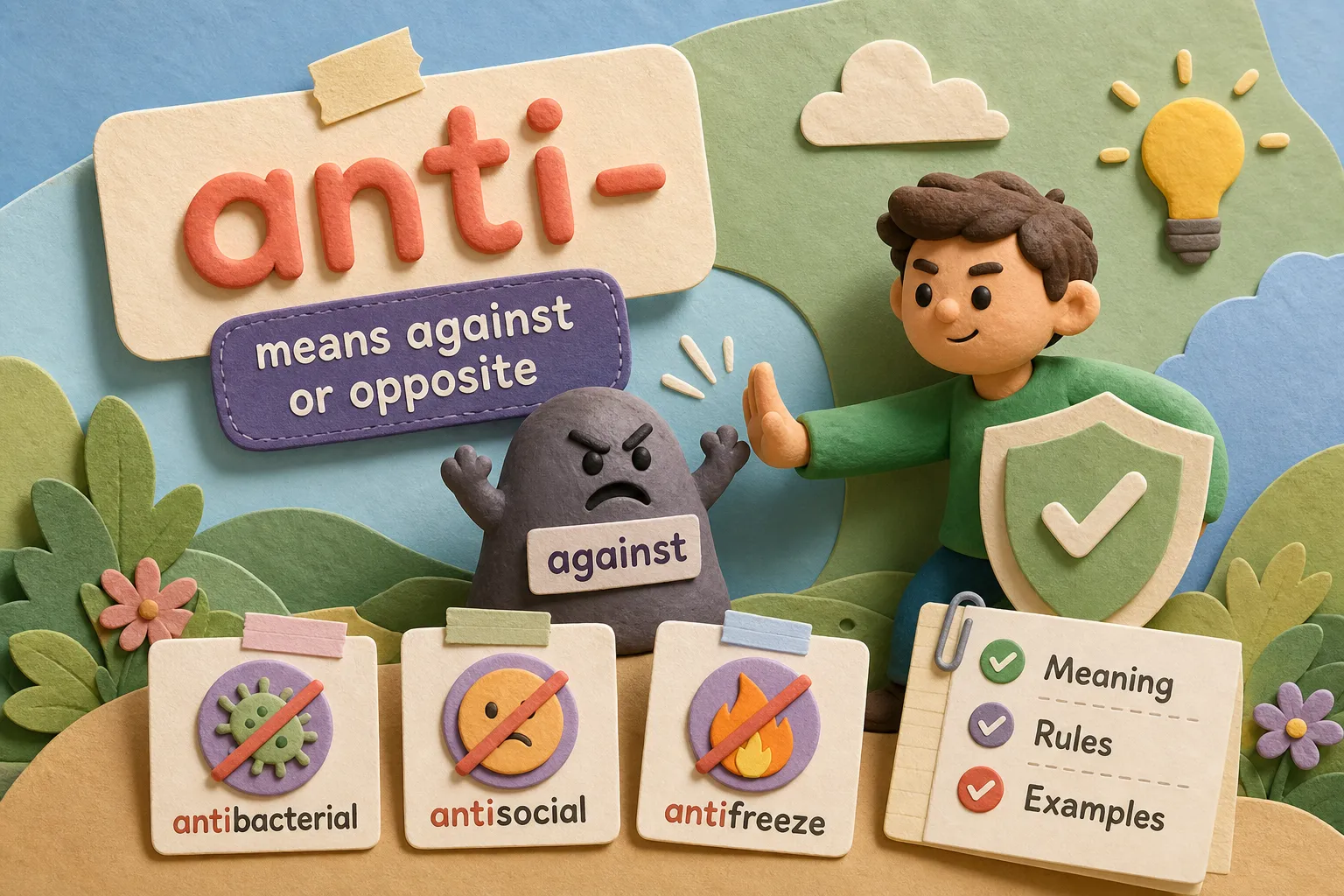
You open a news app in the morning. One article talks about antibiotic resistance. Another mentions an antiwar protest. A health headline uses anti-inflammatory, and your phone’s security software reminds you to update your antivirus. That’s four different words with the same prefix, all before breakfast. Each one uses the anti prefix, written anti-, which means “opposed to” or “designed to prevent.”
The prefix anti- is a very common and productive word-building element in American English. Once you understand what it means and how it works, you stop seeing unfamiliar words and start seeing familiar patterns. By the end of this article, you’ll be able to define the prefix, recognize its two main meanings, know when to hyphenate words with the anti- prefix, and tell it apart from similar prefixes like counter- and un-. This is exactly the kind of pattern-based vocabulary lesson that Your Daily American is built on: understanding how English actually works, not just memorizing longer and longer word lists.
Anti prefix: meaning and where it comes from
The Greek root behind the prefix
The prefix anti- comes from the ancient Greek word ἀντί (pronounced antí). In Greek, this word meant “against,” “opposite,” and sometimes “in place of.” English didn’t borrow this prefix directly from Greek. According to standard etymological sources including Merriam-Webster and the Online Etymology Dictionary, it entered English primarily through learned Latin borrowings, with some words also mediated by Old French, before settling into English as a regular word-building tool.
The Latin connection matters because many formal English words in science, medicine, and law follow Latin word patterns. That’s why anti- appears so often in medical and legal vocabulary. The Greek origin explains the “opposition” idea that runs through almost every anti- word you’ll ever see.
How the meaning settled in modern English
In modern American English, anti- carries two core senses. The first is “opposed to” something. The second is “counteracting or preventing” something. The older Greek meaning of “in place of” is mostly absent from everyday use, though some dictionaries note it as a rare historical sense.
This narrowing makes things simpler for learners. For most words you’ll encounter in news, health writing, and daily conversation, two meanings do the heavy lifting: opposition and prevention. Keep in mind that a small number of anti- words carry extended senses, such as “opposite in position or function”, so it’s always worth checking a dictionary when a word feels ambiguous.
The two main ways anti- works in American English
Anti- as opposition: standing against something
The first sense shows up when a person, group, or policy is opposed to something. You see this constantly in American news and social media. An antiwar protest is a protest against war. An anti-government movement is a group of people opposed to the government. An anti-establishment candidate runs against the political system itself.
This sense is also highly productive, meaning speakers create new anti- words all the time using this pattern. During major news events, new anti- compounds tend to emerge rapidly, think anti-lockdown and anti-mask entering mainstream coverage in the early 2020s. Learning this prefix means you can decode those new words the moment you see them, without stopping to search.
Anti- as prevention or counteraction: blocking something
The second sense is slightly different. Here, anti- means a substance, product, or treatment that prevents or neutralizes something. An antibiotic is a drug that fights bacteria. An anti-inflammatory reduces swelling. Antivenom counteracts the effects of venom from a snake bite. This “prevention” sense is especially dominant in scientific and medical naming conventions, where precision matters.
Most vocabulary lists skip this distinction entirely, but it matters when you read health or science writing in English. When a doctor prescribes an antibiotic, they’re not just “opposed to” your infection. The drug is specifically designed to stop and destroy it. That’s a more active sense of the prefix, and recognizing it helps you read medical language with much greater confidence.
Anti prefix hyphenation rules: hyphen or no hyphen?
When anti- goes without a hyphen
If a word is established and appears in standard American dictionaries, it’s usually written as one closed word with no hyphen. These are words that have been used long enough to feel like single units: antibiotic, antivirus, antidote, antihero, antiseptic, antioxidant, antiperspirant.
A practical rule of thumb endorsed by sources like Merriam-Webster: if you can find the word as a single dictionary entry, write it without a hyphen. For example, antidote appears as one word in every major American dictionary, so there’s no need for a hyphen.
When a hyphen is needed (and why)
Three situations call for a hyphen, according to major American style guides. First, when anti- attaches to a proper noun or a capitalized word: anti-American, anti-NATO, anti-European. Second, when combining the prefix with a word creates an awkward double vowel: anti-inflammatory is easier to read than antiinflammatory. Third, when the compound is new and not yet recorded in the dictionary as a fixed word: anti-mask, anti-lockdown.
You may also notice that American news media, which generally follows AP style, uses hyphens differently than academic writing does. The AP Stylebook defaults to closed forms for most anti- words but maintains a specific list of hyphenated exceptions, such as anti-war, anti-corruption, and anti-abortion. (You may see variation in published examples, including within this article, because different outlets follow different editions of the guide.) The Chicago Manual of Style generally prefers closed forms whenever possible. Both approaches appear in real American English, so seeing either version in print is normal.
Anti- vs. counter-, contra-, and un-: what’s the difference?
How each prefix carries a different shade of meaning
These four prefixes can look similar, but each one carries a different idea.
- anti- means “opposed to” or “designed to prevent.” Example: The doctor recommended an antibiotic to fight the infection.
- counter- means “a direct response or balancing action.” Example: The lawyer prepared a counterargument for the next day in court.
- contra- means “in conflict with” and appears mostly in formal or technical language. Example: The medication was contraindicated for patients with heart disease.
- un- simply means “not” or “reversing an action.” Example: She unlocked the door and went inside.
A quick way to choose the right prefix
Here’s a practical decision rule. If you mean “opposed to something” or “designed to prevent it,” anti- is almost always the right choice. If you mean “responding to something with an equal action,” counter- fits better. If you mean “reversing an action or simply saying ‘not’,” use un-.
For contra-, you mostly need it for recognition, not production. Almost no new everyday words are built with contra- in modern American English. Words like contradict and contraband are fixed vocabulary items that you learn as whole units. You won’t need to build new words with contra- yourself.
Anti- words you’ll hear in American English every day
Health and medical vocabulary
Medical writing uses the anti- prefix constantly. Here are the words you’ll see most often in health and science contexts, each with a short definition and an example sentence.
- Antibiotic: a drug that fights bacterial infection. “The doctor prescribed an antibiotic for the ear infection.”
- Anti-inflammatory: something that reduces swelling or pain. “Ibuprofen is a common anti-inflammatory medication.”
- Antioxidant: a substance that protects cells from damage. “Blueberries are known for being high in antioxidants.”
- Antiseptic: a product that kills germs on skin or surfaces. “She cleaned the cut with an antiseptic before putting on a bandage.”
- Antivenom: a treatment for a venomous bite or sting. “The hospital kept antivenom on hand for rattlesnake bites.”
- Antidepressant: a medication prescribed for depression. “His doctor adjusted the dose of his antidepressant.”
News, politics, and legal topics
American news uses these words almost every day. The lists below are illustrative rather than corpus-ranked, but each word appears with high frequency in American newspapers and broadcasts.
- Antiwar: opposed to military conflict. “Thousands attended the antiwar rally downtown.”
- Anti-government: opposed to the policies or authority of a government. “The group expressed strong anti-government views.”
- Antitrust: related to laws that prevent unfair business monopolies. “The company faced an antitrust investigation by regulators.”
- Anti-discrimination: working against unfair treatment of people. “The new anti-discrimination policy applied to all employees.”
Everyday and consumer language
You’ll also find words with the anti- prefix on product labels and in daily conversation.
- Antivirus: software that protects computers from harmful programs. “Make sure your antivirus software is up to date.”
- Antifreeze: a liquid that prevents a car engine from freezing. “He checked the antifreeze before the long winter drive.”
- Antiperspirant: a product that reduces sweating. “The brand launched a new antiperspirant for sensitive skin.”
- Anti-aging: designed to reduce or slow the visible effects of aging. “The store had a full shelf of anti-aging skin creams.”
Why learning prefixes like anti- is one of the best vocabulary moves you can make
One prefix, dozens of words unlocked
When you learn a single prefix, you don’t gain one word. You gain a tool that works across dozens of words, including ones you’ve never seen before. A learner who understands the anti prefix can read antimicrobial, antiarrhythmic, or anti-corruption for the first time and immediately grasp the general meaning, even without a dictionary. Vocabulary researchers, including Paul Nation, whose work on word frequency and morphological instruction is widely cited in applied linguistics, have consistently found that teaching prefixes and word roots produces stronger long-term vocabulary growth than rote list memorization.
This is how advanced readers and native speakers handle unfamiliar vocabulary. They don’t stop at every new word. They recognize the pattern and keep reading.
How Your Daily American teaches English this way
Your Daily American is built on this approach. Instead of handing you a list of words to memorize, the platform explains how American English actually works: its patterns, its roots, its real-life context. Whether you’re reading a health article, a news headline, or a work email, you’ll have the tools to understand new words immediately and in context.
If this kind of lesson helps you see English more clearly, there’s much more waiting for you. Your Daily American covers pronunciation, professional vocabulary, grammar, and study methods, all designed for real-world use. Take the free proficiency test to find your level, and start building from there.
Wrapping up
The anti prefix comes from Greek, and in modern American English it carries two clear meanings: “opposed to” something, and “designed to prevent or counteract” something. It follows straightforward spelling rules: no hyphen for established dictionary words, and a hyphen before proper nouns, when vowels collide, and with new or unestablished compounds. It’s distinct from counter- (which signals a direct response), contra- (a formal Latin form), and un- (which simply means “not”).
Recognizing prefixes is a real skill, and it pays off every time you read an American news article, a health label, or a work document. The goal isn’t just to know these words with the anti- prefix. It’s to train yourself to see the structure inside unfamiliar words and use that structure to understand them.
Start today: as you read English online or at work, notice every anti- word you come across and ask yourself whether it means “opposed to” something or “designed to prevent” something. That two-question habit, combined with a quick dictionary check for any word that feels ambiguous, will make you a faster, more confident reader. And when you’re ready to go deeper, Your Daily American has more lessons built exactly this way.