You write “I didn’t used to like coffee” and send the message. A native speaker reads it and quietly fixes it: “I didn’t use to like coffee.” You read the correction and feel confused. The two sentences sound almost identical when spoken out loud. So why is one wrong?
This is one of the most common grammar problems for intermediate learners of American English, a confusion often searched as “used to vs. use to” or simply “which spelling is correct?” In casual speech, both forms are often indistinguishable, commonly reduced to a similar sound: “YOOZ-tuh” (roughly /ˈjus.tə/). But in writing, the rules are clear and consistent. Once you understand them, you won’t make this mistake again.
By the end of this lesson, you will know exactly when to write “used to,” when to write “use to,” and how “be used to” and “get used to” fit into the picture. At Your Daily American, every grammar lesson is built around how the language actually works in real American sentences. This one is no different.
What “used to” means and how to use it
What this phrase actually expresses
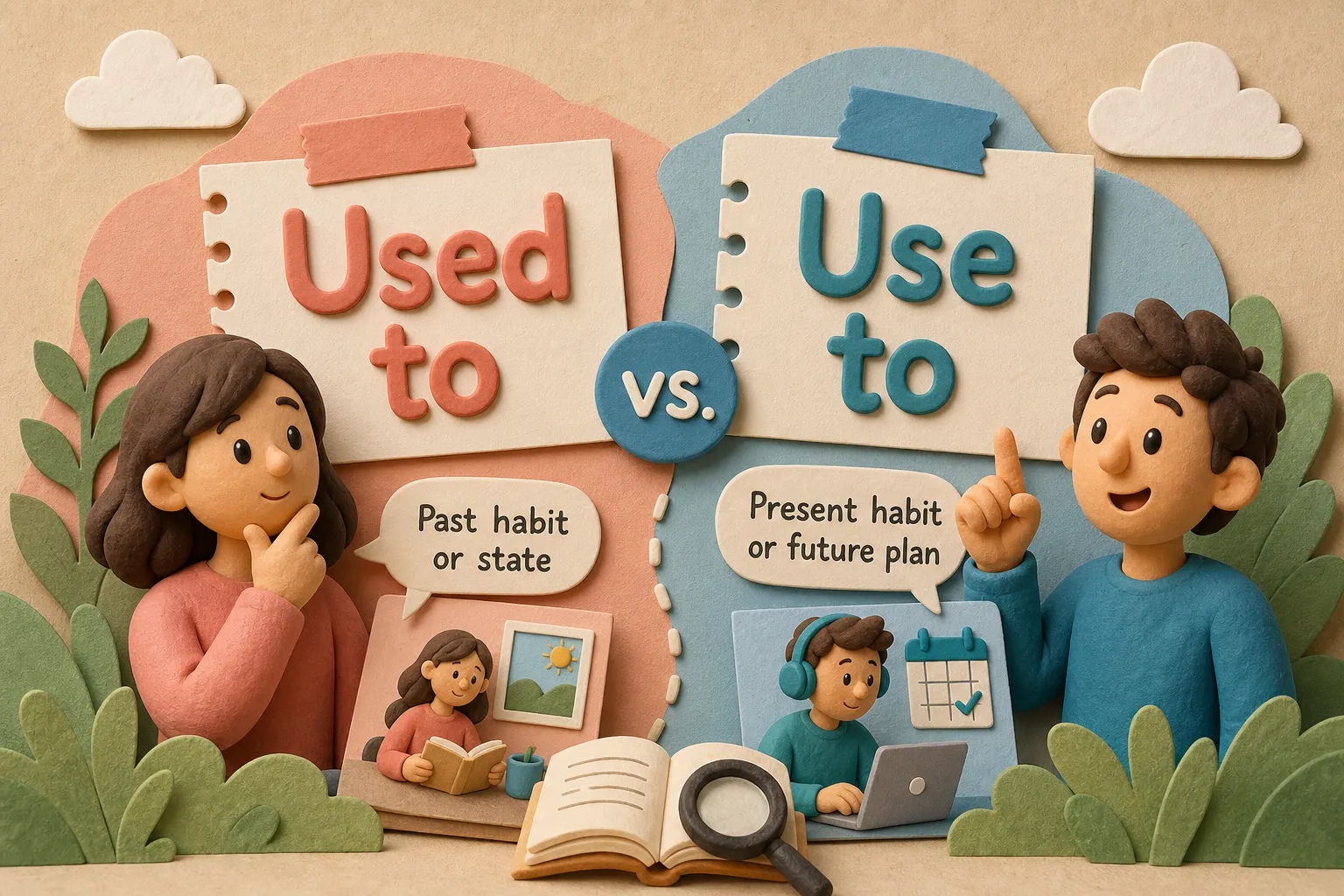
“Used to” describes a past habit or state that is no longer true today. When you say “I used to live in Miami,” the message is clear: you lived there before, but you don’t anymore. That “not anymore” meaning is built into the phrase automatically, listeners already understand the implied contrast without you having to spell it out.
This makes “used to” different from the simple past. “I lived in Miami for two years” is just a fact. “I used to live in Miami” signals a change. That added layer of meaning is what makes this phrase so useful in everyday conversation.
The structure of affirmative sentences
The pattern is simple: subject + used to + base verb. The verb after “used to” is always the base form, the infinitive without “to.” You write “I used to play guitar,” not “I used to played guitar.” You can find authoritative explanations of the structure on the Cambridge grammar pages for “used to.”
- “She used to work the night shift.”
- “We used to take long walks after dinner.”
- “He used to be really shy.”
- “My sister used to drive everywhere, now she takes the subway.”
Habits and states both work
“Used to” works for repeated actions and for situations that stayed the same over a period of time. “I used to drink three cups of coffee a day” describes a habit. “I used to be afraid of dogs” describes a state. Both are correct uses of the phrase, and both carry that same built-in sense of “but not anymore.”
When “use to” (without the d) is correct
Questions formed with “did”
Here is where many learners stumble. When you form a question with “did,” the past tense is already marked by “did.” The main verb drops back to its base form. This same rule applies here, so the correct form is: “Did you use to live in this neighborhood?”, not “Did you used to.”
Think of it this way: you would never say “Did you wanted coffee?” You say “Did you want coffee?” The same logic applies. “Did” carries the past tense, so the verb returns to its base form. For an overview of the common confusion and usage guidance, see this comparison of use to vs. used to.
- “Did she use to play tennis?”
- “Did they use to own a car?”
- “Did he use to take the bus?”
Negatives formed with “didn’t”
The same rule applies to negative sentences. When “didn’t” is in the sentence, drop the “d” from “used.” Writing “I didn’t used to” is the most common error in this grammar area. It feels natural because the spoken form sounds nearly identical to the correct version. In writing, though, the rule is firm.
- “I didn’t use to like vegetables.” ✓
- “She didn’t use to wake up this early.” ✓
- “They didn’t use to live together.” ✓
The one rule that keeps “used to” vs. “use to” straight
The “did” test
You only need to ask one question: does the sentence contain “did” or “didn’t”? If yes, write “use to.” If no, write “used to.” Apply this test before you write the phrase, and you’ll land on the right form every time. This rule reflects standard written and formal American English, the safest choice in any context where correct spelling matters. For a quick dictionary-style take on the same question, Merriam-Webster covers the distinction well (Is it “used to” or “use to”?).
It’s worth noting that in very casual spoken conversation, you may occasionally hear “didn’t used to,” but this is considered informal and is best avoided in writing. Stick with “didn’t use to” and “did you use to” whenever you put words on a page.
| Sentence type | Correct form | Example |
|---|---|---|
| Affirmative statement | used to | I used to run every morning. |
| Question with “did” | use to | Did you use to run here? |
| Negative with “didn’t” | use to | I didn’t use to run at all. |
Why this error happens in the first place
In spoken American English, “used to” and “use to” are often indistinguishable in casual speech. The “d” in “used” blends with the “t” in “to,” creating one smooth sound (roughly /ˈjus.tə/, or “YOOZ-tuh”). Because the ear picks up no difference, the writing rule can feel invisible at first. Once you have the “did” test locked in, the confusion disappears on the page. For additional exercises and explanations from a trusted teaching organization, see the British Council’s page on the different uses of “used to”.
“Be used to” and “get used to” mean something completely different
“Be used to” means already comfortable with something
This is a separate phrase with a separate meaning. “Be used to” means you are familiar with something right now, it describes your current state, not a past habit. When you say “I am used to waking up early,” you mean that waking up early feels normal to you. It doesn’t bother you anymore.
- “I am used to waking up early.” (It feels normal to me.)
- “She is used to the cold weather.” (The cold doesn’t bother her.)
- “They were used to the noise.” (The noise felt normal to them.)
Notice the structure: subject + be + used to + noun or -ing verb. In this construction, “used to” is always spelled with a “d”, even in questions. “Is he used to driving on the left?” is correct. Unlike the past-habit phrase, this form never changes to “use to,” regardless of whether “did” appears. “Did you get used to the noise?” is also correct, with “used” staying intact.
Keeping that spelling consistent is easy once you recognize that “be used to” and “get used to” are fixed idioms, not inflected verbs. Cambridge’s usage notes also distinguish these idioms clearly in their grammar resources.
“Get used to” describes the process of becoming comfortable
“Get used to” describes change over time, you are still adjusting, or you are looking back at when something became normal for you. The structure is: subject + get + used to + noun or -ing verb.
- “I’m getting used to my new job.” (Still adjusting.)
- “She got used to speaking English every day.” (It became normal over time.)
- “He will get used to the schedule.” (Future adjustment.)
The grammar rule both phrases share
After both “be used to” and “get used to,” the next word is always a noun or a gerund (the -ing form of a verb used as a noun). Never a base verb. This gerund requirement trips up many intermediate learners, particularly those whose first language defaults to an infinitive in similar structures. Spanish speakers, for example, often reach for the infinitive form by instinct.
- “I am used to driving on highways.” ✓
- “I am used to drive on highways.” ✗
- “She got used to waking up early.” ✓
- “She got used to wake up early.” ✗
Common mistakes and a quick practice check
The errors that come up most often
Mistake 1: “I didn’t used to like it.”
Fix: “I didn’t use to like it.” The word “didn’t” already carries the past tense. Drop the “d.”
Mistake 2: “I am used to drive to work.”
Fix: “I am used to driving to work.” Always use the -ing form after “be used to.”
Mistake 3: “I use to play basketball.” (affirmative, no “did”)
Fix: “I used to play basketball.” Without “did” or “didn’t,” you need the “d.”
Try it yourself
Fill in the blank with the correct form. Answers are below.
- “Did you ___ (use to / used to) take the train to work?”
- “He ___ (use to / used to) love horror movies.”
- “I’m not ___ (use to / used to) waking up this early.”
- “She didn’t ___ (use to / used to) speak English at all.”
Answers: 1. use to / 2. used to / 3. used to / 4. use to
Now write two sentences of your own: one about a past habit, and one about something you are now accustomed to doing. Writing your own examples is one of the best ways to make a grammar rule stick. For additional examples and practice exercises on this topic, the Cambridge Dictionary and usage pages offer helpful reference material (Cambridge: used to).
A quick recap
“Used to” (with a d) is the standard form for talking about past habits and states that are no longer true. “Use to” (without the d) appears only after “did” or “didn’t” in questions and negative sentences. When you’re unsure which to pick, run the “did” test, it takes two seconds and gets you to the right answer.
“Be used to” and “get used to” belong to a different category entirely. They describe comfort and familiarity, not past habits. After both of them, the next word is always a noun or an -ing verb, never a base verb. Keeping these three phrases separate in your mind will prevent the most common mix-ups at the intermediate level. For another clear student-oriented explanation, see this practical guide to the same confusion (Scribbr: use to vs. used to).
These are small distinctions on the page, but they’re the kind that native speakers notice. Getting the spelling right is the difference between writing that reads smoothly and writing that makes someone pause. If you want to keep building grammar skills like this, explore the grammar section at Your Daily American. For other common confusions, check our piece on Every Day or Everyday? A Simple Grammar Guide, and for tips on precise word choice, read Are You Using “Good” and “Well” Wrong? Here’s the Fix.