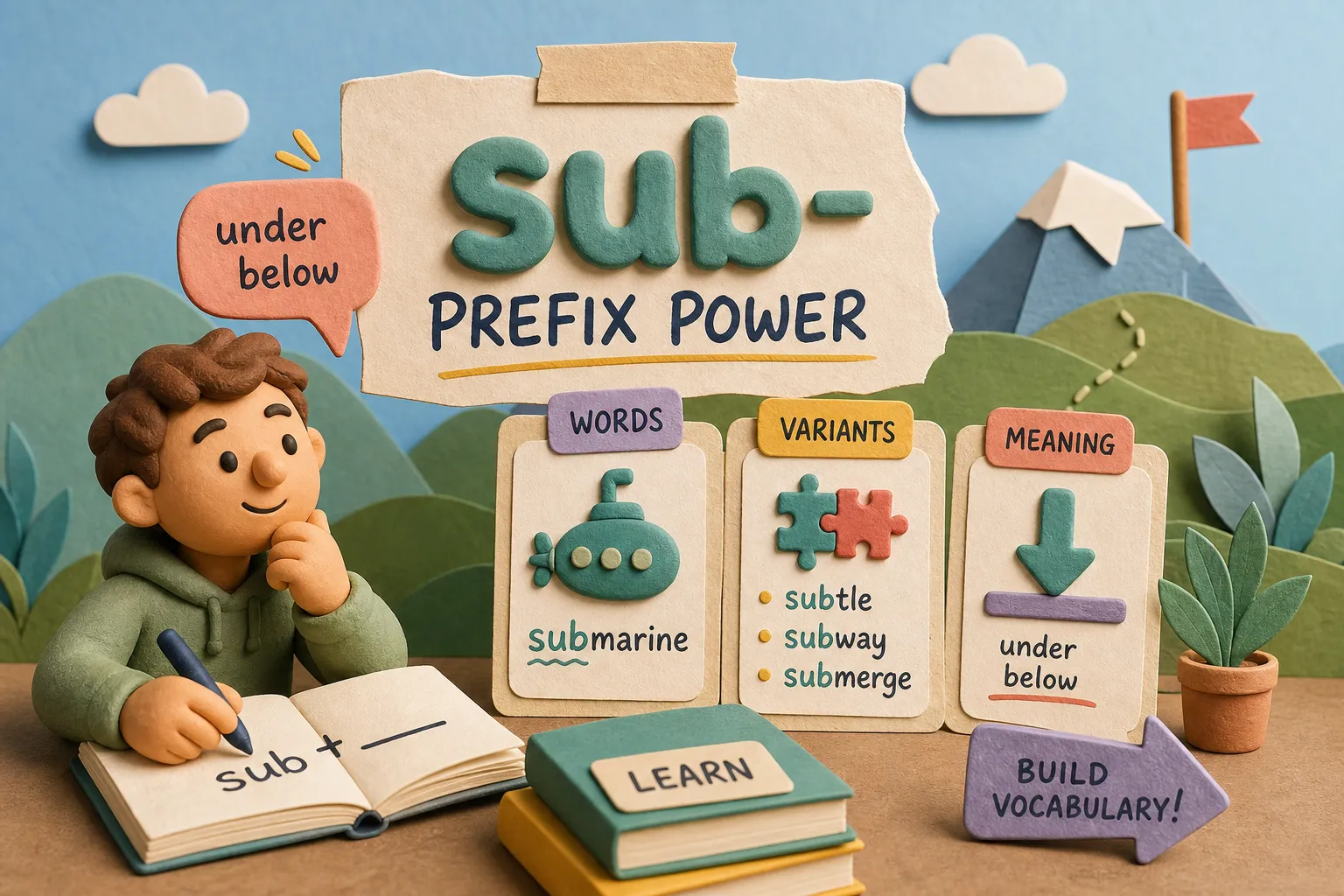
You have seen the words subway, submarine, subscribe, and submit hundreds of times. But have you ever stopped to notice what they all share? Each one starts with the same four letters: s-u-b. That is not a coincidence. The sub prefix, written sub-, is one of the most common building blocks in English, and once you recognize it, you will start seeing it everywhere.
In this lesson, you will learn the meaning and origin of the prefix sub-, see its five spelling variants, and build a working vocabulary of the most useful words that use it. By the end, you will have a practical tool you can use to figure out the meaning of new English words on your own. This is exactly the kind of vocabulary strategy we teach at Your Daily American, where the goal is always real-world fluency, not memorized lists.
What the sub prefix means and where it came from
The Latin root and its original meaning
The prefix sub- comes from Latin. In Latin, sub meant “under,” “below,” or “beneath.” The first meaning was spatial: something physically below something else. English borrowed this prefix directly and kept that core meaning. (Etymonline: origin of sub-)
Over time, English expanded the meaning in four directions. Knowing those four directions helps you decode almost any sub- word you come across.
How the meaning extended in English
The four senses of sub- in English are:
- Physically under: submarine (under the sea), submerge (to go under water), subterranean (underground)
- Lower in rank or secondary: subordinate (below someone in position), subcommittee (a smaller group under the main committee)
- Not fully or below the expected level: substandard (below the standard), subpar (below what is expected)
- A division of something larger: subheading (a smaller heading inside a section), subsection (a part within a section)
Once you know these four senses, a word like subsoil becomes easy. It means the layer of soil under the top layer. No dictionary needed.
How the sub prefix changes spelling before certain letters
Why sub- changes form
The final b in sub- often changes to match the first letter of the word part that follows. This process is called assimilation: the prefix adjusts so the whole word is easier to say. The result sounds more natural in spoken English. (For a quick reference on the sub- root meaning “under,” see Membean: sub, under.)
Many learners do not realize that succeed, support, and surreal all trace back to the same Latin prefix. Note that sur- words can sometimes derive from Latin super- via French rather than from sub- directly, so derivation is word-specific, but the assimilation pattern itself is consistent. Once you see it, those words start to look very different.
The five variants and when to use them
Here are the five main spelling variants of the sub- prefix, each with common examples:
- suc- before c: succeed, success, succumb
- suf- before f: suffer, suffice, suffocate
- sug- before g: suggest, suggestion
- sup- before p: support, supply, suppose, suppress
- sur- before r: surreal, surpass, surrender
All five forms come from the same original Latin prefix. When you recognize this, you stop seeing them as separate vocabulary and start seeing one connected family of words. That shift makes a real difference in how quickly you learn.
Sub- words sorted by what they mean
Words that mean “physically under or below”
This group is the most literal. The words submarine, subway, submerge, subterranean, subsurface, and subsoil all point to something that exists under something else. A good example sentence: “The subterranean tunnel runs beneath the entire city.”
The meaning of sub- is easy to spot here because the image is physical and clear, there is always something above and something below.
Words that mean “lower in rank or secondary”
This group is very common in workplace and professional English. Words like subordinate, subsidiary, subcontractor, subcommittee, and subheading all describe something that sits below or under a main thing. For example: “The report was written by a subcontractor hired by the main firm.” If you work in an English-speaking office, you will hear and read these words regularly.
Words that mean “not fully” or “below the expected level”
Words like substandard, subpar, and subnormal all carry a sense of falling short of a threshold or expectation. Subpar is widely used in American English, in everyday conversation and writing alike. You might hear: “The customer service was subpar.” Or: “That was a subpar performance.” These words are direct and common, so they are worth practicing out loud.
Everyday and professional sub- words you’ll actually use
Common words in daily conversation
The words subscribe, submit, substitute, subtract, suburb, and subject appear in everyday American English at all levels of formality. You can use them in a text message or a formal email. For example: “I need to submit this form by Friday.” Or: “She grew up in the suburbs.” These words are neutral in register, meaning they work in almost any situation.
Words that appear in professional and academic English
Subsequent, substantial, subjective, submission, subordinate, and subsidy appear often in emails, reports, and meetings. A few examples in context: “The subsequent report showed better results.” “The company received a government subsidy to expand production.” “Her performance review was somewhat subjective.” Learning these words will help you read professional documents and participate in workplace conversations with more confidence.
A note on subtle and sublime
Subtle means not immediately noticeable, not loud or obvious. Sublime means extremely good or beautiful, beyond the ordinary. Both words still carry a trace of the sub- meaning: something that exists at a level below what is immediately apparent. You do not need to analyze the etymology every time you use these words, but knowing the connection can help you remember them. “The difference between the two colors is very subtle.” “The music was absolutely sublime.”
The opposite of sub-: prefix pairs that show contrast
Super- as the main contrast to sub-
Sub- means below; super- means above or beyond. This contrast is the clearest and most useful pair to know. A subordinate is below someone in rank; a superior is above. Something substandard is below the standard; something superior in quality is above it. Submerge means to go under; emerge means to come up and out. (See a quick reference for super-.)
The contrast is not always a perfect word pair. Not every sub- word has a super- twin. But the direction of meaning is always the same: sub- goes down, and super- goes up.
Why knowing prefix pairs helps you learn faster
When you know the prefix sub- means “below” and super- means “above,” you have a reliable starting point for guessing the meaning of unfamiliar words. Morphological knowledge, understanding word parts, gives you an edge, especially in reading. The more prefix pairs you internalize, the more patterns you see, and every reading session becomes more productive. It is a skill, not a shortcut, and it gets stronger with practice.
How knowing one prefix speeds up your vocabulary growth
One prefix, dozens of words
English has hundreds of words that use the sub- prefix in some form. Once you recognize it and its variants, you can make a reasonable guess at most of them. This is how fluent speakers process new words: they look for parts they already know and build meaning from there. Studying word parts, prefixes, root words, and suffixes, builds vocabulary faster and supports better reading comprehension than studying words in isolation, a finding that language educators have consistently supported across decades of classroom research.
The next step: study methods that make vocabulary stick
Knowing what sub- means is a solid start. But remembering new words long-term takes a system. Three methods that language teachers consistently recommend are:
- Spaced repetition: reviewing words at increasing time intervals, so you see them again just before you forget them
- Chunking: grouping words by theme or prefix so your brain stores them as a connected set, not isolated facts
- Active recall: testing yourself on a word without looking at the answer first, which strengthens long-term memory
For practical classroom activities and ready-to-use exercises that focus on the sub- prefix and related words, see this set of prefix-sub definition and activity resources.
At Your Daily American, the study tips and vocabulary sections go deeper into each of these methods. The goal is not just to teach you what words mean, but to show you how to remember them and use them naturally in real conversations and writing.
A simple practice to try today
Pick five sub- words from this article that were new to you. Write one sentence for each, using your own life as the context. Make the sentences real: your job, your neighborhood, your daily routine. Then come back to those five words tomorrow and try to recall the meaning before you check your notes. This small habit puts the core idea of spaced repetition to work, and it applies to any vocabulary you want to learn.
What you now know about the sub prefix
Sub- has one core meaning (under/below) and three main extensions: lower in rank, not fully, and a division of something larger. Its five spelling variants, suc-, suf-, sug-, sup-, and sur-, all come from the same Latin root and follow a simple pattern of consonant assimilation, where the prefix adjusts to match the first letter of what follows. Recognizing these forms means you can connect words that once looked completely unrelated.
The best vocabulary learners do not just collect words one by one. They look for patterns, and prefixes are some of the most useful patterns in the English language. The sub- prefix is one of the most common. Now that you know it, you will notice it everywhere.
To keep building from here, explore the vocabulary and study methods content on Your Daily American. There are lessons on other high-frequency prefixes, guides to professional English, and practical study tools designed for learners who want to make real progress in real-world American English. Start with our Prefixes and Suffixes guide, and check the Un- prefix lesson for another high-frequency pattern.