Picture this: you write “February”, one of the twelve months of the year, in a work email without any trouble. Spelling it is no problem at all. Then your manager asks you to confirm the deadline out loud in the team meeting, and you pause mid-word. Your colleague tilts her head. That moment is familiar to a lot of intermediate learners, and it has nothing to do with weak vocabulary or poor grammar. It’s a very specific gap between written fluency and spoken fluency.
By the end of this guide, you’ll be able to say all 12 months of the year clearly and correctly in American English. You’ll know where the stress falls, which months hide real pronunciation traps, and how to use month names naturally in professional conversations, scheduling calls, and emails. These are the details that feel basic on the surface but make a genuine difference when you’re speaking live in a meeting or on a call.
This is the territory that Your Daily American is built around: the practical American English that everyday life and work actually demand. Month names are a perfect place to start.
How Americans Pronounce the Months of the Year
Spelling a month name and saying it correctly are two very different skills. The written form “January” gives you almost no information about which syllable carries the stress or how the vowels reduce in natural speech. Here is the full reference for all 12 calendar months, with IPA transcription and a phonetic respelling you can sound out right now.
January through June: sounds and stress
| Month | IPA (American English) | Phonetic respelling |
|---|---|---|
| January | /ˈdʒæn.ju.er.i/ | JAN-yoo-eh-ree |
| February | /ˈfɛb.ru.er.i/ | FEB-roo-eh-ree |
| March | /mɑːrtʃ/ | MARCH |
| April | /ˈeɪ.prəl/ | AY-prul |
| May | /meɪ/ | MAY |
| June | /dʒuːn/ | JOON |
One sound worth practicing right away: both January and June open with the /dʒ/ sound, like the “j” in “jump.” This sound doesn’t exist in Spanish, Portuguese, French, or Italian, so learners from those backgrounds often substitute a “y” sound and say “Yune” or “Yanuary.” To get /dʒ/ right, place the tip of your tongue just behind your upper front teeth and release with a slight buzzing quality. Try it in a sentence: “The project kicks off in January.”
July through December: sounds and stress
| Month | IPA (American English) | Phonetic respelling |
|---|---|---|
| July | /dʒʊˈlaɪ/ | joo-LY |
| August | /ˈɔː.ɡəst/ | AW-gust |
| September | /sɛpˈtɛm.bɚ/ | sep-TEM-ber |
| October | /ɑkˈtoʊ.bɚ/ | ok-TOH-ber |
| November | /noʊˈvɛm.bɚ/ | noh-VEM-ber |
| December | /dɪˈsɛm.bɚ/ | dih-SEM-ber |
Notice that July carries stress on the second syllable: joo-LY, not JOO-ly. August flips that pattern with stress on the first syllable: AW-gust. September, October, November, and December all share the same second-syllable stress structure. We’ll go deeper on those patterns in the next two sections.
How month abbreviations are actually read aloud
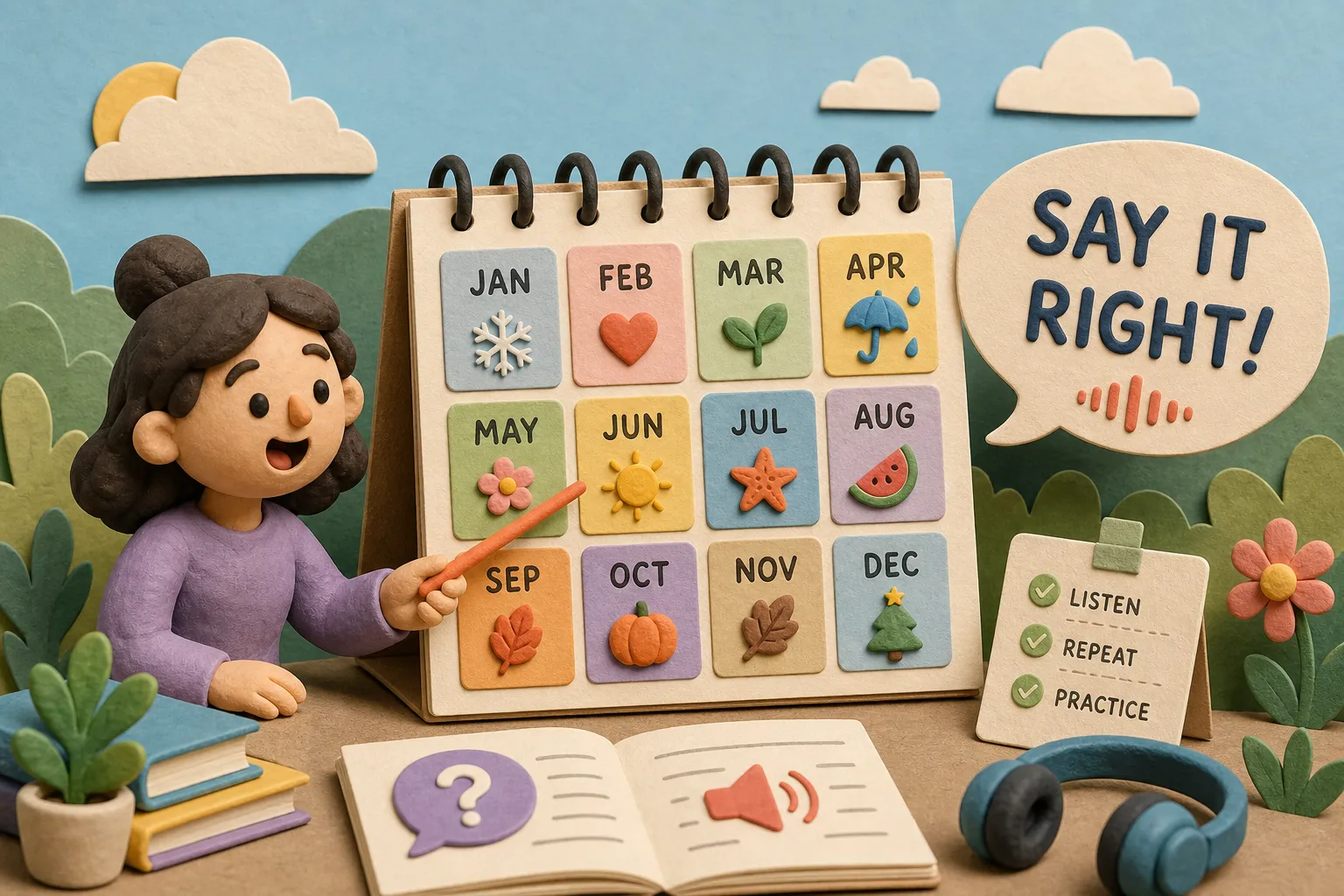
When someone writes “Jan.” in a calendar invite or “Sep.” in a project document, they still say the full month name out loud. Abbreviations only exist in writing. Here are the standard months abbreviations for all 12:
- Jan, Feb, Mar, Apr, May, Jun
- Jul, Aug, Sep, Oct, Nov, Dec
One style note: formal American documents typically use periods after abbreviations (Jan., Feb., Sep.). The months March, April, May, June, and July are generally written out in full even in formal dates, they’re short enough that abbreviating them saves very little space. For a concise external reference on standard formatting and common abbreviations, see abbreviations for months.
The Months of the Year That Trip Up ESL Learners
Certain months cause consistent trouble for ESL learners, and the errors aren’t random. They come from unfamiliar consonant clusters, unstressed syllables that disappear in normal speech, and stress patterns carried over from a learner’s native language. Knowing the cause makes the fix much faster.
February: the most mispronounced month in American English
The most common question: should you say “FEB-roo-air-ee” or “FEB-yoo-air-ee”? In standard American English, the full pronunciation keeps the first /r/ sound: FEB-roo-air-ee. That is the careful, clear version you want in professional settings. In casual everyday speech, many native speakers drop that first /r/ and say “FEB-yoo-air-ee,” and both versions are accepted. For work emails, presentations, and meetings, aim for the full form. You’ll sound precise and polished.
Other problem months: August, September, and beyond
August catches learners off guard because it looks like it should be stressed on the second syllable, the way words like “disgust” or “robust” are. The correct stress lands on the first: AW-gust. The second syllable, “-gust,” uses a reduced vowel, closer to “uhst” than a full “gust.” September, October, November, and December share the same final syllable pattern: the “-ber” ending sounds like “-ber” with a light, reduced vowel, not like the word “bear.” Say it softly and quickly. That alone gets you most of the way to sounding natural.
Why these errors happen across different language backgrounds
Spanish, Portuguese, Italian, and French all have very similar month names to English, and this actually creates a trap. A Spanish speaker says “febrero” with stress on the second syllable and every vowel clearly articulated. That pattern then carries over to English “February,” producing an over-enunciated, foreign-sounding result. The same is true for “septiembre” becoming “sep-tee-EM-bray” instead of “sep-TEM-ber.” Recognizing this tendency gives you a clear target to correct. English is a stress-timed language, which means unstressed syllables are deliberately short and weak. Fighting the urge to give every syllable equal weight is one of the most important shifts you can make.
Stress patterns that separate natural from accented
In American English, every multi-syllable month name has one syllable that gets more weight, more length, and a slightly higher pitch. When stress lands on the wrong syllable, a sentence can sound foreign even when every individual sound is correct.
Where the stress falls in each month name
Here is a quick visual reference for all 12 months, with the stressed syllable in capital letters:
- JAN-yoo-eh-ree | FEB-roo-eh-ree | MARCH
- AY-prul | MAY | JOON
- joo-LY | AW-gust | sep-TEM-ber
- ok-TOH-ber | noh-VEM-ber | dih-SEM-ber
March, May, and June are single syllables, so there’s no stress question there. January and February stress the first syllable. July stresses the second. The four “-ber” months all stress their second syllable, which gives them a satisfying, consistent rhythm once you hear it. If you want a deeper technical explanation of stress placement and its effect on connected speech, see Word Stress in American English: A Complete Guide.
How month names blend into phrases in connected speech
Month names rarely appear alone in real conversation. They show up in phrases, and at normal speaking speed those phrases link together fluidly. “In January” sounds like “in JAN-yoo-eh-ree,” with the word “in” barely stressed and gliding directly into the month name. “By the end of September” flows as one long unit, not five separate words. Practice saying your target month in a full sentence from the start: “The deadline is October 15th.” Phrase-level fluency always sounds more natural than perfect word-level accuracy.
Using month names correctly in professional American English
Month names come up constantly at work, in scheduling calls, confirming deadlines, and sending follow-up emails. Getting them right signals that you’re organized, clear, and comfortable in the language.
How to say dates aloud in meetings and on calls
The standard American English way to say a date is: month name + ordinal number. Say “March fifth,” not “March five” or “the fifth of March.” The ordinal form (first, second, third, fifteenth) is standard in American professional speech. If you need to include the year, say it as “March fifth, twenty twenty-six.” Here are a few examples you’d hear in a real meeting:
- “Let’s schedule this for April second.”
- “The launch is confirmed for November eighteenth.”
- “Can we move the deadline to August twenty-first?”
The phrase “the fifth of March” is standard British English, not American. In a U.S. workplace, dropping “the” and going straight to “March fifth” sounds natural and professional.
Writing month names in professional emails
In formal American English emails and documents, spell out the full month name whenever the month appears alone or with only a year: “January,” “February 2026,” “the October report.” When you write a full date, the correct American format is: Month Day, Year, for example “March 5, 2026.” Note the comma after the day. The numerical format MM/DD/YYYY is also common in American workplaces, so “03/05/2026” means March 5th, not May 3rd, the opposite of the international standard. For a clear, practical guide to US date formatting and punctuation, see how to write the date. If you’re writing to a mixed international audience, spelling out the month avoids that confusion entirely; for additional guidance on writing dates in English, the British Council’s guide on how to write the date in English is useful.
Common professional phrases that use month names
These are the phrases you’ll hear and need to use in meetings, emails, and project updates:
- “As of January first”, stress: “as of JAN-yoo-eh-ree first”
- “By the end of February”, stress: “by the end of FEB-roo-eh-ree”
- “No later than March fifteenth”, stress: “no later than MARCH fif-TEENTH“
- “Sometime in Q2, April through June”, stress: “sometime in Q-2, AY-prul through JOON”
Practice each one as a complete phrase, not just the month name in isolation. That’s exactly how they’ll come up in real conversation.
How to practice month names until they feel automatic
Drilling the months of the year in a list is a starting point, but it won’t produce fluency on its own. Natural pronunciation comes from hearing and using month names repeatedly inside real sentences, phrases, and professional contexts.
Shadowing and sentence-level repetition
The most effective technique here is shadowing. Find a short audio or video clip of a native speaker saying a date or scheduling phrase, then repeat it immediately after, matching the rhythm, stress, and pace as closely as you can. Record yourself saying each month in a complete sentence, such as “My performance review is in September” or “The contract renews on December first.” Compare your recording to a native model and listen specifically for where the stress lands, not just whether the sounds are right. Phrase-level fluency is the real goal, not just accurate isolated words.
A useful memory tool for month lengths: the knuckle trick. Make a fist and tap each knuckle and the gap between knuckles while saying the months in order. Knuckles represent 31-day months; dips represent shorter ones. It’s a physical, tactile trick that sticks quickly, especially if you find yourself blanking on whether June has 30 or 31 days mid-sentence. For another simple reference that lists the months in order and related tips, that short list can be handy when you first start practicing.
Where to go for deeper American English pronunciation practice
Mastering the months of the year is one piece of a much larger pronunciation picture. Connected speech, vowel reduction, American intonation, and the rhythm of stress-timed sentences all shape how natural you sound. Your Daily American offers in-depth pronunciation guides built around real American speech patterns and the situations you actually face at work and in daily life. If this guide gave you a solid foundation, the pronunciation track at Your Daily American is the natural next step for building the full skill: see How to Improve Your American English Pronunciation Like a Native. You can also explore more lessons under our Pronunciation & Listening category for targeted practice.
Take these months from the page into your next meeting
Now that you have the IPA transcriptions, phonetic respellings, stress patterns, and professional phrases in hand, put them to work. Say “FEB-roo-air-ee” with clean stress in your next meeting. Write “March 5, 2026” in your next email. Those small shifts add up fast, and colleagues notice the difference.
Practice the months of the year in context, in actual conversations and writing, and they’ll feel automatic faster than you expect. The goal was never to memorize a list. It was to use these names confidently, without hesitation, every time they come up.