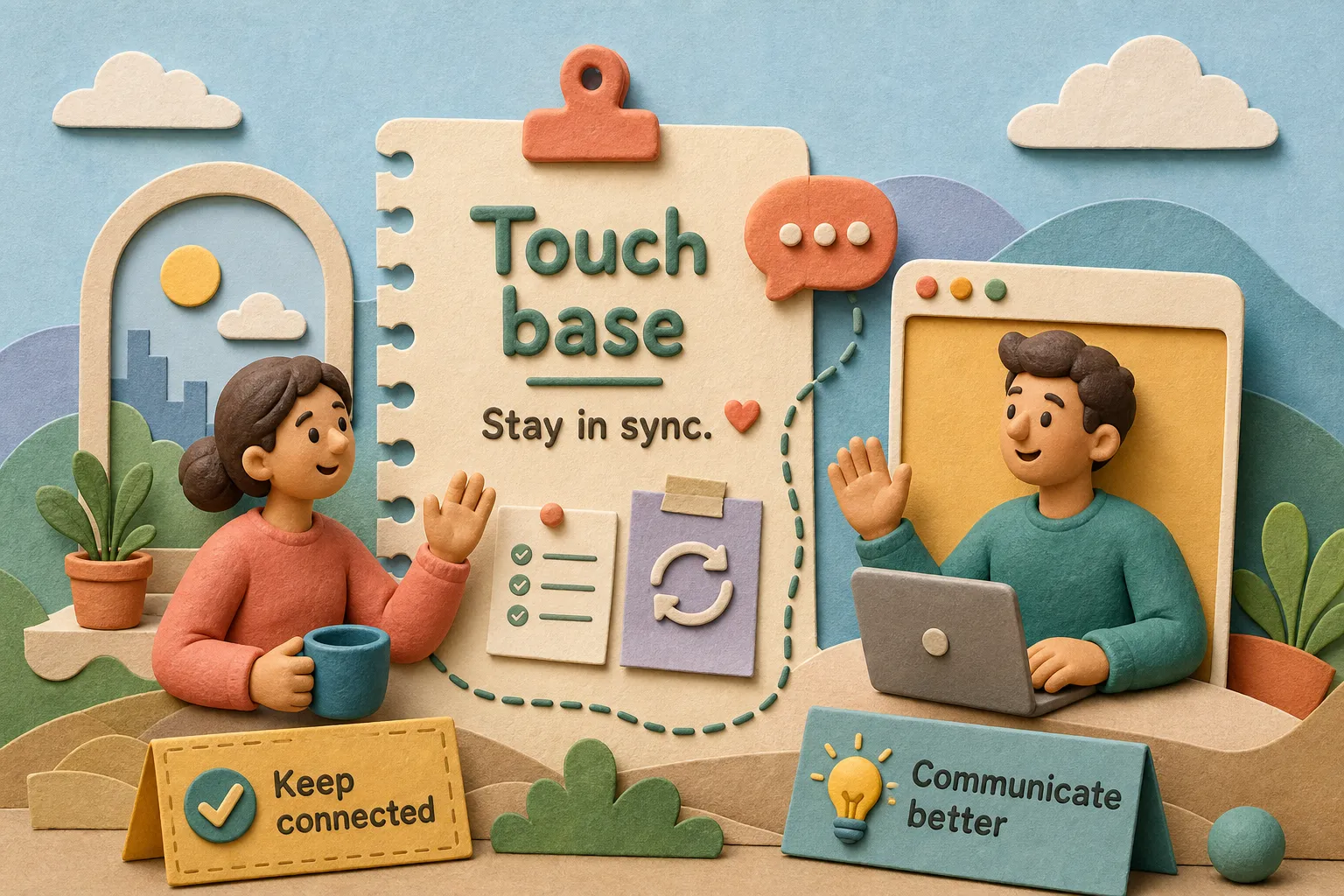
“Touch base” is an American business English idiom that means to have a brief, informal check-in with someone. Despite how common it is, many English learners write “let’s touch bases soon” in professional emails. It looks right, it sounds almost right, and yet native speakers will notice something is off. One small grammar mistake can make a polished email feel slightly unnatural, and that’s the last thing you want at work.
At Your Daily American, phrases like this come up constantly in our workplace English lessons. That’s because they’re everywhere in American professional life. By the end of this article, you’ll know exactly what “touch base” means, why “touch bases” is wrong, and how to use the phrase confidently in emails and meetings. You’ll also have several ready alternatives for when it feels too common.
What “touch base” actually means
Cambridge Dictionary defines “touch base” as “to talk briefly with someone.” Merriam-Webster describes it as “to get in contact with someone briefly.” Both definitions point to the same idea: a short, informal check-in, not a long formal meeting.
The register sits between casual and professional. You’d use it with a colleague, a manager, or a teammate, someone you already work with. It’s common in American business English, but it’s not the right choice for very formal situations, like a first email to a new client or a legal document.
When it fits naturally
The phrase works well for quick status updates, short follow-ups, and brief team check-ins. The key word is brief. When you say “let’s touch base,” you’re signaling that the conversation won’t take long. Here are a few real examples:
- “I wanted to touch base with you about the project timeline.”
- “Let’s check in before the client call tomorrow.”
- “Can we touch base later today about the presentation slides?”
Notice the pattern: “touch base with [person] about [specific topic].” This combination makes the phrase sound natural and clear.
Where this phrase comes from
The most widely accepted explanation is baseball. In the sport, a runner must physically touch a base to be safe. The idiom borrowed that idea: making the necessary, brief contact. Merriam-Webster notes the baseball connection is the standard explanation, though the exact historical path is not fully documented.
Some sources mention a possible military origin from World War II, but major dictionaries don’t support that theory. Baseball remains the most accepted origin.
How it became common workplace language
Over many decades, the phrase moved from sports into American office speech. Today it’s so embedded in business emails and meetings that many people consider it corporate jargon. That reputation is exactly why many native speakers now look for alternatives. Knowing both the phrase and its substitutes gives you more control over your professional communication.
“Touch base” or “touch bases”: the one rule you need
This is the most important grammar point in the article, so read it carefully. In this idiom, base is always singular. The correct form is always “touch base”, never “touch bases.” Style guides and usage sources are clear on this: “touch bases” is an error.
“Touch basis” is also wrong. Basis is a completely different English word. It comes from Greek and means a foundation or starting point. It has nothing to do with this idiom.
A simple way to remember the rule
Think of “touch base” as a fixed phrase, similar to “make contact.” You wouldn’t say “make contacts” if you meant the act of getting in touch with someone. The phrase is frozen, the word doesn’t change. Here’s a quick self-check:
Wrong: “Let’s touch bases next week.” / “I wanted to touch basis with you.”
Right: “Let’s touch base next week.” / “I wanted to touch base with you.”
There’s one more common mistake worth noting. Some learners write “touching basis with you,” which appears to be a mix of “touch base” and “on that basis.” These are two entirely separate phrases, keep them apart.
For the noun form, the correct versions are “a touch-base meeting” or “a quick touch base.” Writing “a touch bases session” is always incorrect.
Using the phrase in emails, meetings, and messages
The phrase is easy to learn. Putting it to work in real emails and meetings takes a bit more practice. Here are practical examples across three common settings.
Touch base email templates
The formula that works is: “touch base with [person] about [topic]” plus a time marker like “this week,” “before Friday,” or “tomorrow.” Here are three short templates you can copy and adjust:
Quick check-in
Subject: Quick check-in
Hi [Name], I wanted to touch base about [topic]. Do you have 10 minutes this week to review it? Best, [Your Name]
Following up on a previous conversation
Subject: Following up
Hi [Name], Just following up on [topic]. I wanted to see if you had any updates or questions. Thanks, [Your Name]
Schedule a brief meeting
Subject: Brief touch-base meeting
Hi [Name], Let’s connect on [topic] sometime next week. Are you available on [day/time]? Best, [Your Name]
In meetings and spoken English
When you say “touch base” out loud, you signal efficiency. You’re telling the other person this will be short. Native speakers often open a brief meeting with “I just wanted to touch base on…” or “Let’s do a quick check-in before the client call.”
Here’s a short example from a real team conversation:
Manager: “Hey, do you have five minutes? I wanted to touch base on the Q3 report.”
Employee: “Sure, I was actually going to reach out to you about that today.”
The tone is direct and efficient, exactly the feeling the phrase creates.
In Slack and async messages
The phrase works well in short messages when you want a quick reply. For example: “Hey [Name], can we connect about the Q3 report sometime today?” However, if you already have specific questions, ask them directly. It’s faster and clearer for the other person.
Smart alternatives when “touch base” feels overused
Because this phrase is so common, many native speakers now find it a bit stale. Good touch-base synonyms make your communication sound fresher and more specific.
The best synonyms and when to use each
Check in works best for a quick status update with a colleague or direct report. It’s friendly and low-pressure: “Let’s check in on Thursday to see where things stand.” Use it when you want to keep things informal without sounding vague.
Follow up is the right choice when you’re continuing a previous request or conversation: “I’d like to follow up on the proposal we discussed last week.” It’s probably the most professional and widely accepted alternative in formal workplace settings.
Reach out works well when you’re starting contact or asking someone to reply: “Feel free to reach out if you have any questions.” It fits naturally at the end of emails or after introductions.
Catch up is more casual. Use it when you want to reconnect after some time away: “We should catch up soon and compare notes on the new process.” Save this one for people you know well.
Connect or get in touch are neutral and slightly more formal. They work well with people outside your immediate team: “Let’s connect next week to discuss the details.” Both are safe choices when you’re unsure of the other person’s preferred tone.
Discuss or have a quick conversation are the clearest options when you want to be specific about what the meeting is for: “Can we have a quick conversation about the budget before end of week?” These leave no ambiguity about the purpose.
Quick rewrites to practice with
Reading alternatives in context helps you use them naturally. Here are a few before-and-after pairs:
- “Let’s touch base next week.” → “Let’s connect next week to review the plan.”
- “I wanted to touch base about the project.” → “I wanted to check in about the project timeline.”
- “Can we touch base later?” → “Can we have a quick call later today?”
- “Just touching base on my earlier email.” → “Just following up on my earlier email.”
Notice how each rewrite adds more information. The reader knows what to expect before the conversation even starts.
Keep building your workplace English, one phrase at a time
American professional English runs on fixed phrases and soft language. These phrases rarely follow obvious grammar rules. Knowing when and how to use them is what separates learners who sound natural from those who sound correct but slightly off. “Touch base” is just one example.
There are dozens more just like it. “Loop me in” means to include someone in a conversation or email thread. “Circle back” means to return to a topic later. “Take this offline” means to discuss something privately outside the meeting. “Get the ball rolling” means to start a project or process. Each one carries context, tone, and cultural meaning that a dictionary definition alone won’t give you.
Where to go next
If you want to work through dozens of phrases like this in a structured way, with real examples and guidance on register and tone, Your Daily American has a full track built around professional American English. You’ll find workplace vocabulary, email phrases, meeting language, and pronunciation guidance all in one place.
You can also take the free proficiency test to see exactly where you stand. It covers reading, listening, writing, and speaking, and gives you a clear action plan based on your results. It’s a good starting point if you’re not sure which skills to focus on first.
Three things to take with you
“Touch base” means a brief, informal check-in. The word “base” is always singular, never write “touch bases” or “touch basis.” And when the phrase feels overused, “check in,” “follow up,” or “reach out” are clear, professional options that work in almost any context.
This phrase appears in almost every American workplace, so knowing it well gives you a small but real advantage in daily professional communication. It signals that you understand not just the words, but how the language actually works.
Try this: write one short work email this week using “touch base” correctly, or swap it out for a more specific alternative and notice how the tone changes. That kind of practice is how phrases stop feeling like study material and start feeling like your own.
Frequently asked questions about “touch base”
Is “touch bases” ever correct?
No. In this idiom, “base” is always singular. “Touch bases” is a grammar error, regardless of context. The correct phrase is always “touch base.”
What is the difference between “touch base” and “touch basis”?
“Touch basis” is not a real phrase. Basis is a different English word meaning a foundation or starting point. The correct idiom is “touch base,” derived from baseball, not from the word basis.
When should I avoid using “touch base”?
Skip it in very formal situations, a first email to a new client, a legal or official document, or any setting where corporate jargon would feel out of place. In those cases, “follow up,” “discuss,” or “connect” are cleaner choices.
What are the most professional alternatives to “touch base”?
“Follow up” is generally the most formal and widely accepted substitute. “Connect,” “discuss,” and “have a quick conversation” are also strong options when you need to be specific about the purpose of the meeting.
Can “touch base” be used as a noun?
Yes. The noun form appears as “a touch-base meeting” or “a quick touch base.” Both are correct. “A touch bases session” or any plural form is always incorrect.
Is “touch base” only used in American English?
The phrase is most common in American business English, though it appears in other varieties of English as well. Because it originated in American culture and baseball, it’s most natural, and most expected, in American professional settings.