You get a text from a coworker: “NGL, the ETA is EOD and the boss is OOO, LMK ASAP.” You understand maybe two of those words. For ESL learners and anyone new to American digital communication, this is a familiar and frustrating experience. American texting runs on text abbreviations, and that shorthand moves fast.
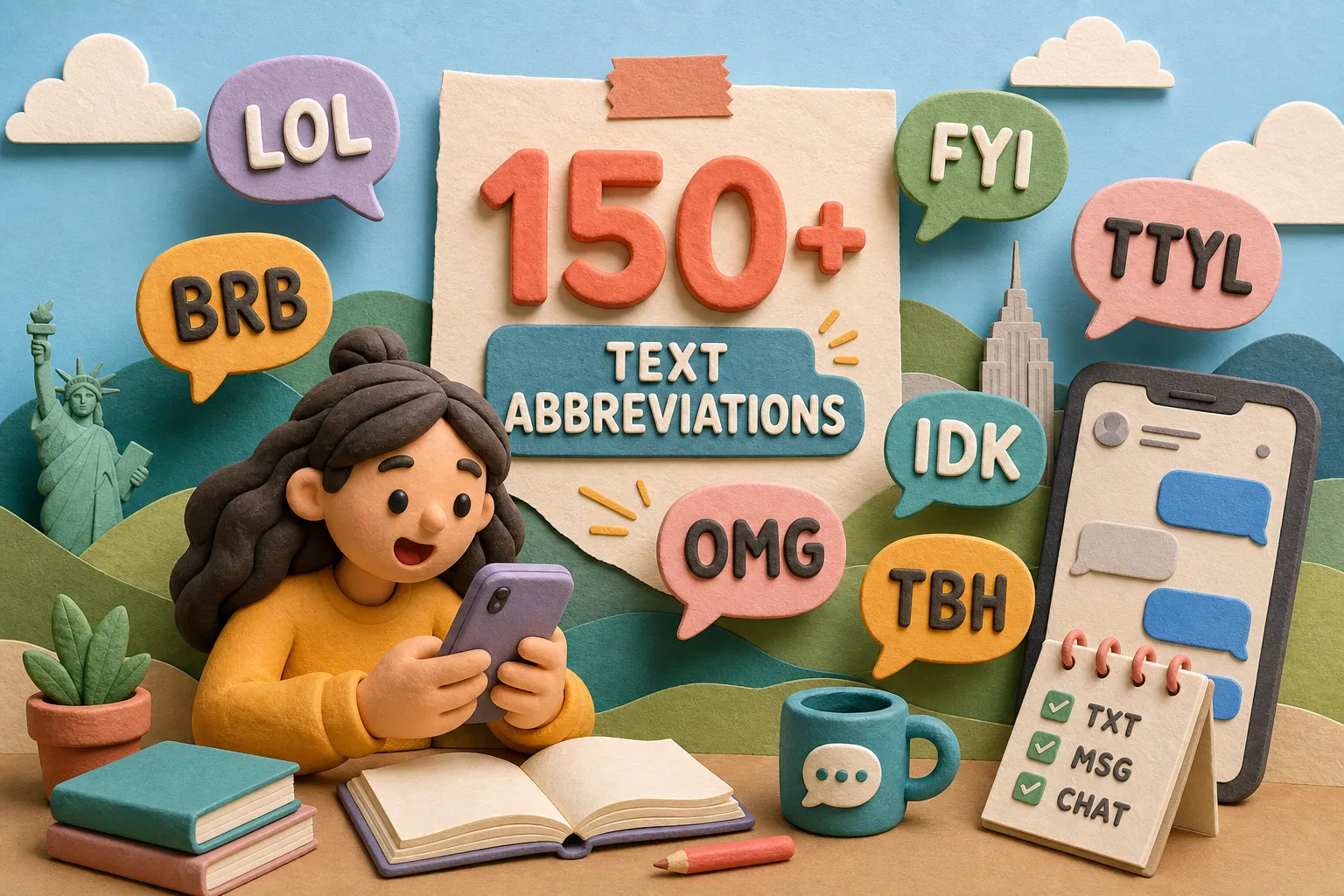
By the end of this guide, you will be able to decode the most common text abbreviations used in casual and workplace conversations, recognize which ones fit which situations, and avoid the mistakes that make messages feel off or confusing. We have also organized a full reference list of 150+ abbreviations you can save and use anytime.
If you want to go further than shortcuts and really understand how Americans communicate, the tone, the rhythm, the cultural context behind every message, Your Daily American is built exactly for that. Here is where that fluency starts.
Everyday casual text abbreviations you need to know
Reaction and emotion markers
Americans use these texting acronyms to react quickly and show emotion without typing a full sentence. They are the backbone of casual texting, and understanding the tone behind each one matters just as much as knowing the definition.
| Abbreviation | Meaning | Example |
|---|---|---|
| LOL | laughing out loud | “That was so awkward, LOL.” |
| OMG | oh my God | “OMG, I can’t believe she said that.” |
| NGL | not gonna lie | “NGL, the food was not great.” |
| TBH | to be honest | “TBH, I think we should cancel.” |
| IKR | I know, right? | “IKR, it was so long.” |
| SMH | shaking my head | “He forgot again. SMH.” |
| FR | for real | “That was FR the best pizza I’ve had.” |
| LMAO | laughing my a** off | “I can’t stop laughing, LMAO.” |
One important cultural note: “LOL” is often used to soften a message or signal mild amusement rather than indicate literal laughter. It fills awkward moments and signals that someone is not being too serious. “TBH” and “NGL” both signal honesty; some users treat NGL as a more candid or blunt preface compared with TBH, often prefacing a surprising or unexpected comment.
Quick-reply shortcuts for fast conversations
These chat abbreviations replace full sentences in fast-moving conversations. Think of them as the texting equivalent of a quick nod or a thumbs-up, they keep things moving without demanding a full typed response. The table below covers the ones you will run into most often in everyday American texts.
| Abbreviation | Meaning | Example |
|---|---|---|
| BRB | be right back | “BRB, grabbing coffee.” |
| GTG / G2G | got to go | “GTG, talk later.” |
| LMK | let me know | “LMK if you can make it.” |
| HMU | hit me up | “HMU when you’re free.” |
| OMW | on my way | “OMW, be there in 10.” |
| RN | right now | “I need this RN.” |
| IDK | I don’t know | “IDK, maybe ask her.” |
| NVM | never mind | “NVM, I found it.” |
| WYD | what are you doing? | “WYD tonight?” |
Here is a cultural detail that most textbooks miss: replying with just “K” can feel cold or passive-aggressive to Americans, even though it simply means “okay.” If someone sends you a long message and you reply with “K,” they may think you are annoyed. Use “Sounds good,” “OK!” or “Got it” instead when the situation calls for a warmer tone.
Workplace text abbreviations and semi-professional shortcuts
Status and time abbreviations for the office
These SMS abbreviations are widely accepted in professional messages, including Slack, Teams, and work text threads. They function more like standard business terms than casual slang, so using them with a manager or client is common in many workplaces, though it is best to use them when you are confident the recipient will recognize them.
| Abbreviation | Meaning | Example |
|---|---|---|
| ASAP | as soon as possible | “Please send the file ASAP.” |
| ETA | estimated time of arrival | “What’s the ETA on the report?” |
| EOD | end of day | “I’ll have it done by EOD.” |
| OOO | out of office | “I’m OOO until Monday.” |
| WFH | work from home | “I’m WFH today.” |
| TBD | to be determined | “The location is TBD.” |
| TBA | to be announced | “Start time is TBA.” |
A realistic example of how these appear together: “FYI, the report is TBD until the client confirms. ETA is EOD Friday.” That sentence is common in many American workplace Slack messages, though norms vary by company and formality level.
Sharing information without sounding too informal
These abbreviations help you share updates and context quickly. They each carry a slightly different tone, so it helps to know when each one fits best.
- FYI (for your information): neutral and helpful. “FYI, the office closes early Friday.”
- ICYMI (in case you missed it): great for following up on something shared earlier. “ICYMI, the meeting was moved to 3 p.m.”
- TL;DR (too long; didn’t read): use this to give a short summary. “TL;DR: the plan is delayed until next week.”
- TIA (thanks in advance): polite, but some recipients interpret it as implying an expectation of action, so use it with care.
- WIP (work in progress): “The deck is still a WIP, but I’ll share it soon.”
A good rule of thumb: if you would not say the abbreviation out loud in a meeting, spell it out in a formal email. Reserve these shortcuts for Slack, Teams, and text threads where everyone clearly knows them.
Newer text slang trending right now
Stance markers and social-media crossovers
Older shortcuts saved time. Newer text slang signals an attitude or a point of view, they show where the speaker stands, not just what they mean. These are especially common among younger Americans, and they bleed in from social media captions into everyday text conversations.
- FR (for real): adds emphasis or agreement. “That movie was FR incredible.”
- IYKYK (if you know, you know): creates an insider feeling. “That reference was perfect. IYKYK.”
- POV (point of view): used to set a scene, borrowed from short videos. “POV: you open the group chat and see 200 unread messages.”
- ICL (I can’t lie): a newer version of NGL. “ICL, I didn’t expect to like it this much.”
- FS (for sure): agreement or confirmation. “FS, I’ll be there.”
Why stance markers matter for ESL learners
These chat abbreviations carry tone, not just information. If a coworker texts “NGL, that meeting was a lot,” they are not simply saying it was long. They are signaling mild frustration while staying polite. Reading the feeling behind the abbreviation is what separates basic comprehension from real fluency.
Compare these two messages: “That presentation was good.” versus “NGL, that presentation was good.” Adding NGL can suggest the speaker is offering a candid or unexpected positive opinion, depending on context, it may imply they were pleasantly surprised. The abbreviation shifts the whole meaning. That kind of nuance is exactly what Your Daily American focuses on: not just what words mean, but how Americans actually use them. For additional examples and common expressions, see Common American Expressions Every English Learner Should Know, Your Daily American.
Text abbreviations that confuse even fluent speakers
When the same letters mean different things
Some online acronyms cause real confusion because they look the same but mean something very different depending on context. These are worth knowing before you run into them. For a comprehensive texting dictionary, check out Textus’s texting dictionary, which lists many of these overlapping meanings and examples.
- ASL: in texting, it means “age, sex, location” (often used by strangers online). In another context, it means “American Sign Language.” Very different meanings.
- NSFW (not safe for work): this is critical to recognize. If you see “NSFW” before a link, do not open it in a public or professional setting. The content is likely explicit or inappropriate.
- SMH: some people misread this as “so much hate” instead of “shaking my head.” The standard meaning is shaking my head, as a sign of disappointment or disbelief.
- TBA vs. TBD: “TBA” means the information will be announced soon. “TBD” means it has not been decided yet. They are close but not the same.
- WTF: this is a strong expression of shock or anger. It can also be used sarcastically between close friends. The tone depends entirely on who sends it and why.
A simple rule for when NOT to abbreviate
Before using any abbreviation, think through a few quick questions: Will this person definitely know what it means? Is this conversation informal enough for text shorthand? Could this abbreviation sound rude or lazy in this context? If you have any doubt on any of those points, write it out in full.
“K” and “W/E” (whatever) are good examples of shortcuts that land badly even when you mean no harm. Both feel dismissive to most Americans. Writing out the full phrase is always the safer and more respectful choice when you are not sure.
Teen text codes parents and educators should recognize
Privacy signals and codes to keep adults out
Some abbreviations are designed to let teens know when an adult is nearby. These are not automatically dangerous, but knowing they exist helps parents understand when a conversation is being hidden on purpose.
- POS: parent over shoulder
- PIR: parent in room
- CD9 / Code 9: parents are around
- KPC: keeping parents clueless
- 99: parents are gone
For a quick overview aimed at parents, see this Parents guide to teen texting codes, which highlights many of the privacy signals and what they commonly mean.
Serious warning signs to take action on
A few abbreviations signal something more serious. Parents and educators should know these and watch for them, especially in patterns rather than single messages.
- KMS / KYS: “kill myself” or “kill yourself.” A single use after a bad grade is likely venting. Repeated use, or a third party sending this to your child, is a serious red flag.
- LMIRL: “let’s meet in real life.” This can indicate an attempt by a stranger to move a conversation offline, which is a safety concern.
- WTTP / GNOC / DTF: these are signals of sexual solicitation. They should be taken seriously immediately.
- 420: a common reference to marijuana use.
For guidance on keeping teens safe on Snapchat and in text conversations, check these texting and Snapchat safety tips for parents. Remember: context and frequency matter most. The goal is not to panic over every abbreviation but to stay aware. A calm, open conversation with your child is almost always more effective than an immediate confrontation.
Now you can read American texts with confidence
You now know the most common casual text abbreviations, the ones that work in professional settings, the newer stance markers that carry attitude and tone, the chat lingo with confusing double meanings, and the codes worth watching for in teen conversations.
A cheat sheet is helpful, but text abbreviations are only one layer of how Americans communicate. Knowing the tone behind a message and the cultural context that shapes it, including the right moment to use “NGL” versus saying nothing at all, is what makes the difference between understanding English and actually connecting in it. If you want a compact reference, this list of 100 texting abbreviations is a useful companion to the guide above.
At Your Daily American, you can build exactly that kind of fluency. The platform covers everyday phrases, workplace communication, pronunciation, and the cultural context that makes American English feel natural. Explore our Everyday American English, Your Daily American lessons. Take the free proficiency test to find your level, or explore the next lesson and start using what you learn right away: 25 Small Talk Phrases Americans Use Every Day, Your Daily American.