What is juxta meaning, and why does it matter for your English vocabulary? You’re watching an American TV show. A character says, “The director uses juxtaposition to show the contrast between wealth and poverty.” You recognize “position,” but that front part, juxta , stops you cold. Here’s the good news: learning one small prefix can help you understand dozens of English words far more quickly. That is exactly what this lesson will do.
By the end of this article, you will be able to define the prefix juxta- , say it correctly in American English, explain where it comes from, and recognize it in both everyday and medical vocabulary. This is the kind of word-building strategy that sits at the heart of how Your Daily American teaches vocabulary: instead of memorizing each word separately, you learn the building blocks that unlock many words at once.
We will cover the Latin origin, pronunciation, common English words, medical terms, and why this approach works. There is also a short practice section at the end so you can check what you have learned.
Juxta meaning and Latin origin: how iuxta became a prefix
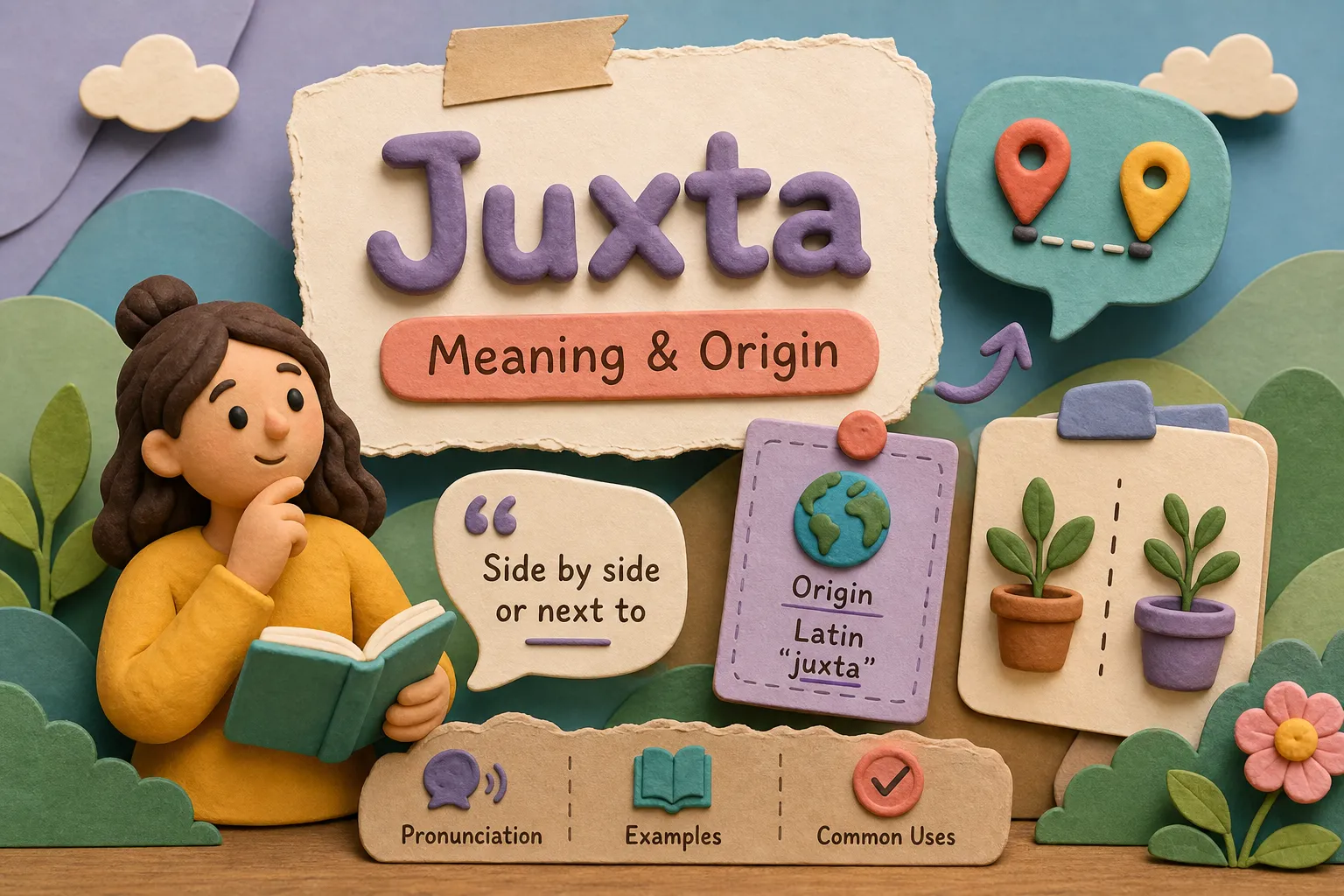
The prefix juxta- comes directly from the Latin word iuxta , which meant “beside,” “near,” or “close to.” In Latin, it described physical closeness (the idea of placing two things side by side). Etymologists trace the word even further back to a Proto-Indo-European root meaning “to join” or “to yoke,” which makes intuitive sense: something yoked to another thing sits right beside it. For a concise lexical entry on the Latin form, see the Wiktionary entry for iuxta.
You may notice the spelling change from Latin iuxta to English juxta . Latin used the letter “i” where English later adopted “j.” When English borrowed Latin vocabulary during the 1600s and 1700s, scholars wrote the “i” as a “j” to signal a consonant sound, a shift documented in orthographic histories of early modern English. The meaning stayed the same; only the spelling shifted.
So why is juxta a prefix rather than a regular English word? A prefix is a word part you attach to the beginning of another word to extend its meaning. English already had common words like “beside” and “near” for everyday use, so juxta never needed to stand alone. It survived only as a combining form, always attached to another word or root.
According to the Oxford English Dictionary, the first recorded English use of a juxta- compound was juxtaposition in the 1660s, followed by juxtapose in 1826. Those two attestation dates show just how long this prefix has been shaping English vocabulary. For a detailed etymological note on the word juxtaposition , consult the etymology of “juxtaposition”.
Juxta meaning: pronunciation in American English
Step-by-step phonetic breakdown
The correct pronunciation is JUK-stuh . In the International Phonetic Alphabet (IPA), it is written as /ˈdʒʌkstə/. The word has two syllables. “JUK” rhymes with “duck” and “tuck.” The second syllable, “stuh,” is soft and unstressed, similar to the ending of “extra” or “ultra.”
Speakers of languages where the combination ju produces a different sound, such as the “y” sound in Spanish or the “h” sound in some Portuguese dialects, may initially say something closer to “YOOK-stah” or “HOO-stah.” In American English, ju at the start of a word makes a /dʒ/ sound, the same one you hear at the start of “juice,” “jump,” and “just.” Once you connect juxta to those familiar words, the correct pronunciation clicks into place. For more on common pronunciation pitfalls and how learners often mispronounce English words, see our article on English Words Non-Native Speakers Mispronounce Most Often.
Hearing juxta in longer words
The same sound carries forward into the two words you will use most often. Juxtapose is pronounced juk-stuh-POHZ (IPA: /ˌdʒʌkstəˈpoʊz/). Juxtaposition is pronounced juk-stuh-puh-ZI-shun (IPA: /ˌdʒʌkstəpəˈzɪʃən/). Notice that the stress moves toward the end in juxtaposition . Say each word out loud three times slowly before moving on. That repetition builds the muscle memory you need to use these words naturally in conversation. If you want to hear native American pronunciations and practice along, try this online American pronunciation practice for “juxtaposition”.
Everyday English words that use the juxta- prefix
Juxtapose: placing things side by side
Juxtapose means to place two things next to each other, usually to compare or contrast them. It is a regular verb: juxtapose, juxtaposed, juxtaposing. You will hear it in conversations about art, writing, film, and news. Think of it as the action, the deliberate placing of two items in proximity so the comparison becomes visible.
- “The photographer juxtaposes old buildings and modern skyscrapers to show how the city has changed.”
- “The article juxtaposes two very different opinions on the same policy.”
- “She juxtaposed the two resumes to help her choose the better candidate.”
Juxtaposition: the result of placing things beside each other
Juxtaposition is the noun form. It refers to the act or result of placing two things side by side for effect. You will see this word in literary analysis, art criticism, and academic writing, but it also turns up in everyday conversation and news articles.
- “The juxtaposition of the two images made the contrast impossible to ignore.”
- “Writers often use juxtaposition to make their point stronger.”
There is also an adjective form, juxtapositional , which appears primarily in academic contexts. Corpus data suggests that juxtapose and juxtaposition appear far more frequently in general and professional English than juxtapositional does, so focus on those two forms first. They are the ones you are most likely to encounter in real conversations and writing tasks.
Juxta- in medical and scientific English
Key medical terms and what they describe
The prefix juxta- is relatively common in medical and biological terminology. ESL learners often encounter these terms in medical documents, subtitles, or healthcare conversations, which makes understanding the prefix especially useful. Every time you see juxta- , the meaning is the same: located beside or next to a specific body part. Once you know this, you can start to decode terms you have never seen before. For a general textbook overview of prefixes used in medical terminology, see this chapter on medical prefixes and suffixes.
- Juxtaglomerular: located next to the glomerulus (a small filter unit inside the kidney). Juxtaglomerular cells help control blood pressure.
- Juxtamedullary: situated near the medulla (the inner part of a structure). Juxtamedullary nephrons (the kidney’s filtering units) are important for concentrating urine.
- Juxtacortical: located next to the cortex (the outer layer of an organ or bone). This term appears in radiology reports describing bone lesions.
- Juxtaforaminal: beside a foramen, which is an opening in a bone. You will see this in spine imaging reports.
- Juxtarenal: located near the kidney. This is a standard term in vascular and renal imaging.
How to decode any new juxta- word
A reliable method: when you see an unfamiliar juxta- word, apply the meaning “beside” or “next to” to whatever follows the prefix. If you know what the second part means, you can build the full definition yourself. Take juxtarenal as an example. It breaks into juxta- (beside) plus renal (relating to the kidney). Put them together: “beside the kidney.” You did not need a dictionary for that.
This method removes the intimidation factor of long medical or technical words. Research by linguists such as Nation (2001) and Bauer and Nation (1993) suggests that roughly 90% of academic and professional English vocabulary traces back to Latin and Greek roots. When you learn one prefix, you are not just learning one word. You are picking up a key that opens a whole cluster of related words.
Why learning prefixes like juxta- expands your vocabulary faster
One prefix, many words
Language teachers and researchers widely agree that learners who study word parts, such as prefixes and roots, can recognize and understand new words significantly more efficiently than learners who study each word in isolation. The reason is straightforward: instead of memorizing 50 words one by one, you learn 10 building blocks and use them to unlock those same 50 words on your own. This is called morphological learning, which simply means learning through word structure.
With juxta- alone, you can now decode juxtapose , juxtaposition , juxtaglomerular , juxtamedullary, juxtarenal , and more. You do not need to look all of them up. You already understand the core idea behind each one.
How Your Daily American teaches this method
Your Daily American is built around exactly this kind of smart vocabulary learning. Rather than presenting word lists for rote memorization, the platform focuses on how language is structured, so you can apply what you know to new words and new situations. The study tips and vocabulary sections include lessons on prefixes, roots, and a technique called spaced repetition (reviewing words at timed intervals to move them into long-term memory). The goal is to give you tools that make vocabulary growth feel manageable rather than overwhelming. You can also build everyday fluency with our essential phrasal verbs list, which pairs well with prefix learning for active usage practice.
Quick practice: check what you know about juxta-
Try these three prompts
Take a moment and try each one before reading the answers.
- Cover the definitions above. Can you explain what “juxtapose” means using your own words?
- You see the term juxtarenal in a medical article. Using what you know about juxta- , what do you think it means? (Answer: located next to the kidney. Renal relates to the kidney.)
- Write one sentence using “juxtaposition” about two things you see in your home or city.
What to do next
Start a simple prefix journal. Use a notebook or a note on your phone. Each time you find a new prefix, write it down with its meaning and two example words. Do this consistently and your vocabulary will grow faster than it ever did with word lists alone. Every new prefix you learn works like a key: it opens not just one word, but an entire cluster of them. For more articles, lessons, and study method guides, visit the Your Daily American blog.
Putting it all together
Understanding juxta meaning gives you more than one definition to remember. The prefix juxta- comes from the Latin word iuxta , meaning “beside” or “next to.” It entered English as a combining form because English already had everyday words like “beside” and “near” for common use. In American English, juxta is pronounced JUK-stuh (/ˈdʒʌkstə/). You will find it in familiar words like juxtapose and juxtaposition , and in medical terms like juxtaglomerular and juxtamedullary.
The bigger takeaway is this: when you understand the juxta meaning and origin, you stop treating vocabulary as a list and start seeing it as a system. Long, unfamiliar words become puzzles you can actually solve. You spot the prefix, apply the meaning, and the rest falls into place.
For more prefix-based vocabulary lessons, study method guides, and practical American English content, explore the vocabulary and study tips sections at Your Daily American . The resources there are designed to help you move from simply recognizing words to using them with real confidence.
Frequently asked questions about juxta meaning
What is the juxta meaning in English?
Juxta- is a Latin-derived prefix meaning “beside,” “near,” or “next to.” In English, it always attaches to another word or root rather than standing alone.
How is juxta pronounced in American English?
It is pronounced JUK-stuh (/ˈdʒʌkstə/). The first syllable rhymes with “duck,” and the second syllable is soft and unstressed.
What is the juxta meaning and origin?
The prefix comes from the Latin word iuxta . Etymologists link it further back to a Proto-Indo-European root relating to joining or yoking things together. The spelling shifted from i to j when English scholars adapted Latin borrowings in the 1600s and 1700s.
What are the most common words that use juxta-?
The two most common are juxtapose (verb: to place side by side) and juxtaposition (noun: the result of placing two things side by side). Medical English also uses terms like juxtaglomerular , juxtamedullary, and juxtarenal .
Is juxta a word by itself?
No. In English, juxta functions only as a prefix. It is always combined with another root, as in juxtapose or juxtacortical.