You are reading a news article and you see the headline: “Senator doubles down on immigration policy.” You understand each word, but the full meaning feels unclear. Or maybe your American coworker said, “We need to start doubling down on this project,” and you nodded without being completely sure what they meant. This kind of gap is very common for English learners, and it is exactly why understanding expressions with their full cultural story matters so much. This lesson explains what “doubling down” means, where it comes from, and how to use it correctly.
By the end of this lesson, you will be able to explain what “doubling down” means literally and figuratively. You will know where the phrase comes from, how to use “double down on” correctly in a sentence, and where you are likely to hear or read it. At Your Daily American, we teach expressions like this one with their full context, because knowing the story behind a phrase is what makes it truly stick.
The blackjack move that started it all
What actually happens when you “double down” at the table
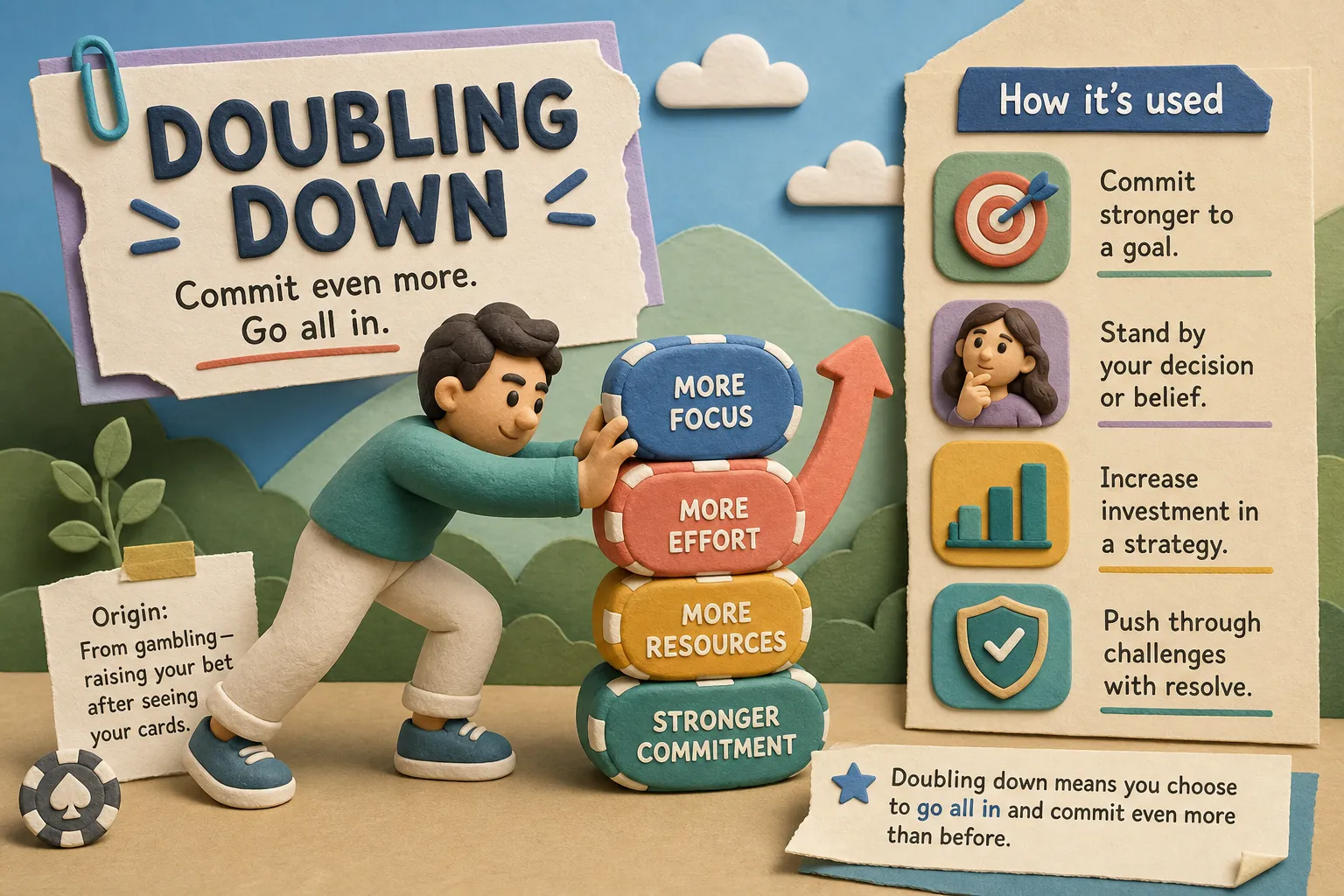
Blackjack is a popular card game played in American casinos. The goal is to get cards that add up to 21, or as close to 21 as possible, without going over. When you “double down” in blackjack, you choose to double your original bet after seeing your first two cards. In exchange, you receive exactly one more card, and your turn ends there. Most casinos only allow this move on the initial two cards, and some tables restrict it further to totals of 9, 10, or 11, though rules vary by casino.
The key idea is risk. You are putting more money on the table at a moment when you feel confident. You believe your hand is strong, so you increase your commitment. If you are right, you win twice as much. If you are wrong, you lose twice as much. That same sense of confident, high-stakes commitment is exactly what the figurative phrase carries today. For more on basic blackjack strategy and guidance about when players typically choose to double down, see this when to double down in blackjack guide.
How the phrase left the casino and entered everyday speech
The earliest recorded use of “double down” in print dates to 1949, in Scarne on Cards by John Scarne, a widely cited authority on gambling and card games. For several decades after that, the phrase was used mainly in gambling contexts. By the 1990s, however, Americans were applying it to everyday decisions far outside the casino.
This pattern will keep coming up as your vocabulary grows. American English draws frequently from gambling and sports to describe real-life situations. Phrases like “raise the stakes,” “call someone’s bluff,” and “a long shot” all come from gambling but now appear in business, politics, and casual conversation. You can also check the Dictionary.com entry for additional examples and slang notes.
What “doubling down” means today
The clear, simple definition
Cambridge Dictionary defines “double down” as “to continue doing something in an even more determined way than before.” Merriam-Webster adds that it means to become more resolute or committed, especially when that choice involves risk. A useful synonym is to commit more strongly, particularly when there is pressure to stop or change direction.
Someone criticizes your decision publicly. Instead of backing away, you push forward with even more energy. You are not just staying the course. You are increasing your effort and your investment in that direction. That is what it means to double down, and that is why the phrase shows up so often when the stakes are high.
The emotional tone the phrase carries
This phrase is not neutral. It carries either a positive or a negative charge, depending on who is speaking and why. If the speaker admires the action, “doubling down” sounds bold and confident. If the speaker disagrees with the action, it sounds stubborn or reckless.
For example, a sports commentator might say a coach “doubled down on his game plan” to show admiration for the coach’s confidence. But a journalist might write that a politician “doubled down on a failed policy” to suggest the politician is ignoring criticism. The phrase is the same, but the framing of the sentence around it shapes the meaning. Pay close attention to context when you hear or read it.
“Double down” vs. “double down on”: getting the grammar right
When “double down” stands alone
In the blackjack sense, no preposition is needed. You simply say, “She decided to double down.” The gambling move is complete without adding anything after it. In figurative use, the verb can also stand alone when the context is already clear, which happens often in news headlines or short statements.
Here are a few examples with no preposition:
- “The senator doubled down.” (The topic was already discussed earlier in the article.)
- “Instead of apologizing, he doubled down.”
- “The company chose to double down rather than pull back.”
When to say “double down on,” and what follows it
In everyday figurative use, “double down on” is the more common and natural construction. The word “on” is followed by a noun phrase: a policy, a strategy, a claim, an effort, or a position. This is the form you will see most often in news articles and professional conversations.
The pattern is straightforward. In the blackjack sense, no “on” is needed. In figurative use, “double down on” is typically followed by a noun phrase naming the thing you are committing to more strongly. For instance: “The company doubled down on its remote work strategy.” “She doubled down on her earlier claim.” “The coach doubled down on the team’s defensive approach.” Each sentence names what the commitment is being increased toward.
How Americans actually use it: politics, business, and the news
Examples of doubling down in politics
American politicians use this phrase often, and journalists use it to describe them just as often. Barack Obama used it directly in a speech: “Let’s double down on a clean energy industry that has never been more promising.” He was telling voters to commit more strongly to a policy direction despite uncertainty. Bill Clinton used it as an attack at the Democratic National Convention, saying Democrats could not give power to someone who would “double down on trickle-down”, meaning continue an economic policy he believed had already failed.
News reporters also used it to describe Mitt Romney, writing that he was “doubling down” on his criticism of the Obama administration’s response to an overseas crisis. The phrase is popular in political coverage because it signals intensity, commitment, and risk in a single compact expression.
Business leaders and the press
Business news uses this phrase just as much as political reporting. Tim Cook said Apple would “double down on secrecy,” and separately described the company’s commitment to Siri with the same phrase: “We’re doubling down on it.” After Facebook’s difficult early days as a public company, Mark Zuckerberg said it was “a great time for people to double down,” signaling confidence despite public pressure.
Cambridge Dictionary includes this business example: “Expect to see Fox double down on its marketing efforts to give the movie a big boost.” Sentences like this appear regularly in business coverage when a company is pushing harder on a strategy even while critics argue it should change course. Recognizing “doubling down” in this context will help you follow business news much more easily.
Using “doubling down” yourself: sentences for real situations
At work and in professional contexts
In professional settings, the phrase works in both third-person reporting and first-person statements. Here are a few models to study:
- “The CEO doubled down on her plan to expand into new markets.”
- “Our team is doubling down on quality after the client’s feedback.”
- “He doubled down on his proposal during the meeting, even after the pushback.”
Notice how each sentence names what the person is committing to more strongly, which is the “on” plus noun phrase construction. You can also use it in the first person, “I’m going to double down on this approach for the next quarter”, and it sounds equally natural in professional writing and conversation. The marketing department might double down on social media spending; a manager might double down on a hiring strategy. The structure is the same across all these contexts.
In casual conversation and everyday speech
In informal speech, Americans often drop the “on” when the subject of the conversation is already understood. For example: “He keeps getting criticized, but he just doubles down every time.” Here is a short dialogue to show how natural it sounds:
Friend A: “Did you see that the manager is still going with the old system even after all the complaints?”
Friend B: “Yeah, he totally doubled down. He’s not changing anything.”
In this exchange, no “on” is needed because both speakers already know what they are talking about. In everyday speech, the phrase moves quickly and stays short.
Quick self-check: can you use “doubling down” correctly?
Three practice prompts to try
Try these on your own. Write your answers in a notebook or type them out. The act of writing the phrase yourself is one of the best ways to move it from passive understanding to active use.
- Fill in the blank: “The coach decided to _____ on the team’s defensive strategy after losing two games in a row.”
- Rewrite this sentence using “double down on”: “The politician continued to support her policy even more strongly after the criticism.”
- Write your own sentence: Think of a real situation where someone you know continued pushing harder on something despite pressure to stop. Write one sentence about it using “double down on.”
The one mistake to avoid
A common error among ESL learners is using “double down” when they really mean something simpler, like “try harder” or “focus more.” This phrase carries a specific meaning: you are increasing your commitment at a moment of risk, criticism, or resistance. There is pressure from outside to change, and instead, you push harder in the same direction.
If there is no element of risk or outside pressure, the phrase may sound unnatural. For example, “I doubled down on studying for my exam” is a little awkward if there was no challenge or criticism involved. In that case, “I focused more on studying” or “I worked harder on my exam prep” is more natural. Save “double down on” for moments when the stakes are real and the resistance is clear.
Now you know the full story
You now know where “doubling down” comes from, what it means today, and how to use it correctly, and that combination is what makes it stick. The origin is blackjack: a player doubles their bet in exchange for one final card, accepting real risk in a moment of confidence. The modern figurative meaning builds directly on that: to commit more strongly to something when others are pushing back or when the situation calls for a decisive choice. And the grammar rule is straightforward, use “double down on” plus a noun phrase in figurative speech, and drop the “on” in the original blackjack sense or in casual conversation when context makes the subject clear.
Keep the broader cultural note in mind as well. American English draws on gambling and sports language constantly, and learning the original context of an expression is what separates a learner who recognizes a phrase from one who can actually use it. At Your Daily American, every expression we teach comes with exactly this kind of cultural background, real examples, and practical guidance so you can start using it naturally right away. Explore more expressions like this one and keep building the vocabulary that actually shows up in American life. Now you can use “doubling down” with confidence in news, business, and everyday conversation.