You’re standing in the office break room waiting for the microwave. A coworker walks in. Silence. Your mind goes blank about small talk, not because you don’t speak English, but because you have no idea what Americans actually talk about in these moments. That gap between knowing the language and knowing the social script is exactly what this article closes.
Small talk is one of the most commonly requested topics from learners at every level here at Your Daily American, and it makes sense. Many language programs give limited attention to these kinds of pragmatic social scripts, so most learners have to figure it out on their own. By the end of this article, you’ll have 12 specific openers ready to use, a clear map of which topics are safe and which to avoid, and two small habits that make casual conversation feel natural instead of stressful.
What safe small talk actually looks like in American daily life
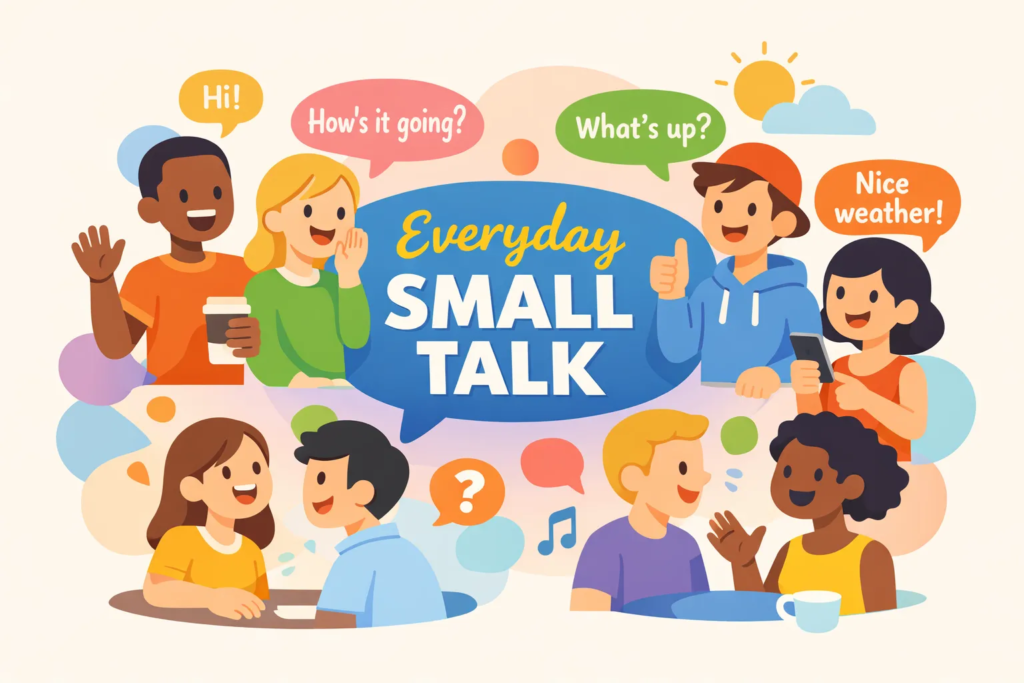
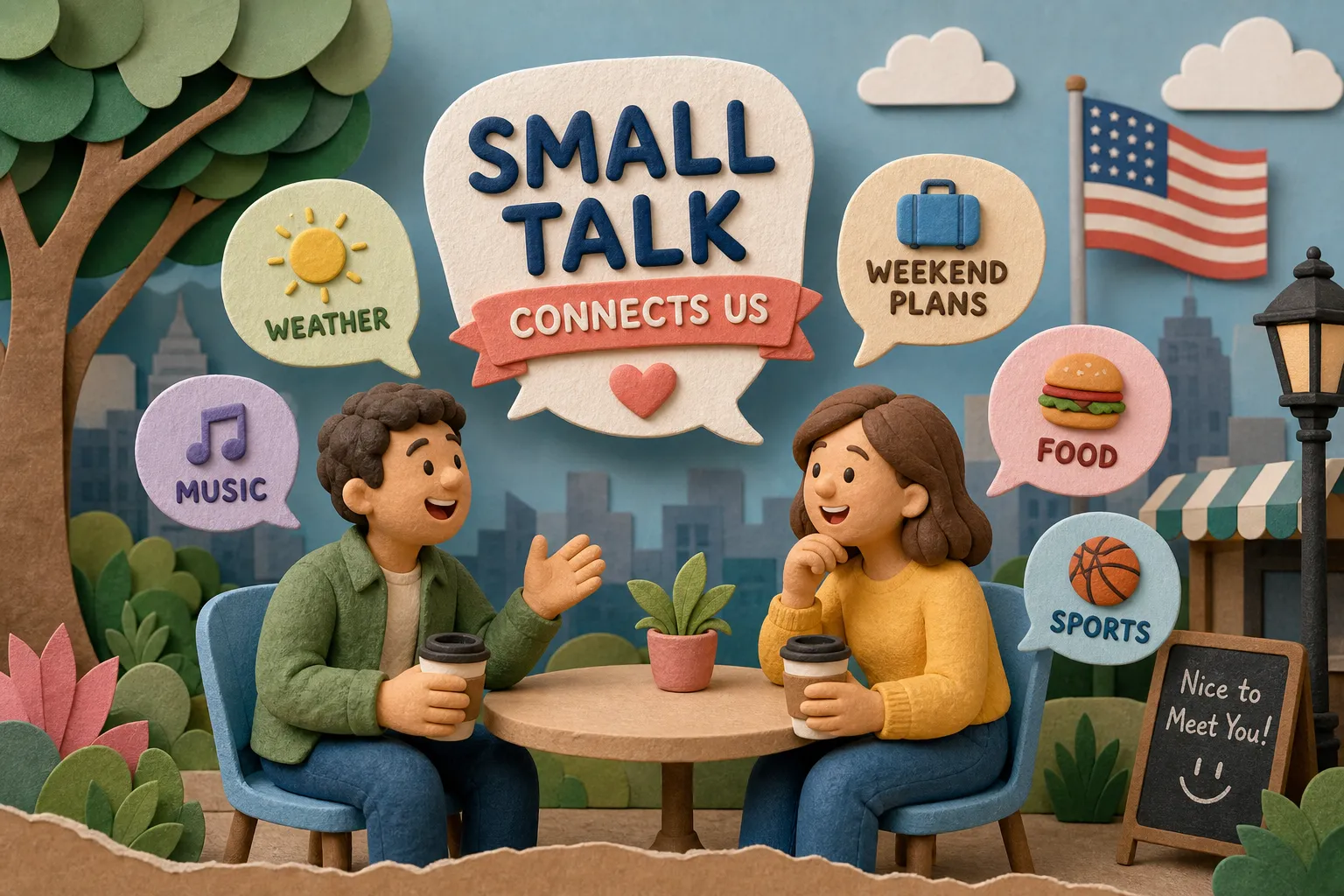
The topics Americans reach for in casual moments aren’t random. They follow a pattern: easy to answer, easy to exit, and they don’t force anyone to take a position. The core categories that come up most in real American interactions are weather, weekend plans, food and restaurants, TV shows and entertainment, local events, travel stories, hobbies, and sports. A coworker might say, “Did you catch the game last night?” as they grab their coffee. A neighbor might ask, “Any fun plans this weekend?” as you check the mail. These are signals of friendliness, not invitations to have a deep discussion.
Some commonly avoided topics in casual American settings include politics, religion, personal finances, health details, and questions about relationship status or age. This isn’t a formal rule; it’s a cultural pattern worth understanding. These subjects can quickly reveal strong differences in values or personal circumstances, which creates tension in a conversation that was only meant to be light and friendly. Knowing why helps you apply the logic to new situations, not just memorize a “don’t” list.
Here’s something that changes how a lot of learners think about chit-chat: safe doesn’t mean shallow. The goal of small talk isn’t to go deep. It’s to create a brief moment of connection and signal that you’re approachable. A quick exchange about traffic or what you’re making for dinner builds real rapport over time. When you understand that, the pressure to say something impressive completely disappears.
12 ready-made conversation starters for real American settings
In the office or break room
Workplace small talk lives in a specific register: light, friendly, and non-intrusive. The best openers are ones the other person can answer in one to three sentences without having to think too hard. These four work consistently well:
- “What are you working on this week?”
- “Any good plans for the weekend?”
- “Have you tried that new place on Fifth?”
- “That coffee smells amazing, what is it?”
The last one is an observation-based opener, and those are especially strong in the office because they’re tied to something real and shared in the moment. You’re not manufacturing a topic out of nowhere.
At social events and parties
Social gatherings give you built-in context to work with. The host, the venue, the crowd, all of it is fair game. These openers fit naturally into party settings because they connect to what’s already happening around you:
- “How do you know the host?”
- “Have you been here before? What do you think of it?”
- “I like your jacket, where did you get it?”
- “What’s keeping you busy lately?”
Notice that three of these four are open-ended. They invite a story, not a yes or no. That’s what keeps the conversation alive past the first few lines.
At networking events and professional gatherings
Networking small talk has one common trap: the question “So, what do you do?” It feels natural, but it’s overused and often puts people on the spot. These four alternatives are open-ended and far more interesting to answer:
- “How did you get into your field?”
- “What are you working on right now?”
- “What’s been the most interesting part of your week?”
- “What brought you to this event?”
The key difference is that these questions invite a story, not a job title. People remember the person who asked them something genuinely engaging, not the one who made them recite their LinkedIn summary.
How to keep the conversation going after your first line
The follow-up pattern that works every time
A good opener only gets you started. What keeps small talk alive is a rhythm that builds naturally: open-ended opener, reflective follow-up, one deeper question. For example, “What are you working on this week?” leads to “Oh, what else does that involve?” which leads to “What’s been the most interesting part of it?” You stay on one thread and go one level deeper, rather than jumping to a new topic. That single habit is what separates a real conversation from a series of disconnected questions.
Short scripts for three common situations
Here are three complete scripts so you can see the pattern in action. Read them out loud to get a feel for how they flow.
Office setting: “What are you working on this week?” → “Oh, what all does that involve?” → “What do you enjoy most about that kind of work?”
Social event: “How do you know the host?” → “Oh wow, so you’ve known each other a long time, what’s that story?” → “What was that experience like for you?”
Networking event: “How did you get into your field?” → “What was the path like for you?” → “What do you enjoy most about it now?”
Each script stays on one thread and goes one level deeper. That’s the whole formula. You don’t need to be clever or funny, you just need to be genuinely curious and ask the next natural question.
Mistakes that make small talk feel awkward (and better lines to fix them)
The closed question trap and the dead-end reply
Two of the most common ESL patterns kill momentum fast: asking yes/no questions and giving one-word answers. “Did you have a good weekend?” can be answered with a single word, and often is. “Good, thanks” as a reply gives the other person absolutely nothing to work with. Both shut down what could have been a real exchange.
The fix is small but powerful. Swap the closed question for an open question:
- Instead of “Did you have a good weekend?” → “What did you get up to this weekend?”
- Instead of “Good, thanks.” → “Pretty good, I finally got to try that new Thai place. Have you been?”
Add one specific detail to any reply. That detail gives the other person something to respond to, and the conversation becomes mutual instead of one-sided.
Over-preparing and sounding scripted
A lot of learners freeze because they’re waiting for the perfect line. They rehearse something, the moment passes, and they say nothing. Here’s the thing: authenticity beats polish in small talk every time. A real, simple line like “I’m a little tired today, but glad I came, how about you?” works better than a carefully rehearsed opener because it sounds like a human being, not a script. Speak from the moment you’re actually in, not from memory. Most casual conversations aren’t about evaluating your English, the other person is usually just glad someone started talking.
Two micro-skills that cut small talk anxiety fast
The active listening signal
Active listening is used through short verbal acknowledgments in conversation, and most ESL learners underuse them. These phrases signal that you’re engaged, they buy you a moment to think, and they make the other person feel genuinely heard. Here are four icebreaker responses that fit naturally into casual American conversation:
- “Oh really?”, works well when someone shares something surprising
- “That’s interesting.”, signals engagement without committing you to a strong opinion
- “Tell me more.”, one of the most powerful phrases in small talk; it’s an invitation and a compliment at the same time
- “What happened next?”, use this when someone is telling a story; it keeps the energy moving
For ESL learners especially, these short responses are gold. They keep the conversation flowing while you process what was just said. You don’t have to produce a perfectly formed sentence every time someone speaks. Responding with “Oh really? What happened after that?” is completely natural and shows you’re fully present.
The “one detail” technique for richer replies
This second micro-skill works alongside active listening. Whenever you answer a question, add one specific detail the other person can follow up on. It shifts the dynamic from a one-sided exchange to a real back-and-forth. Instead of just answering “pretty good,” you say “pretty good, I went hiking on Saturday and the trail was way more intense than I expected.” Now the other person has a thread to pull on.
Here’s your practice prompt: take these three common small talk questions and write a reply that includes one specific, open-ended detail for each one.
- “How’s your week going?”
- “Any fun plans coming up?”
- “What do you do?”
Write your answers out loud or on paper. Notice how adding one concrete detail, a place, an activity, a reaction, immediately gives the other person something to engage with. That’s the whole skill. Practice it a few times and it starts to feel automatic.
You already have everything you need to start
Small talk isn’t about being funny, clever, or impressive. It’s about showing up, being present, and giving the other person something easy to respond to. With 12 specific openers and a clear follow-up structure, you have more than enough to handle any break room, party, or networking event with confidence. Building your social conversation skills really does start this simply.
Start with the two micro-skills first: the active listening signal and the one-detail reply. These are the fastest way to go from awkward to natural, and you can practice both in your very next conversation. You don’t need a perfect situation. Any casual moment works.
If you want to go further, Your Daily American offers dedicated small talk phrase guides and full situational conversation lessons organized by setting, workplace, social events, networking, and more. Each lesson includes ready-to-use phrase lists, cultural context notes, and real dialogs so you can hear how these conversations actually sound. The next break room moment doesn’t have to catch you off guard. Everything you need to handle it is already in this article, and there’s plenty more waiting when you’re ready.