You’re watching an American show, scrolling through Instagram, or reading a text from your American friend, and you see it: “my BFF is coming over tonight.” The BFF meaning is straightforward, it stands for “best friend forever”, but the real questions run deeper: do real people actually say this out loud? Is it formal or casual? Can anyone use it, or is it just for teenage girls? And is it even still a thing in 2026?
Those are exactly the right questions to ask. Real American conversations are packed with informal shorthand like this, the kind that never shows up in a grammar textbook but fills every group chat, Instagram caption, and casual phone call. At Your Daily American, breaking down that everyday language is the whole point, and this term is a perfect place to start. By the end of this lesson, you’ll know the full definition, where it came from, how to use it naturally in writing and speech, and how it fits into the broader family of American friendship slang.
BFF Meaning: What It Stands For
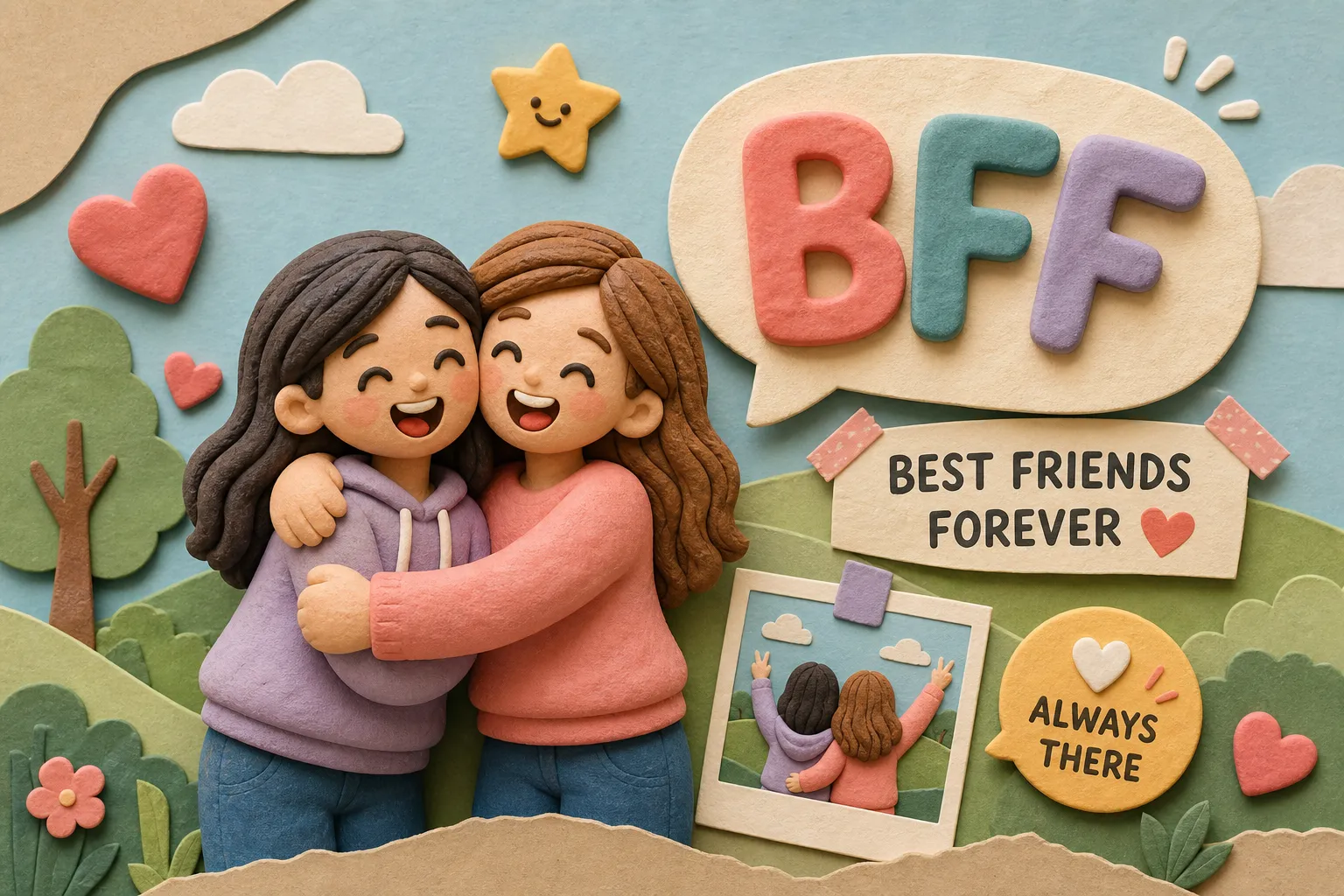
BFF stands for “best friend forever” or “best friends forever,” with the plural form depending on context. Cambridge Dictionary defines it simply as “a person’s best friend,” and Merriam-Webster keeps it equally direct: “a very close friend.” The definition itself is simple, but the emotional weight behind it is what makes it worth understanding.
One thing worth noting right away: the word “forever” in the phrase is about affection, not a literal lifelong promise. When an American says “she’s my BFF,” they’re saying this person is extremely close to them, someone they trust and care about deeply. They’re not signing a contract. The “forever” is warmth, not a legal term.
In speech, Americans say the three letters separately: B-F-F, pronounced /biː ef ef/, or “BEE-ef-EF.” It’s an initialism, which means each letter gets its own sound, the same way you’d say “FBI” or “ATM.” It is not pronounced as a single spoken word. In writing, you’ll see it as “BFF,” “bff,” or occasionally “B.F.F.” Lowercase in text messages is completely normal and doesn’t change the meaning. Many ESL learners assume the term is only a written abbreviation, but Americans say it out loud in casual conversation all the time, “She’s my BFF from college” is something you’d hear just as easily as read.
BFF Origin: A Brief History
Most people assume BFF was born out of early 2000s texting culture, when everyone was shortening everything to fit a character limit. The actual origin goes back further. The Oxford English Dictionary traces the term to 1978, long before smartphones, texting, or social media existed. People were using friendship abbreviations in informal written notes and correspondence decades before the internet made them universal. Slang almost always has deeper roots than its “viral moment” suggests.
The phrase became a household term in American pop culture in 1997, when it appeared on Friends, one of the most-watched sitcoms in American television history, specifically in Season 3, Episode 25, “The One at the Beach.” After that, the term spread rapidly through teen culture and then exploded again in the early 2000s with the rise of texting, where short abbreviations were both practical and stylish. For ESL learners, this matters: Friends shaped a huge amount of casual American English that people still use and encounter today. If you watch the show to study English, which many learners do, you’re already familiar with the cultural ground this slang grew out of.
BFF Meaning in Use: Real Examples Across Contexts
Texting and direct messages are where the abbreviation feels most at home. The term fits naturally because texting rewards brevity, and the tone is always warm and casual. These are the patterns you’ll see most often:
- “Miss you, BFF.”
- “Need my BFF’s advice ASAP.”
- “My BFF is coming over tonight, finally.”
- “We’ve been BFFs since middle school.”
The two most natural structures to practice are “my BFF” (when talking about one close friend) and “we’re BFFs” (when describing the relationship between you and someone else). Both patterns come up constantly, so getting comfortable with them gives you a solid foundation.
Social Media Captions
On social media, the term shows up constantly in birthday posts, travel photos, and brunch pictures. Typical captions look like: “Happy birthday to my BFF,” “Weekend with my BFF = perfect reset,” or simply “BFF day at brunch.” Notice that social captions tend to drop articles and stay short, “BFF day at brunch” feels more natural in that context than “A BFF day at brunch.” That’s just how caption writing works in American social media.
Spoken Usage
In conversation, Americans use the term out loud in informal settings, especially among Millennial and older Gen Z speakers. You’d hear things like “She’s my BFF from college,” “That’s my BFF right there,” or “I’m meeting my BFF for coffee.” One important register note: the abbreviation is always informal. It does not belong in a professional email, a formal introduction, or a work presentation. Save it for casual conversations, texts, and social posts.
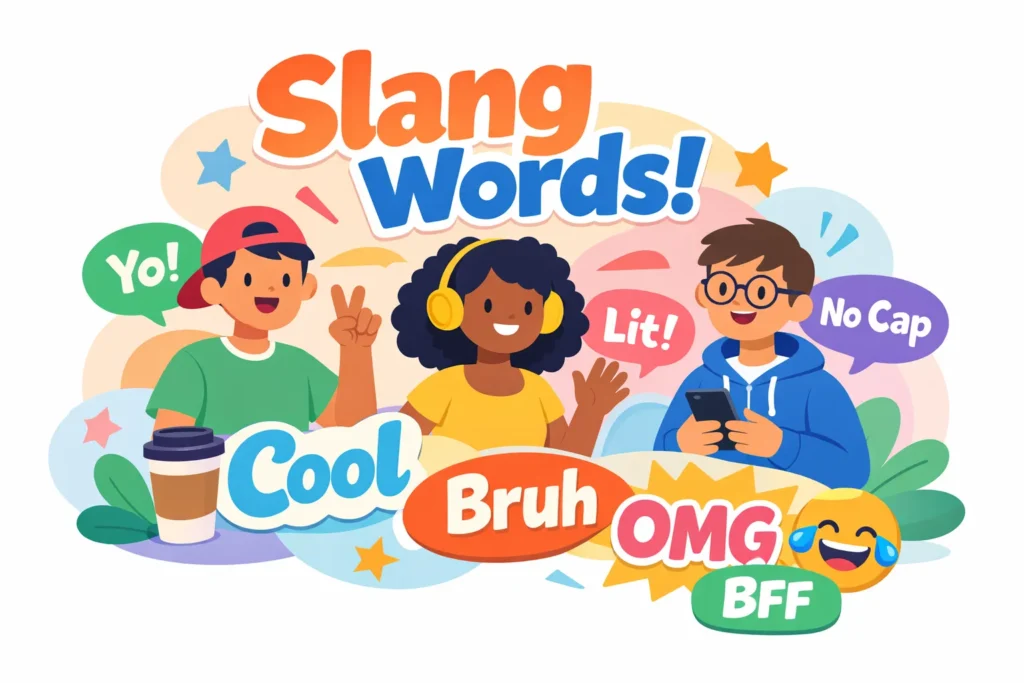
BFF, Bestie, BFFL, and BF: The Friendship Slang Family
This term doesn’t exist in isolation. It’s part of a whole family of common American slang words Americans use, and knowing the differences helps you choose the right one for each situation. Here’s a clear breakdown:
- BF: usually means “best friend,” but it can also mean “boyfriend,” so context matters a lot. This is the one ESL learners need to watch most carefully. “My BF is coming over” could mean very different things depending on who’s speaking.
- BFF: “best friend forever,” the core term, warm and familiar, best used for one very close friend.
- BFFs: the plural form, used when talking about a tight group of close friends together.
- BFFL: “best friend for life,” the same warmth but with slightly more dramatic energy. Less common, but you’ll still see it occasionally.
- Bestie: casual, affectionate slang for a close friend. It doesn’t carry the “forever” idea, but it carries real warmth and sounds very current.
For practical use, here’s a simple guide. If you’re texting a close friend casually, both “BFF” and “bestie” work well. For an Instagram caption, either feels natural. If you’re referring to a group of close friends, “BFFs” is the right plural. If you want to sound current with younger American speakers, lean toward “bestie.”
Is BFF Still Something People Actually Say in 2026?
The honest answer is yes, bestie has taken the lead with Gen Z, but the term is nowhere near gone. Bestie feels lighter, more spontaneous, and it works in both sincere and slightly playful contexts. You can even use “bestie” with gentle sarcasm (“Oh, thanks so much, bestie…”) in a way that “best friend forever” doesn’t carry naturally. That flexibility is part of why bestie moved to the top spot with younger speakers.
Other friendship terms that have joined the space include “fam” for a close friend group, “my person” for one specific emotionally significant friend, and “sis” or “bro” for casual affectionate address. These terms reflect a broader Gen Z trend toward signaling closeness through connection and energy rather than a fixed label.
That said, think of “best friend forever” as a classic term rather than an outdated one. It appears constantly in birthday posts, throwback photos, group chats, and casual speech among Millennials and plenty of Gen Z speakers too. A practical rule for learners: when in doubt, “bestie” is the safer choice with younger speakers; “BFF” is understood by everyone and sounds completely natural with anyone in their mid-twenties or older.
Try It Yourself: Using BFF Naturally
Reading about slang is useful, but using it is what builds real fluency. Before you move on, try these short practice prompts, write them out, say them aloud, or type them into a notes app:
- Write a casual text sentence using “my BFF” to tell an imaginary friend you miss them.
- Create a two-word social media caption using the term.
- Fill in the blank: “We’ve been ______ since high school.”
There’s no trick to these. They’re small moments of practice that move vocabulary from something you recognize into something you can actually produce, and that shift is exactly where real fluency lives. Small steps like these are what About, Your Daily American is built around: covering the Common American Expressions Every English Learner Should Know that shows up in texts, conversations, and social feeds rather than just grammar exercises.
Quick Reference: What You’ve Learned
Now you know the BFF meaning, best friend forever, and how Americans use the term in 2026. It has been around since at least 1978, went mainstream after a Friends episode in 1997, and is still very much alive in texts, captions, and casual American conversation today. It is always informal, always warm, and always used for someone you’re genuinely close to.
Keep the key distinctions handy: “BF” can mean best friend or boyfriend depending on context; “BFFL” adds a “for life” emphasis; “BFFs” is the plural for a tight group; and “bestie” is the more current, flexible alternative that younger speakers tend to reach for first. None of these terms belong in formal or professional writing, but in the right casual moment, they’re a natural part of sounding fluent in everyday American English.
Further reading: the Cambridge Dictionary definition of BFF, contemporary coverage of the term’s formal recognition like the CBS News report on additions to the Oxford Dictionary, and scholarly work on texting behavior and adolescent communication patterns such as this research article on adolescent communication can provide useful background if you want to dig deeper.