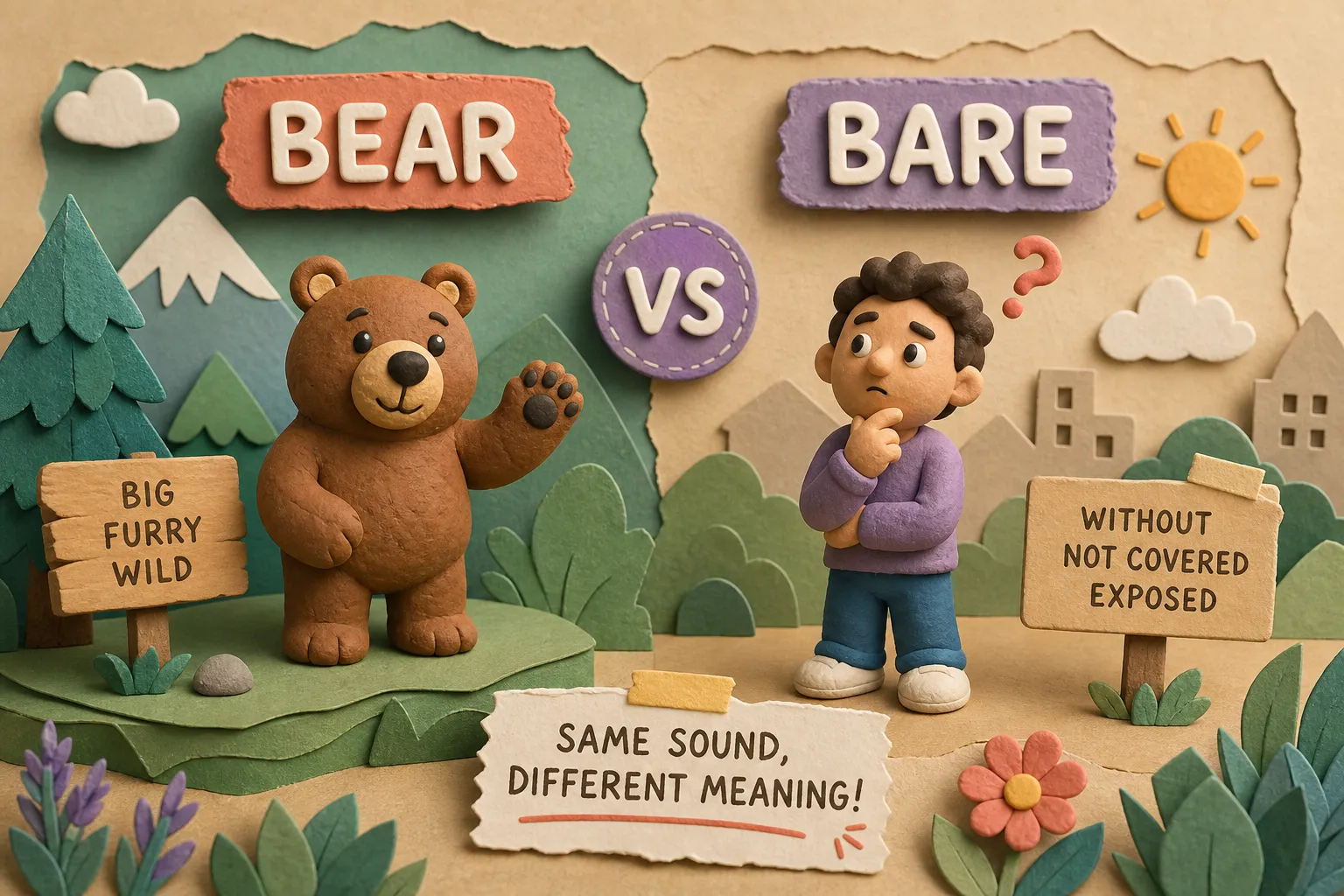
Bear vs. bare is one of those word pairs that trips up even careful writers. Both words are pronounced exactly the same in American English (/bɛr/, like “bair”), yet they do completely different jobs in a sentence. Mixing them up is the kind of error that slips right past spell-check and lands directly in front of a native speaker who notices immediately.
Here’s a real scenario: you’re wrapping up a work email and you type “bare with me while I confirm the details.” Your intentions are good, but the sentence now says something very different from what you meant. By the end of this lesson, you’ll know the meaning and grammar role of each word, recognize which one belongs in common phrases like “bear with me” and “bare minimum,” and have a quick swap test you can use anytime you’re not sure. Getting homophones right is one of those small, precise skills that makes your written English feel genuinely fluent, not just grammatically correct. At Your Daily American, that kind of real-world accuracy is exactly what we work toward.
Bear vs. Bare: Meaning and Usage
Bear as a noun
Yes, a bear is the large, furry animal from nature documentaries and national parks. That meaning is rarely the source of confusion. “A black bear wandered into the campsite last summer”, clear, simple, no mix-up possible. The problem starts when bear shows up as a verb.
Bear as a verb: carry, endure, and produce
As a verb, bear has several connected meanings, all involving something being held, supported, or brought forward. Two of those senses cover physical and emotional weight:
- To carry or support: “The old bridge can’t bear the weight of heavy trucks.”
- To endure or tolerate: “She had to bear the full cost of the repair herself.”
Two more senses cover output and direction:
- To produce or give rise to: “The project finally bore fruit after months of work.”
- To move in a direction: “Bear left at the intersection and follow the signs toward downtown.”
Notice that each of these senses involves presence, weight, or output. Something is being held up, pushed through, or produced. That pattern is the key to remembering which word to use.
The grammar role: noun and verb
Bear works as both a noun and a verb. That double function is exactly why it appears in so many idioms and fixed phrases in English. When a word carries this much meaning, it tends to show up everywhere, which is part of what makes it worth learning carefully and completely.
What “bare” means and when it shows up
Bare as an adjective: uncovered, empty, minimal
Bare almost always points to something that’s absent, missing, or reduced to its simplest form. Think of bare feet on a hardwood floor, bare walls in an empty apartment, or someone sitting at a bare desk with nothing on it. The word signals a lack of covering or extras. “She packed the bare essentials for the trip, just a toothbrush and two changes of clothes.” Or: “The startup launched with a bare-bones budget and grew from there.”
The core meaning of bare is always about absence or minimalism. If you can picture something stripped down, uncovered, or reduced to its simplest version, bare is almost certainly the right word.
Bare as a verb: to uncover or reveal
Bare can also function as a verb, but its meaning is narrow: to expose or uncover something. “He bared his teeth when the dog approached.” Or: “She finally bared her frustration in the meeting, saying what everyone else had been thinking.” This verb sense is less common than the adjective, but it’s worth knowing so you recognize it when you see it.
A quick contrast worth remembering
Bare works as an adjective (most often) and occasionally as a verb meaning “to expose.” The consistent pattern: bare signals absence, exposure, or minimalism. Bear signals presence, endurance, or output. One word is about what’s there and must be carried; the other is about what isn’t there at all.
The phrases where people get the bear vs. bare difference wrong most often
“Bear with me” vs. “bare with me”: the most searched mix-up
“Bear with me” is always the correct form. Here, bear is a verb meaning “be patient” or “tolerate.” You’re asking someone to endure a brief moment while you check something or finish a task. “Bare with me,” taken literally, would mean to undress together, obviously not the intent in a Monday morning status update email.
Here’s how it sounds in a real workplace context: “Bear with me while I pull up the latest version of the report.” Or in a meeting: “Bear with me for just a moment while I find the right slide.” Native speakers use this phrase constantly in professional settings, so getting it right in writing genuinely matters.
Other frequently confused phrases in everyday and professional English
Several common phrases fall into one camp or the other. Here’s a quick breakdown:
- Bear in mind, keep something in consideration: “Bear in mind that the client’s deadline is Friday, not Monday.”
- Grin and bear it, accept something unpleasant with composure: “The commute takes an hour each way, but we just grin and bear it.”
- Bare minimum, the lowest acceptable level: “The draft meets the bare minimum requirements, but it needs more depth.”
- Bare essentials, only what’s strictly necessary: “Pack the bare essentials and nothing more.”
- Bare bones, a stripped-down version of something: “It’s a bare-bones proposal right now, but the core idea is solid.”
Why ESL learners are especially prone to this mistake
Native speakers absorb these phrases over years of reading and hearing them in real contexts. When you’ve heard “bear with me” dozens of times before you ever see it written, the correct spelling becomes automatic. For ESL learners, the challenge is different: these phrases often appear in writing first, without that long auditory history. Both words sound identical, so sound alone won’t guide you. The fix is building a clear meaning connection for each word before the high-pressure moment of sending an email arrives.
For more on this common error, see ESLdesk’s explanation of the bear/bare error.
A simple test that makes the bear vs. bare choice obvious every time
The “carry or cover” swap test
Ask yourself: does this word mean something like “endure,” “carry,” or “tolerate”? If yes, use bear. Does it mean something like “uncovered,” “exposed,” or “minimal”? Then use bare. Try it on these two examples.
“Please __ with me while I check the file.” Can you swap in “tolerate”? Yes: “Please tolerate this while I check the file.” That works, so the answer is bear. Now try: “She walked across the cold floor with __ feet.” Can you swap in “uncovered”? Yes: “She walked across the cold floor with uncovered feet.” That fits perfectly, so the answer is bare. The test works in seconds and doesn’t require stopping to analyze grammar categories. For a concise reference on usage, see Merriam-Webster’s note on bare vs. bear.
A visual memory anchor for each word
Two quick memory hooks that work under pressure. First: bare contains the word “are” inside it. Something that IS bare IS exposed, empty, or uncovered, the word carries its own meaning inside itself. Second: bear contains the word “ear” inside it. You need your ears to bear (endure) someone who talks at length in every meeting. These aren’t deep insights; they’re fast, sticky cues designed to work when you’re moving quickly and need a reliable answer. Learn more about mnemonic devices and how simple memory anchors help language learners.
Quick practice: try these sentences yourself
Fill-in-the-blank prompts
Choose bear or bare for each sentence below. Try the swap test on each one before checking the answers.
- “Please __ with me while I transfer your call to the right department.”
- “She moved into the new apartment and the walls were completely __.”
- “The report covered only the __ facts: no background, no context.”
- “I genuinely can’t __ another two-hour meeting with no clear agenda.”
- “He completed the repair with his __ hands, no tools at all.”
Answer guide with explanations
- Bear. You’re asking for patience. Swap test: “Please tolerate while I transfer your call” works. Bear with me.
- Bare. The walls are uncovered, empty. Swap test: “The walls were completely uncovered” fits exactly.
- Bare. “The bare facts” means the plain, stripped-down information. The word signals minimal, nothing extra.
- Bear. “I can’t tolerate another two-hour meeting”, bear is the endure/tolerate verb here.
- Bare. Bare hands means hands without gloves or tools, uncovered. Classic adjective use.
Getting these right in your writing signals that you don’t just know English words, you know how to use them precisely. Native speakers notice that kind of care, even when they can’t name exactly what feels right about the sentence. Precision like this builds with practice, one phrase at a time. If you want related practice on pronunciation and commonly misused words, check our piece English Words Non-Native Speakers Mispronounce Most Often, Your Daily American.
Two words, two clear meanings
Here are the two core ideas worth keeping: bear handles the heavy lifting, it carries, endures, supports, and produces. Bare points to what’s absent: uncovered, exposed, stripped down to the minimum. When you’re not sure which to use, run the swap test. “Endure or carry” points to bear; “uncovered or minimal” points to bare. That test will get you to the right answer faster than any grammar rule.
Getting the bear vs. bare difference right is one of those details that adds up quietly over time. Your emails read more cleanly, your writing feels more assured. Native speakers sense that you’ve developed a genuine feel for the language, the kind that goes beyond vocabulary into real precision. For another clear explanation of this particular pair, see Grammarly’s guide to bear vs. bare.
At Your Daily American, we focus on exactly this level of word-level accuracy: not abstract rules, but the real language patterns that make your English work confidently in daily life and at work. If you want more on using these words in professional contexts, browse our Professional English, Your Daily American category, and for common phrase usage see our post on Common American Expressions Every English Learner Should Know, Your Daily American. Small distinctions like bear vs. bare are how fluency actually gets built, one careful, well-chosen word at a time.