Picture this: you’re at the register at Target, and the cashier says “That’ll be forty-three seventy-five.” You hear the numbers, but for a split second, your brain freezes trying to piece it together. You hand over two twenties, hoping it’s enough. Sound familiar? Numbers in English come up every single day, and the gap between recognizing them and actually using them fluently is bigger than most learners expect.
By the end of this lesson, you’ll have the tools to say most numbers correctly in American English with practice, whether it’s a price at checkout, a phone number, a street address, a meeting date, or a figure in the millions. This is a system built around how real Americans actually speak and write numbers every day.
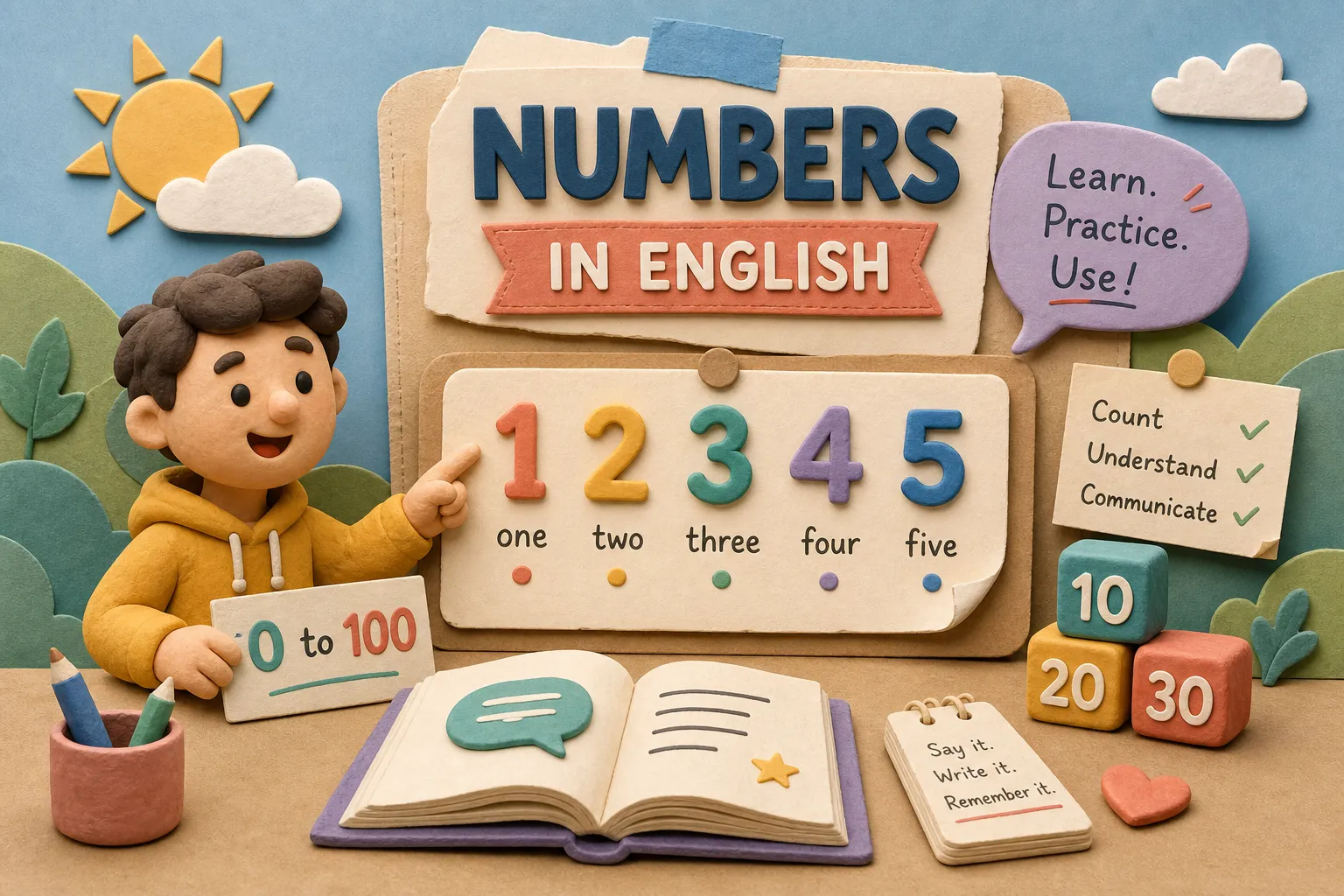
Numbers in English: Cardinal spelling and pronunciation from 0 to 100
Before building toward large numbers, you need a solid foundation. Most intermediate learners already know the basics, but a few spellings and pronunciation patterns trip people up consistently.
The spellings that catch everyone off guard
The most common spelling mistake is “fourty”, it doesn’t exist. The correct spelling is forty, no “u.” This one is so widespread that even native speakers sometimes second-guess it. Similarly, “twelve” ends in a “-ve” that doesn’t follow any obvious pattern, and “eight” has a silent “gh” that surprises many learners.
The tens follow this pattern: twenty, thirty, forty, fifty, sixty, seventy, eighty, ninety. Notice that “eighty” comes from “eight” but drops the “t”; it’s not “eightty.” And “fifty” comes from “five,” not “fivety.” These are fixed forms. Memorize them as a set and you’ll stop second-guessing yourself in written work.
Thirteen or thirty? Getting the stress exactly right
The stress difference between teen numbers and tens is a frequent source of confusion for ESL speakers and native listeners alike, and it has real consequences. The difference is in where the stress falls. Teen numbers are stressed on the second syllable: thir-TEEN, fif-TEEN, six-TEEN. The tens are stressed on the first: THIR-ty, FIF-ty, SIX-ty.
Here’s why it matters. Imagine you’re on a phone call at work and you say, “I need thirteen copies by noon.” If your stress lands on the first syllable, your colleague might hear “thirty” and print the wrong amount. That’s not a grammar error, it’s a stress error, and native speakers really do mishear these. Practice by exaggerating the difference at first: thir-TEEN versus THIR-ty, fif-TEEN versus FIF-ty, and then gradually bring it back to natural speed.
Building 21 to 99: the hyphen rule
Any number from 21 to 99 that combines a tens word and a ones word is hyphenated in writing: twenty-one, forty-five, sixty-seven, ninety-three. According to major style guides such as the Chicago Manual of Style and Merriam-Webster, the hyphen is required, not optional. If the ones digit is zero, you just say the tens word alone: “thirty,” not “thirty-zero.” Simple, clean, and consistent.
For a clear chart and extra practice with common forms, see numbers in English.
Ordinal numbers and when Americans actually use them
Ordinal numbers show position or order: first, second, third, fourth, and so on. Most learners know the basics, but the irregular forms and real-world usage patterns are where mistakes creep in.
The irregular forms you can’t just guess
The first three ordinals are completely irregular: first, second, third. After that, most ordinals follow a “-th” pattern, but there are important exceptions. “Five” becomes “fifth” (not “fiveth”), “eight” becomes “eighth” (not “eightth”), “nine” becomes “ninth” (not “nineth”), and “twelve” becomes “twelfth” (not “twelveth”). These four forms are commonly mistaken by learners at every level.
For rules and clear writing tips on ordinals, check how to write ordinal numbers correctly.
For tens, the “-y” ending changes to “-ieth”: twentieth, thirtieth, fiftieth, and so on. For compound ordinals like twenty-first or forty-third, only the last word changes: twenty-first, forty-third, sixty-second. The tens word stays exactly the same.
Where ordinals show up in daily American life
Americans use ordinals constantly in spoken English, often in places where the written form doesn’t show it. Floor numbers in buildings: “I’m on the fifteenth floor.” Competition results: “She finished in third place.” Rankings in lists or presentations: “The second thing I want to cover today is budget.” These come up in meetings, in small talk, and in everyday navigation.
Dates are a particularly important case. When you see “January 21” written on a calendar or an invitation, Americans say it as “January twenty-first.” The ordinal is spoken even when the written form doesn’t include “st,” “nd,” “rd,” or “th.” This gap between the written and spoken form surprises a lot of learners, but once you know it, you’ll start hearing it everywhere.
For more practice and examples specifically on saying dates aloud, try this guide on saying the date in English.
Building large numbers the way Americans do
Large numbers follow a clear, repeating pattern. Learners who haven’t internalized it often import structure from their first language, which can produce forms that sound immediately off to a native ear.
The grouping pattern behind big numbers
English reads numbers in groups of three digits, and each group gets a label: hundred, thousand, million, billion. Written numerals use commas to mark those groups: 1,450 / 23,000 / 2,500,000. Here’s how that looks in spoken form:
- 101 = one hundred one
- 1,450 = one thousand four hundred fifty
- 23,000 = twenty-three thousand
- 450,000 = four hundred fifty thousand
- 2,500,000 = two million five hundred thousand
Read the number in groups, left to right, and label each group. That’s the whole system.
“Two thousands” and other mistakes to stop making
A very common error ESL learners make with large numbers is treating scale words like nouns: “two thousands,” “three millions,” “five hundreds.” In English, these words don’t take an “s” when they follow a number. It’s “two thousand,” “three million,” “five hundred”, no exceptions when a number precedes the scale word.
The “s” only appears when you use these words without a number in front of them, as a noun on their own: “thousands of people,” “millions of dollars.” But when a number precedes them, no “s.” This single rule fixes one of the most persistent large-number mistakes right away.
The “and” question: American vs. British style
If you’ve heard “one hundred and one” and wondered whether the “and” belongs there, here’s the answer: in American English, “and” is generally left out of whole numbers above 100. American style says “one hundred one,” not “one hundred and one.” British English does use “and” in this position, which is why you’ll hear both, especially in media from the UK.
The key exception in American English: “and” does appear when you hit a decimal point or a cents amount. “Eleven hundred fifty-four dollars and sixty-one cents.” That “and” signals that something follows the whole number. In American speech, hearing “and” in the middle of a number often suggests that a decimal or cents amount is coming next, though it’s a tendency rather than an absolute rule.
How Americans say prices, dates, phone numbers, and addresses
Real-world number use doesn’t always match the textbook pattern. These four contexts come up every single day in American life, and each has its own spoken conventions.
Prices and currency out loud
The standard spoken form for a price like $43.25 is “forty-three dollars and twenty-five cents.” In casual speech, Americans often drop the unit words entirely, you might hear “forty-three twenty-five” at a department store counter or “four seventy-nine” at a coffee shop for $4.79. Shorter prices lend themselves to this informal pattern most naturally; longer amounts are more commonly stated in full. Whole dollar amounts work two ways: $20 is “twenty dollars” in formal speech and just “twenty bucks” in informal conversation. For $1.99, you’ll hear “a dollar ninety-nine” or “one ninety-nine” interchangeably.
American dates: month first, years split in two
The U.S. date format always puts the month before the day: December 12, 2026, not 12 December. Spoken, that becomes “December twelfth, twenty twenty-six.” Years are where many learners get tripped up. Years from 1100 through 1999 are spoken as two pairs: 1995 = “nineteen ninety-five.” The transition years 2000 to 2009 are usually said in full: “two thousand” and “two thousand nine.” Starting with 2010, Americans shifted back to the two-pair pattern: 2010 = “twenty ten,” 2015 = “twenty fifteen,” 2026 = “twenty twenty-six.”
Phone numbers and addresses
American phone numbers are read in three groups: area code (three digits), prefix (three digits), line number (four digits). The rhythm sounds like this: “seven-one-four, five-five-five, one-two-three-four.” In casual speech, repeated digits often become “double”: “double five” instead of “five five.” For street addresses, a four-digit number like 1428 is spoken as “fourteen twenty-eight Oak Street,” not “one thousand four hundred twenty-eight.” That chunked, two-pair reading reflects the natural American spoken pattern, though in very formal or unfamiliar contexts speakers may read each digit individually. ZIP codes are always read digit by digit.
For extra guidance on reading street addresses naturally in English, see how to read street addresses in English.
Decimals, fractions, and percentages in spoken American English
These three come up constantly in real conversation, from cooking measurements to finance to sports stats. Each has a clean, simple spoken rule.
How to say decimals correctly
Say “point,” then read each digit individually. 3.14 is “three point one four,” not “three point fourteen.” 0.5 is “zero point five” or just “point five.” The most common mistake is grouping the digits after the decimal into a number the way you’d read a whole number. Each digit after “point” is generally read separately, in precise contexts like spreadsheets or financial reports, this holds without exception. In casual speech, prices like $3.49 often become “three forty-nine,” where the decimal digits are compressed for speed.
Fractions: the shortcuts native speakers actually use
For common fractions, Americans almost always use the informal forms: 1/2 is “half” or “one half,” 1/4 is “a quarter,” 3/4 is “three quarters.” For less common fractions, the rule is cardinal over ordinal: 2/3 is “two thirds,” 3/5 is “three fifths,” 7/8 is “seven eighths.” In a recipe, you’d say “add three quarters of a cup of flour” or “use half a teaspoon of salt.” The formal “one half” and “one quarter” sound technically correct but slightly stiff in everyday conversation.
Percentages: the spoken rule
Percentages are the simplest: say the number, then say “percent.” 25% is “twenty-five percent.” 0.5% is “half a percent” or “point five percent.” For a number like 3.5%, you’ll hear “three-point-five percent” in financial or news contexts. The real value is knowing where percentages actually appear in daily life, interest rates, test scores, statistics in presentations, and sale signs at stores.
Putting it all together: your complete system for numbers in English
Here’s what you can do right now that you couldn’t do confidently before: say any price at a register, read a phone number aloud in the right rhythm, say a year correctly whether it’s 1985 or 2026, and work through a large number without adding a rogue “s” to million or thousand. Reading decimals digit by digit instead of grouping them is in your toolkit too.
Four habits will move the needle fastest: stress thir-TEEN differently from THIR-ty, never say “two thousands” or “three millions,” say dates with ordinals even when they’re written without them, and read decimals one digit at a time after “point.” Lock those in, and American listeners will notice the difference right away.
Numbers in English are one piece of a much larger picture. At Your Daily American, there are in-depth lessons on Pronunciation & Listening, Professional English, and the real patterns of fast native speech that never make it into textbooks. For more useful vocabulary, check our 75 American English Phrases for ESL Beginners.
For your practice prompt: pick three numbers from your own life, your phone number, your street address, and your birthday, and say each one out loud using today’s rules. That’s fluency in action.