Picture this: you’re reading a long Reddit thread about someone’s apartment-hunting nightmare in New York City. The post is twelve paragraphs long. You scroll to the bottom and find this line: “TL;DR: Landlord was a scam. Got my deposit back after threatening legal action.” You understand every individual word, but something doesn’t quite click. What is the tldr meaning, exactly? Is it a phrase? An abbreviation? And why does it have a semicolon in it?
This is precisely the kind of everyday American English that fluent learners often miss, not because it’s grammatically complex, but because it lives online, in comment sections, Slack messages, and email threads rather than in any textbook. At Your Daily American, the focus is on real-world language that matters: not just grammar rules, but the expressions you actually encounter while scrolling, working, and communicating with American colleagues every day.
By the end of this article, you’ll know exactly what TL;DR means, how to spell it correctly, where to place it in a message, when it’s appropriate to use, and what to say instead when you need something more professional. You’ll walk away ready to use it, or avoid it, with full confidence.
TL;DR meaning: what it means and where it came from
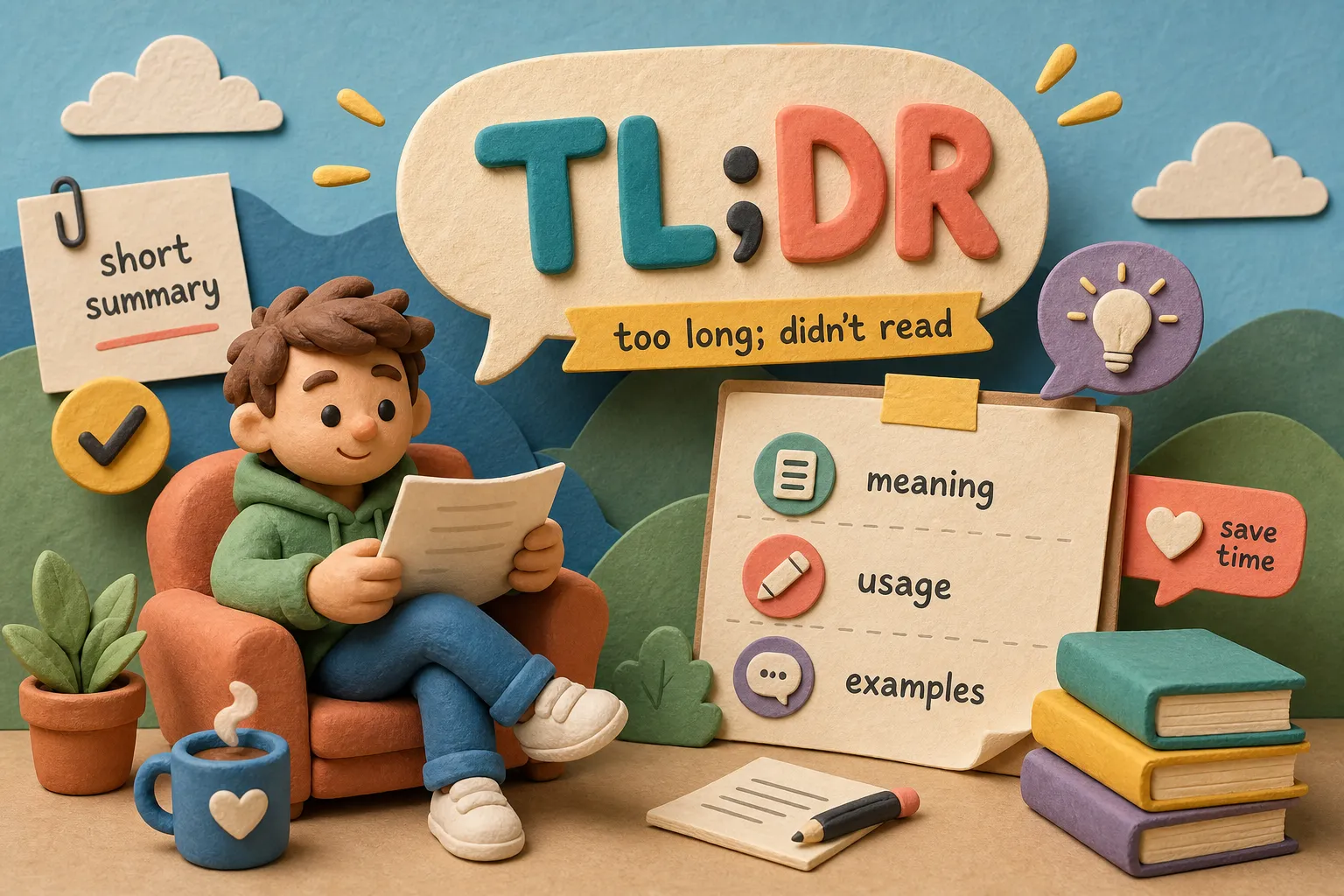
TL;DR (also written tldr, without punctuation) stands for “too long; didn’t read.” The tldr meaning is exactly what it sounds like: the content was so long that the reader either skipped it entirely or summarized it for others. The semicolon in the full phrase isn’t decorative. It connects two related independent clauses, “too long” and “didn’t read”, which is why the abbreviation carries a semicolon too. Think of it as a grammatically honest abbreviation.
The phrase was first documented in 2002, on the Usenet newsgroup rec.games.video.nintendo, according to the Oxford English Dictionary. From there, it spread through early internet forums and message boards before becoming common on Reddit, social media, and a wide range of online platforms. Merriam-Webster now includes TL;DR as an official dictionary entry, classifying it as both an abbreviation and a noun with two senses: a comment signaling that something is too long, and a brief summary of longer content.
For ESL learners working with American colleagues or consuming American media, not recognizing this abbreviation can cause real comprehension gaps in online and informal contexts. It turns up frequently across casual platforms and registers, so understanding it goes a long way toward reading and writing natural American English online.
TL;DR, TLDR, or tl;dr: which spelling is correct?
All four are acceptable. Merriam-Webster lists TL;DR, tl;dr, TLDR, and tldr as valid variants. The semicolon mirrors the structure of “too long; didn’t read,” where the punctuation joins two related clauses. TL;DR (all caps) is commonly recommended as the clearest form and is widely used in professional and semi-formal writing. Lowercase (tl;dr) is often seen in casual online spaces like Reddit, Discord, and informal chats. When you’re unsure, use TL;DR, it’s the most widely recognized form.
A key formatting note: when you use TL;DR to introduce your own summary, common style calls for a colon directly after it. The format is “TL;DR: [your short summary here].” That colon signals that the summary follows, working the same way “Summary:” or “Note:” functions in formal writing. Here’s a clean example:
“TL;DR: The meeting is rescheduled to Thursday. No other agenda changes.”
Without the colon, the abbreviation floats without a clear signal to the reader. With it, the structure is immediately clear, even to someone skimming at speed. Common style and usage guides echo this colon format, making it a reasonable style standard to follow.
The two ways people use TL;DR
Understanding tldr meaning requires recognizing that it functions in two very different ways. Confusing them can lead to genuine miscommunication.
The first use is as a reaction to someone else’s writing. When TL;DR appears as a standalone comment or reply, it’s a criticism. It means: “This is too long. I didn’t read it.” Native speakers use it this way on forums, in comment sections, or in group chats. The tone ranges from joking to genuinely dismissive, and it can come across as rude depending on the relationship and context. If you see this usage in a comment section, read it as the digital equivalent of someone rolling their eyes at a long-winded speaker.
The second use is as a label for your own summary, and this is the one you’ll actually want to use yourself. When a writer adds TL;DR at the end (or beginning) of a long post, it’s a courtesy. It says: “I know this is long. Here’s the short version for you.” This is the “long story short” move, and native speakers use it to signal self-awareness about length. A long Reddit post about a salary negotiation might end with: “TL;DR: Asked for a raise, got it. Here’s what I said.” That kind of framing makes content reader-friendly and shows respect for the audience’s time.
When TL;DR fits and when it backfires
TL;DR is commonly used on informal platforms such as Reddit, X (formerly Twitter), Discord, and personal blogs. It fits anywhere the tone is already casual, the relationship between writer and reader is informal or anonymous, and the content is long enough that a quick summary genuinely helps. In these settings, TL;DR often functions as a helpful signal, it lets skimmers find the key point without wading through the full post.
The mistake ESL learners make most often is carrying TL;DR into professional contexts where it doesn’t belong. Using it in an email to a client, a report for a supervisor, or a LinkedIn message to someone you’ve never met may come across as overly casual or flippant in some professional contexts. The problem isn’t just that it’s informal. It’s that TL;DR implicitly acknowledges that your content might be too long, which is the opposite of the impression you want to make in professional communication. You want your reader to feel that your message is worth their full attention, not that you’re already apologizing for its length. Safer alternatives include “Summary” or “Executive summary.”
The deciding principle is simple: if you’re confident the relationship and platform are both casual, TL;DR works. If there’s any doubt about the formality level, skip it and use a professional alternative instead.
How to place TL;DR correctly across different platforms
On Reddit and most discussion forums, convention places TL;DR at the bottom of the post, after the full text. This structure rewards readers who want the whole story while giving skimmers a clear exit. A multi-paragraph post about a missed flight might end with: “TL;DR: Missed my connecting flight in Dallas. Airline rebooked me for free and gave me a food voucher.” The placement signals that the detail comes first and the summary is a bonus.
For long work emails, especially those going to busy colleagues, the TL;DR (or its professional equivalent) belongs near the top, right after the greeting and before the body of the email. An example: “TL;DR: Please approve the vendor contract by Friday. Full details below.” This approach reflects a core value in American workplace communication: respect the reader’s time and lead with what matters most. Front-loading the key point is considered efficient, not lazy.
Platform context shapes placement too. On X, compress your summary to one sharp, punchy line and put it up front. On LinkedIn, keep the tone polished and lead with the value your post delivers. In chat, one clear sentence dropped at the start is usually enough. The broader rule: the faster and more skimmable the platform, the earlier your TL;DR should appear. On slower, more conversational platforms, placing it at the end still works well.
Professional alternatives when TL;DR is too casual
Every context that calls for a TL;DR has a more polished version that does the same job without the internet slang feel. Here are the options worth knowing, along with when each one fits best:
- Summary: the most neutral, universally acceptable choice. Use it for emails, reports, and articles when you want a concise restatement without any informal connotation.
- In short: conversational but still professional. Use it when you want to signal brevity in a memo, presentation, or explanation.
- Bottom line: strong and direct. Use it in business writing when you want to state the conclusion or recommendation clearly, especially in decision-making contexts.
- Key takeaways: best when you’re highlighting the most important points rather than compressing the full content. Use it after meetings, presentations, and project post-mortems.
- Executive summary: the most formal option. Use it for long reports, proposals, and business plans where a senior reader needs the main points before diving into details.
The principle is simple: match the phrase to both the tone and the job it’s doing. Use “Summary” for neutral brevity. Use “Key takeaways” when you want to spotlight conclusions rather than recap everything. Use “Executive summary” when the document is long and the audience is senior. Reserve TL;DR for when the relationship and the platform are both genuinely casual.
Now you’ve got it: put it to use
Here’s what you can do now that you couldn’t before reading this:
- Define tldr meaning and explain where the abbreviation came from
- Choose the right spelling for the right context
- Recognize whether TL;DR is being used as a criticism or a courtesy
- Decide whether the setting calls for TL;DR or a professional substitute
- Place it correctly in your own writing across different platforms
That’s not a small set of skills. It’s the difference between reading a Reddit thread and fully understanding it, between writing a professional email and accidentally sounding like you’re posting in a forum.
This kind of language awareness is exactly what bridges the gap between grammatically correct English and natural American fluency. Knowing what a phrase means is only half the job. Knowing when native speakers use it, and when they don’t, is what makes your English sound genuinely fluent rather than just technically accurate.
Here’s a short practice to try right now: find a long message you sent recently, or an article you read this week, and write a TL;DR line for it. Then rewrite that same summary using “Bottom line:” or “In short:” and notice how the tone shifts. That small exercise teaches you something no grammar rule chart can, how word choice changes the entire feel of a message. If you want to keep building this kind of practical American English vocabulary, Your Daily American has more everyday language lessons waiting for you.
Frequently asked questions about tldr meaning
What does tldr mean?
TL;DR (also spelled tldr) stands for “too long; didn’t read.” It can function as a criticism, meaning the reader skipped a long post, or as a label a writer adds to introduce a short summary of their own longer content.
How do you spell tldr?
Merriam-Webster recognizes four variants: TL;DR, tl;dr, TLDR, and tldr. All are acceptable. TL;DR (all caps, with semicolon) is the most widely recognized form and the safest choice when you’re unsure.
When should I use TL;DR?
Use TL;DR in casual, informal settings, Reddit posts, Discord messages, personal blogs, or group chats, where a quick summary helps skimmers. Avoid it in professional emails, client-facing documents, or formal reports. In those contexts, “Summary,” “Bottom line,” or “Executive summary” does the same job without the internet-slang tone.
Does TL;DR need a colon after it?
When you’re using TL;DR to introduce your own summary, adding a colon, “TL;DR:”, is common style and improves clarity. Merriam-Webster uses this format in its own entry examples. The colon signals that the summary follows immediately, the same way “Summary:” or “Note:” works in formal writing.