You’re listening to a podcast, a meeting, or a conversation with a native speaker, and someone says, “It’s more nuanced than that.” You understood every word and still felt lost. That’s not a grammar problem. That’s a nuance problem, and understanding nuance meaning is one of the most common sticking points for intermediate English learners.
By the end of this lesson, you’ll be able to define “nuance,” pronounce it correctly, recognize it in real conversations, and use it naturally in your own sentences. You’ll also understand how it connects to related terms like “subtlety” and “connotation,” and why those distinctions matter for real fluency. At Your Daily American, the core belief is that true fluency comes from understanding how words work, not just what they mean. This lesson is a perfect example of that philosophy in action.
Nuance Meaning: Definition and Pronunciation
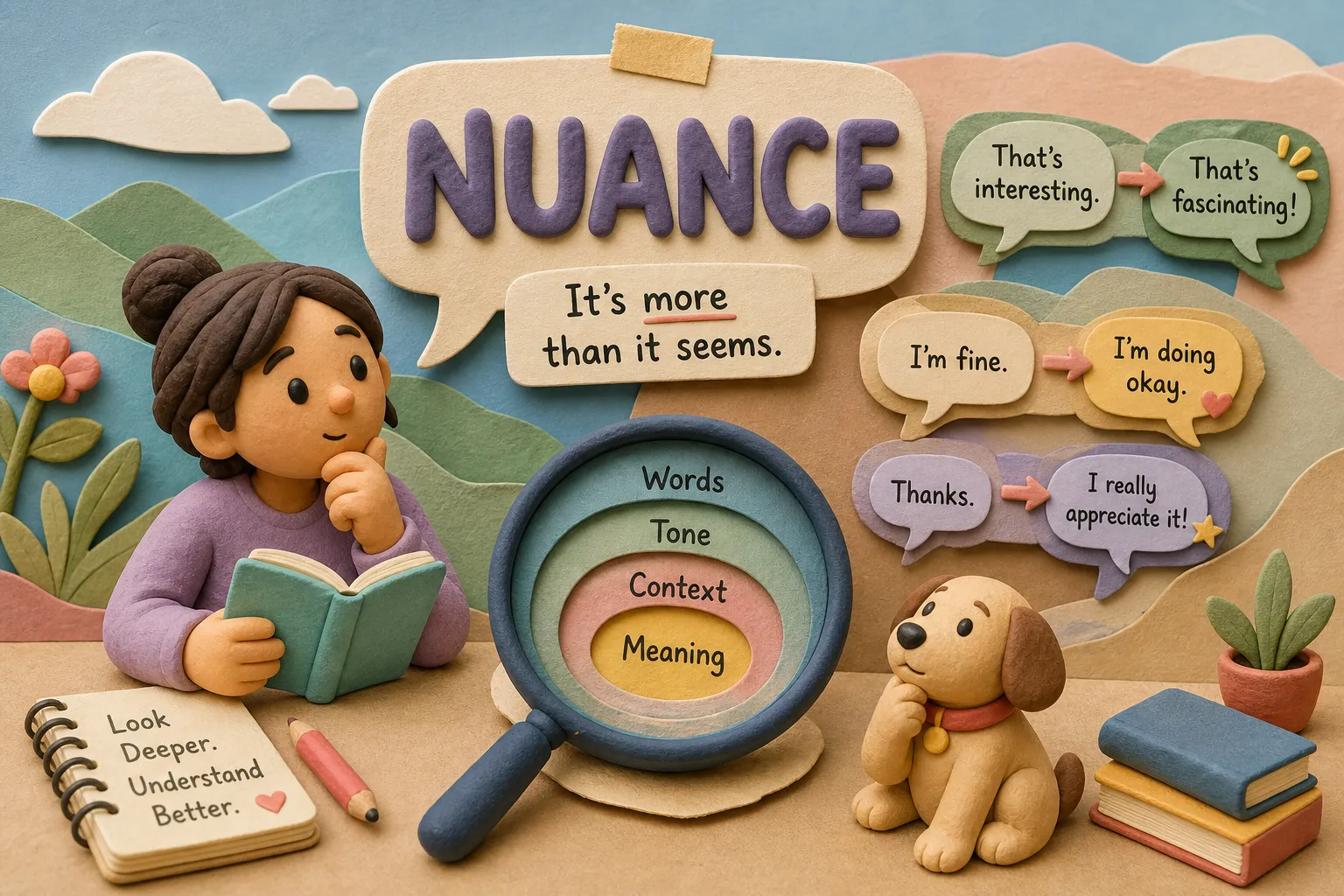
Merriam-Webster defines “nuance” as “a subtle distinction or variation” or “sensibility to, awareness of, or ability to express delicate shadings of meaning, feeling, or value.” Cambridge and Oxford align closely, defining it as a small, often important difference in meaning, feeling, or sound that isn’t immediately obvious. Put simply, nuance meaning comes down to the fine detail that changes how something is understood.
Learners often first encounter “nuance” as a vague, intellectual-sounding word used by academics or politicians. It isn’t. Once you understand it, you’ll spot it everywhere, in conversations about relationships, career decisions, and everyday word choices.
How to Say “Nuance” in American English
Here’s the pronunciation: /ˈnuː.ɑːns/, or in simple phonetic spelling, NOO-ahns. Some American speakers say NYOO-ahns; both are correct and natural. The word has two syllables, and the stress falls on the first one: NOO-ahns, not noo-AHNS. Over-stressing that second syllable is a common error, and it can sound slightly off to American ears.
From Noun to Adjective: What “Nuanced” Means
“Nuanced” is the adjective form, and you’ll hear it constantly. It means showing awareness of subtle differences, not black and white, not oversimplified. Compare these two sentences: “Her answer was simple and direct” versus “Her answer was nuanced.” The second tells you she thought carefully, considered multiple angles, and didn’t reduce a complex situation to one easy conclusion.
Why Nuance Matters More Than You Think in English
A sentence can be grammatically perfect and still land completely wrong. Native speakers don’t just respond to grammar; they respond to tone, register, and the emotional coloring of your word choices. This is the layer that grammar textbooks often skip entirely, and it’s exactly where most intermediate learners get stuck.
The Gap Between Correct and Natural
Consider this: “I want a coffee” and “I’d like a coffee” are both grammatically correct. But in a professional setting or when speaking to someone you’ve just met, “I want” can sound blunt or even rude. “I’d like” is warmer and more polished. No grammar rule tells you that. Only nuance does.
How Missing Nuance Creates Real Misunderstandings
Imagine you want to compliment a friend who lost weight. You say, “You look so skinny!” You meant it kindly, but in American English, “skinny” often implies being too thin, which can read as a criticism. “Slim” or “you look great” would land the way you intended. These aren’t grammar problems. They’re nuance problems, and recognizing that distinction is what starts moving your English from correct to natural.
Nuance Meaning vs. Subtlety, Connotation, and Shade of Meaning
These four terms are closely related, and even advanced learners mix them up. Here’s the clearest way to think about each one.
Nuance vs. Subtlety: Not the Same Thing
Nuance is the fine distinction itself. Subtlety is the quality of being understated or indirect; it describes how something is expressed, not the distinction itself. You might say, “The subtlety of her tone added nuance to an otherwise blunt statement.” Consider this scenario: a colleague delivers feedback in a measured, quiet voice rather than stating a criticism outright. She didn’t say anything harsh, but the way she said it changed the meaning. The nuance is what shifted; the subtlety is how it was delivered.
What Connotation Has to Do With All of This
Connotation is the emotional or associative coloring a word carries beyond its dictionary definition. It’s one of the main sources of nuance in English. Take “stubborn” and “determined.” Both describe a person who doesn’t give up or change their mind easily, same behavior, but “stubborn” carries a negative connotation (inflexible, unreasonable), while “determined” is positive (strong-willed, focused). Those different connotations create the nuance between the two words.
Shade of Meaning: A Near-Synonym Worth Knowing
“Shade of meaning” is nearly interchangeable with “nuance” in language discussions, and teachers and native speakers use it often. Here’s a quick reference to keep them straight:
- Nuance: the fine distinction or variation itself
- Subtlety: the quality of being delicate or understated in expression
- Connotation: the emotional or associative coloring a word carries
- Shade of meaning: a slight variation in meaning; nearly synonymous with nuance
Real American English Nuance Examples
The best way to internalize nuance is through real word pairs. Each pair below looks almost identical on the surface, but the social and emotional difference is significant.
Slim vs. Skinny: When a “Compliment” Isn’t One
“Slim” describes someone as toned and healthy-looking. It’s generally flattering and safe to use. “Skinny,” on the other hand, suggests being very thin, sometimes to an unhealthy degree, and can come across as critical even when you mean well. Picture this scenario: your friend has been working out for months and asks how they look. “You look so slim” is a genuine compliment. “You look so skinny” might make them worry you think they’ve gone too far.
Interested vs. Passionate: Degrees of Feeling
“Interested” means you’re curious or paying attention. “Passionate” means you’re deeply invested, emotionally committed, and driven. In a job interview, the difference matters enormously. “I’m interested in marketing” tells the interviewer you find it appealing. “I’m passionate about marketing” tells them it’s something you care about at a deeper level and have likely invested real time and energy into. One answer opens a door; the other walks through it.
Stubborn vs. Determined: Same Behavior, Opposite Judgment
This is one of the clearest nuance examples in American English. Both words describe a person who refuses to give up or change course. The difference lives entirely in the speaker’s attitude toward that person. If you admire someone, you call them determined. If you’re frustrated with them, you call them stubborn. The behavior is identical; what changes is the speaker’s judgment, not any factual difference in what the person did.
How to Train Yourself to Notice Subtle Differences in Meaning
Understanding nuance intellectually is one thing. Developing a genuine sensitivity to it takes practice. Here are strategies you can start using today.
Pay Attention to How Words Feel, Not Just What They Mean
When you learn a new word, find two or three near-synonyms and compare them directly. Ask yourself: What feeling does each one carry? Who says this, a friend, a boss, a stranger? In what situation? Try this with pairs like mad/angry, cheap/affordable, or curious/nosy. You’ll quickly notice that words you thought were interchangeable actually carry very different social weight.
Study With Material Built Around Real American Usage
Reading dictionary definitions alone won’t build nuance awareness, context is everything. You need to see words used in authentic conversations, cultural settings, and real situations. This is the core philosophy behind About, Your Daily American: every lesson goes beyond the textbook definition to show how words actually work in real American speech, who uses them, when, and why. That kind of context is what turns passive vocabulary into active, confident English.
Make It a Daily Habit
When you watch a show or read an article, flag moments where a slightly different word would change the tone. Keep a short “nuance journal” where you write down word pairs you notice and what makes them different. This doesn’t need to take more than five minutes a day. Short, consistent practice builds the kind of sensitivity that occasional intense study never does.
How to Use “Nuance” and “Nuanced” Correctly in Your Own Sentences
“Nuance” works as both a count noun and a noncount noun in English. As a noncount noun: “This topic requires nuance” or “She speaks with real nuance.” As a count noun: “There are nuances in this situation I didn’t notice at first.” A common error is treating “nuance” like an adjective, as in “It’s very nuance.” That construction doesn’t work. The word is a noun, and “nuanced” is the adjective you want.
Using “Nuanced” as an Adjective
“Nuanced” collocates naturally with words like argument, perspective, approach, analysis, and performance: “a nuanced argument,” “a nuanced perspective,” “a nuanced take on the situation.” One important note: “nuanced” doesn’t mean simply “complicated” or “confusing.” It emphasizes subtle, carefully considered distinctions, the idea that something has been thought through with attention to the fine differences that matter. In everyday speech, you might say, “His take on the situation was nuanced; he saw both sides clearly.” That’s exactly right.
Put It Into Practice Today
You can now define nuance, pronounce it correctly (NOO-ahns), recognize it in word pairs like slim/skinny and interested/passionate, and use both “nuance” and “nuanced” accurately in your own sentences. More importantly, you understand what nuance actually is: the fine detail that changes how language lands, the layer between correct and natural.
Understanding nuance meaning is what moves you from “good at English” to “natural in English.” It’s not about memorizing more words; it’s about understanding the weight each word carries. That shift changes everything about how you communicate.
Here’s your practice prompt: pick two words you already know that mean something similar, maybe “house” and “home,” or “confident” and “arrogant.” Think about the nuance between them and write one sentence for each that shows the difference in meaning or tone. For more lessons built exactly like this one, with real American context and cultural depth, explore the vocabulary and study skills content at Common American Expressions Every English Learner Should Know, Your Daily American.