By the end of this article, you’ll know exactly what “have a blast” means, when to use it, and how to say it naturally in real American conversations. You’ll also find practical alternatives organized by formality level, so you can always pick the right phrase for the right moment.
You’ll hear this expression before a weekend trip, after a birthday party, and in text messages between friends, yet most English classes never teach phrases like it. That’s the kind of gap that Your Daily American is built to close: real American expressions with real context, so you can speak naturally and confidently in everyday life.
This article covers the meaning, real conversation examples, grammar patterns, formality level, alternatives, and common mistakes. Read it once, practice the examples, and you’ll be ready to use this expression today.
What “have a blast” really means
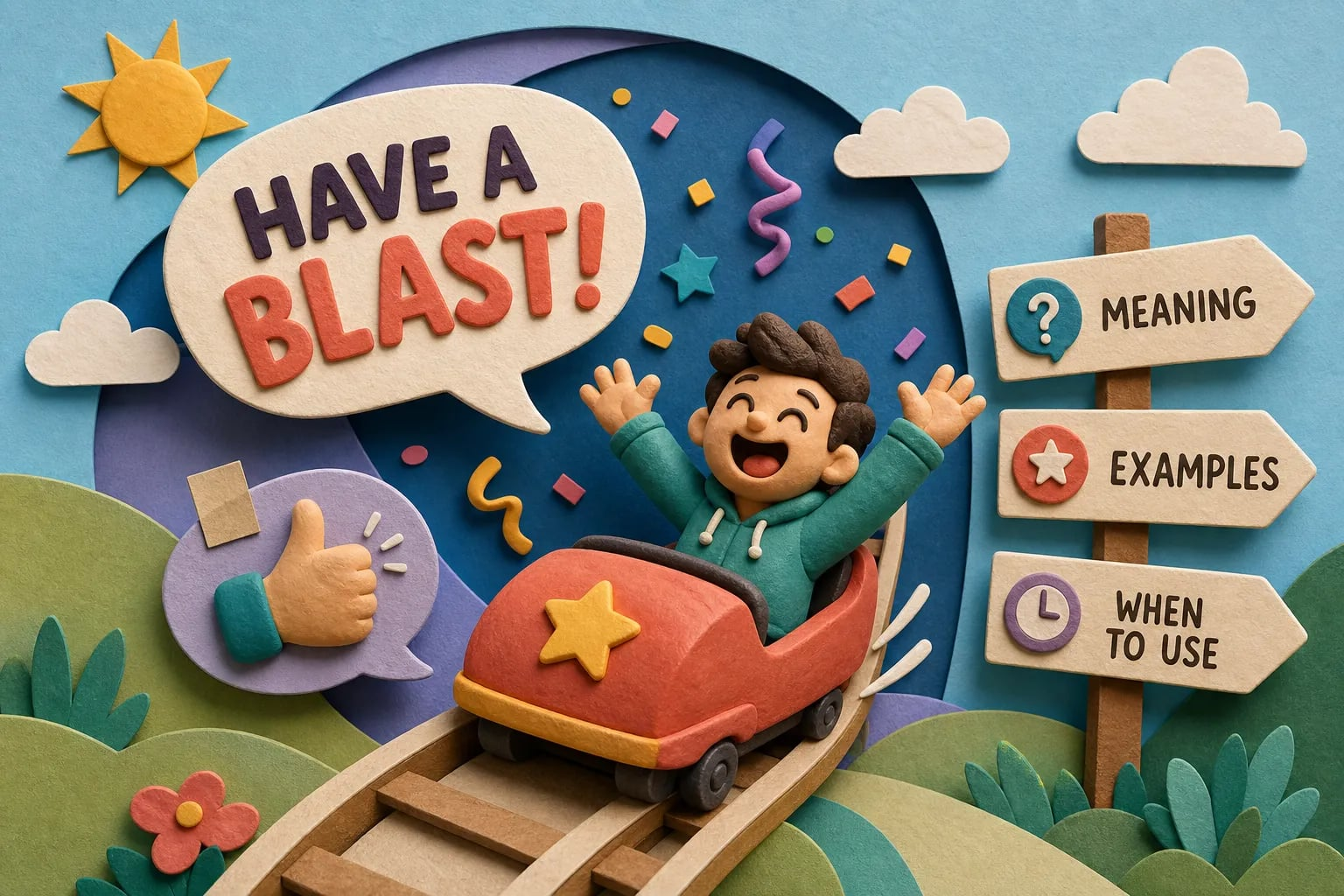
“Have a blast” means to have a very fun and enjoyable time. Native speakers use it to describe a specific event or experience they truly loved, a party, a road trip, a night out with friends. A few quick examples show the range:
- “We had a blast at the game last night.”
- “I had a great time on my trip to New York, absolute blast.”
- “The kids are having so much fun at the pool.”
The phrase is always positive and enthusiastic. When someone uses it, they mean the experience was genuinely great, not just “okay” or “fine.”
Pronunciation note: In careful speech, the phrase sounds like /hæv ə blæst/. In natural, connected American English, it reduces to something closer to “həv uh BLAST”, the vowel in “have” weakens to a schwa, and the stress lands squarely on “blast.” Most native speakers say it this way in everyday conversation. If you want to hear different examples, you can listen to native speakers pronouncing “have a blast” on Youglish.
The literal word “blast” vs. the idiomatic phrase
Literally, “blast” means an explosion, a rush of air, or a loud noise (see the Cambridge definition of “blast”). In this phrase, it works as a picture of pure energy and excitement, think of it as an “explosion of fun.” The word suggests something powerful and memorable, and that same energy carries over to describe a great time. Once you see the connection, the phrase makes perfect sense.
Where this expression came from
Most sources trace “have a blast” to the United States around the 1950s, when American slang was expanding rapidly. What began as a casual regional expression gradually spread, and the phrase is now widely recognized across many English-speaking regions, particularly where American English has a strong cultural influence. It remains common in casual and social contexts today, though, as you’ll see below, it doesn’t belong in formal professional or academic writing.
The phrase in real American conversations
Native speakers use this expression across many social situations. The short dialogs below show how it sounds in real life, each one using a different verb tense so you can see the grammar working in context.
At a party or celebration
Maya: “Hey! How was Jamie’s birthday party?” Carlos: “Oh, it was so much fun! The music was great and we stayed until midnight.” Maya: “I knew it would be fun!”
In natural follow-up, Carlos might also say “We had a blast”, the past tense form is the most common way to describe an event that just ended.
On a trip or vacation
Tom: “How was your weekend in Chicago?” Sara: “We had a blast. We walked along the lake, tried great food, and just relaxed.” Tom: “That sounds amazing.”
Past-tense storytelling is the expression’s natural home. People reach for it when sharing travel experiences with coworkers or friends back home, it packs a lot of enthusiasm into three short words. Notice also that Sara drops any extra explanation; the phrase does the emotional work on its own.
Before a fun event
Jake: “Are you nervous about the concert tonight?” Priya: “A little.” Jake: “Don’t be. You’re going to have a blast.”
“You’re going to have a blast” is a warm, encouraging phrase. Speakers use the future tense to build excitement for a friend before an experience they haven’t had yet.
How to build sentences with this phrase
Many learners understand what a phrase means but aren’t sure how to use it in different tenses. This section shows you exactly how the grammar works.
Tense forms
The expression works in all three main tenses:
- Past: “We had a blast at the concert.”
- Present progressive: “She’s having a blast at summer camp.”
- Future: “You’re going to have a blast.”
Remember that “have” changes with the subject, “he has a blast,” “she had a blast.” And always keep the article “a” in the phrase. Leaving it out is one of the most common mistakes learners make.
Short forms and natural variations
Two shorter forms turn up constantly in spoken American English. “It was a blast” drops the full verb phrase entirely, while “That was such a blast” adds warmth and emphasis. They cover slightly different emotional registers, but both sound natural and relaxed.
You can also add intensifiers to push the enthusiasm higher. “We had an absolute blast” and “I had a total blast” both sound very natural, those extra words signal to the listener that you didn’t just enjoy yourself, you really, deeply had a great time.
When the phrase fits, and when it doesn’t
“Have a blast” is a casual, informal expression. It sounds perfect in some situations and out of place in others. Knowing the difference helps you sound both natural and professional.
Where it sounds natural
This phrase fits well in everyday social situations: conversations with friends and family, text messages and social media captions, friendly chats at work before a holiday, and casual emails between people who know each other well. If your coworker is heading out for vacation, saying “Have a blast on your trip!” sounds warm and genuine.
It works equally well in spoken conversation and informal writing. A social media caption like “Had a blast in Miami this weekend!” is completely natural and common.
Contexts where a different phrase works better
The expression is too informal for business reports, formal speeches, or academic papers. The contrast is easy to spot:
- Informal text to a friend: “Have a blast at the festival!” ✓
- Professional email to a client: “I hope you enjoy your time at the conference.” ✓
The second sentence is clear and professional. Using casual slang in a formal context can give the wrong impression, so always read the room before choosing your phrase.
Natural alternatives organized by formality
The right alternative depends on how casual or emphatic you want to sound. These options are grouped so you can find the phrase that fits the moment.
Casual alternatives (everyday conversation)
These phrases are close in meaning and work well in daily life:
- Have a ball: “We had a ball at the wedding.”
- Have fun: “Have fun at the party tonight!”
- Have a good time: “I hope you have a good time.”
- Enjoy yourself: “Go out and enjoy yourself this weekend.”
- It was a good time: “It was a good time. We should do it again.”
Emphatic alternatives (for extra excitement)
Reach for these when an experience was truly unforgettable:
- Have the time of your life: “You’ll have the time of your life in Hawaii.” (For more examples of this kind of emphatic phrase, see the lesson on similar expressions at Espresso English:phrases like “have the time of your life”.)
- Live it up: “We lived it up on our last night in the city.”
- I loved every second: “I loved every second of that concert.”
- It was an incredible time: “It was an incredible time. I’m still smiling.”
Neutral and slightly formal alternatives
These work well in semi-formal settings, like a message to a boss or a professional contact you don’t know very well:
- Have a great time: “I hope you have a great time at the event.”
- Have a wonderful time: “Have a wonderful time on your trip.”
- Really enjoy yourself: “I hope you really enjoy yourself this weekend.”
- I thoroughly enjoyed it: “I thoroughly enjoyed the experience.” (Best for formal written communication.)
Common mistakes and how to avoid them
Grammar and usage mistakes to watch for
Three errors come up most often among learners:
- Missing the article “a”: ✗ “I had blast at the party.” ✓ “I had a blast at the party.” The phrase always needs that article. Without it, the sentence sounds incomplete and unnatural.
- Using it in formal writing: ✗ (in a work report) “The team had a blast at the annual summit.” ✓ “The team thoroughly enjoyed the annual summit.” Always check the formality level before choosing this expression.
- Overusing it: In natural speech, people mix many phrases when describing good experiences. If the expression appears in every other sentence, it starts to sound repetitive. The alternatives listed above are there precisely to help you vary your language.
Confusing this phrase with similar-sounding expressions
Occasionally learners mix up idioms that share a word or a rhythm but mean something completely different. “Take a shot,” for example, means to try something or to drink a small amount of alcohol. “Make a scene” means to behave badly and attract public attention. Neither is related to having a good time. Context is your best guide, pay attention to the situation and the words around any unfamiliar expression, and the meaning usually becomes clear.
Where to keep learning American expressions like this one
Your Daily American publishes lessons on dozens of everyday American English phrases, just like this one. Each lesson covers the meaning, real examples, cultural context, and clear usage tips. If you want to build your vocabulary one expression at a time, the next lesson is waiting for you. For another native-English perspective specifically on this phrase, check out All Ears English’s lesson on “have a blast”.
Try it yourself: Think of something fun you did recently. Write one full sentence using the past tense form of this expression. Then write a second sentence using one of the alternatives above. Even one minute of writing practice makes a real difference in how quickly a new phrase sticks.
Using this expression with confidence
“Have a blast” means to have a very fun and enjoyable time. It’s casual and enthusiastic, and it works in past, present, and future tenses. You now have more than a dozen alternatives organized by formality, so you can always find the right phrase for the right moment.
Use the expression freely the next time you talk about a party, a trip, or a fun weekend. When the situation calls for something more formal or more emphatic, you know exactly which alternative to reach for.
This is one of many expression lessons available at Your Daily American . Each one is built the same way: a clear meaning, real examples, and practical tips you can apply right away. Come back for your next lesson on essential phrasal verbs and keep building your American English, one phrase at a time.
Also, if you’re working on natural spoken English and want practice with short conversational patterns, our guide to Filler Phrases Every American English Learner Should Know can help you sound more fluent and natural.