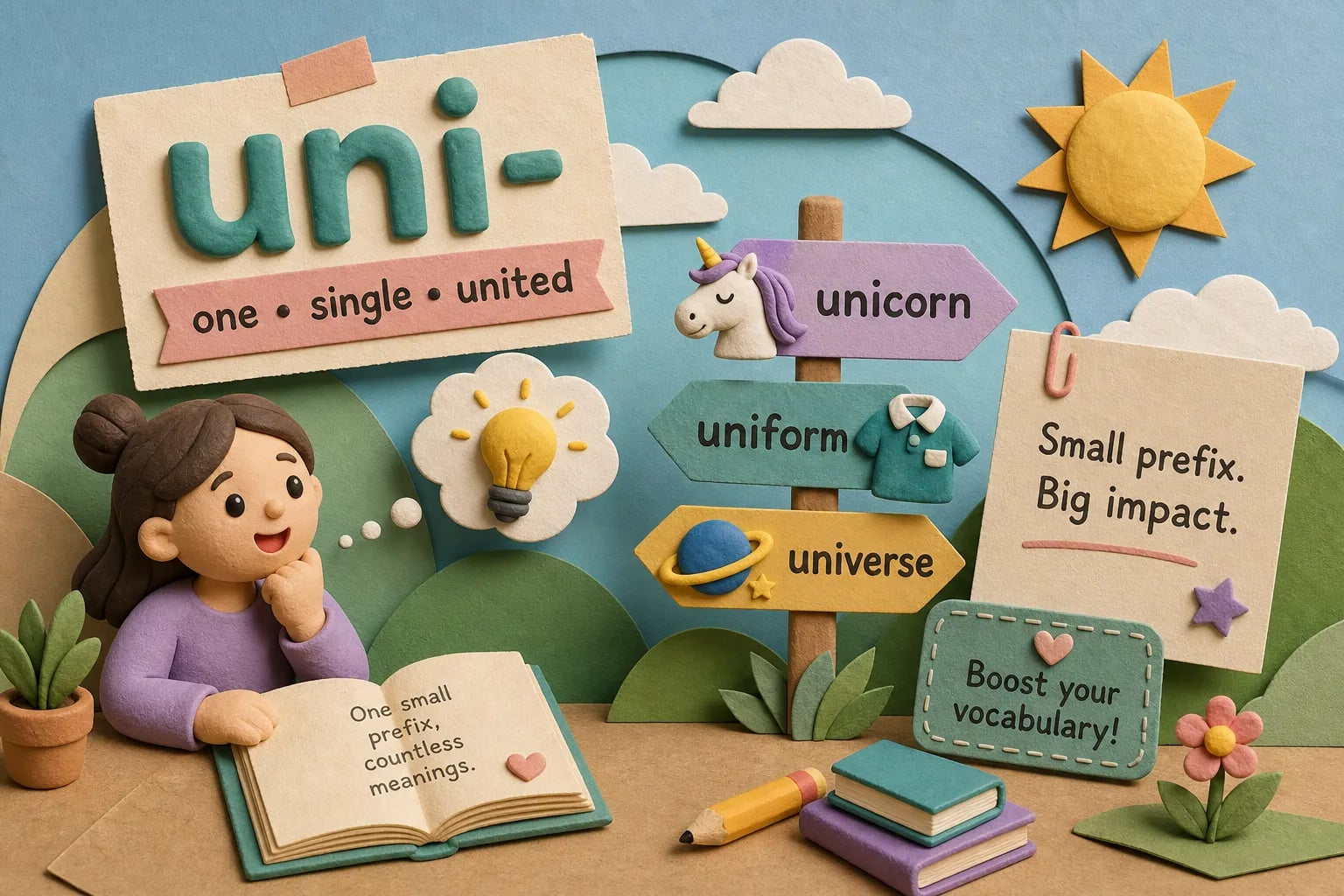
What do a unicorn, a university, and a unilateral business decision have in common? They all start with the same Latin piece: uni-, which means “one.” Understanding the uni prefix is one of the most efficient things you can do for your English vocabulary, because that one small piece is doing a lot of work across the language, and once you see it, you’ll notice it everywhere.
By the end of this article, you’ll recognize the uni prefix in words you’ve never studied and use a solid set of uni- words correctly in everyday American English. At Your Daily American, this is how vocabulary is built: not word by word, but by understanding the patterns behind the language. This article is that approach in action.
What the uni prefix means and where it comes from
The Latin root behind “one”
The uni prefix comes from the Latin word unus, meaning “one” or “single.” That Latin word itself traces back to an even older source: the Proto-Indo-European root *oi-no-, the ancient ancestor of “one” across many European languages. If you speak Spanish, French, Portuguese, or Italian, you already know this root. The words uno, un, and uma all come from the same place, which makes the prefix instantly familiar for many ESL learners. For a concise etymology of the prefix, see Etymonline’s entry for “uni-“, and for a learner-friendly root overview check Membean’s root page for uni- (“one”).
When did it enter English?
Words like universe and unicorn arrived in English in the late 1300s, borrowed from Latin and French. The prefix became truly productive in English, meaning it was used to form brand-new English words, during the 1800s. That’s when words like unicycle appeared. The prefix has a long history, but most of the words you’ll use today came through centuries of borrowing and gradual adoption.
How to say uni prefix words correctly
The “yoo” sound you need to get right
When uni- functions as a prefix (in words derived from the Latin unus), it is pronounced with a “yoo” sound at the start, like the word you. In IPA, that’s /juː/. It is not “oo” (like food) or “uh” (like under), that “uh” sound belongs to the separate negating prefix un-, as in undo or unhappy. For a focused explanation of the negating un-, see Un- prefix: The Simplest Way to Expand Your Vocabulary. So uniform is “YOO-ni-form” and unity is “YOO-ni-tee.” A simple way to practice: say “you” and add the rest of the word directly after.
One word that behaves a little differently is unique. The stress falls on the second syllable, and the “-ni-” uses a long “EE” sound: yoo-NEEK (/juˈniːk/). Most other common uni- words use a short “ih” sound in the middle syllable: YOO-ni-form, YOO-ni-verse, YOO-ni-ty. If you want extra help hearing the difference in connected speech, watch this clear pronunciation guide from Rachel’s English: Rachel’s English: uni- prefix pronunciation. If you want to double-check stress patterns, Merriam-Webster’s free online dictionary includes audio pronunciation for every entry.
One article rule ESL learners often miss
Because university starts with a “yoo” sound (which is a consonant-like sound, not a vowel sound), the correct article is “a university,” not “an university.” ESL teachers and writing guides consistently flag this as a common mistake at all levels, including among advanced learners. The rule for choosing “a” or “an” is based on the sound that follows, not the letter. The same applies to these words:
- a uniform
- a united front
- a unique opportunity
If you see a word starting with the letter u that makes the “yoo” sound, use “a” in front of it.
Uni prefix words you already use in everyday life
The words that show up in daily American English
The words below are common in everyday American English, you’ll encounter them regularly in conversation, reading, and listening. Study the example sentences carefully. Notice how the meaning of “one” or “single” is always present, even when it’s not obvious at first. For longer lists of uni- words and quick lookup, see this curated list of words starting with “uni-” and ending with “-e”.
- unit: a single part of something larger. “Each lesson is one unit of the course.”
- unique: the only one of its kind. “Her way of explaining grammar is unique. I’ve never heard it described that way before.”
- union: a group of people joined together for a shared purpose. “The teachers’ union is meeting on Friday to discuss salaries.”
- unity: the state of being together as one. “The coach’s speech focused on team unity before the final game.”
- uniform: clothing that makes everyone look the same. “You have to wear a uniform at that job. No exceptions.”
- universe: all existing matter, space, and time. “The physics department studies the origins of the universe.”
- university: an institution for higher education. “She started university in the fall and loves her program.”
- unicorn: a mythical horse with one horn, or in business English, a startup company worth over one billion dollars. “That app became a unicorn in less than three years.”
- unicycle: a vehicle with one wheel. It’s a clear example of the uni prefix at work: one wheel, one rider.
How the “one” meaning shows through
In every one of these words, the idea of “one” or “single” is present. A union brings different people into one group. Unity is the state of being one. A uniform makes everyone look the same, one appearance for an entire team or organization. Once you see this pattern, the words stop feeling like separate vocabulary items and start feeling like variations of the same idea.
Why “unisex” doesn’t mean what you might expect
The “one” that actually means “for everyone”
This is where learners sometimes get confused. If uni- means “one,” does unisex mean “only one sex”? It doesn’t. Unisex means “one shared category for both men and women.” A unisex bathroom is a single facility that everyone uses. A unisex jacket is designed so that both men and women can wear it comfortably.
The same “unified” logic appears in other words. Unison means everyone doing something at the same time, as one. “The choir sang in perfect unison.” University originally meant “a single institution covering all areas of learning.” In each case, uni- points to one shared thing, not one exclusive thing.
How to think about this without getting confused
Here’s a simple thinking strategy: when you see the uni prefix, ask yourself, “What is the ONE thing here?” In unisex, the one thing is the single shared category. In unicycle, the one thing is the one wheel. In unity, the one thing is the single group or feeling. This question works for nearly every uni- word you’ll encounter, and it helps you work out meaning without memorizing a separate rule for each word.
Uni prefix words you’ll hear in professional American English
Vocabulary for meetings, emails, and business conversations
The uni prefix shows up often in workplace English, especially in written communication and formal speech. These words are worth learning if you work in an American company or communicate with U.S. clients.
Unify / unified (to bring together as one; already brought together): “The new policy unified the team’s approach to customer service.” You’ll hear unified in presentations and reports, and it works naturally in both spoken and written professional English. Unification (the process of making separate things into one) takes that same idea a step further: “The unification of the two departments took six months and required careful planning.” This word appears often in corporate emails and strategy documents.
Unilateral (done by one side only, without agreement from others): “The manager made a unilateral decision without consulting the team.” This is a C1-level word, you’ll see it more in writing and news than in casual conversation. Unison (everyone acting or speaking together at the same time) can be literal or figurative: “The board voted in unison to approve the new budget.”
A note on formality register
Register means the level of formality in language. Unified and unify work well in both spoken and written professional English. Unilateral sounds more formal and appears more often in reports, news articles, and business writing than in everyday conversation. Paying attention to register helps you choose the right word for the right situation.
Why learning one prefix is smarter than learning one word at a time
The case for pattern-based vocabulary building
If you learn the word uniform today, you know one word. But if you understand that the uni prefix means “one,” you can work out the meaning of unify, unity, unified, unification, and more without studying each one separately. Language researchers have found that the brain stores words in connected groups rather than as isolated entries, so learning a prefix activates an entire cluster at once.
This approach also helps with words you’ve never seen before. If you read unicameral for the first time in a political article, you can figure out that it describes a legislature with one chamber, even without a dictionary. That kind of independent reading skill is a sign of real progress.
How Your Daily American is built around this idea
About, Your Daily American organizes vocabulary into meaningful patterns and categories rather than random word lists. Learners who understand prefixes, roots, and contexts make faster progress because each new word connects to something already known. There’s a learning method called active recall, basically, trying to remember something before you check, and it works surprisingly well for building retention. Try it now: after reading this article, find one more uni- word you haven’t seen before and work out its meaning using the uni prefix before you look it up.
What you can do with this now
The core takeaway is straightforward. The uni prefix comes from the Latin unus, means “one” or “single,” and appears in some of the most useful words in American English. Knowing its pronunciation (always “YOO” at the start) and its core meaning lets you decode new vocabulary without opening a dictionary every time.
The uni prefix is also part of a larger family. Prefixes like bi- (two), tri- (three), and multi- (many) follow the same pattern-based logic. Each one you learn opens up a new group of words, and those groups connect to each other. That’s how vocabulary grows, not one word at a time, but in clusters. For more on how prefixes and suffixes unlock vocabulary, see Prefixes and Suffixes: Unlock Thousands of English Words.
Pick one word from this article and write a sentence you’d actually say out loud, a work situation, a class, a daily conversation. Share it with a language partner or write it in your study notes. Then visit About, Your Daily American to explore more vocabulary lessons built on the same pattern-based approach. The uni prefix is just the beginning. Words taught in context stick, and these will too.