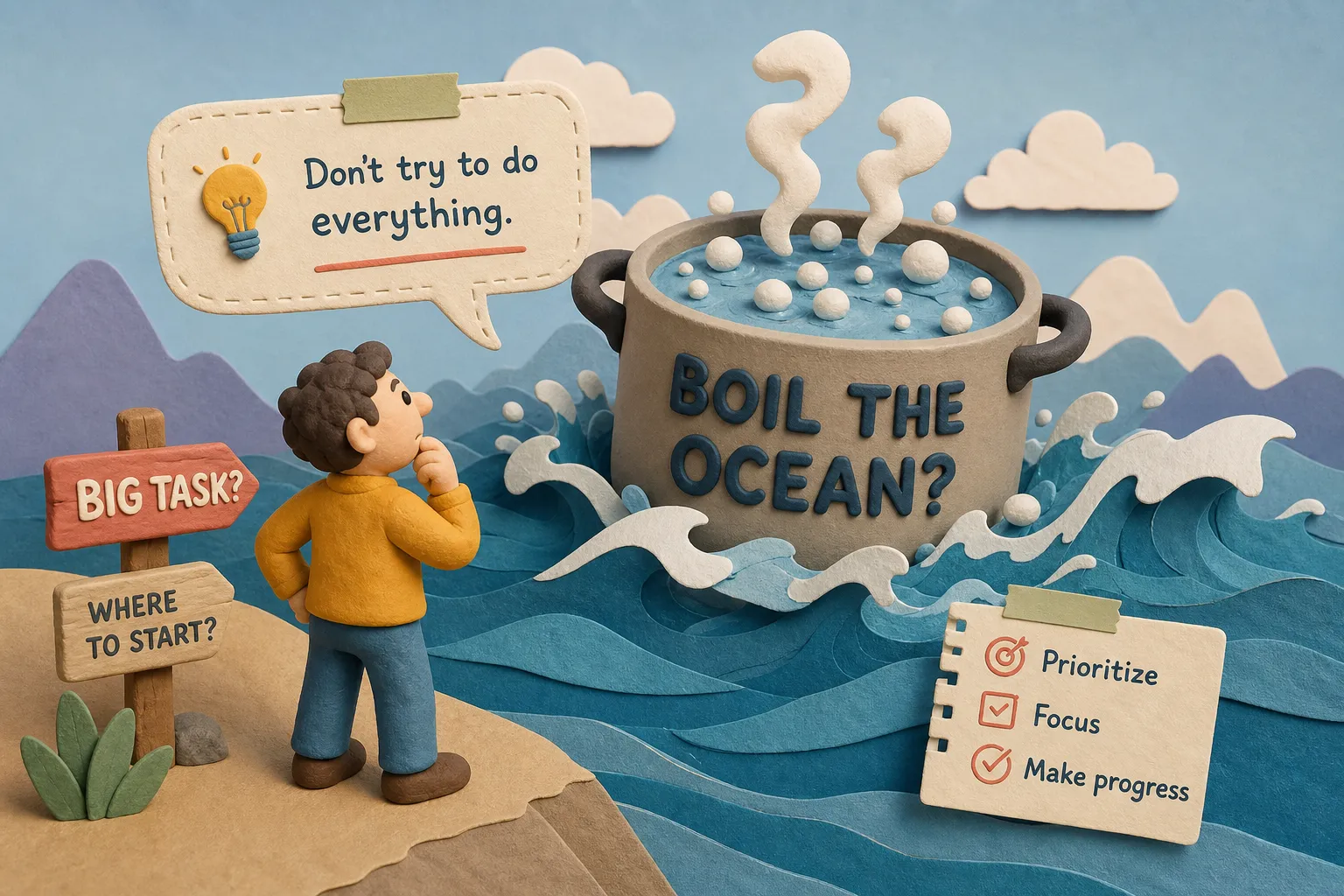
Picture this: you’re in a meeting. Your team has just presented a bold new plan, and there’s energy in the room. Then a senior colleague leans back and says, “I love the ambition here, but let’s not boil the ocean.” Everyone nods. You smile and nod too. But inside, you have no idea what just happened. Was that a compliment? A warning? A polite way of saying the plan is terrible?
This kind of figurative language is everywhere in American workplaces. It shows up in strategy calls, planning sessions, and casual hallway conversations. If you don’t recognize it, you can miss the entire point of what someone is telling you. By the end of this article, you’ll know exactly what “boil the ocean” means, where it probably comes from, and what to say when you hear it at work.
What “boil the ocean” actually means
Start with the mental picture. Imagine you have a pot. Now imagine trying to use that pot to heat every single drop of water in the Pacific Ocean. It’s not just very difficult, it’s impossible. No amount of effort or time would ever get the job done. That’s the image this phrase uses.
In a business conversation, the phrase means a plan or project is too large, too complex, or too unfocused to realistically succeed. It describes the kind of overly ambitious strategy that tries to do everything at once: reach every customer, launch every product, and solve every problem in a single effort. Here’s a typical example sentence: “We can’t do that here. Let’s pick the three markets that matter most this quarter and focus there.” For an additional concise business definition, see WallStreetMojo’s explanation.
For pronunciation, say it like this: “boil the OH-shun.” The stress falls on “boil” and “OH.” In natural conversation, native speakers often run the words together so it sounds like one smooth phrase rather than three separate words.
One important cultural note: this phrase is a gentle redirect, not an attack. In many American workplace settings, figurative language serves as a way to soften direct criticism. When a colleague says “let’s not boil the ocean,” they’re not saying your idea is stupid. They’re saying the scope is too wide and needs focus. The tone is practical, not harsh.
Where the phrase comes from
The most popular story connects the phrase to Will Rogers, an American comedian and social critic from the early 20th century. According to the story, someone asked him how the U.S. should deal with German submarines during World War I. Rogers reportedly said: “Boil the ocean.” When asked how, he answered: “I’m just the idea man.” It’s a funny image of a wildly impractical suggestion made by someone who doesn’t have to do the actual work.
However, this story is not confirmed. No one has found a direct record of Rogers saying it. Other names that appear in these stories, including Mark Twain, are also unverified. The Cambridge Dictionary documented the phrase in business use by 2014, though research suggests it was in use for several decades before that. For another concise reference you can consult Investopedia’s definition. The honest answer is that no one knows exactly who said it first. What we do know is that the image works. It’s vivid, a little absurd, and immediately clear, which is exactly why it stuck.
When and why Americans say “boil the ocean” at work
You’ll hear this phrase most often during planning or strategy sessions. A team presents a large-scale project with ten goals, four product launches, and a new market entry, all in the same quarter. Someone raises their hand and says, “I think we’re boiling the ocean here. Can we narrow this down?” That’s the phrase doing its job: slowing things down and asking the team to focus. For a practical take on prioritizing initiatives, see Don’t Boil the Ocean.
It also appears as a response to a single ambitious proposal. One person suggests something very large in scope, and another uses the phrase to pump the brakes. It’s not a “no.” It’s usually a “yes, but smaller.” The phrase invites the team to ask: what’s the most important piece? Where should we start?
Experienced professionals also use it as a self-check. You might hear someone say, “Wait, are we boiling the ocean here?” when they catch their own team drifting toward an over-complicated plan. Using the idiom this way signals that you think carefully about scope and resources, not just ideas, and that kind of awareness tends to register with colleagues.
How to respond when someone says “boil the ocean”
If the feedback is fair, the best move is to agree and immediately offer a more focused version of the plan. You don’t need to defend the original scope. Just show that you can adapt. These phrases work well in that moment:
- “You’re right. Let’s start with just one market and build from there.”
- “Fair point. What if we focused on X first and revisited the rest next quarter?”
- “Good call. Let me come back with a tighter version of this.”
These responses show two things: you heard the feedback, and you can think on your feet. That combination makes a strong impression in any meeting.
When the broader scope is genuinely necessary
Sometimes a large-scale approach is justified. If you believe the full scope is warranted, don’t defend your ambition in general terms. Instead, explain the specific reason the pieces need to work together. Try something like: “I hear you, but here’s why we need all three components to launch at the same time.” Then give a clear, concrete reason, a number, a dependency, or a risk. Avoid sounding defensive. Let the reason do the work.
Seeing it play out in a real conversation
Here’s a short dialogue that shows how this can sound in an actual meeting:
Manager: “This is a great vision, but I feel like we’re boiling the ocean.”
You: “That’s fair. What if we launched with just the enterprise tier first, tested our assumptions, and then expanded?”
Manager: “Now we’re talking.”
Notice that the response is specific. It doesn’t just agree in general, it offers a concrete alternative. That’s what makes it effective.
Related phrases you’ll hear in the same conversation
“Bite off more than you can chew” carries the same core message: you’re taking on more than you can handle. The difference is that “boil the ocean” focuses on the impossibility of the task itself, while “bite off more than you can chew” focuses on a person’s capacity. Both phrases signal the same problem, but the ocean idiom tends to appear more in business and strategy discussions, while “bite off more than you can chew” is more common in everyday conversation.
Filler phrases like “move the needle,” “circle back,” or “peel the onion” can also appear in these meetings and carry related meanings.
Scope creep is a more technical term from project management. It means a project slowly grows larger than its original plan, often without anyone noticing until it becomes a serious problem. If someone says “we need to watch for scope creep,” they’re warning that the project is quietly expanding and needs to be controlled. For practical project-management guidance on how to avoid scope creep, see this overview on how to avoid scope creep. Scope creep is the slow version of the same overreach in business: the difference between jumping into a massive project all at once versus letting a manageable one drift into an unmanageable situation over time.
A few other phrases signal the same idea in American workplace English:
- “Let’s keep it focused.”
- “What’s the MVP here?” (MVP = minimum viable product, meaning the simplest version of the idea that still works)
- “Let’s not overcomplicate this.”
Recognizing this family of phrases is a real fluency skill. When you hear any of them, you know the conversation is shifting from big ideas to practical limits. That shift is a critical moment in any American business meeting, and following it means you’re tracking the conversation at a native level.
Where to keep building your American business English
Business idioms don’t appear in grammar textbooks. They live in strategy calls, Slack messages, and quick conversations between meetings. Many intermediate English learners have strong grammar but feel lost the moment a meeting fills with filler phrases like “move the needle,” “circle back,” or “peel the onion.” These expressions have nothing to do with their literal words, and that gap can make a confident speaker feel unsure in professional settings.
That’s exactly the gap that Your Daily American is built to close. The platform teaches real American English as it’s actually used: in offices, on video calls, and in daily life. Each lesson gives you not just the meaning of a phrase, but the context around it, when people say it, why they say it that way, and what the right response looks like. That’s the level of understanding that moves you from following a conversation to actually participating in it with confidence.
If you want to stop guessing at phrases and start using them naturally, take the free proficiency test on Your Daily American. It takes about 15 minutes and gives you a clear picture of where you stand and what to focus on next.
Now you know what to say
“Boil the ocean” is a polite, practical American way of saying: this plan is too big, let’s focus. It’s not criticism. It’s a redirect. Now you know the meaning, the disputed origin, the typical settings where it appears, and exactly how to respond, whether you agree or want to push back.
The next time you hear this phrase in a meeting, you won’t freeze. You’ll recognize the signal immediately: it’s time to narrow the scope and get specific. You’ll know what the room expects to hear next, and you’ll be ready to say it. That kind of confidence doesn’t come from memorizing a list of idioms. It comes from understanding the context behind them, one phrase at a time.