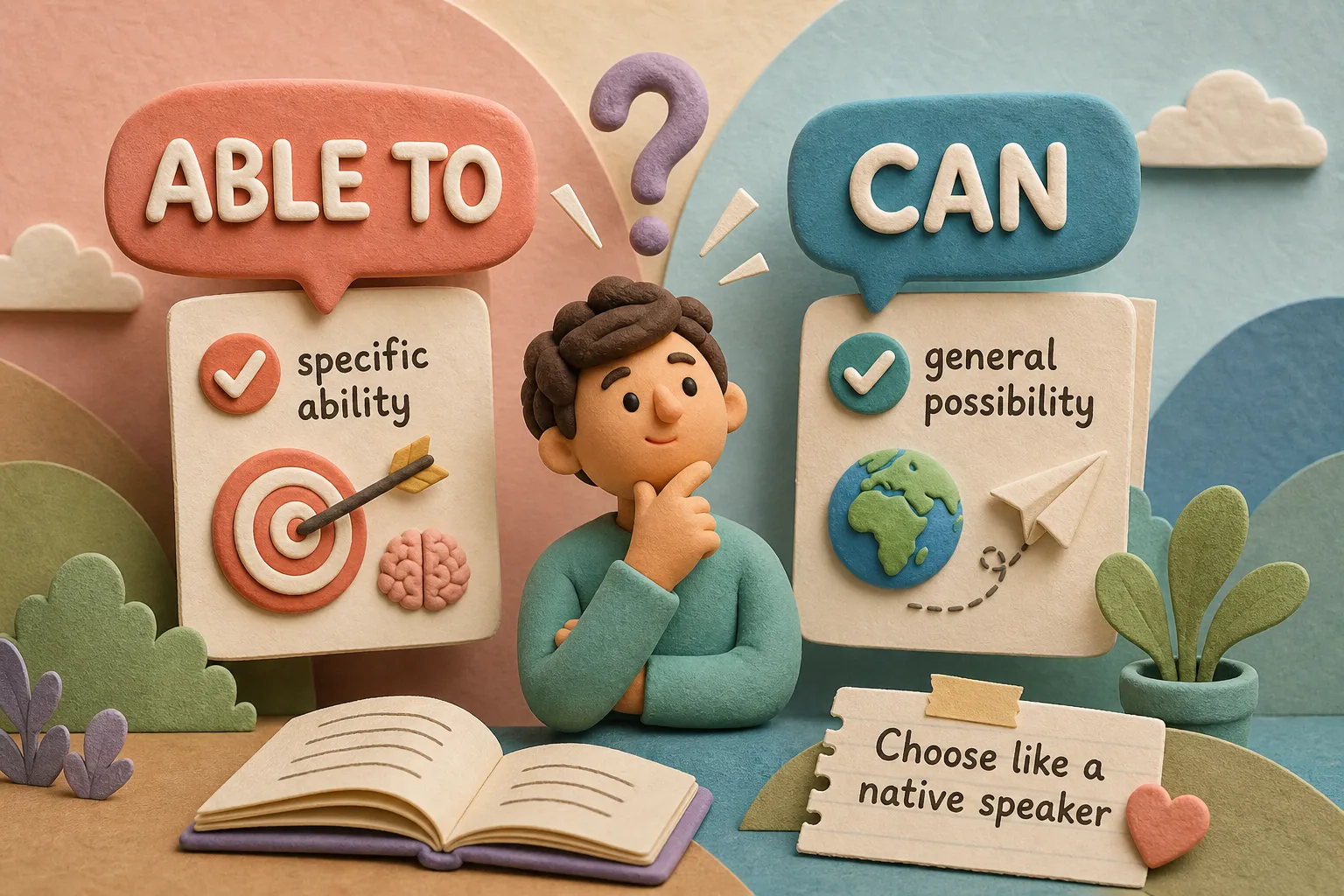
Both “can” and “able to” express ability. And because they overlap so much, many learners treat them as completely interchangeable. The problem isn’t grammar. It’s naturalness.
When you say “I am able to help you” to a coworker, you’re grammatically correct. But a native speaker would say “I can help you” without a second thought. The first sentence sounds formal, even a little stiff. The second sounds like a real person talking. That difference, correct vs. natural, is exactly the kind of gap this lesson is designed to close.
By the end of this lesson, you will know when to use “can,” when “able to” is the stronger choice, and why mixing them up can make your English sound translated even when your grammar is perfect.
Why “can” is the natural default in everyday speech
What “can” actually covers
“Can” is a modal verb, a helping verb that expresses ability, permission, or possibility. It covers three things in everyday American English: ability (“I can swim”), permission (“You can leave early”), and possibility (“This can happen to anyone”). One short word handles all three jobs, which makes it remarkably flexible in conversation.
How native speakers use “can” in real conversation
Here are three short dialogues. Notice how “can” sounds completely natural in each one.
At a café:
Customer: “Can I get a medium latte?”
Barista: “Of course! Can you give me your name?”
At work:
Alex: “Can you help me with this report?”
Maya: “I can look at it after lunch.”
Talking about skills:
Friend: “I didn’t know you could play guitar.”
You: “Yeah, I’ve been playing for three years.”
Now try replacing “can” with “able to” in those same lines. “Are you able to help me with this report?” works grammatically. But it sounds like a formal email, not a conversation with a coworker. The meaning stays the same; the tone shifts completely.
The speed rule
In fast, natural American speech, “can” is shorter and easier to say. It also contracts: “I can’t do that” flows smoothly. “I am not able to do that” doesn’t contract, and it adds three extra syllables. Native speakers gravitate toward the simpler, faster option in conversation. According to usage studies of spoken American English, “can” strongly dominates casual speech, and its efficiency is a big reason why. You can read more about how “can” functions in grammar on the Cambridge Dictionary’s grammar page on “can”.
When “able to” is the better, more natural choice
Formal writing and professional communication
“Able to” fits naturally in written English: emails, cover letters, reports, and formal requests. It signals a more deliberate, professional tone. Compare these two versions of the same idea:
- Spoken, casual: “I can attend the meeting.”
- Written, formal email: “I am able to attend the meeting on Thursday.”
Both are correct. The register, the level of formality, is what differs. In a job application, “I am able to lead cross-functional teams” sounds more polished and deliberate than the casual alternative. Context determines which one fits better.
Emphasizing achievement or a specific result
When you want to show that something was accomplished after effort or difficulty, “able to” carries more weight. Compare: “After six months of practice, she was able to give the entire presentation in English.” That sentence emphasizes the achievement. “She could give the presentation in English” is flatter, it sounds like a general skill, not a real accomplishment. When the result matters, “able to” is the stronger choice.
After certain grammatical structures
Some verbs require “able to” because “can” simply cannot follow them. You cannot say “seem can” or “feel can.” You have to say “seem able to” and “feel able to.” Here are two clear examples:
- “She seems able to handle the pressure well.”
- “He doesn’t feel able to continue right now.”
You don’t need to memorize a list. Just notice the pattern: after linking verbs like “seem,” “appear,” and “feel,” use “able to.” Your ear will start to recognize when “can” just doesn’t sound right.
The tense gap: where “able to” fills in for “can”
Why “can” runs out of tenses
“Can” primarily works in the present tense. It has no infinitive form and no perfect tense form of its own. This is not a flaw, it is just how modal verbs work in English. (Note: “can” can also appear in certain future contexts, such as “I can help tomorrow,” but it doesn’t work across all tenses the way “able to” does.) Once you understand this tense limitation, a lot of confusion disappears. The British Council’s grammar reference for can and could explains modal verb limitations and useful comparisons in learner-friendly detail.
Future and perfect forms in real sentences
These four forms come up regularly in real American speech and writing. Knowing them builds genuine fluency, not just textbook grammar.
- Future: “I will be able to help you after the meeting.” (not “I will can help you”)
- Present perfect: “She has been able to work from home this year.”
- Infinitive: “It’s nice to be able to sleep in on weekends.”
- Past perfect: “He had been able to finish before the deadline.”
These are not unusual sentences. You will commonly encounter these forms in everyday American English speech and writing. Recognizing the pattern helps you build them naturally, without stopping to analyze the grammar every time.
Past ability: when “could” is not enough
“Could” expresses general past ability. “I could swim when I was a child” means swimming was a skill you had. But for a single, completed action in the past, “was/were able to” is the better choice. Compare these two sentences:
- “I studied hard, and I was able to pass the exam.” (specific achievement, confirmed result)
- “I could pass the exam.” (sounds incomplete; the listener waits for more)
The first sentence tells a clear story. The second leaves something open. When you want to say something was done, and done successfully, “was/were able to” is the structure that confirms the result.
The ESL overuse pattern: why it happens and what it sounds like
The translation problem
Some learners transfer the “be able to” structure from their native language into English, particularly those whose first language expresses ability using a longer, multi-word construction. The result is sentences like “I am able to help you” where a native speaker would simply say “I can help you.” Both sentences are grammatically correct. Only one sounds natural in a casual conversation.
Common overuse examples with corrections
Here are five common examples. The left column shows the overly formal version. The right column shows what a native speaker would say in a casual or everyday context.
| Instead of this… | Say this. |
|---|---|
| “I am able to come tomorrow.” | “I can come tomorrow.” |
| “Are you able to hear me?” | “Can you hear me?” |
| “She is able to speak three languages.” | “She can speak three languages.” |
| “I am able to finish by Friday.” | “I can finish by Friday.” |
| “He is able to drive.” | “He can drive.” |
The longer versions are not wrong. In a formal email or professional document, some of them would actually fit well. But in spoken conversation or a casual text message, they tend to sound stiff and overly deliberate.
How it lands with a native listener
A native speaker will understand “I am able to help you” without any confusion. But they may register it as overly formal, even a little distant. In social settings or team meetings, that small gap in naturalness can affect how confident and fluent you come across, even when your grammar is perfect. The goal isn’t just to be understood. It’s to sound like a comfortable, natural speaker. That difference matters more than most learners realize.
How to retrain your instincts and start sounding more natural
The simple default rule for choosing “able to” vs. “can”
Use this two-step check for any sentence. First, try “can.” Second, if “can” doesn’t fit, because the tense is wrong, because a linking verb comes before it, or because you’re writing something formal, switch to “able to.” Most of the time, “can” works. When it doesn’t, “able to” is waiting. Grammar guides and ESL teaching resources consistently recommend this kind of default approach: start with the simpler form and adjust from there. For more comparisons and common confusions, see Grammarly’s guide to “can” vs. “could”.
Listening as a learning tool
Start noticing how people in American TV shows, YouTube videos, and podcasts use “can” vs. “able to.” You’ll quickly see that “can” dominates casual speech, while “able to” appears in specific, deliberate moments. The goal is to absorb the rhythm naturally over time, not to study it like a grammar chart. At Your Daily American, the pronunciation and expression guides are designed specifically to help you hear these patterns in real American English, not just read about them on a page. Check our resources like the Common American Expressions guide and the filler phrases page to hear how native speakers shape natural responses, and review the short answers in English guide to practice concise, native-like replies. For an additional learner-focused explanation of when to use “can” versus “be able to,” see Engoo’s ultimate guide to using “can” and “be able to”.
Quick practice: try it yourself
Read each sentence below. Choose “can,” “was/were able to,” or “will be able to.” The answers and explanations follow.
- “I _______ finish the project by Thursday.” (said in a casual conversation with a colleague)
- “After months of training, she _______ run the full race.”
- “I hope I _______ travel more next year.”
- “He doesn’t seem _______ focus today.”
Answers:
- can, casual spoken context, present ability, and no tense issues make “can” the natural fit here.
- was able to, this describes a specific past achievement following effort and preparation, so “was able to” confirms the completed result.
- will be able to, future ability requires “will be able to” because “can” has no future tense form of its own.
- able to, “can” cannot follow the linking verb “seem,” so “able to” is the only grammatical option here.
The takeaway: small choices build real fluency
“Can” and “able to” are not always the same. The choice between them is less about grammar rules and more about sounding natural in the right context. Reach for “able to” when you need tenses that “can” cannot cover, when you’re writing something formal, or when you want to emphasize a real achievement. Let “can” handle everything else.
The simple default works in practice: try “can” first, and switch when it doesn’t fit. Start listening for both forms in everyday conversations, videos, and podcasts, and you will start to feel the difference rather than just understand it.
Closing the gap between grammatically correct and naturally fluent takes time. It builds through small, consistent choices exactly like this one. Every time you pause and ask “which one sounds right here?” you are moving closer to the kind of English that feels confident and effortless in any situation.