You learned “will” in grammar class. Then you heard an American colleague say, “I’m presenting at 3,” and your friend texted, “It’s gonna rain, bring a jacket.” No “will” anywhere. You probably wondered if you missed something.
You didn’t. This guide explains the future tense in American English and covers the four forms you’ll hear most often. Native speakers switch between them naturally, and each form sends a specific message to the listener. By the end of this lesson, you’ll know exactly which future tense form to choose, in conversation and at work.
Grammar rules are a great starting point. But understanding how these future tense forms actually sound in fast American speech is a separate skill entirely. That’s what Your Daily American is built for: real language, as Americans actually use it, not just rules on paper.
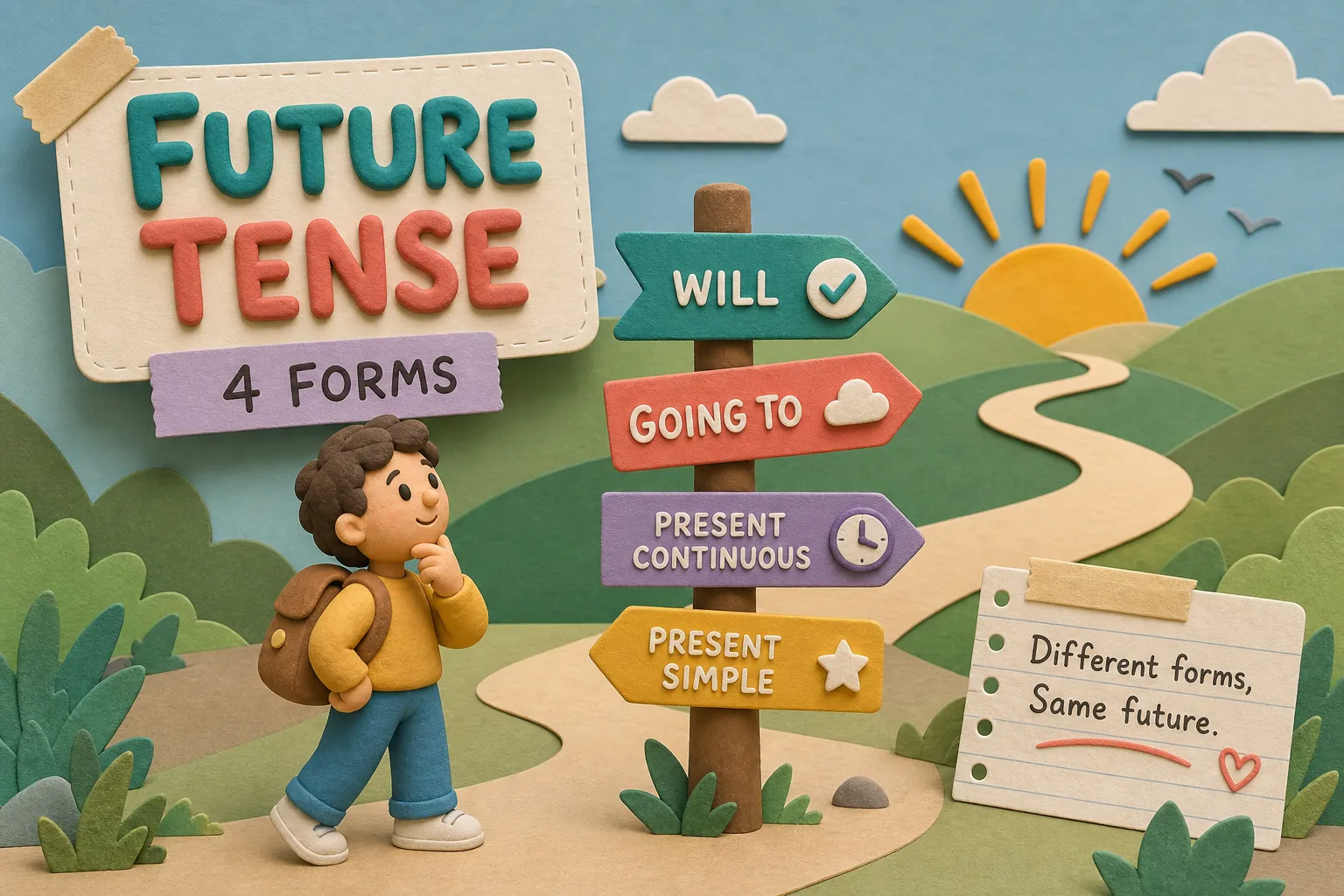
The four future tense forms are “will + verb,” “be going to + verb,” present continuous (am/is/are + verb-ing), and simple present. Each one tells the listener something different. Here’s how all four work, and when to use each one.
Why Americans use four different future tense forms
What textbooks often skip about the future in English
Spanish and French have dedicated future tense verb endings. English doesn’t work that way. Instead, you choose between four main forms based on context: Is the plan new or old? Is there visible evidence? Is the event on a fixed schedule? The wrong choice doesn’t always break a grammar rule, but it can sound unnatural to a native speaker.
This is why a sentence like “I will meet my manager tomorrow” can feel off, even if it’s technically correct. A native speaker would say “I’m meeting my manager tomorrow” because the appointment is already set. Knowing the rule is useful. Knowing the reason behind it is what makes you sound natural.
A quick map of the four forms
Here’s a simple preview of all four future tense forms, with a full section on each below.
| Form | Structure | Example |
|---|---|---|
| Future simple | will + base verb | “I’ll send you the file.” |
| Going to | am/is/are + going to + base verb | “I’m going to take a Python course.” |
| Present continuous | am/is/are + verb-ing | “I’m meeting my manager at 10.” |
| Simple present | base verb (third person: verb + s) | “The meeting starts at 9 AM.” |
Future tense form 1, “Will”: for decisions you make right now
When “will” sounds natural
“Will” is for decisions you make at the moment of speaking. If you already planned something before the conversation, “will” sounds off. Two quick examples show this clearly.
Someone asks, “Can you close the window?” You say, “Sure, I’ll close it.” You just decided. A friend calls and needs a ride. You say, “Don’t worry, I’ll come get you.” That’s a decision made right in the moment, not before the call.
“Will” for predictions and promises
“Will” also works in two other common situations. First, general predictions based on your opinion or belief, without visible evidence: “I think this project will take about two weeks.” Second, promises and offers: “I’ll send you the report by noon.”
In a workplace setting, you might say: “I’ll take care of the slides for Friday’s presentation” (an offer made right now) or “I think the client will accept our proposal” (a prediction based on your opinion). Both use “will” correctly.
How “will” contracts in real speech
In spoken American English, “will” frequently contracts to “‘ll”: I’ll, she’ll, they’ll. “I’ll” is pronounced /aɪl/, similar to the word “aisle.” You’ll hear this form constantly in natural conversations. Recognizing “‘ll” in fast speech helps you catch the future tense when the full word “will” goes by too quickly to notice, a practical skill for any ESL learner working on listening comprehension.
Future tense form 2, “Going to”: for plans and what you can already see
Plans you made before the conversation
“Going to” is for things you decided before the current moment. The plan is already in place. Compare these two sentences: “I’ll take a Python course” (decided right now) versus “I’m going to take a Python course next month” (decided last week). Same idea, very different timing.
This shows up often in the workplace. “We’re going to launch the new product in March” tells your listener that the decision exists already. Using “will” here would suggest the team just decided this in the meeting, which changes the meaning entirely.
Predictions with visible evidence
“Going to” is the right choice when you can see signs of what’s about to happen. You’re using present evidence to predict the future. “Look at those clouds. It’s going to rain.” You can see the clouds right now. “She’s looked at the data three times. She’s going to ask about it in the meeting.” You can see her behavior. Both predictions are grounded in visible evidence.
This is what separates evidence-based “going to” from opinion-based “will.” When you see a sign, use “going to.” When you’re expressing a general belief, use “will.”
How “going to” sounds in American conversation
In casual American speech, “going to” often reduces to “gonna” (pronounced /ˈɡʌnə/, like “GUN-uh”). You’ll hear this constantly in informal settings. However, “gonna” is not appropriate in job interviews, formal presentations, or professional written communication. Use the full “going to” in those contexts.
One important rule: “gonna” only replaces “going to” when it precedes another verb. You can say “I’m gonna go,” but you can’t say “I’m gonna New York.” When “going” is the main verb, keep the full form. If you want to get comfortable with reductions like “gonna” in fast American speech, the pronunciation content at Filler Phrases Every American English Learner Should Know covers connected speech and how Americans actually sound in real conversations. For a short, practical explanation of how speakers reduce “going to” into “gonna,” see this guide on how to pronounce “gonna” and “wanna”.
Future tense forms 3 and 4, present continuous and simple present
Present continuous: when the plan is already booked
Present continuous (am/is/are + verb-ing) is for fixed future arrangements. Think of something already on the calendar: a confirmed appointment, a booked dinner, a scheduled call. The key signal is a specific time and a confirmed plan.
“I’m meeting with my manager tomorrow at 10.” “We’re having dinner with clients on Friday.” These are set arrangements. Using “will” in these sentences, “I will meet my manager tomorrow”, would suggest you just made that decision on the spot, which isn’t what you mean.
Simple present: for timetables and schedules
Simple present (the train leaves, the meeting starts, the flight arrives) is for fixed external schedules. These are official timetables, not personal plans. They follow a set program that exists outside of your control.
“The conference starts at 9 AM.” “The flight arrives at 6:45 PM.” A common mistake is saying “The train will leave at 9” when the natural form is “The train leaves at 9.” If it’s on a printed schedule, use simple present.
If you want extra practice with saying and writing times, see Numbers in English: The Complete Practical Guide.
Future tense: present continuous vs. simple present
Use present continuous for personal arrangements you set up: “I’m leaving at 6.” Use simple present for fixed external schedules: “The store closes at 9.” One is your plan. The other is someone else’s schedule. That single question, whose plan is it?, solves most cases.
Will vs. going to: a fast way to choose the right future tense
Two questions that settle it
When you’re not sure which future tense form fits, two questions usually settle it quickly.
- Did I decide this just now, in this conversation? Use “will.”
- Did I plan this before this conversation started? Use “going to” or present continuous.
For a concise comparison that highlights the difference between opinion-based “will” and evidence-based “going to,” see this short explanation on will vs. going to.
Here are three pairs that show the same idea in different contexts:
- “I’ll order the pizza” (just decided at dinner) vs. “I’m going to order from that new place” (decided earlier today)
- “I’ll help you with that” (just offered right now) vs. “I’m going to email the team today” (already on your to-do list)
- “I’ll call you back” (a spontaneous offer) vs. “I’m going to call the client this afternoon” (already planned)
How this plays out at work
Native speakers move between all four forms in a single conversation. In a team meeting, you might hear them back to back: “I’ll send that over now” (spontaneous decision), “We’re going to present the results next Tuesday” (plan already in place), and “The call starts at 2 PM” (fixed schedule). Each sentence tells the listener something different about timing and intent.
Noticing these patterns in real conversations is one of the fastest ways to make them feel automatic in your own speech. The grammar makes sense on paper. What builds fluency is hearing it in context, repeatedly and in real situations.
Common mistakes and how to fix them
The five errors ESL learners make most
Check if any of these sound familiar. Each one is easy to fix once you see it.
1. Using “will” for pre-planned events.
Wrong: “I will meet my friends on Saturday.”, Use this only when the plan was just made.
Right: “I’m going to meet my friends on Saturday.” or “I’m meeting my friends on Saturday.”
2. Forgetting “am/is/are” before “going to.”
Wrong: “I going to play tennis tomorrow.”
Right: “I am going to play tennis tomorrow.” The verb “to be” is always required before “going to.”
3. Adding “-ing” after “will.”
Wrong: “He will winning the match.”
Right: “He will win the match.” After “will,” always use the base form of the verb.
4. Using “will” inside “if” clauses.
Wrong: “If I will go, I will call you.”
Right: “If I go, I will call you.” In conditional sentences, the “if” clause uses simple present, not a future form.
5. Misplacing “probably” with “won’t.”
Wrong: “I won’t probably be there.”
Right: “I probably won’t be there.” The adverb “probably” comes after “will” (“I will probably go”) but before “won’t” (“I probably won’t go”).
Try it yourself: a short practice check
Complete each sentence with the correct future tense form. The answers are right below.
1. You just realized you need to check your email.
“I ___ my email real quick.”
Answer: I’ll check my email real quick. (Spontaneous decision.)
2. You booked a dentist appointment for Thursday.
“I ___ the dentist on Thursday.”
Answer: I’m seeing the dentist on Thursday. (Or: I’m going to see the dentist on Thursday. Fixed arrangement.)
3. The conference program says it begins at 9 AM sharp.
“The conference ___ at 9 AM.”
Answer: The conference starts at 9 AM. (Official schedule, simple present.)
How did you do? If any answer surprised you, go back and re-read the section for that form. One pass through the rule, then one look at the example, is usually enough for it to click.
Beyond the four forms: future continuous and future perfect
The four forms above cover the vast majority of future tense situations you’ll encounter in everyday American English. That said, English also has additional grammatical future constructions worth knowing: the future continuous (will + be + verb-ing), the future perfect (will + have + past participle), and the future perfect continuous (will + have + been + verb-ing). These express more specific meanings, an action in progress at a future point in time, an action completed before a future moment, or the duration of an action up to a future moment. They appear less often in casual conversation but come up in professional writing and more formal speech. Look for deeper coverage of these forms in the grammar resources at 12 English Verb Tenses: A Pocket Guide for Non-Native Speakers, Your Daily American. For another full overview of English future tenses with clear examples, see this guide on English future tenses.
Putting it all together
These four future tense forms exist because each one tells the listener something specific. “Will” signals a new decision made on the spot. “Going to” signals a plan already in place, or visible evidence of what’s about to happen. Present continuous signals a fixed, confirmed arrangement. Simple present signals an official schedule that exists outside your control.
As a next step, find a recent email or message you wrote in English and look at every future statement in it. Ask yourself: did I use the right future tense form? Now that you know the distinctions, you might choose differently.
If you want to go deeper into how these forms sound in real American conversations, explore the grammar and pronunciation content at Your Daily American. Knowing the rules is the foundation. Using them naturally, without stopping to think, is the goal.