Read these two sentences: “She work at a hospital.” “I am knowing the answer.” Do you know what is wrong with them? Both sentences have present tense errors, and both are among the most common mistakes intermediate learners make. The first sentence is missing the -s that goes with “she.” The second uses a continuous form with a verb that does not work that way.
The present tense describes actions or states that are current, habitual, or generally true. By the end of this lesson, you will be able to use the simple present and present continuous correctly, add the third-person -s every time, and avoid the stative verb mistake that trips up many intermediate learners. These grammar points come up very frequently in real American conversations and workplace situations. At Your Daily American, every grammar lesson is built around real-life contexts, because that is how grammar rules actually become part of how you speak.
What the simple present tense does (and when to use it)
Habits, routines, and general facts
The simple present describes things that are generally true or happen on a regular basis. It covers three main situations: habits and routines (“She drinks coffee every morning”), general truths (“Water freezes at 32°F”), and permanent situations (“He lives in Chicago”). If something is always true or follows a regular schedule, the simple present is the right choice. A common workplace example is “Our team meets on Mondays”, a standing routine, not something happening at this exact moment.
How to conjugate it correctly
The table below shows the full simple present conjugation for the verb work.
| Subject | Verb form | Example |
|---|---|---|
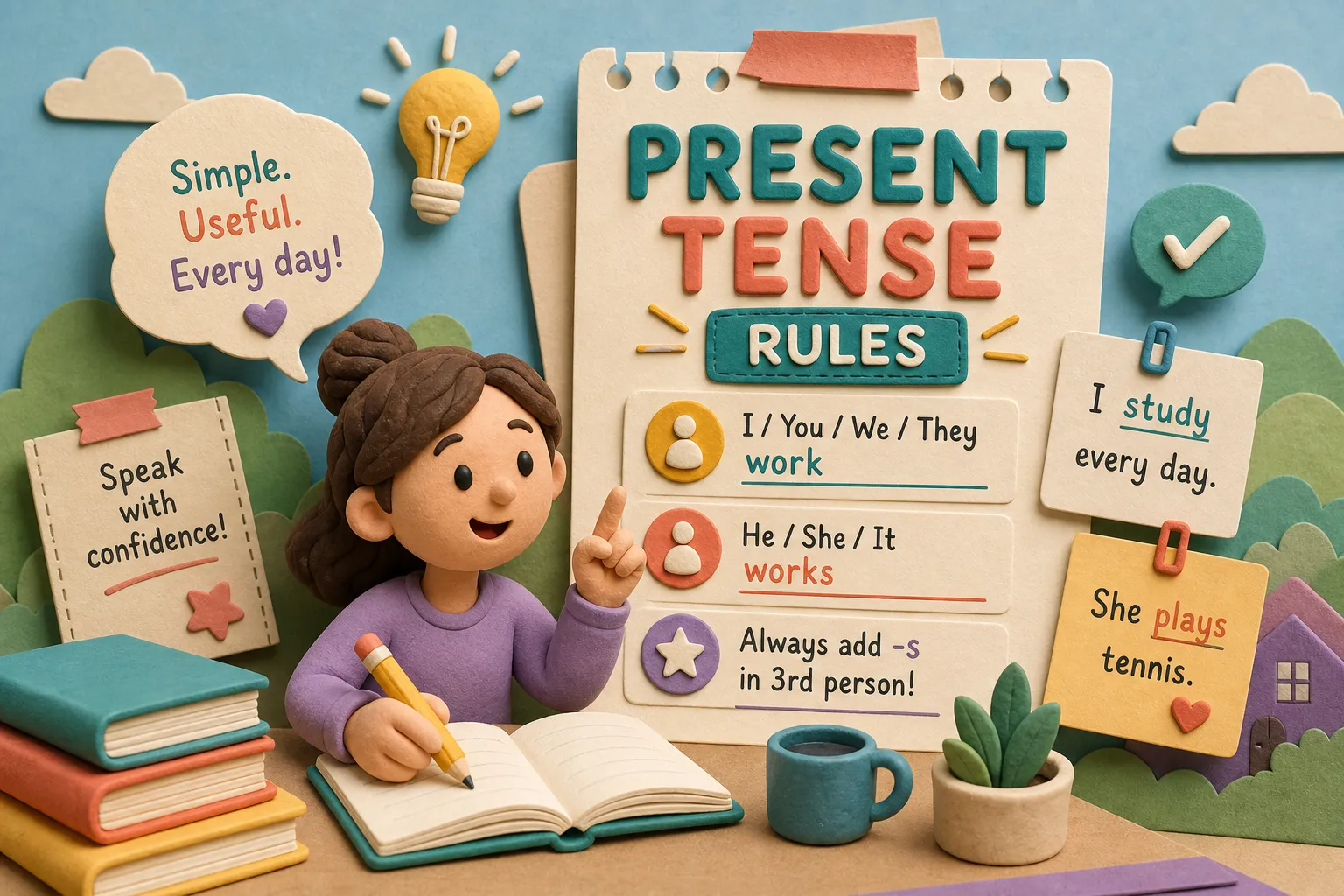
| I | base verb | I work |
| You | base verb | You work |
| He / She / It | verb + -s or -es | He works |
| We | base verb | We work |
| They | base verb | They work |
A key rule to keep in mind is third-person singular agreement. When the subject is he, she, it, or a singular name, add -s or -es to the verb. Watch out for a few irregular spellings: go becomes goes, study becomes studies, and have becomes has. Also notice that I and you do not take the -s, even though they are singular subjects, something many learners find surprising at first.
How the present continuous tense works
Actions in progress and temporary situations
The present continuous (also called present progressive) is formed with am/is/are + verb-ing. You use it for two main situations: something happening right now (“She is talking on the phone”) and a temporary situation (“He is living in New York this summer”). Americans also use the present continuous for near-future arrangements, which comes up often in daily conversation: “I am meeting my manager tomorrow.” The action is not happening at this moment, but the plan is already set.
Stative verbs: the ones you cannot make continuous
Some verbs describe a state or condition rather than an action in progress. These are called stative verbs (verbs that express a state, not an activity), and they do not work in the continuous form. The most common ones fall into three broad groups, though these categories overlap, and the lists below are not exhaustive:
- Feelings: love, hate, want, need, prefer, like
- Mental states: know, understand, believe, think (when it means “have an opinion”), remember
- Senses: hear, see, smell, taste
The classic error is: “I am knowing the answer.” The correct sentence is: “I know the answer.” Know is a stative verb, it describes a mental state, so it stays in the simple present. For more examples and guidance on stative verbs, see stative verbs.
Some verbs can be stative or dynamic (action-based) depending on meaning. Think is a useful example. “I think you’re right” is stative because it expresses an opinion. “I am thinking about the project” is dynamic because it means you are actively considering something right now. The same principle applies to have: “I have a car” is stative (possession), while “I am having lunch” is dynamic (an activity in progress).
Simple present vs. present continuous: how to choose
Signal words that point to each tense
Certain time words are strong clues about which tense to use. Simple present signal words include: always, usually, often, sometimes, never, every day, every week, on Mondays. Present continuous signal words include: right now, at the moment, currently, today, this week, still, Look!, Listen! These words are not absolute rules, but when you see “every day,” you almost certainly need the simple present. When you see “right now” or “at the moment,” you almost certainly need the continuous.
Side-by-side sentence comparisons
These four sentence pairs show exactly how the tense changes the meaning. “She works from home” describes her regular situation. “She is working from home this month” tells us this is temporary, just for now. The first is a fact; the second is a current, short-term change.
“I drink tea every morning” is a daily habit. “I am drinking tea right now” describes what is happening at this exact moment. Notice how the signal words, “every morning” and “right now”, point directly to the right tense.
“He checks his email at 9 AM” describes his daily routine. “He is checking his email” tells you what he is doing right now. And “They speak English at work” is their general practice, while “They are speaking English in the meeting” refers to what is happening in one specific meeting right now.
Three present tense mistakes that come up most often
Dropping the third-person -s
In many languages, including Spanish, Portuguese, and Mandarin, verbs do not change form based on who is performing the action. Because of this, learners from those backgrounds often do not notice when the -s is missing. The error sounds like this: “He work at a hospital.” The correct form is: “He works at a hospital.” Use this self-check: whenever your subject is he, she, it, or a person’s name, ask yourself if the -s is there before you finish the sentence. For a clear explanation and practice activities on subject-verb agreement, see this subject-verb agreement resource.
Using continuous form with stative verbs
Even after learning the stative verb rule, many learners still use the continuous form by habit. “I am wanting a coffee” should be “I want a coffee.” “She is understanding the lesson” should be “She understands the lesson.” The quick check is simple: does this verb belong to the feelings, mental states, or senses categories? If yes, stay with the simple present.
Missing do/does in negatives and questions
This error is very common among intermediate learners: “She not like spicy food.” The correct form is: “She doesn’t like spicy food.” In negatives and questions, do and does carry the tense, and the main verb returns to its base form. With he, she, and it, you need does (not do), and the main verb loses its -s. Write “She does not like,” not “She does not likes.”
Quick practice: test yourself
Try these six sentences on your own before reading the answers. Choose the correct verb form or correct the error in each sentence.
- She _____ (work / works / is working) in a hospital. She _____ (work / works / is working) from home right now.
- I _____ (know / am knowing) this song.
- They _____ (meet / are meeting) every Monday.
- He _____ (not like / doesn’t like) spicy food.
- We _____ (launch / are launching) the new product this week.
- Water _____ (boil / boils) at 212°F.
Answer key
1. works / is working. “She works in a hospital” describes a permanent situation (simple present). “She is working from home right now” uses “right now,” which signals the present continuous.
2. know / 3. meet. Know is a stative verb and cannot be used in the continuous form. “Every Monday” in item 3 is a frequency signal that points to the simple present, both answers follow the same core rule.
4. doesn’t like. Negatives with he, she, and it require does + not + base verb.
5. are launching. “This week” signals a current, temporary activity, so the present continuous is correct here.
6. boils. This is a general scientific fact, so the simple present is the right choice.
If you got any wrong, go back to the section covering that rule and re-read it. Many language teachers recommend reviewing a rule right after making a mistake, that immediate connection between the error and the correction is what helps it stick.
Where to see these tenses used in real American English
Why grammar needs real context to stick
Learning a grammar rule from a chart is only the first step. The rule becomes natural when you see and hear it used in real situations: ordering at a café, writing a work email, joining a meeting, or chatting with a colleague. The simple present and present continuous are very commonly used in everyday American conversations, which makes getting them right especially worthwhile. Seeing them in real contexts is what moves a rule from something you know to something you use without thinking. For an accessible overview of the present tense forms, see this present tense guide.
How Your Daily American brings grammar into everyday conversation
At Your Daily American, grammar lessons are built around real conversational and professional situations. You can see how native speakers use the simple present and present continuous in workplace emails, small talk, daily routines, and meetings. The platform organizes lessons by skill and topic, so you always know what to study next and how each piece connects to real life. Ready to keep going? Explore the present perfect lesson, practice with the stative verbs reference list, or sharpen your accuracy with subject-verb agreement exercises.
Putting it all together
To pull it all together: use the simple present for habits, routines, and general facts. Use the present continuous (am/is/are + verb-ing) for what is happening right now or for temporary situations. Always add -s with he, she, it, and singular names. And stay away from the continuous form with stative verbs like know, understand, want, and believe.
These two tenses cover many of the present-tense situations you will encounter in daily American English. (Other present-tense forms, like the present perfect and present perfect continuous, build on this foundation, see our present perfect lesson when you are ready for that next step.) Getting the simple present and present continuous right will make your speech and writing sound more natural right away. You do not need to master every grammar rule at once, just get these two solid first. For a compact overview of all twelve tenses, see our 12 English Verb Tenses: A Pocket Guide for Non-Native Speakers.
Here is something to try right now: write two or three sentences about your daily routine using the simple present. Then write two or three sentences about what you are doing today using the present continuous. Write them in a notebook or language journal, then share with a study partner if you have one. Using the language is always more powerful than reading about it.
Frequently asked questions about the present tense
When do I use the present continuous instead of the simple present?
Use the present continuous when an action is happening right now or is temporary. Use the simple present for habits, routines, and general facts. Signal words like “right now” and “at the moment” point to the continuous; words like “every day” and “usually” point to the simple present.
Which verbs are stative verbs?
Stative verbs describe states rather than actions. Common ones include know, understand, believe, want, need, love, hate, hear, and see. These verbs generally do not appear in the continuous form. Some verbs, like think and have, can be stative or dynamic depending on meaning.
Why do I need to add -s to verbs with he, she, and it?
English requires subject-verb agreement in the simple present. When the subject is he, she, it, or a singular noun, the verb takes an -s or -es ending. This rule applies only to third-person singular subjects, all other subjects use the base form of the verb.
How do I form negatives in the simple present?
Use do not (don’t) or does not (doesn’t) plus the base verb. Use does not with he, she, and it. For example: “She does not like spicy food”, not “She does not likes spicy food.”
What is the difference between present tense and present perfect?
The simple present describes current habits and general facts. The present perfect (formed with have/has + past participle) connects a past action to the present moment, for example, “I have lived here for five years.” For a full breakdown, visit our present perfect lesson. You can also review the British Council’s guide to the present perfect simple and continuous.