You are reading an English sentence right now: “Running every morning changed my life.” You pause. You think: “Wait, isn’t running a verb? Why is it the subject here?” This moment of confusion is something many English learners experience, and it is a great question. That sentence is a perfect example of -ing words in action, specifically, a word ending in -ing that works like a noun instead of a verb.
By the end of this guide, you will understand every major role that -ing words play in American English. You will be able to spot the difference between a gerund (an -ing form used as a noun) and a present participle (an -ing form used as a verb or adjective), apply the correct spelling rules, and use these words with confidence. Context is what makes grammar stick, and every example in this lesson comes from real sentences you would actually hear in the United States.
Here is what this article covers: gerunds, present participles, -ing adjectives, progressive tenses, spelling rules, and a practical word list organized by function.
What makes -ing words so flexible in English
Adding -ing to a verb base creates a new word form that can work in several different ways. The word cook becomes cooking, and from that point, the sentence decides what job it does, one word, many possible roles. This flexibility is one reason words ending in -ing confuse so many English learners.
Look at these three sentences with the same word:
- “Cooking is my hobby.” → cooking is a noun (the subject of the sentence)
- “She is cooking dinner.” → cooking is a verb (showing an action in progress)
- “I took a cooking class.” → cooking is an adjective (describing the noun class)
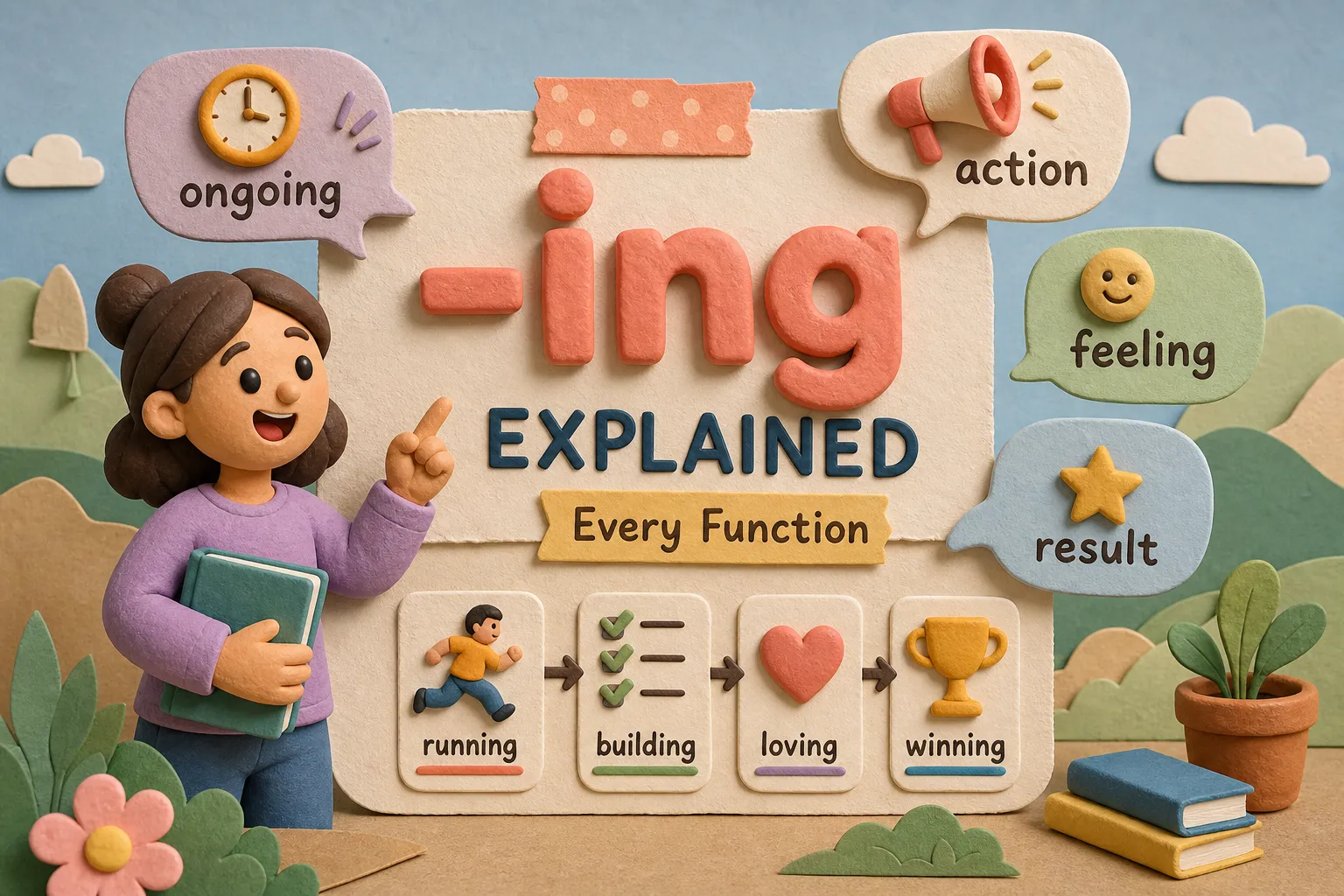
The word did not change. The sentence changed. Once you understand the main roles of -ing words, reading and using them becomes far more natural. Those roles are: gerund (noun function), present participle (verb or adjective function), and part of a progressive tense (a verb phrase showing ongoing action). The same -ing suffix covers all of these uses.
Gerunds: when an -ing word acts like a noun
A gerund is an -ing word that works as a noun in a sentence. It names an activity or idea the same way a regular noun like music or work does. Gerunds are built from verbs, but they function exactly like nouns inside the sentence, which is why they are sometimes called “nouns ending in -ing.”
Gerunds can appear in several positions:
- As a subject: “Swimming is great exercise.” / “Learning a new language takes time.”
- As an object: “I enjoy reading.” / “She finished working at six.”
- After a preposition: “He is good at cooking.” / “Thank you for helping.”
In American English, gerunds follow common prepositional phrases like good at, interested in, tired of, and thanks for. These patterns show up every day because prepositions in English are almost always followed by a noun or gerund, never an infinitive.
Here is a simple test to spot a gerund. Try replacing the -ing word with a regular noun like it or something. If the sentence still makes sense, you have a gerund. “Swimming is fun” becomes “It is fun.” That works, so swimming is a gerund. One common mistake ESL learners make is using an infinitive (the to + verb form) where a gerund is needed. For example: “I enjoy to read” is incorrect. The correct sentence is “I enjoy reading.”
Participles: when -ing words describe or support a verb
Present participles are the -ing form of a verb used to show ongoing action or to describe a noun. When an -ing word pairs with a form of be to form a verb phrase, it expresses progressive aspect, meaning the action is in progress. These verb phrases are not gerunds; they are verbs. Examples from real American English: “She is running late.” / “They were talking all night.” / “I am waiting for you.” Note that in some cases, such as idiomatic phrases, the line between a progressive verb and an adjectival use can blur, but the core pattern of be + -ing signals ongoing action.
Some -ing words also describe nouns directly, functioning as adjectives. These participial adjectives are common in both daily conversation and the workplace: an interesting story, a boring meeting, a surprising result, an exciting game, a confusing question. These -ing adjectives typically describe what a situation or thing causes a person to feel. This leads to one of the most common ESL mistakes in American English: confusing -ing adjectives with -ed adjectives.
Here is the key difference. The -ing adjective describes the cause: “The meeting was boring.” (The meeting caused boredom.) The -ed adjective describes the feeling: “I was bored.” (I felt the boredom.) The thing or situation uses -ing. The person who feels something uses -ed. This pair causes a lot of confusion, so keep it in mind: boring/bored, exciting/excited, tiring/tired, confusing/confused.
The fastest way to tell a gerund from a participle is to look at the job the -ing word is doing:
- Gerund: “Running keeps me healthy.” → noun; the subject of the sentence
- Participle verb: “She is running a marathon.” → verb; showing an action in progress
- Participle adjective: “The running water is cold.” → adjective; describing the noun water
Verbs ending in -ing: how they build progressive tenses in American English
Progressive tenses, verb forms that show an action is, was, or will be in progress, all follow the same structure: a form of be plus an -ing verb. Once you know the pattern, all three tenses are straightforward to build.
The present progressive uses am/is/are + -ing for actions happening right now: “I’m working from home today.” / “She’s studying for her test.” / “They’re having dinner.” Americans also use this tense for future plans in casual speech. “We’re flying to Miami next week” sounds completely natural.
The past progressive uses was/were + -ing for actions that were in progress at a specific moment in the past: “I was driving when you called.” / “We were watching the game.” The future progressive uses will be + -ing: “I’ll be traveling next month.” / “She’ll be joining the meeting late.”
One important mistake to avoid: do not use stative verbs (verbs that describe mental states or feelings rather than actions) in the progressive form. These verbs include know, believe, want, need, understand, love, and hate. “I am knowing the answer” is incorrect. The correct sentence is “I know the answer.” These verbs describe a state, not an action in progress, so they typically stay in simple tense forms. (A few informal or advertising exceptions exist, “I’m loving it” being the most famous, but for standard American English, treat stative verbs as non-progressive.)
Spelling rules for adding -ing the right way
Three main spelling rules cover almost every situation. Learning them will save you from common writing errors.
Rule 1: Double the final consonant when the base word has one syllable, one short vowel sound, and one final consonant: run → running, sit → sitting, swim → swimming, stop → stopping. Do not double if there are two vowels before the consonant (rain → raining) or two final consonants (help → helping). Also, never double the letters w, x, or y. For words with more than one syllable, doubling depends on stress: if the final syllable is stressed, double the consonant (begin → beginning); if it is not, do not double it (visit → visiting).
Rule 2: Drop the silent -e before adding -ing: make → making, dance → dancing, hope → hoping, write → writing. The exception is words ending in -ee: keep both e’s. See → seeing, agree → agreeing. Also note that words ending in -ie change the -ie to -y before adding -ing: die → dying, lie → lying, tie → tying.
Rule 3: Never change -y to -i before -ing. Unlike other endings, -ing never triggers a y → i change. Simply add -ing directly: play → playing, enjoy → enjoying, study → studying. One special case worth noting: words ending in -c add a k before -ing to preserve the hard /k/ sound: panic → panicking, picnic → picnicking.
A practical -ing word list organized by function
Use this list as a reference for writing, teaching, or self-study. The same -ing word can appear in more than one category depending on how the sentence uses it, so always check the context first.
Common verbs ending in -ing used as present participles
These all show ongoing actions when paired with a form of be:
- running, “He is running to catch the train.”
- working, “She is working on a new project.”
- talking, “They are talking in the hallway.”
- making, “I am making dinner right now.”
- helping, “We are helping the new team members.”
- learning, “You are learning something new every day.”
- listening, “He was listening to a podcast.”
- driving, “She was driving home when it started to rain.”
- sleeping, “The baby is sleeping.”
- writing, “I will be writing the report all morning.”
Common nouns ending in -ing: gerunds in everyday use
These work as the subject or object of a sentence, or come after a preposition:
- swimming, “Swimming twice a week is a great habit.”
- cooking, “She is passionate about cooking.”
- reading, “Reading in English every day builds your vocabulary fast.”
- traveling, “Traveling alone teaches you a lot.”
- hiking, “We love hiking on weekends.”
- shopping, “Shopping online is very convenient.”
- studying, “Studying before bed does not work well for everyone.”
- teaching, “Teaching is one of the most rewarding careers.”
- singing, “She has always been interested in singing.”
- working, “He is tired of working long hours.”
Common -ing adjectives for daily life and work
These describe what a situation, person, or thing causes someone to feel. You will hear and read these regularly in American English:
- interesting, boring, exciting, tiring, surprising, general daily use
- confusing, frustrating, annoying, common when explaining problems
- challenging, rewarding, motivating, frequent in workplace conversations
- amazing, terrifying, satisfying, common in storytelling and reviews
Examples from real American settings: “That was a challenging project, but very rewarding.” / “The instructions were confusing.” / “What an exciting opportunity.” These are the kinds of phrases you will hear in meetings, casual conversations, and emails every week.
Putting it all together
Here is the core idea to remember: -ing words are not just verb forms. They are one of the most flexible tools in English, and the same -ing word can be a noun, a verb, or an adjective. Context decides the role, not the word itself.
Quick summary: a gerund acts as a noun (“Cooking is fun”). A present participle used as a verb shows ongoing action (“She is cooking”). A participial adjective describes a noun (“a cooking show”). A progressive tense combines a form of be with an -ing verb to show action in progress (“I was cooking when you called”).
Now try this short practice. Read each sentence and decide: is the -ing word a gerund, a participle verb, or a participial adjective? First: “Cooking smells great.” Second: “She is cooking dinner.” Third: “We took a cooking class.” Check your answers: the first uses cooking as a gerund (the subject of the sentence). The second uses it as a participle verb (paired with is). The third uses it as a participial adjective (describing the noun class).
English grammar makes much more sense when you see it working in real sentences. That is exactly the approach at Your Daily American, teaching you the American English you actually hear and use every day, in real conversations and everyday situations. Keep exploring, and keep practicing.