Your manager leans forward in the meeting and says, “Before we move forward, we need to justify the ROI on this.” Everyone at the table nods. You understand the general idea, but you’re not sure you could explain the number, calculate it, or push back if something seemed off. If you’ve ever searched for a clear ROI meaning, this article is your answer, written in plain English, with real examples you can use at work.
By the end, you’ll be able to calculate ROI for real situations, use it confidently in meetings and emails, and spot when the number is being misused. At Your Daily American, we help international professionals build the business vocabulary they need to participate fully in moments like this one. ROI is a great place to start.
ROI meaning: what it really means in plain English
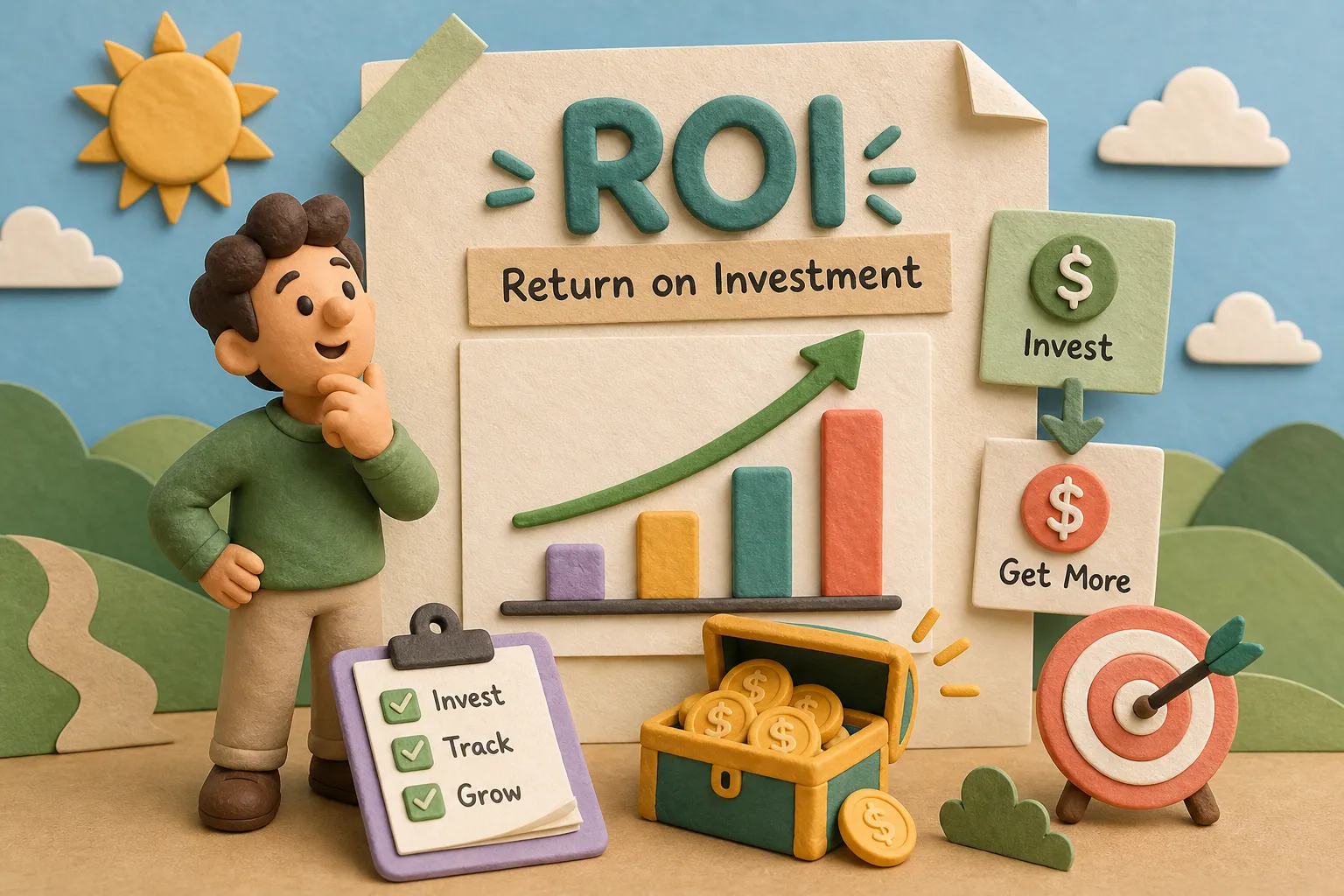
ROI stands for return on investment. It answers one simple question: “Was this worth it?” More specifically, it measures whether a decision made money or lost it. “Investment” means what you put in, typically money, but also time or other resources that can be converted to a dollar value (for example, staff hours valued at the hourly wage rate). “Return” means what you got back. When you compare the two, you can see whether the decision paid off.
ROI is most commonly expressed as a percentage. That makes it easy to compare very different types of decisions. A company can weigh the return on a marketing campaign against the return on buying new equipment, even though those are completely different things.
Why companies use ROI to make decisions
When a manager asks, “What’s the ROI on this?”, they’re asking whether the benefit is worth the cost. This question comes up constantly in business. A team is considering a new software subscription: is it worth the annual fee? A training program costs $5,000 per employee: will it improve performance enough to justify that spend? A marketing campaign needs a budget approval: how much revenue should it generate? In each case, ROI gives a number that makes the decision easier to defend, or to question.
The difference between a “good” ROI and a “bad” one
A positive ROI means you made more than you spent. A negative ROI means you lost money. Zero percent ROI means you broke even: you got back exactly what you put in. What counts as “good” depends on the situation. A 5% ROI on a six-month marketing campaign is very different from a 5% ROI on a ten-year construction project. You always need to ask: over what time period, and compared to what alternative?
ROI meaning, formula and examples
The formula is straightforward. ROI equals the gain minus the cost, divided by the cost, then multiplied by 100. Written out: ROI = (Gain − Cost) ÷ Cost × 100. “Gain” is the total value you received. “Cost” is the total amount you invested. Subtracting cost from gain gives you your net profit, the actual money made. Dividing by cost shows how efficient the investment was. For a practical walkthrough on the calculation steps, see Fidelity’s guide on how to calculate ROI.
The basic formula and what each part means
Think of it this way. If you spend $1,000 and get back $1,250, your net profit is $250. Divide $250 by $1,000 and you get 0.25. Multiply by 100 and you get 25%. That means for every dollar you invested, you earned 25 cents in profit. The percentage format makes it easy to compare this against any other investment.
Three real-world examples that make the formula click
Example 1: Stock purchase. You buy 100 shares at $20 each, for a total cost of $2,000. Later, you sell at $26 per share, bringing in $2,600. Your net profit is $600. ROI: ($600 ÷ $2,000) × 100 = 30%. In plain English: for every dollar you invested, you earned 30 cents back.
Example 2: Marketing campaign. A small business spends $3,100 on a campaign. The campaign brings in $8,500 in new sales, leaving a net gain of $5,400. ROI: ($5,400 ÷ $3,100) × 100 = 174%. The campaign returned $1.74 in profit for every $1 spent. That’s a strong result by most benchmarks.
Example 3: Equipment purchase. A business buys equipment for $50,000. Over one year, it generates $30,000 in cost savings and $20,000 in extra sales, for a total gain of $50,000. ROI: ($50,000 − $50,000) ÷ $50,000 × 100 = 0%. The business broke even in year one. If those gains continue into year two, the cumulative ROI turns positive, which is why the time period always matters.
How to talk about ROI in meetings, emails, and presentations
Knowing the formula is one thing. Saying it confidently in front of your team is another. Many international professionals understand the concept perfectly but hesitate in the moment because they aren’t sure which phrases native speakers actually use. The sections below give you ready-to-use language for both spoken and written business contexts.
Phrases to use in meetings and presentations
Practice the ones that fit your role before your next meeting.
- “What’s the projected ROI on this initiative?” (asking about expected return)
- “The campaign delivered an ROI of 174%, which came in above our target.” (reporting a positive result)
- “Before we approve this, can we walk through the expected ROI?” (raising a concern professionally)
- “Option A gives us a higher ROI in year one, but Option B has stronger returns over three years.” (presenting a comparison)
- “How do we justify the spend to leadership?” (asking about cost approval)
- “Do we have a ballpark figure, a rough estimate, for the expected return?” (asking for an approximate number)
Phrases to use in emails and written reports
Written business English tends to be slightly more formal than spoken conversation. These phrases are clear, professional, and ready to use in your next email or report draft.
- “I’ve attached a brief ROI analysis for your review.”
- “Based on the numbers, the ROI on this investment is approximately 45%.”
- “The ROI looks strong on paper, but I want to flag a few costs we haven’t accounted for yet.”
- “This option appears cost-effective, meaning good value relative to cost, based on a three-year projection.”
ROI variants you’ll hear in business conversations
Once you work in an English-speaking company, you’ll hear a few related terms alongside ROI. You don’t need to master the finance behind each one. You just need to recognize them and understand enough to follow the conversation. For a formal definition and background on the topic, see the general article on return on investment.
Annualized ROI vs. simple ROI
Simple ROI shows your total gain relative to your original cost over the full investment period, useful for a quick snapshot, though it doesn’t account for time value of money or ongoing costs. Annualized ROI converts that total into a yearly rate, which makes it easier to compare investments held for different lengths of time. The standard approach is to calculate: (1 + total ROI)^(1/n) − 1, where n is the number of years. If you’d like a clear walkthrough of how to calculate annualized return, this guide to annualized return is helpful.
Here’s why it matters in practice. A 21% total ROI over three years is not the same as 21% per year. The annualized figure would be closer to 6.6% per year, because the gain was spread across three years. A useful clarifying question to ask at work: “Are you looking at total ROI, or are you working with the annualized figure?”
ROIC and ROAS: two terms worth knowing
ROIC stands for Return on Invested Capital. It measures how efficiently an entire company uses all its capital, from investors and from debt alike, to generate profit. Analysts and senior leaders use this when evaluating a whole business, not a single project. ROAS stands for Return on Ad Spend. It measures the revenue generated for every dollar spent on advertising. Marketing teams use it to judge whether a specific campaign is performing well. The goal here is recognition: if you hear these terms, you’ll know what question they’re answering. For a quick comparison of ROAS and ROI in marketing contexts, see resources that explain the difference between ad spend metrics and traditional ROI.
When ROI can mislead you, and what to do about it
ROI is a useful number, but it has real blind spots. Knowing these will help you ask smarter questions and avoid decisions based on incomplete information.
Three common mistakes when using ROI
Ignoring the time factor. A 30% ROI over six months is very different from a 30% ROI over five years. The basic formula treats them the same, but they are not the same. Always ask: “Over what time period is this ROI calculated?” For multi-year projects, annualized ROI or NPV will give you a more accurate picture.
Missing hidden costs. If the calculation leaves out staff time, setup fees, or ongoing maintenance, the ROI looks better than it really is. Before you accept a number, ask what costs were included and which were left out.
Attribution problems. In marketing especially, it’s hard to know which specific action caused a result. A customer might have seen a social media ad, an email, and a podcast mention before buying. ROI often assigns full credit to one source, which can distort the picture. One way to handle this is to use multi-touch attribution models, which distribute credit across all the touchpoints in a customer’s journey.
What to use alongside ROI for better decisions
Two additional tools are worth knowing. NPV, or Net Present Value, calculates the value of future cash flows in today’s money. This matters because $10,000 received three years from now is worth less than $10,000 today. Payback period tells you how long it takes to recover the initial investment. Both tools give you a more complete picture than ROI alone. For a practical, user-friendly guide to ROI that covers common business scenarios, Xero’s resources can be useful.
Strong communicators don’t just present the ROI number. They also explain what else they considered. A useful phrase for this: “The ROI looks solid, but I also ran a payback period analysis to make sure the timing works for our budget.” That kind of statement builds credibility and shows financial awareness.
Put this into practice today
You now have the full picture of the ROI meaning: what return on investment is, how to calculate it, how to talk about it at work, and how to think critically when someone presents a number. To make it stick, try this: write two sentences explaining an ROI result as if you’re updating your manager. Use the phrases from this article. Writing forces you to actively use what you’ve learned, which builds retention faster than reading alone. If you want tips on study techniques and practice methods, check the Study Tips & Methods section for ideas.
If you want to keep building vocabulary like this, the kind that actually comes up in meetings, emails, and presentations, Your Daily American offers a structured path from professional phrases to workplace communication patterns that get used every day. Start with the free proficiency test to find your level, then build from there.