You’re sitting in a meeting. Your manager says, “Our KPIs are down this quarter, so we need to adjust our strategy.” Everyone around the table nods. You nod too. But inside, you’re not sure what a KPI actually is, or what you could say next.
If you’ve ever wondered about the KPI meaning in business meetings, you’re not alone. This is one of the most common moments ESL professionals describe at Your Daily American. Business terms like KPI come up constantly in meetings, emails, and performance reviews. When you understand them, you can participate with confidence. When you don’t, you stay quiet, even when you have something valuable to say.
By the end of this lesson, you’ll be able to define KPI clearly, tell the difference between a KPI and a regular metric, recognize real examples from different teams, and use the right phrases at work. Let’s start with the basics.
KPI meaning: what KPI stands for and why it matters
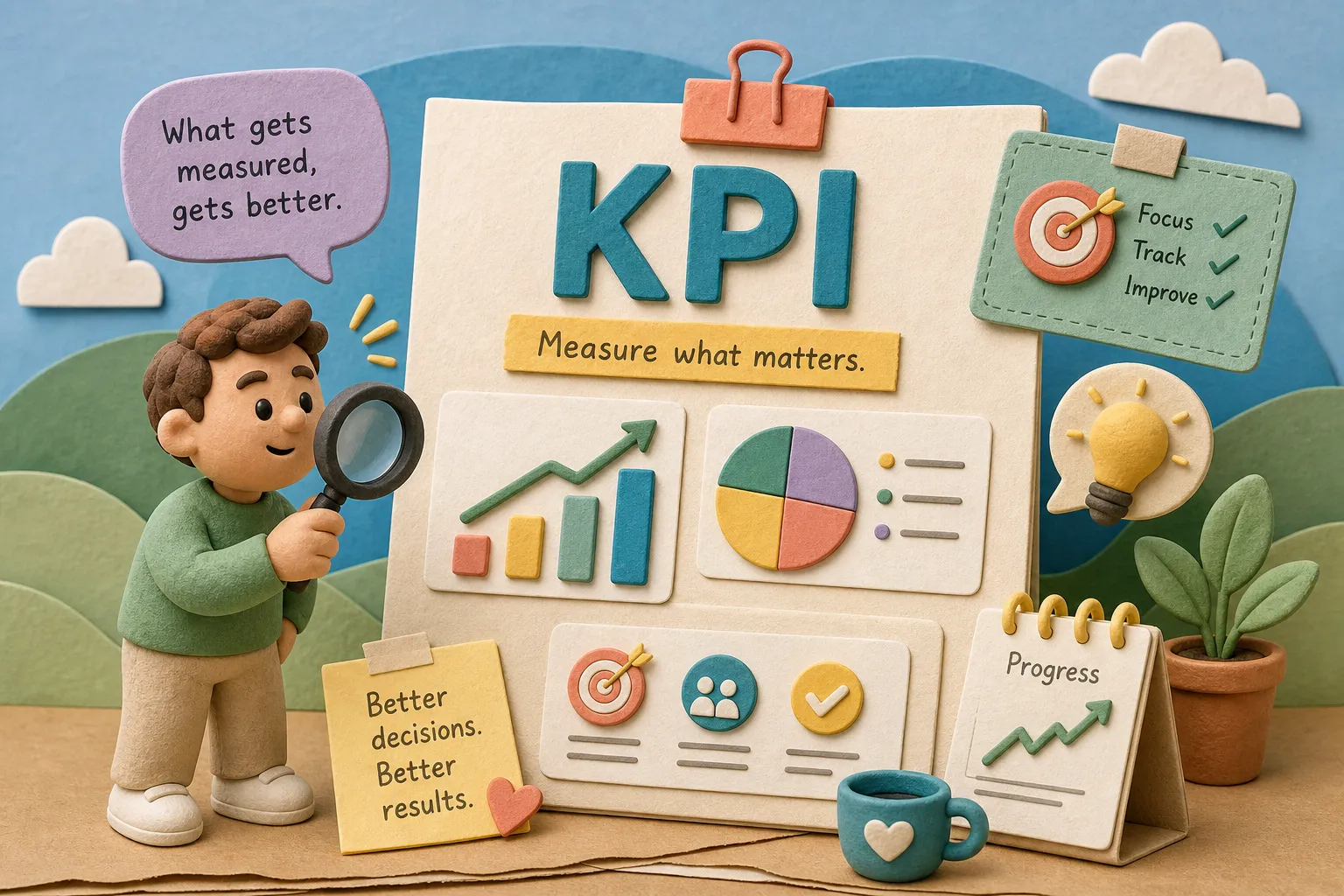
KPI stands for Key Performance Indicator. Break it down word by word. An “indicator” is a sign that shows you something. A “performance indicator” shows you how well something is working. A “key” performance indicator is the most important one, the one your team or company cares about most.
The meaning of KPI, in one clear sentence: it’s a number that tells a team or company whether they are reaching an important goal. If your company’s goal is to grow sales, a KPI might be monthly revenue. If your team’s goal is to respond to customers faster, a KPI might be average response time in hours.
KPI is widely used across tech, marketing, finance, and other teams focused on strategy and performance tracking, you’ll often hear it in strategy meetings. Once you understand the KPI meaning, you’ll notice the term everywhere. For an authoritative overview, see the KPI basics.
KPI vs. metric: a small but important difference
A metric is any number a business tracks. Website visits, emails sent, hours worked, these are all metrics. A metric is simply a number you measure, nothing more.
A KPI is a special type of metric. Not every number is a KPI. A KPI is a performance metric that connects directly to a specific goal. Here’s a quick way to see the difference:
- “Number of pages a visitor looks at on our website”, this is a metric. It’s useful, but it doesn’t tell you if you’re reaching a goal.
- “Percentage of visitors who buy something”, this is a KPI. It shows progress toward a sales goal.
- “Number of job applications received”, metric. It’s data, but not tied to a result.
- “Number of days it takes to fill an open position”, KPI. It shows whether your hiring process is efficient.
The key question to ask is: does this number tell us if we’re reaching a goal? If yes, it’s a KPI. If it’s just useful information, it’s a metric.
KPI examples from real workplaces
KPIs look different depending on the team. Here are simple, real examples from three common areas.
Sales team: A common KPI is the conversion rate, the percentage of potential customers (called “leads”) who actually buy something. Another is monthly revenue, meaning the total money earned in one month. Example sentence: “Our conversion rate KPI this month is 12%.” For more concrete examples of common sales measures, see this guide to sales KPIs.
HR team: One key KPI is time to hire, which means how many days it takes to fill an open job. Another is employee retention rate, the percentage of employees who stay with the company over a period of time. Example sentence: “We track time to hire as one of our top HR KPIs.”
Marketing team: A popular KPI is cost per lead, which shows how much money the team spends to get one potential customer. Another is website traffic, the number of visitors to the company website each month. Keep in mind that website traffic works best as a KPI when it’s tied to a specific goal, such as increasing leads. On its own, it may be more of a supporting metric.
What SMART KPIs mean
You’ll often hear people at work say, “Let’s make this a SMART KPI.” SMART is an acronym, a word formed from the first letter of each quality it describes. Each letter stands for one quality a good KPI should have:
- Specific: clear and exact, you know exactly what you’re measuring
- Measurable: you can track it with a number
- Achievable: realistic, you can actually reach it
- Relevant: connected to an important goal
- Time-bound: has a deadline, like “by the end of Q3”
A SMART KPI is not “do better at sales.” That’s too vague. A SMART KPI is “increase conversion rate from 10% to 15% by the end of Q3.” It’s specific, you can measure it, it’s realistic, it connects to the sales goal, and it has a clear deadline. When you hear someone say “let’s make this SMART,” they’re asking for that level of detail. For a practical overview of the SMART goal framework, this resource is helpful.
How to measure KPIs: a quick overview
Understanding the KPI meaning is one thing, knowing how to measure KPIs is another. Most teams track KPIs using a KPI dashboard, a visual report (often a screen or shared document) that shows all your key numbers in one place. Some teams update dashboards weekly; others check them in real time.
The measurement method depends on the KPI itself. A performance metric like conversion rate is usually pulled from sales software. Time to hire often comes from an HR system. Website traffic is measured through analytics tools. What matters most is that the data source is consistent, so you’re comparing the same thing from one period to the next.
Phrases native speakers use when talking about KPIs
Knowing the definition of KPI is step one. Using it in real conversations is step two. Here are phrases you’ll hear, and that you can use, at work:
- “We’re tracking three KPIs this quarter.”, A common update sentence in team meetings.
- “Our KPIs show that customer satisfaction is improving.”, Uses a KPI as evidence in a discussion.
- “We didn’t hit our KPI last month, so we need to adjust our strategy.”, How teams talk about missing a target without sounding negative.
- “Can you share the KPI dashboard before the meeting?”, Requests the visual report that shows all KPIs in one place.
Pay attention to these verb and noun pairs. They are the combinations native speakers use most often:
- track a KPI, follow it regularly over time
- set a KPI, decide what you will measure and what the target is
- hit a KPI, reach your target (also: meet a KPI)
- miss a KPI, not reach your target
- report on KPIs, share the numbers with your team or manager
- review KPIs, look at the numbers together and discuss them
One important pronunciation note: “KPI” is normally said as three separate letters, K (kay), P (pee), I (eye). In American English, you say “kay-pee-eye” /ˌkeɪ piː ˈaɪ/. Speakers generally pronounce each letter rather than blending them into a single word. A common style guideline is to write “Key Performance Indicator” in full the first time you use it in a presentation or written report, then use “KPI” from that point on.
How to talk about KPIs in meetings and performance reviews
Now you have the vocabulary. Here’s how to use it in two common situations: a team meeting and a performance review.
In a team meeting, you might present results, ask about data, or suggest a new goal. Try these sentences:
- “Our KPI for this quarter is [number].”, Use this to state a goal clearly.
- “We’ve reached 80% of our KPI target.”, Use this to give a progress update.
- “According to the KPI dashboard, our numbers are up 15% from last month.”, Use this when you want to support your point with data.
- “I’d like to propose a new KPI for customer response time.”, Use this when you want to suggest tracking something new.
In a performance review, your manager may ask: “How are you tracking against your KPIs?” This question asks you to compare your actual results to your targets. Use this structure to answer: state the KPI, give the number, say if you’re on track, and briefly explain what you did.
Here’s an example: “My KPI was to close 10 new accounts per month. I averaged 12, so I’m above target. I focused on following up with leads within 24 hours, and that helped a lot.” That answer is clear, confident, and data-driven, exactly what American managers want to hear.
Another useful phrase for reviews: “My KPI results fell below target this quarter. I’ve identified the main reason, and here’s my plan to improve.” This shows accountability without sounding negative or defensive. It’s the professional way to handle a difficult result.
If you want more help with performance review language and meeting English, the Professional English section at Your Daily American includes lessons built specifically for these moments, from presenting your results clearly to asking the right questions in strategy meetings.
Put it all together
Here’s a quick recap of what you learned. The KPI meaning comes down to this: KPI stands for Key Performance Indicator, and it’s a number that shows progress toward a specific goal. Not every metric is a KPI, only the ones tied to important goals qualify. Good KPIs are SMART: specific, measurable, achievable, relevant, and time-bound. And “KPI” is always said as three letters: kay-pee-eye.
You now have real phrases you can use at work:
- “We’re tracking our KPIs.”
- “We met our target this quarter.”
- “Let me check the dashboard.”
- “I’m above target this quarter.”
These are the sentences that show you understand the work, not just the language.
Here’s a small practice challenge: think of one goal in your work or study life right now. What number would show you’re making progress toward it? That number is your KPI. Try writing one SMART version of it: specific, with a target number and a deadline.
When you’re ready to keep building your professional English, explore the Professional English section at Your Daily American. You’ll find lessons on meetings, emails, presentations, and the business vocabulary that helps you participate fully, not just listen from the side.