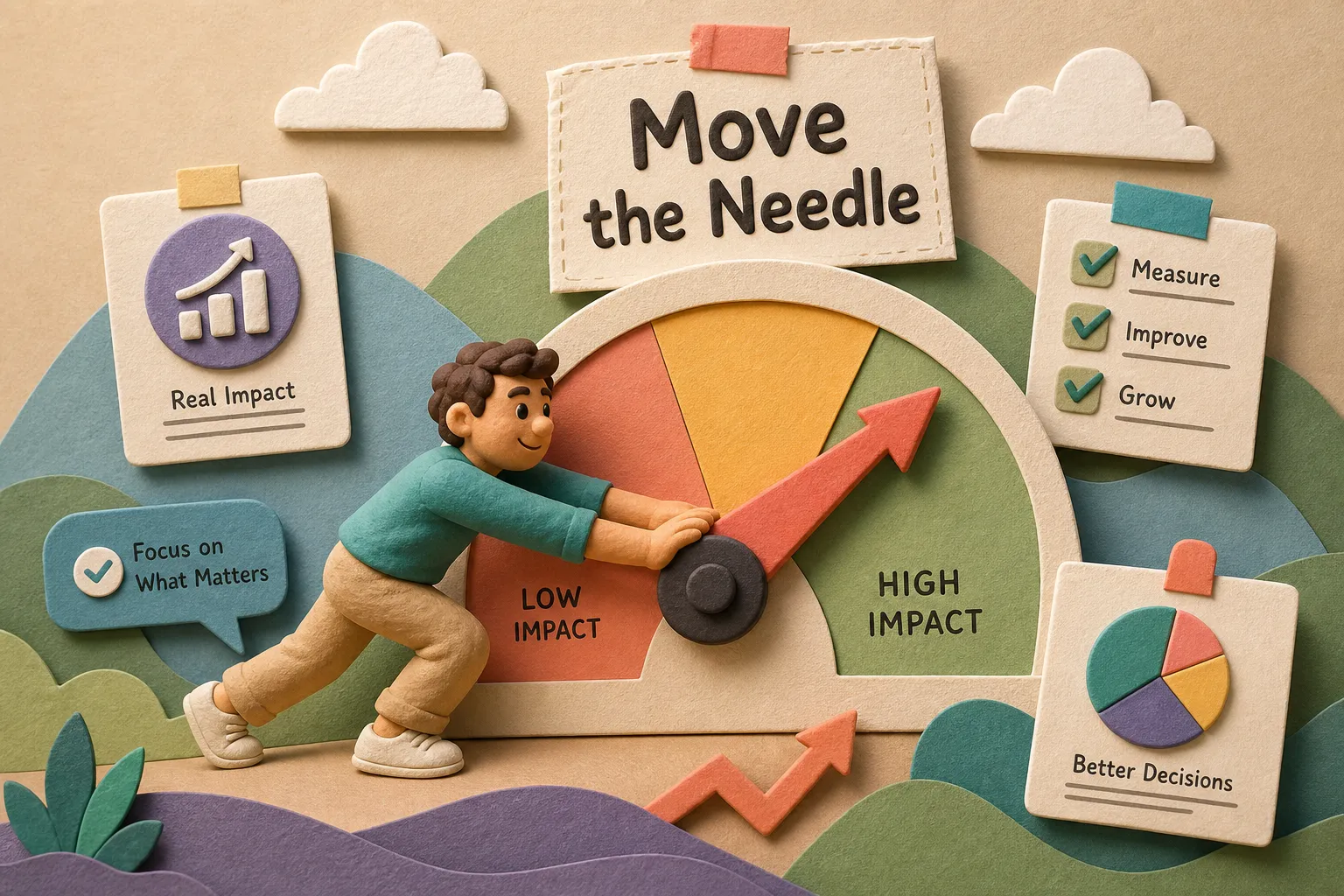
You are sitting in a meeting with your American colleagues. The manager looks around the table and says, “We need to find something that actually moves the needle this quarter.” You understood every single word. But somehow, the full phrase still feels a little unclear. What does it really mean? Is it good or bad? Should you agree or push back?
This is the challenge with idioms in professional American English. An idiom is a phrase where the meaning is different from the individual words. You can know all the words and still miss the point. “Move the needle” is one of the most common business idioms you will hear in American workplaces, appearing commonly in meetings, presentations, performance reviews, and strategy discussions.
By the end of this article, you will know exactly what the phrase means, where it came from, how to use it correctly, and how to avoid the most common mistakes. In our professional English lessons at Your Daily American, expressions like this come up constantly and trip up even advanced learners. This article will make sure this phrase is no longer a problem for you.
What “move the needle” really means
“Move the needle” is an idiom that means to make a noticeable, measurable difference. It does not mean a small or minor change. According to Merriam-Webster, it means “to have an effect on something important.” Collins defines it as “to have a noticeable effect on a situation or to change it in an important way.” Both definitions point to the same idea: the change has to be real and visible, not just a tiny adjustment.
This matters a lot in professional settings. The phrase carries an expectation of significant impact. If someone says a new strategy “barely moved the needle,” that is a polite way of saying it made almost no difference. On the other hand, if someone says an idea “really moved the needle,” they are saying it worked well and produced clear, measurable results.
Examples in natural use
Here are three sentences that show the phrase the way Americans actually use it:
- “The new ad campaign finally moved the needle on sales.”
- “We’ve tried three different approaches, but none of them made a noticeable change.”
- “What will it take to actually make a measurable impact on customer satisfaction?”
Notice how each sentence connects the phrase to something specific: sales, results, satisfaction. That combination of the idiom plus a clear metric is how Americans use it most often at work.
Where this phrase comes from
The origin is practical and visual. It comes from the literal needle on a physical measuring instrument, like a speedometer in a car or a pressure gauge on a machine. These gauges were common in factories and industrial settings. When the needle on the dial moved, the reading had changed in a real, visible way. That image became a natural way to describe meaningful change.
For quick dictionary-style definitions and etymology, check the Phrases.org.uk meaning of “move the needle” or the Wiktionary entry for “move the needle”.
The phrase is commonly attributed to American business jargon from the 1980s, though that attribution appears in phrase dictionaries rather than early documented print evidence. The earliest confirmed print example is from a Time magazine article by Janice M. Horowitz, published on July 28, 2002, which described how some candies “barely move the needle” for serious chocolate lovers. The Guardian was using it regularly by 2012, and The New York Times followed by the mid-2010s. Today, it is widely used across business journalism and corporate discussions in many industries.
Knowing this history helps you remember the phrase. Picture a needle on a dial. If it moves, something changed in a way you can see and measure. That mental image makes the idiom easier to reach for at the right moment.
How to use “move the needle” correctly
The most common grammar pattern is “move the needle on [something]”, where “on” introduces the specific metric or topic being affected. You can also say “move the needle for [a person or group]” when talking about how something benefits a team or organization. Both “moved the needle” (past) and “moving the needle” (present/ongoing) are common in everyday business speech.
For additional usage notes and examples, see the Grammarist entry on “move the needle”.
Patterns side by side
- ✓ “We moved the needle on engagement.” (most common)
- ✓ “This project could move the needle for the whole team.”
- ✗ “We need to move the needle sales.” (missing preposition, ungrammatical)
ESL learners from Spanish and Portuguese backgrounds often drop the preposition “on” and write something like “move the needle sales,” or use the wrong one, such as “in sales” or “to sales.” The correct preposition is “on” when you name a metric or topic. Using the wrong one signals to native speakers that the phrase was translated rather than learned naturally.
One detail that matters more than it seems: always say “the needle,” not “a needle.” The article “the” is what makes this an idiom. Generally speaking, “a needle” reads as literal, as in an actual, physical needle, and loses the idiomatic meaning entirely.
Useful synonyms and when to use them
Two related phrases are “move the dial” and “shift the needle.” They cover the same core idea but carry slightly different tones. Use “move the dial” in casual team discussions when you want a conversational, energetic feel. Use “shift the needle” when you want to sound more precise and results-focused, such as in a formal presentation or a written report. Research suggests these are used in similar contexts, though there is a tonal difference, they are not perfectly interchangeable.
“Move the needle” in real business situations
The phrase appears most naturally when a team is reviewing results and deciding where to focus next. It signals that the person speaking cares about real impact, not just effort or activity. When you hear it in a meeting, the best response is usually to connect it to a specific metric, American managers tend to appreciate that kind of direct, results-focused thinking.
Here is a short example dialogue between two colleagues reviewing a project. This kind of exchange is typical in any team that tracks performance by outcomes:
Manager: “We’ve been running this campaign for two months. What’s actually moving the needle?”
Team member: “Our email sequence moved the numbers on conversions, but the social ads haven’t done much.”
Notice how the team member does not just say “yes” or “no.” They answer with a specific tactic (the email sequence) and a specific metric (conversions). That is the professional English pattern that works well in American workplaces.
In presentations, the phrase is a strong way to open a summary of results or propose a new direction. Using it tells your audience you are focused on real outcomes, not just effort, a valued signal in American professional culture, where success is measured by results. You could say:
- “Today I’ll show you the three things that moved the needle for us this quarter.”
- “To move the needle on retention, we need to focus on the onboarding experience.”
In performance reviews and one-on-one conversations, framing your contributions this way shows that you think in terms of measurable results. Try sentences like these:
- “I want to focus on initiatives that will genuinely make an impact on my performance metrics.”
- “This quarter, I shifted the needle on customer satisfaction by redesigning the feedback process.”
Using this kind of language in a performance context shows fluency with professional American English. It tells your manager that you understand what success looks like and that you connect your work to outcomes.
One phrase is a good start, but fluency takes more
Knowing this phrase well is a real step forward. But professional fluency in American English means being comfortable with dozens of connected phrases, patterns, and communication styles. Real workplace fluency means you can lead a meeting, present results clearly, give feedback, or push back on an idea, all in natural, confident American English.
That kind of fluency does not come from memorizing one phrase at a time. It comes from studying language in context, with real examples, cultural explanations, and regular practice across many situations. If you want to build from phrases like this one into full professional fluency, Professional English, Your Daily American is built exactly for that.
For targeted practice, start with short, high-utility collections such as our Filler Phrases Every American English Learner Should Know and then move on to broader pattern lists like Essential Phrasal Verbs You Must Know. Those resources are designed to help you connect single expressions into fluent, natural speech.
Your Daily American also offers a free CEFR proficiency test. CEFR is a standard international scale for measuring language level, running from A1 beginner to C2 expert. Take the test to find out where you stand and where to focus next, so you are building toward something specific, not just studying at random.
Now you can use this phrase with confidence
“Move the needle” means to make a noticeable, measurable difference, the kind you can point to with data. It comes from the visual image of a needle moving on an industrial gauge, and the correct grammar is “move the needle on [metric],” always with “the” and always with the right preposition. The related phrases “move the dial” and “shift the needle” give you options depending on tone and context.
You also know where it fits naturally: in team meetings when reviewing results, in presentations when showing impact, and in performance conversations when connecting your work to outcomes. You know the most common mistakes to avoid. Now the phrase is yours to use.
Try it right now. Write one sentence using “move the needle on” about your own work or a project you care about, something like: “I want to move the needle on my speaking confidence this month.” Writing a new phrase in your own words, even as a quick practice, is one of the fastest ways to make it feel natural. Give it a try.