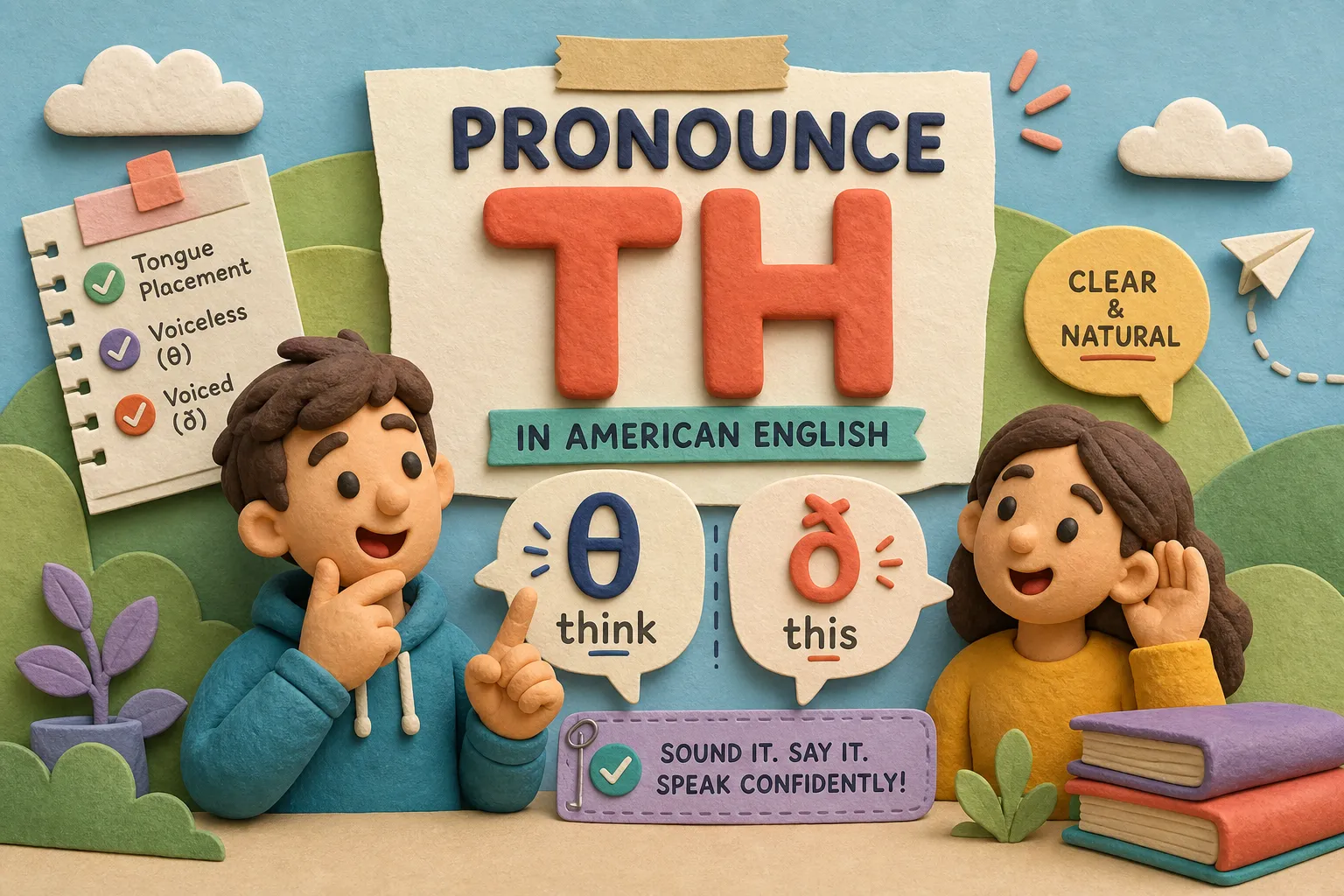
By the end of this guide, you’ll know how to pronounce TH in American English, both sounds, not just one. You’ll be able to identify /θ/ and /ð/ by ear, produce them reliably with the right tongue position, understand why you’re making the substitution errors you’re making, and practice with drills that actually build the habit. The goal isn’t just knowing about the sounds; it’s being able to use them without thinking.
Here’s the first thing most learners don’t realize: TH is not one sound. It’s two completely different sounds that share the same spelling. One is voiceless /θ/ (as in think) and the other is voiced /ð/ (as in this). Many learners are never shown where the tongue goes, and that tongue placement is often the key fix. This is exactly the kind of sound-by-sound, physically detailed pronunciation work that Your Daily American is built around, so if you want to go deeper after this guide, that’s where to go next.
The two TH sounds: voiceless /θ/ vs. voiced /ð/
Think of /θ/ as the “quiet” TH. When you produce it, there’s no vibration in your throat, just air passing through a narrow space between your tongue and teeth. Put your hand on your throat and say think. You feel nothing. TH is a dental fricative: the tongue contacts the teeth to create friction rather than a full stop. Common words with voiceless /θ/ include: think, three, thank, thing, thick, thought, Thursday, thousand, teeth, thumb. In IPA, it’s /θ/, a soft, breathy hiss made right at the teeth.
The voiced /ð/ is the same physical setup, but with the voice switched on. Put your hand on your throat and say this. You feel a gentle buzz. That buzz is the only difference. Common words with voiced /ð/ include: the, this, that, these, those, they, them, their, other, mother, brother, weather. Notice something: /ð/ shows up in almost every English sentence because it carries the most frequent function words in the language. Frequency studies of spoken English consistently show that /ð/ appears at an exceptionally high rate, especially in words like the, which is estimated at around 7% of all spoken tokens.
How to pronounce TH in American English: step-by-step tongue placement
Both sounds use the same mouth setup. Place your tongue tip gently between your upper and lower front teeth, or just behind the upper front teeth so it lightly touches the back edge. Your lips stay slightly parted and your teeth don’t fully close. The single most important rule: air must flow through continuously. The moment you block and then release the air, you’ve made a /t/ or /d/, not a TH. Do a quick mirror check, you should briefly see the tip of your tongue.
Making voiceless /θ/ first
With your tongue in position, breathe out steadily, like you’re gently fogging a mirror, but right at the teeth. No voice box involvement at all; this is pure air friction. Hold the /θ/ sound in isolation for two full seconds and feel the airflow over your tongue tip. Then try it in words: think /θɪŋk/ (THINGK), three /θri/ (THREE), thank /θæŋk/ (THANK). Focus on keeping that air stream smooth and unbroken.
Adding voice to get /ð/
Keep your tongue in exactly the same position. Keep the airflow going. Now add a hum. The moment your vocal folds engage, the /θ/ becomes /ð/. Practice switching back and forth: /θ/ /θ/ /θ/ … /ð/ /ð/ /ð/. Do it slowly, changing only the voicing. Then try it in words: this /ðɪs/ (DHIS), the /ðə/ (DHUH when unstressed), mother /ˈmʌðər/ (MUH-dher). The physical position never changes; voicing is the only variable.
Common TH errors in American English: why you’re saying “d,” “t,” “s,” or “f” instead
Substitution errors happen because your first language trained your tongue to stay back, and your brain finds the nearest familiar sound to TH. The pattern is predictable based on your language background. When the error pattern is clearly diagnosed and targeted practice is applied consistently, corrections tend to come faster than most learners expect. Accent coaches frequently rank the TH among the top problematic sounds in American English, which is why focused drills pay off.
Spanish speakers often turn voiceless /θ/ into /t/ or /s/, so think comes out as “tink” or “sink,” and voiced /ð/ turns into /d/, so this sounds like “dis.” Mandarin and Korean speakers frequently replace /θ/ with /s/ or /t/, and /ð/ with /d/ or /z/. The root cause is the same across all groups: the tongue stays back behind the teeth instead of moving forward to the dental position, which turns TH into either a stop (/t/, /d/) or a different fricative (/s/, /z/). For more on common mispronunciations by learners, see our piece on English Words Non-Native Speakers Mispronounce Most Often, Your Daily American.
Here’s a simple diagnostic: if think sounds like “tink,” your tongue is forming a complete stop instead of letting air flow through. If it sounds like “sink,” your tongue is in the right general area but sitting behind the teeth at the alveolar ridge instead of at the teeth. If this sounds like “dis,” your voicing is correct but your placement is wrong. The two-step fix is the same in every case: move the tongue forward to the teeth, then keep the airflow smooth and continuous with no full stop.
Practice these contrasts to train your ear and your muscle memory:
- think vs. “tink” vs. sink, TH vs. /t/ vs. /s/
- this vs. “dis”, /ð/ vs. /d/
- they vs. day, /ð/ vs. /d/
- thin vs. tin vs. sin, /θ/ vs. /t/ vs. /s/
High-frequency TH words you’ll use every single day
Voiceless /θ/ appears mainly in content words: nouns, verbs, and adjectives with real-world meaning. Your core list to master: think, thing, three, thank, thick, thought, through, throw, Thursday, thousand, teeth, thumb, thirsty, theory. In daily American life, you’ll say sentences like: “I think the pharmacy is three blocks that way” and “Thanks, I’ll get it Thursday.” Mispronouncing these words may reduce clarity, since they carry the core meaning in a sentence.
Voiced /ð/ is disproportionately common because it lives in function words, the grammatical glue of every sentence. Your core list: the, this, that, these, those, they, them, their, there, then, than, though, other, another, mother, brother, father, weather, breathe, smooth. Consider this sentence: “They said the weather over there is better than this.” Every italicized word uses /ð/. You can’t get through a normal conversation without it. Frequency studies of spoken English consistently estimate that the alone accounts for roughly 7% of all spoken tokens, making /ð/ one of the most-produced sounds in the language.
One connected-speech note worth knowing: in fast American speech, the reduces to /ðə/ before consonants (“the coffee”) and to /ði/ before vowel sounds (“the airport”). And them often reduces to “’em” in casual speech: “Give ’em a call” or “Tell ’em I said hi.” These reductions are normal and natural, not lazy. Recognizing them helps your listening just as much as your speaking.
When TH isn’t /θ/ or /ð/: spelling exceptions to know
A small set of words breaks the TH rule completely, and hitting them unprepared can shake your confidence. The most important ones to know are:
- Thomas /ˈtɑːməs/: pronounced exactly like “Tomas,” with a plain /t/ at the start
- Thailand /ˈtaɪlænd/: “TY-land,” not “TH-ailand”, a proper noun with /t/ rather than a TH sound
- Stephen /ˈstiːfən/: “STEE-fun,” where the TH is pronounced /f/, the most widely cited /f/ exception in English
- Asthma: often pronounced /ˈæzmə/ (“AZ-muh”) in casual American speech, though you may also hear /ˈæsθmə/ in more careful or clinical contexts
The /t/ pronunciation shows up almost exclusively in proper nouns and loanwords. For everyday vocabulary, if you rarely or never hear a TH realization in native speech examples, check a reliable dictionary or listen to multiple natural examples; you can also consult the Wikipedia article on the pronunciation of English “th” for more background. When in doubt, listen first.
Minimal pairs and sentence drills to make both sounds automatic
Knowing how to pronounce TH in American English is only half the battle. You need repetition in context until the correct tongue placement happens without conscious effort. Start with minimal pairs, which force your ear and your mouth to process the exact distinction.
Work through each group separately:
- For /θ/ vs. /ð/: thin/then, three/these, thigh/thy, teeth/teethe, mouth (noun)/mouth (verb)
- For TH vs. /t/ and /d/: think/tink, thin/tin, they/day, then/den, breathe/breed
- For TH vs. /s/ and /z/: think/sink, thank/sank
Say each pair three times slowly, keeping full attention on tongue position, not speed. For more practice sets and ideas, check out examples of minimal pairs that make the contrast obvious.
Once minimal pairs feel reliable, move to sentences that mix both TH sounds together:
- “This is the third thing I thought about.” (contains both /ð/ and /θ/)
- “They think the weather will be better by Thursday.”
- “My brother and mother both thanked them.”
- “Three thousand people breathe that air every day.”
Read each sentence once at slow speed, focusing entirely on tongue placement. Then read it again at natural conversational speed. Record yourself both times and compare. Self-recording is one of the highest-value things you can do because it removes the gap between what you think you’re saying and what you’re actually producing.
A simple five-minute daily routine: spend days one through three doing only the mirror test in isolation, holding /θ/ and /ð/ for two seconds each and alternating between them. Days four through seven, add five minimal pairs per session. From day eight onward, move to the sentence drills with self-recording. That progression, from sound to word to sentence, mirrors the standard articulation practice sequence used in accent coaching. You can supplement that routine with focused TH sound exercises designed specifically for the dental fricatives.
TH is one of the highest-impact wins in American pronunciation
The reason TH matters so much is straightforward: /ð/ in particular appears very frequently in natural English, especially in function words like the, they, this, and them. Getting these sounds right doesn’t just fix one or two words; it improves the clarity of everything you say. The voiceless /θ/ and voiced /ð/ share the same tongue position, the same airflow requirement, and the same need for a continuous friction sound rather than a hard stop. Once that physical habit is in place, the sounds become automatic.
The fix is almost always physical: tongue forward to the teeth, airflow smooth and unbroken, no stopping and releasing. Practice in context, not just isolation. Sentences build the muscle memory that isolated drills can’t fully develop on their own. Many learners notice a real difference in their own speech within a few weeks of consistent practice, though results vary depending on your starting point and how regularly you drill.
If you want to work through every challenging American sound with the same level of physical detail and real-world context this guide uses, the pronunciation track at Your Daily American is built exactly for that: one sound at a time, with tongue placement, IPA, phonetic respellings, and drills, organized so you always know what to work on next and why it matters. Start with our guide How to Improve Your American English Pronunciation Like a Native, Your Daily American, and explore the full Pronunciation & Listening collection for follow-up lessons and drills.
Quick self-check before you go
Try saying these three sentences out loud right now, focusing on every TH sound: “I think they’re both right.” / “This is the thing I thought about.” / “My brother thanked them.” If any TH comes out as /t/, /d/, or /s/, go back to the mirror test from the tongue placement section above. Forward tongue, steady air, no hard stop. That’s how to pronounce TH in American English, and once the habit is built, you won’t have to think about it at all.