You’re watching an American TV show and the host says something that sounds like “wadder” or “budder.” You rewind it. You listen again. The closed captions say “water” and “butter.” You didn’t mishear anything. That’s exactly how the words are pronounced.
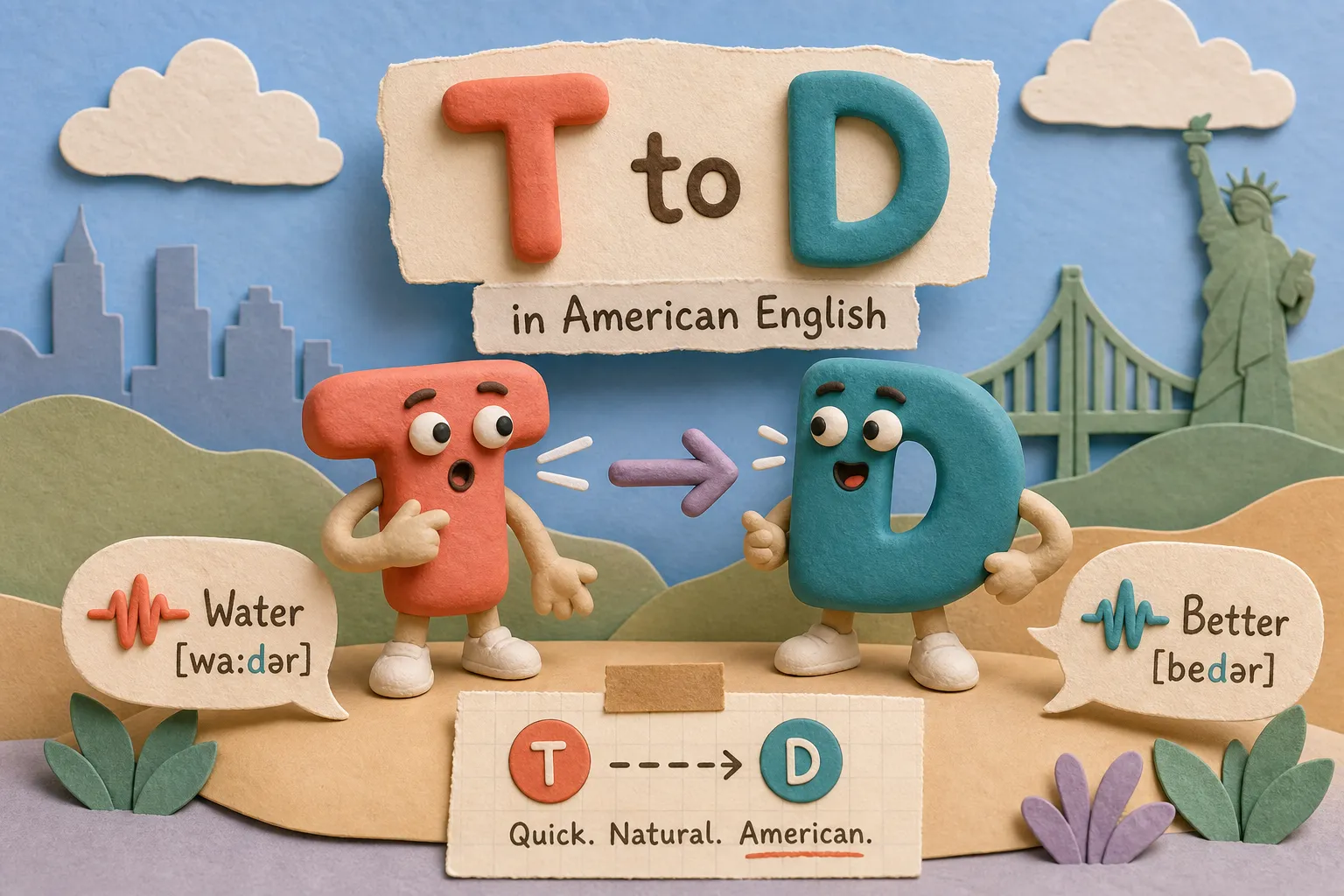
What you’re hearing is called T-flapping, the reason Americans say “budder” instead of “butter” and “wadder” instead of “water.” It’s one of the most frequent sound changes in General American English, occurring many times in a typical conversation, and one of the hardest to notice if nobody has pointed it out to you. At Your Daily American, we cover it extensively in our pronunciation lessons because it’s that central to understanding American speech. By the end of this article, you’ll know exactly what T-flapping is, when and why it happens, which words are affected, and how to start hearing and producing it yourself.
What’s Actually Happening When “Butter” Sounds Like “Budder”
The sound you’re hearing isn’t /t/ and it isn’t /d/. It’s a third consonant that English spelling never taught you about: the alveolar flap, transcribed in IPA as /ɾ/. To make this sound, your tongue tip makes a single, extremely brief tap against the alveolar ridge, the firm, bumpy shelf of tissue right behind your upper front teeth, and immediately bounces away. There’s no full stop, no burst of air, no closure. The tongue barely interrupts the flow of sound around it.
Compare that to a true /t/: voiceless, fully stops the airflow, and releases with a small puff. Or a true /d/: voiced, but still a complete stop-and-release. The flap /ɾ/ is voiced like /d/ but happens so quickly that it barely registers as a consonant at all. That’s why it sounds like a soft /d/ to your ear, and why “butter” (IPA: /ˈbʌɾɚ/) arrives sounding like “BUH-der” and “water” (IPA: /ˈwɔɾɚ/) lands as “WAH-der.” Note that these respellings are broad approximations meant to illustrate the pattern, the IPA symbols give you the precise picture.
The Difference Between /t/, /d/, and /ɾ/ in One Clear Comparison
Say the word “top.” That initial /t/ is crisp, voiceless, and released with a light puff of air against your hand. Now say “dog.” The /d/ is voiced from the start, but it still involves a full stop-and-release at the alveolar ridge. Now say “butter” casually, the way you’d say it ordering at a diner. That middle consonant is /ɾ/: neither a full /t/ nor a full /d/, but a quick tap that’s its own distinct sound. American English uses it as an automatic shortcut in specific phonetic environments.
Standard British English Handles This Differently
If you learned English from British materials, teachers, or media, this explains a persistent gap in your listening comprehension. Standard British Received Pronunciation (RP) typically keeps a clear, crisp /t/ in words like “butter,” “better,” and “water.” Some British accents go the other direction and use a glottal stop instead. General American takes a different path entirely with the flap. This single difference is one of the most immediately recognizable contrasts between the two varieties, and it’s a major reason why switching from British to American listening practice can feel like learning a new language all over again.
T-Flapping: The Rule Behind Why Americans Say “Budder,” Not “Butter”
T-flapping follows a consistent rule. In General American English, /t/ (and sometimes /d/) becomes a flap when it sits between two vowel sounds and the syllable that follows it is unstressed. Both conditions must be present. Take “butter”: the /t/ comes after the stressed vowel “u” and before the unstressed syllable “er.” Flapping conditions: met. Now take “return”: the /t/ comes before the stressed syllable “TURN.” No flap. The /t/ stays crisp.
This is why “city” becomes “SIH-dee,” “pretty” becomes “PRIH-dee,” and “getting” becomes “GEH-ding.” In every case, the /t/ falls in that intervocalic sweet spot with an unstressed syllable following it. The double-T spelling in words like “butter,” “better,” and “letter” often coincides with exactly this intervocalic position, making it a helpful cue, though single-T words like “city” and “pretty” flap too, and a few double-T words have exceptions near morphological boundaries.
When the Rule Doesn’t Apply (and Why)
The flap doesn’t happen before a stressed syllable. Words like “hotel” (ho-TEL), “return” (re-TURN), and “attack” (a-TACK) all have /t/ at the start of a stressed syllable, so the /t/ stays a full, clear /t/. After the /l/ sound, many speakers maintain a stop rather than a flap, depending on the word and dialect. Morphological awareness can block it too: some speakers keep a clear /t/ in “nighttime” because they perceive the word boundary between “night” and “time.” These aren’t random exceptions, they all follow the same logic: flapping only happens when the surrounding sounds create the right low-effort conditions.
T-Flapping Across Word Boundaries
The rule doesn’t stop at word edges. When one word ends in a vowel sound and the next word starts with an unstressed vowel, the /t/ at the boundary often flaps in exactly the same way. “Get it” becomes “geddit.” “Put it on” becomes “puddit on.” “What are you doing” becomes something closer to “whadder you doing.” This is the part that makes fast American speech genuinely difficult to decode, because the /t/ you’re expecting at the end of one word has merged into a flap that bridges it to the next. For a corpus-based perspective on how frequently this shows up in broadcast speech, see the corpus-based study of T-flapping.
How T-Flapping Makes Common Words Sound Like “Budder” Not “Butter”
Below are the words you’ll hear flapped constantly in American conversation. The phonetic respellings are broad approximations to help you hear the pattern:
- butter, BUH-der
- water, WAH-der
- better, BEH-der
- letter, LEH-der
- matter, MAH-der
- city, SIH-dee
- pretty, PRIH-dee
- little, LIH-dul
- kitty, KIH-dee
- meeting, MEE-ding
- getting, GEH-ding
- putting, PUH-ding
Every one follows the same pattern, stressed vowel, flap /ɾ/, unstressed syllable. The double-T spelling is a useful starting cue: when you see it and the syllables around it match the pattern, expect a flap.
How Flapping Shows Up in Natural Fast Speech
In real conversation, the flap compounds quickly across whole phrases. “I’ll get it for you” arrives sounding like “I’ll geddit fer ya.” “What a beautiful city” flows out as something close to “Whada byoodiful siddy” (IPA approximation: /ˈwʌɾə ˈbjuɾɪfəl ˈsɪɾi/). Native speakers aren’t being lazy or careless; this is the systematic, fully standard pronunciation of General American English. Once you know the rule, what used to sound like a blur of sounds starts to resolve into a predictable pattern.
Writer vs. Rider: The Minimal Pairs That Reveal the Flap
Here’s the part that surprises most learners. In casual American speech, “writer” and “rider” are often pronounced identically. Both are produced with /ɾ/ in the middle, so both land as something like “RYE-der.” The spelling difference is real, but the spoken difference in relaxed conversation effectively disappears. American listeners use context, not the precise consonant, to tell them apart. Several studies have explored this neutralization in casual speech patterns, see this analysis of flapping and related phenomena for more on how perception and context interact.
This is exactly why fast American speech can feel like a stream of ambiguous sounds. You’re listening for a /t/ that isn’t there, and instead you’re getting a /ɾ/ that could match either spelling. The surrounding words in a sentence carry the disambiguation, the flap itself stays neutral. Once that clicks, a lot of the confusion dissolves.
The Classic Flap Minimal Pairs
These pairs are the most useful ones to know:
- writer / rider
- latter / ladder
- metal / medal
- atom / Adam
- patting / padding
- matter / madder
In connected speech, both words in each pair may surface with the same /ɾ/. The key insight is that American listeners rely on context, not consonant precision, to decode meaning.
Why Spelling Misleads Learners Here
If you learned English primarily through reading, you built strong expectations about what /t/ should sound like in the middle of a word. T-flapping breaks that expectation completely, and it can feel like the speaker is making a mistake. They aren’t. The alveolar flap is the fully correct, rule-governed pronunciation of educated, standard General American English. It’s not slang, it’s not careless, and it’s widespread across many U.S. varieties, especially in casual speech. It’s the default in General American, and that’s the variety you hear on national TV and in most American media. For examples of commonly mispronounced words and why orthography can mislead learners, check our guide on English Words Non-Native Speakers Mispronounce Most Often, Your Daily American.
A Head Start for Spanish Speakers (and What Everyone Else Can Do)
If Spanish is your first language, you already know this sound. The American flap /ɾ/ is articulated nearly identically to the Spanish single-r in words like “pero” or “caro”: a quick, single tap of the tongue tip on the alveolar ridge. The tongue gesture itself is not new to you. What’s new is the phonological context: in English, this sound appears where a /t/ is written, not where an “r” is written.
Connecting the Familiar Sound to a New Context
The cognitive shift for Spanish speakers is straightforward. You don’t need to learn a new muscle movement; you need to learn a new trigger for a movement you already make. The phrase “pero ella” in Spanish uses the exact same tongue tap as “better all” in English. Once you make that connection, flapping stops feeling foreign and starts feeling like a natural application of something already in your phonetic toolkit.
For Learners from Other Language Backgrounds
For speakers of Mandarin, Japanese, Portuguese, or other languages, a simple technique works well: say “butter” very slowly. Hold the first vowel “buh,” then make the lightest, most glancing possible tongue contact before sliding into “er.” The goal is to avoid the full /t/ stop entirely, no burst of air, no complete closure. Practice at that slow speed several times, then gradually increase your pace until the flap happens automatically in the transition between the vowels.
Practice Drills: Train Your Ear, Then Train Your Tongue
Listening comes before speaking. Your ear needs to recognize the flap consistently before your mouth can reproduce it reliably. Both phases require nothing more than a smartphone and a few minutes of focused attention.
Listening Drill: Catch the Flap in Real American Speech
Open any American TV clip, podcast, or YouTube video, a sitcom, a news interview, a late-night show. Listen specifically for /t/ sounds in the middle of words. Every time you hear “getting,” “better,” “little,” or “water,” notice what the /t/ actually sounds like. Write the words down. With focused listening practice, most learners begin to notice the flap more reliably within a few short sessions. It becomes a predictable pattern you can anticipate, not an accident you have to decode after the fact. That shift in perception is what makes fast American speech suddenly more manageable. For an accessible primer on the voiced alveolar flap (IPA /ɾ/) with illustrations, see this Voiced alveolar flap overview.
Speaking Drill: Slow-Motion to Natural Speed
Start slowly with a full, clear /t/: “but-ter.” Then speed it up and let the /t/ soften into a tap: “bu-der.” Finally, record yourself and compare it to a native speaker saying the same word. Work through these practice targets in order: city, pretty, water, butter, meeting, getting it, put it on. The last two are phrase-level, which is where the real fluency work happens. Don’t aim for perfection immediately, aim for awareness first, and let the naturalization follow.
Going Deeper with Connected Speech at Your Daily American
T-flapping is one piece of a larger system. Reduction, linking, and vowel weakening all interact with the flap in natural American conversation, and understanding how they work together is what takes your listening comprehension from “I catch individual words” to “I follow the whole conversation.” Your Daily American’s Pronunciation & Listening, Your Daily American guides cover these patterns in the same clear, example-driven format as this lesson. If the flap clicked for you here, the rest of the system is one click away. For a technical phonetics report that dives into how flaps pattern in different phonetic environments, you can consult this phonlab report from Berkeley.
Putting It All Together
That “budder” moment makes complete sense now. The speaker wasn’t mumbling. The /t/ in “butter” became a flap /ɾ/ because it fell between a stressed vowel and an unstressed one, exactly where General American systematically makes that swap. The flap /ɾ/ is a brief alveolar tap, neither a full /t/ nor a full /d/. It appears in the intervocalic position when the following syllable is unstressed. And you train it the same way you train any pronunciation feature: ear first, then mouth, slow before fast.
Understanding t-flapping, why Americans say “budder” not “butter”, does more than sharpen one sound. It makes native American speakers easier to follow overall. You stop searching for a /t/ that was never going to arrive and start hearing the actual sound that was always there. Fast speech begins to resolve into a system rather than a stream of noise. T-flapping is one pattern in that system, and every pattern you add makes the rest of that stream clearer. Head to How to Improve Your American English Pronunciation Like a Native, Your Daily American to keep building.